Every household relies on a handful of large appliances, and when one of them stops working the effect is immediate. A washing machine that will not drain, an oven that will not heat or a freezer that has gone quiet overnight sends people looking for help the same day. That steady, urgent demand makes domestic appliance repair a solid business for practical people who enjoy diagnosing faults and dealing with customers face to face.
It is also changing. Customers are more willing to repair than they were a decade ago, partly because of cost and partly because of concern about waste, and the UK’s 2021 “right to repair” rules have made spare parts and repair information easier for professional repairers to obtain for newer models. At the same time, national repair networks, manufacturer service departments and online booking sites compete hard for the same call-outs.
This guide explains how to start an appliance repair business in the UK: choosing what to repair, the rules on gas and refrigerants, sourcing parts, pricing your call-outs, consumer law, warranty work, waste and how to win customers through local search and AI recommendations.
Key points
- Most appliance repair needs no specific licence, but any work on gas cookers and hobs must be done by a Gas Safe registered engineer.
- Sealed refrigeration systems are specialist work with their own rules, so many repairers stick to fridge faults outside the sealed system.
- Since 2021, manufacturers of newer washing machines, dishwashers and fridges must make certain spare parts and repair information available to professional repairers.
- Clear call-out charges, written quotes and honest repair-or-replace advice are the foundation of trust and good reviews.
- Appliance breakdowns are urgent and local, so a strong Google Business Profile and detailed reviews strongly influence who gets the call.
In this guide
- Decide what you will repair
- Learning the trade: fault-finding skills and experience
- Gas cookers and hobs: Gas Safe registration
- Fridges, freezers and refrigerants
- Spare parts and the right to repair rules
- Pricing, call-out charges and quotes
- Consumer law and your guarantees
- Warranty and extended warranty work
- Waste, disposal and safe working
- Startup costs
- Local SEO for appliance repair engineers
- AI assistants and “is it worth fixing?” questions
- Frequently asked questions
- Final thoughts
Decide what you will repair
Domestic appliance repair covers a wide range of machines, and most engineers do best by being clear about what they do and do not cover. The main categories are:
- Washing machines and washer-dryers — usually the largest share of call-outs, covering pumps, door locks, bearings, heaters, motors, brushes and control boards.
- Tumble dryers — belts, heaters, thermal fuses, sensors and blocked condenser or vent systems.
- Dishwashers — drain pumps, heaters, circulation pumps, door seals, leaks and spray arms.
- Electric ovens, cookers and hobs — elements, thermostats, fan motors, door hinges and switches.
- Gas cookers and hobs — only if you are Gas Safe registered for those appliances (see below).
- Fridges and freezers — thermostats, fans, door seals, defrost faults and control boards; sealed system work is a separate specialism.
- Range cookers and integrated appliances — higher-value jobs that reward experience and careful work.
You can also decide on brands. Some engineers specialise in a few premium brands and build a reputation for them; others take on most brands and turn away only the very old or obscure. Whatever you choose, make it obvious on your website and listings, because customers search by brand and by fault as often as by appliance.
Your working model
Most appliance repairers are mobile, working from a van and visiting customers’ homes. Some add a small workshop for bench repairs to circuit boards and motors, and some sell spare parts or reconditioned machines alongside repairs. A mobile model keeps overheads low, but it means your working day is shaped by travel, so the area you choose to cover matters a great deal.
Learning the trade: fault-finding skills and experience
There is no general licence needed to repair electrical appliances in the UK, which means your reputation rests on competence. You need to be confident with electrical safety, testing and fault finding, as well as the mechanical side of each appliance.
Useful routes into the trade include:
- Working for an established repair firm or manufacturer service network to gain experience across many brands.
- Practical appliance repair and electrical safety courses, including portable appliance testing.
- Manufacturer technical training, where it is available to independents.
- Building your own knowledge base of common faults by model, which becomes one of your most valuable assets.
Leave work you are not qualified for to someone who is. Customers respect an engineer who says “that is a sealed system fault, so you need a refrigeration engineer” far more than one who has a go and makes it worse.
Tip
Test and record the appliance’s condition before you start — leaks, error codes, dents and any missing parts. A quick photo and a note on the job sheet prevent disputes about damage or faults that were already there.
Gas cookers and hobs: Gas Safe registration
By law, any business carrying out work on gas appliances in Great Britain must be on the Gas Safe Register. That includes installing, repairing, servicing or disconnecting a gas cooker or hob, and it can include faults that look electrical, such as ignition problems, because the work affects a gas appliance.
Registration is not a single blanket qualification. Engineers are assessed for specific types of gas work, and the Gas Safe ID card shows the categories of appliance each engineer is qualified to work on. If you want to offer gas cooker repairs, you need the relevant cooker and hob competence as well as registration.
If you are not Gas Safe registered, say so clearly and limit your work to electric cookers, ovens and hobs. Never describe yourself as a “cooker engineer” in a way that implies gas work you cannot legally carry out. Many customers check, and so do letting agents and landlords.
Fridges, freezers and refrigerants
Fridge and freezer repair splits into two kinds of work. Faults outside the sealed system — thermostats, fans, defrost heaters, sensors, door seals, lights and control boards — are well within the scope of a general appliance engineer. Faults inside the sealed refrigeration circuit, such as leaks or failed compressors, involve opening the system and handling refrigerant.
Most modern domestic fridges in the UK use a hydrocarbon refrigerant, which is flammable and needs specific handling knowledge and equipment. Some older appliances contain fluorinated gases (F gases). The government’s guidance on certification for companies working on equipment containing F gas explains that businesses carrying out installation, repair, maintenance or decommissioning on stationary refrigeration equipment containing F gas for others need company certification, and individuals handling F gas need personal qualifications.
For most independent appliance engineers, the practical answer is to stay out of the sealed system unless you have the right training, certification and equipment. Be honest with customers about the cost of sealed system repairs on domestic fridges, which often makes replacement the better choice.
Spare parts and the right to repair rules
The Ecodesign for Energy-Related Products and Energy Information Regulations 2021, often called the right to repair rules, came into force in Great Britain in 2021. They cover several household appliances, including washing machines and washer-dryers, dishwashers, and refrigerating appliances such as fridges and freezers.
For models covered by the rules, manufacturers must make certain spare parts available for seven or ten years after the last unit of a model is placed on the market, depending on the product and the part. Some parts, such as motors, pumps, heaters and circuit boards, are available to professional repairers only; simpler parts, such as door seals and racks, must also be available to the public. You can read the dishwasher requirements on legislation.gov.uk as an example of how the rules work.
Registering as a professional repairer
The rules also require manufacturers to give registered professional repairers access to repair and maintenance information. Manufacturers can ask you to show that you have the technical competence to repair the appliance and that you have insurance covering your activities, and they can charge reasonable fees. It is worth registering with the manufacturers whose machines you see most often.
Choosing parts suppliers
You will usually buy from a mix of manufacturer parts channels and independent spares wholesalers. Look for:
- Fast, reliable delivery so you can complete repairs on a second visit within days, not weeks.
- Clear labelling of genuine and compatible parts.
- A straightforward returns process for faulty or incorrectly supplied parts.
- Trade accounts that make it easy to price jobs consistently.
Be transparent with customers about whether you are fitting genuine or compatible parts, and stock the parts you fit most often so you can complete more repairs on the first visit.
Pricing, call-out charges and quotes
How you price is one of the biggest factors in whether customers trust you. Most appliance engineers use one of three approaches:
| Pricing model | How it works | Things to watch |
|---|---|---|
| Call-out plus labour and parts | A fixed charge for the visit and diagnosis, then labour and parts on top | Explain what the call-out includes and whether it is deducted if the customer goes ahead |
| Fixed price per repair | One price for a common repair, including parts and labour | Works well for frequent jobs; keep a buffer for awkward installations |
| Diagnosis then quote | A charge for diagnosis, followed by a written quote | Make sure customers know the diagnosis charge is payable whether or not they proceed |
Whatever model you use, make your charges easy to find before the customer books. Since April 2025, the Digital Markets, Competition and Consumers Act has required businesses to include unavoidable charges in the headline prices they advertise to consumers, so if every visit carries a call-out charge, do not advertise a lower “from” price that leaves it out. If you are unsure how the rules apply to your pricing, check the guidance on Business Companion, the trading standards site for businesses.
Other good practice includes:
- Confirming the call-out charge when the customer books, by text or email.
- Giving a clear quote once you have diagnosed the fault, before you order parts or start work.
- Explaining any extra charges, such as for integrated appliances that need removing from units.
- Telling customers how long parts are likely to take to arrive.
Repair or replace advice
Customers often ask whether an appliance is worth repairing. Give honest advice based on the age and condition of the machine, the cost of the repair and the likelihood of other parts failing. Recommending replacement when a repair is not sensible costs you one job but earns you trust, reviews and future calls.
Consumer law and your guarantees
When you carry out a repair for a consumer, the Consumer Rights Act 2015 applies. Your service must be carried out with reasonable care and skill. If no price has been agreed in advance, the customer only has to pay a reasonable price, and if no timescale has been agreed, the work must be done within a reasonable time. Parts you supply must be of satisfactory quality, fit for purpose and as described.
If a repair is not carried out with reasonable care and skill, the customer can ask you to put it right, and if that is not possible or not done within a reasonable time, they may be entitled to a price reduction. Having a clear process for return visits avoids small problems becoming complaints.
Because most of your work is agreed in customers’ homes, there are also rules on information you must give and on cancellation rights for contracts made off your premises, including some specific provisions for urgent repairs. Check Business Companion’s guidance on doorstep and off-premises contracts so your booking process and paperwork are right.
Offer a written guarantee on your repairs, covering parts and labour for a stated period, and explain what it does not cover, such as unrelated faults or misuse. A clear guarantee helps customers choose you and reduces arguments later.
Warranty and extended warranty work
Many appliances are still under a manufacturer’s guarantee or covered by an extended warranty or appliance insurance plan. This affects you in two ways.
First, customers with an appliance under a manufacturer’s guarantee should usually contact the manufacturer first, as an independent repair may affect their ability to claim. Ask about guarantees when you take the booking, and explain the position honestly.
Second, some independent engineers work as subcontractors for manufacturers, warranty companies or national repair networks. This can fill quiet days and bring steady volume, but rates are often lower than private work, and there may be detailed requirements for paperwork, parts and response times. Weigh it carefully against building your own private customer base, which is usually more profitable over time.
Waste, disposal and safe working
Old parts and appliances you remove are waste electrical and electronic equipment (WEEE). As a business you have a duty of care to store waste safely and pass it only to authorised waste carriers and treatment facilities, keeping records of each transfer. If you take customers’ old appliances away, you are carrying their waste and need upper-tier waste carrier registration; in England this is being replaced by an environmental permit system from 22 July 2027. Fridges and freezers need specialist treatment because of the refrigerants and insulation foam they contain, so make sure your recycling partner can take them.
If you sell new or reconditioned appliances, you may also have retailer take-back obligations under the WEEE regulations, so check the government’s guidance for your situation.
Safe working practice matters in customers’ homes too:
- Isolate appliances properly and test before you work on them.
- Use the right lifting technique and equipment for heavy machines, and get help when needed.
- Protect floors and worktops, and clean up any water or detergent spills.
- Carry out electrical safety tests after repairs and record the results.
- Keep public liability insurance in place, and check whether you also need cover for tools, stock in your van and any staff you employ.
Startup costs
Costs vary widely depending on your area and whether you start with a new or used van. These are rough guides only.
| Item | Typical cost | Notes |
|---|---|---|
| Van | £5,000–£20,000 | A reliable used van is fine to start; racking helps |
| Tools and test equipment | £1,000–£4,000 | Multimeter, insulation and PAT testing, specialist tools |
| Initial parts stock | £1,000–£3,000 | Focus on the common parts for brands you see most |
| Training | Varies | Electrical safety, appliance and manufacturer courses |
| Gas Safe registration | Varies | Only if you plan to work on gas cookers and hobs |
| Insurance | Varies | Public liability, tools, stock and vehicle |
| Website and booking system | £1,000+ | Clear charges and online booking help conversions |
Local SEO for appliance repair engineers
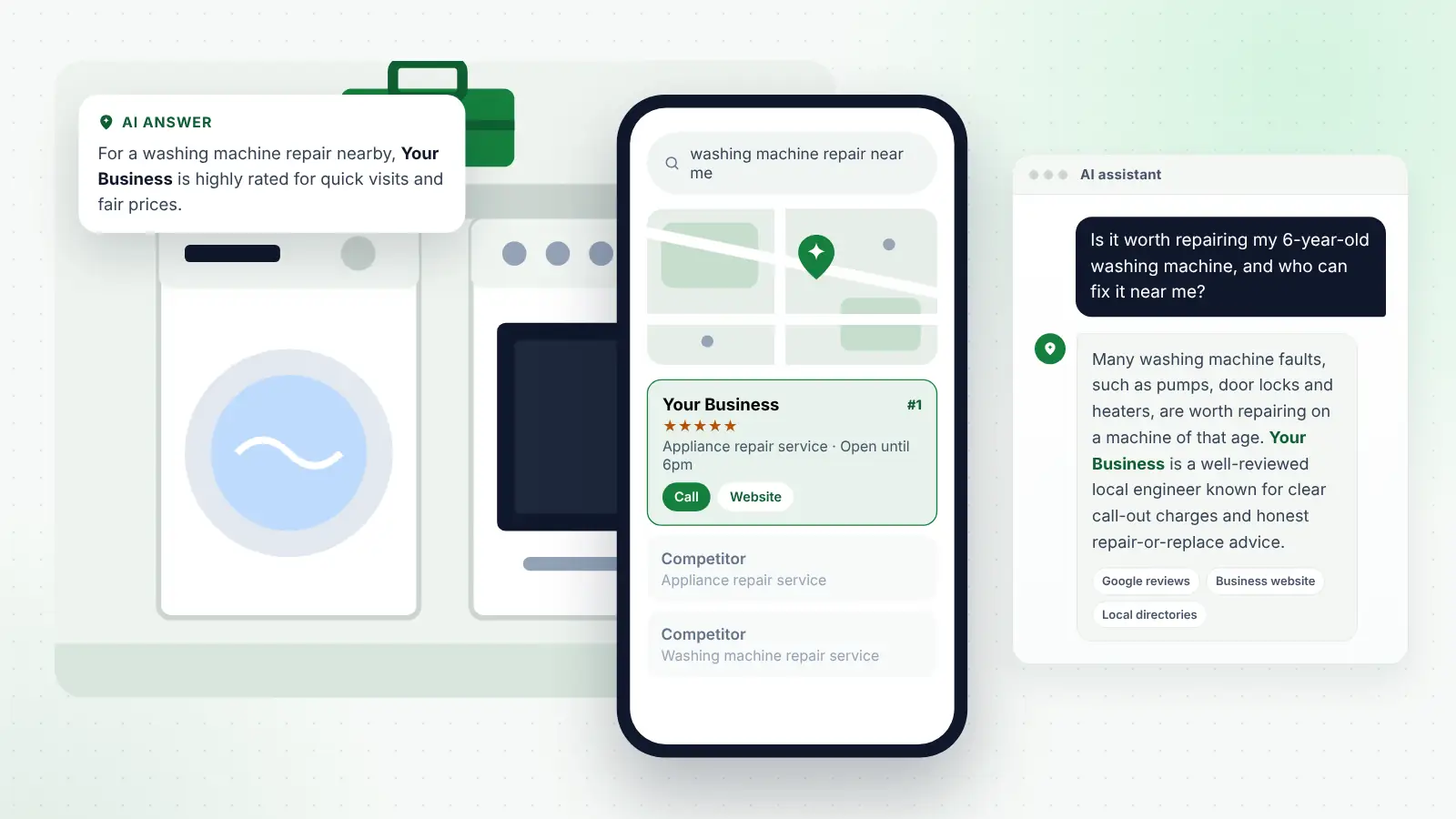
Appliance repair searches are urgent and highly local. People type “washing machine repair near me”, “oven repair” plus their town, “Bosch dishwasher repair” or “freezer not freezing what to do” into Google, look at the map results, check reviews and ring one or two engineers. If you are not in that short list, you rarely get the call, however good your work is.
Google Business Profile
Your Google Business Profile is likely to be the first thing many customers see. Make sure it includes:
- The right primary category, such as “Appliance repair service”, with relevant secondary categories such as “Washing machine repair service” or “Refrigerator repair service”.
- A service area that matches where you genuinely travel, rather than an oversized radius.
- Each appliance and common repair listed as a service, with your call-out charge or guide prices where possible.
- Real photos of your van, tools and work in progress, not stock images.
- Accurate hours, including whether you take weekend or evening calls.
- Regular updates, such as tips for common faults or seasonal advice.
Reviews
Ask every customer for a review at the end of the visit, when the machine is working again. A text with a direct link makes it easy. Reviews that mention the appliance, brand and fault — “fixed our Hotpoint washing machine pump the same day” — help you appear for similar searches. Respond to each one, and when someone is unhappy about a repeat fault, answer calmly and explain what you will do.
Matching engineer details across the web
Keep your business name, address, phone number and service area identical across your website, Google, Bing, Apple Maps and UK directories. If you are a mobile engineer, decide how you present your address and stick to it everywhere.
Your website
A strong appliance repair website includes:
- A page for each appliance type, with the common faults you fix and the brands you cover.
- Clear call-out charges, what they include, and how quotes work.
- Your guarantee, Gas Safe registration number if relevant, and insurance details.
- Pages for the main towns or areas you cover, each with genuinely local information.
- Online booking or a simple enquiry form that asks for the appliance, brand, model and fault, so you arrive prepared.
If you would rather spend your time on repairs, a specialist provider of local SEO for appliance repair engineers can look after your profile, listings, content and links for you.
Local links
Links and mentions from local business groups, letting agents, kitchen fitters, community websites and local news help show you are a genuine local business. Sponsoring a local team or writing practical tips for a community newsletter can earn mentions naturally.
AI assistants and “is it worth fixing?” questions
More people now ask AI tools such as ChatGPT, Google Gemini, Perplexity, Microsoft Copilot and Google’s AI Overviews about broken appliances. Typical questions include “why is my dishwasher not draining?”, “is it worth repairing a 10-year-old washing machine?”, “how much does an oven repair cost?” and “who can fix a Samsung fridge freezer near me?”. The answers often combine general advice with suggestions of local businesses.
These tools draw on information from across the web, and they tend to favour businesses with:
- Matching details for the appliances, brands, postcodes and phone number you list on your site, Google profile and repair directories.
- Detailed reviews that describe real appliances, faults and outcomes.
- Clear service descriptions covering appliances, brands, call-out charges and guarantees.
- Helpful FAQs that answer the questions customers actually ask, such as repair or replace and how long parts take.
- Mentions on reputable sites, such as local news, trade bodies and partner businesses.
For appliance engineers, the repair-or-replace question is a real opportunity. If your website explains honestly when a repair makes sense and when it does not, you are giving AI tools exactly the kind of clear, helpful information they look for, and giving customers a reason to trust you before they call.
Tip
Write a short FAQ for each appliance type answering the questions you hear on the phone every week. It helps customers, saves you time and gives search engines and AI tools clear answers to draw on.
Frequently asked questions
Do I need a licence to repair washing machines and other appliances?
There is no general licence needed to repair electrical appliances in the UK. You do need to work safely, follow consumer law and waste rules, and carry suitable insurance. Gas cooker and hob work must be done by a Gas Safe registered engineer.
Can I repair fridges without F-gas certification?
You can work on parts outside the sealed system, such as thermostats, fans, door seals and control boards. Work that involves opening a sealed system and handling refrigerant needs the right training and equipment, and F-gas certification where the system contains F gases. Check the government’s guidance before offering sealed system repairs.
How do I get spare parts for newer appliances?
Use a mix of manufacturer parts channels and independent wholesalers. For newer washing machines, dishwashers and fridges covered by the 2021 right to repair rules, you can register with manufacturers as a professional repairer to access certain parts and repair information.
Should I take warranty work from manufacturers or networks?
It can bring steady volume and fill quiet days, but rates are often lower than private work and the requirements can be demanding. Many engineers use it as a supplement while building their own private customers.
How soon will a new repair business show up in local search?
A filled-in Google profile and tidy listings can start producing calls in the first few weeks. Earning a high map position and regular AI mentions is slower, generally three to six months, and quicker where few independent engineers compete.
Final thoughts
A successful appliance repair business combines solid technical skill with honesty. Know your limits on gas and refrigeration, register for the parts and information you are entitled to, be upfront about call-out charges, and stand behind your work with a clear guarantee.
After that, focus on being easy to find the moment a drum stops turning or a fridge stops cooling. A complete Google Business Profile, detailed reviews, clear information on your website and consistent details across the web will help you win more call-outs, and help AI assistants recommend you when customers ask who to call.