If you have searched Google recently, you will have noticed that many results now start with a block of AI-written text. These are AI Overviews: short summaries generated by Google that try to answer your question directly, with links to the websites they draw on. They became available in the UK in 2024, and Google has since added AI Mode, a more conversational search experience that began rolling out to UK users in July 2025.
For local businesses, this raises practical questions. Do AI Overviews appear for local searches? Will they take clicks away from your website? Can you appear in them, and if so, how? And does the map pack still matter?
This guide answers those questions as clearly as possible, without overstating what anyone knows. Google does not publish exactly how these features choose sources, and the features are still changing. What we can do is look at Google’s own guidance, what is visible in search results, and the steps that consistently help local businesses stay visible.
Key points
- AI Overviews are Google-generated summaries shown above many search results, with links to supporting sources.
- AI Mode is a separate, chat-style search experience in Google that handles longer, follow-up questions.
- Google says both are built on its core search ranking and quality systems, so ordinary SEO and local SEO still apply.
- For many “near me” searches, the map pack and Google Business Profiles remain central, and Google says Business Profiles can also help you be visible in AI responses.
- Being cited in an AI Overview depends on having helpful, indexable content that answers the question well.
- No one can guarantee inclusion; focus on strong foundations and track enquiries rather than single searches.
In this guide
- What are Google AI Overviews?
- What is Google AI Mode?
- How AI Overviews show up for local searches
- Why the map pack and Business Profiles still matter
- How Google chooses sources for AI Overviews
- Will AI Overviews reduce traffic to my website?
- What local businesses can do: a practical plan
- Writing content that AI Overviews can use
- Can I stop my content appearing in AI Overviews?
- How to track the impact on your business
- Frequently asked questions
- Final thoughts
What are Google AI Overviews?
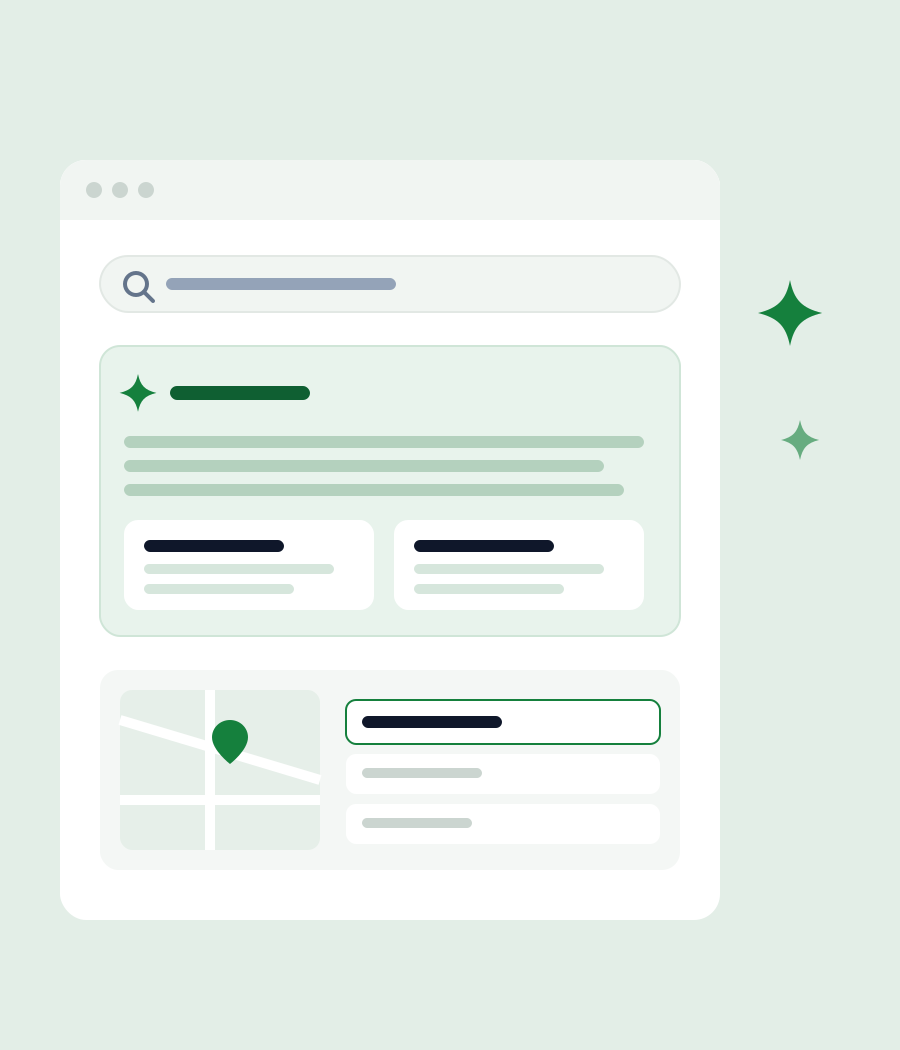
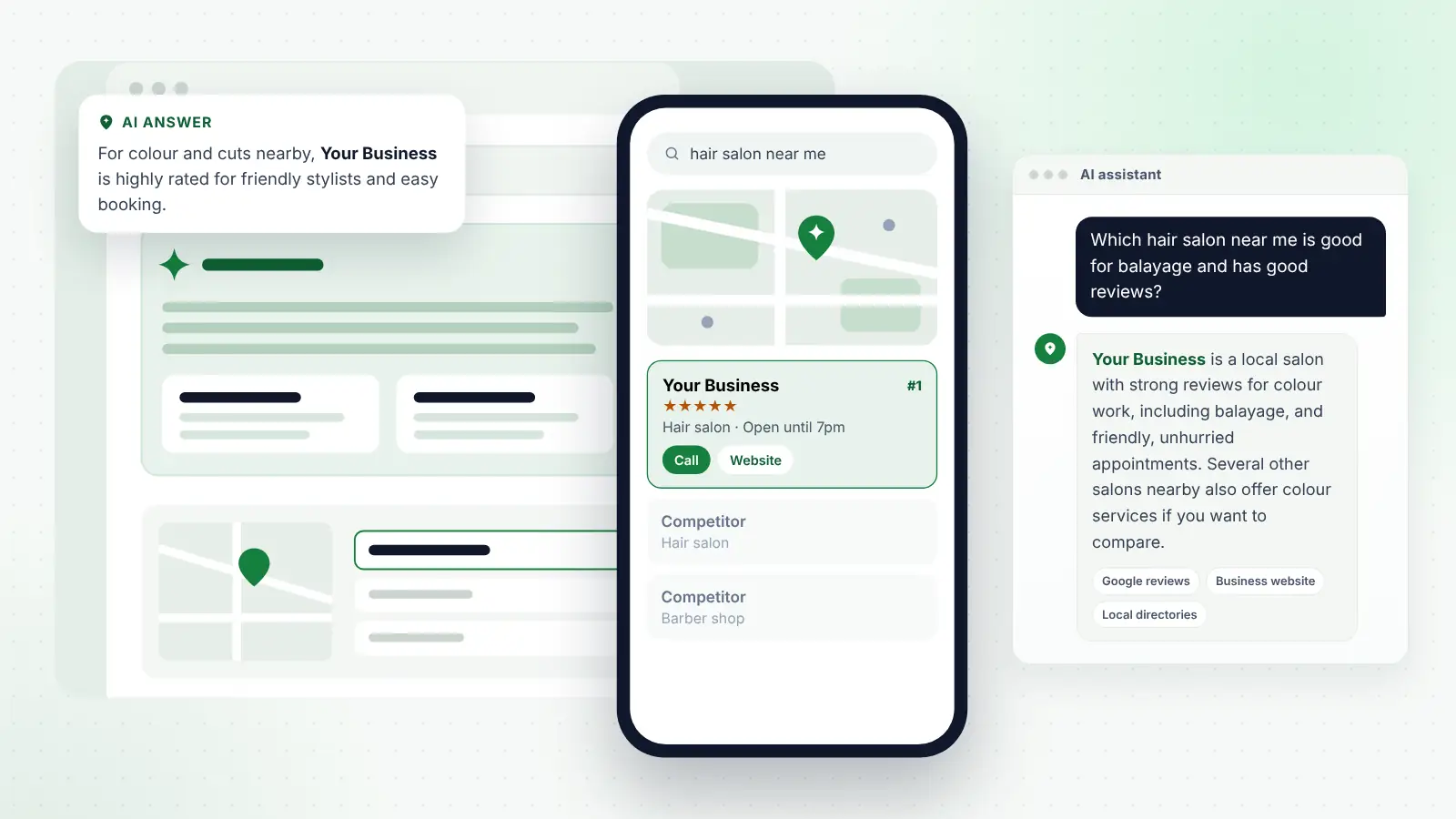
An AI Overview is a summary that appears at the top of some Google search results pages. Google’s systems read relevant pages from its search index and generate a short answer, usually with a set of linked sources shown alongside or beneath the text. You can expand the overview to see more detail and click through to the sources.
AI Overviews do not appear for every search. They tend to show for informational questions, comparisons and multi-part queries, where a summary is genuinely useful. Simple navigational searches, such as a business name, often show traditional results instead.
Google first launched AI Overviews in the United States in May 2024 and expanded them to the UK and several other countries from August 2024.
What is Google AI Mode?
AI Mode is a separate tab or mode in Google Search that works more like a chat assistant. Instead of a single summary, it gives a longer answer and lets you ask follow-up questions. Google says it breaks complex questions into smaller parts, runs several searches at once and then combines the results.
For local businesses, AI Mode matters because people use it for detailed planning questions, such as “find me a hair salon in Bath that’s good with curly hair and open on Sundays” or “what should I look for in a builder for a kitchen extension in Leeds?”. These are exactly the kinds of questions where a business with clear, specific information can stand out.
Google’s AI features are not the only place this happens. Many people ask the same kinds of questions in ChatGPT, Gemini, Copilot or Perplexity. Those assistants appear to draw on different sources: Gemini can use Google’s own data, Copilot uses Bing search, and ChatGPT uses a mix of search and data providers that OpenAI does not fully disclose. But they seem to reward the same things: consistent details, genuine reviews and clear answers on your website.
How AI Overviews show up for local searches
Local searches fall into a few broad types, and AI features behave differently for each.
| Search type | Example | What you typically see |
|---|---|---|
| Direct “near me” search | hair salon near me | Map pack with business listings is usually prominent |
| Service plus town | balayage specialist Cheltenham | Map pack, organic results and sometimes an AI Overview |
| Question or advice | how much does balayage cost in the UK | AI Overview more likely, with links to guides and businesses |
| Comparison or planning | best salon in Bristol for curly hair | AI Overview or AI Mode answer that may name businesses |
| Brand search | your business name | Your Business Profile and website, sometimes a summary |
The pattern varies by industry, location and over time, so check your own key searches rather than relying on a general rule. What is clear is that the map pack remains a major part of local results, while AI features are becoming more common for the questions people ask before they choose who to contact.
Why the map pack and Business Profiles still matter
It is easy to assume AI Overviews have replaced everything else. For local businesses, that is not the case. When someone is ready to book or call, the map pack is still where many of them look, and Google’s own guidance says Business Profiles can help your services be visible in its AI responses too.
In practice, this means traditional local SEO is still the foundation:
- A complete Google Business Profile. Accurate categories, services, opening hours, service areas, photos and a clear description.
- Steady, genuine reviews. These influence both map rankings and how your business is summarised.
- Consistent business details. The same name, address and phone number on your website and across the directories that matter.
- A helpful website. Service pages and area pages that explain what you do and where.
- Local links and mentions. Evidence from other reputable sites that you are an established local business.
If you would prefer specialists to manage this alongside your AI visibility, look for local SEO and AI search support that treats the two as one joined-up job, since the same foundations drive both.
How Google chooses sources for AI Overviews
Google’s guidance on optimising for generative AI features, published in 2026, is fairly direct. It says these features are rooted in its core search ranking and quality systems, and that the best practices for search apply to them as well. Some specific points from that guidance are worth knowing:
- Pages need to be indexed and eligible to be shown with a snippet in order to appear as a supporting link.
- You do not need to create new machine-readable files, AI text files or special markup to appear.
- Structured data is not required for AI features, though it remains useful for ordinary search features.
- Unique content, such as first-hand experience, is more valuable than content that recycles what others have already said.
- Google Business Profiles can help a business’s products and services be visible in AI responses.
In other words, the route into AI Overviews is the same as the route into good search visibility generally: useful, accurate, accessible content from a business Google can trust.
Tip
Search a few of the questions customers ask you, such as “how long does a full head of highlights take?”, and look at which sites the AI Overview links to. If they are all national chains or magazines, a clear local answer on your own site may have a real chance.
Will AI Overviews reduce traffic to my website?
Possibly, for some searches. When a question is fully answered in the summary, fewer people may click through. Many publishers have raised concerns about this, and it is a fair worry for businesses that relied on informational blog posts for traffic.
For local service businesses, the picture is a little different:
- People looking for a local service usually still need to contact someone. A summary can answer their background questions, but they still have to choose a business.
- Being linked or named in an overview can put you in front of people at an earlier stage of their decision.
- Calls, direction requests and bookings from your Business Profile are not affected in the same way as blog traffic.
The useful shift is to measure what matters for your business, which is enquiries, rather than focusing only on website visits. A slight drop in clicks to a general advice article is less important than whether the phone keeps ringing.
What local businesses can do: a practical plan
Here is a straightforward plan that improves your chances of being visible in AI Overviews and AI Mode while also strengthening your normal local presence.
- Audit your Google Business Profile. Fill every relevant field, check your categories and add up-to-date photos.
- Fix inconsistent listings. Search for your business name with old addresses or numbers and correct anything outdated.
- Create proper service pages. One page per main service, covering what is involved, who it suits, typical timescales and how pricing works.
- Answer common questions on your site. Write short, direct answers to the questions customers ask you most.
- Show local relevance. Mention the towns and areas you serve, with useful local detail rather than copy-and-paste lists.
- Demonstrate first-hand experience. Describe real projects, before-and-after examples and the reasoning behind your recommendations.
- Make sure your site is indexable. Check Google Search Console for pages that are not being indexed and fix technical blocks.
- Build reviews and local mentions. Ask for reviews after every job and look for genuine opportunities to be mentioned on local and industry sites.
Writing content that AI Overviews can use
You do not need to write in a special way for AI. Google has said its AI systems can understand synonyms and general meaning, and that there is no requirement to break content into tiny pieces. That said, some habits make your pages easier for both people and machines to use.
Answer the question early
If a page is about “how long does a boiler service take?”, give the answer in the first paragraph, then expand. Readers appreciate this and summaries are easier to draw from.
Use clear headings
Headings that describe the content, such as “What’s included in a full service” or “How we price kitchen extensions”, help Google understand the structure of your page.
Be specific and local
General content is everywhere. Content that says “most Victorian terraces in our area need a full rewire because…” shows real knowledge and is far more useful.
Keep it honest and current
Out-of-date prices, services you no longer offer or old opening hours can be repeated in summaries. Review key pages at least twice a year.
Tip
Add a short “last reviewed” note to key service and pricing pages and actually review them. Keeping facts current protects you from being summarised with old information.
Can I stop my content appearing in AI Overviews?
Google provides controls such as the nosnippet setting, which limits how your content is shown in search results. However, these controls apply to ordinary search snippets as well, so they can reduce your visibility in standard results too. For most local businesses, opting out would do more harm than good. If you are considering it, take advice first and test carefully.
How to track the impact on your business
Because AI Overviews vary between users and searches, tracking them precisely is difficult. A practical approach:
- Google Search Console. Your performance reports show clicks and impressions from Google Search, and Google’s guidance points to Search Console reporting on generative AI features such as AI Overviews and AI Mode. Watch overall trends for your key pages.
- Google Business Profile performance. Monitor calls, website clicks and direction requests month by month.
- Manual checks. Keep a short list of important searches and questions, check them regularly and note whether you appear in the overview, the map pack or the organic results.
- Ask customers. Add “how did you hear about us?” to your enquiry form or phone script, with options for Google search, Google Maps and AI assistants.
Expect any improvements to build gradually. Profile and listing fixes can help within weeks, but stronger visibility usually develops over three to six months.
Frequently asked questions
Do AI Overviews appear for every search?
No. They appear for many informational and comparison searches but not all. Simple local searches such as “hair salon near me” often lead with the map pack instead. The mix varies and changes over time.
Can I pay to appear in an AI Overview?
Google has been testing and rolling out ads within or alongside AI Overviews in some markets, but organic inclusion in the summary cannot be bought. Being cited depends on your content and how well it answers the question.
Do I need schema markup to appear in AI Overviews?
Google says structured data is not required for its AI features. It remains useful for describing your business clearly and for other search features, so it is worth having, but it is not a requirement or a shortcut.
Is AI Mode the same as Gemini?
They are related but separate. AI Mode is part of Google Search and uses a custom version of Google’s Gemini models. The Gemini app is Google’s standalone assistant. Both can draw on Google’s search and Maps information.
Will AI Overviews replace Google Maps for local businesses?
There is no sign of that so far. Maps and the local pack remain central to how people find and contact local businesses, and Google says Business Profiles help with visibility in its AI responses as well. Keeping your Business Profile strong supports both.
Final thoughts
AI Overviews and AI Mode change how Google presents information, but they do not change what makes a local business visible: accurate details, genuine reviews, a helpful website and a good reputation across the web. Google itself describes optimising for its AI features as part of ordinary SEO.
The businesses most likely to benefit are those that answer customers’ questions clearly, show real local knowledge and keep their information consistent everywhere. Focus there, track the enquiries that actually reach you, and give the work a few months to build. Whatever form Google’s results take next, those foundations will still count.