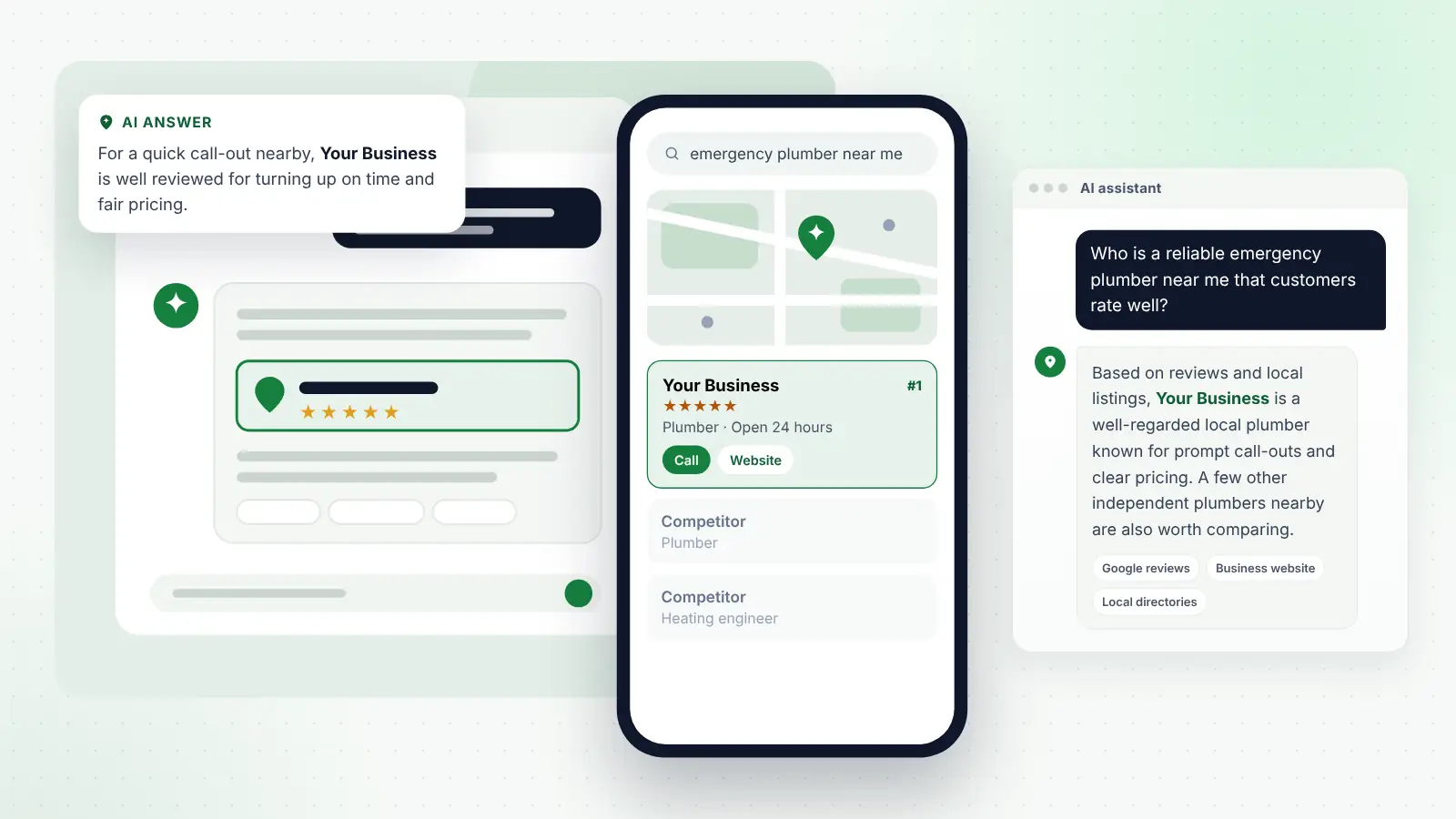
If you run a local business, you have probably heard a new acronym doing the rounds: AEO, short for answer engine optimisation. It is sometimes called GEO (generative engine optimisation), AI SEO or simply AI search optimisation. Whatever the label, the idea is the same. More people now ask a question and read a written answer, rather than scrolling through ten blue links, and businesses want to be the ones named in that answer.
The tools doing the answering include ChatGPT, Google Gemini, Microsoft Copilot, Perplexity and the AI Overviews that now appear at the top of many Google searches in the UK. When someone types “who is a good emergency plumber in Leeds?” or “which dentist near me is good with nervous patients?”, these tools pull together information from across the web and recommend a handful of businesses.
This guide explains what AEO actually is, how it differs from the SEO you may already know, what these tools seem to rely on, and the practical steps a small business can take. It also covers the things that are overhyped, because there is a lot of confident advice in this area that does not hold up.
Key points
- AEO means making your business easy for AI assistants to understand, trust and recommend when people ask questions.
- It builds on ordinary SEO and local SEO rather than replacing them; Google itself describes optimising for its AI features as part of normal SEO.
- AI tools lean on consistent business details, reviews, clear website content and mentions on other reputable sites.
- Different assistants appear to draw on different data sources, so being visible on Google, Bing and the main directories all matters.
- There are no shortcuts or special files that guarantee a mention, and no one can promise you will appear.
- Results usually build gradually over three to six months as your online footprint gets stronger.
In this guide
- What AEO means in plain English
- How AEO differs from SEO and local SEO
- Why AEO matters for local businesses now
- How AI assistants find information about businesses
- The signals AI tools seem to rely on
- Why traditional local search still matters
- A practical AEO checklist for small businesses
- What AEO is not: common myths
- Common mistakes local businesses make
- How to measure progress with AEO
- Frequently asked questions
- Final thoughts
What AEO means in plain English
Traditional search engine optimisation is about helping your web pages appear in a list of results. Answer engine optimisation is about helping your business appear inside the answer itself.
An “answer engine” is any tool that responds to a question with a written reply rather than a list of links. Google’s AI Overviews and AI Mode, ChatGPT, Gemini, Copilot and Perplexity all fall into this group. They read, summarise and combine information, and they often name specific businesses when someone asks for a recommendation.
So AEO is the work of making sure that, when these tools look for information about your type of business in your area, they find clear, accurate, consistent facts about you, plus enough independent evidence that you are a genuine, well-regarded option.
It helps to think of it in three parts:
- Being understood. The tools need to know what you do, where you do it, who you serve and how people can contact you.
- Being trusted. They need signals from outside your own website, such as reviews, directory listings and mentions in local news or industry sites, that confirm you are real and reputable.
- Being relevant to the question. Your content needs to address the specific things customers ask about, such as emergency call-outs, prices, areas covered or particular services.
How AEO differs from SEO and local SEO
AEO is not a separate discipline that sits apart from SEO. It grows out of it. Google’s own guidance for site owners, updated in 2026, makes the point that optimising for its generative AI features is essentially the same as optimising for search in general, because those features are built on its core ranking and quality systems.
That said, the emphasis shifts a little. Here is a simple comparison.
| Traditional SEO | Local SEO | AEO / AI search | |
|---|---|---|---|
| Main goal | Rank web pages in organic results | Appear in the map pack and “near me” results | Be named or cited in AI-written answers |
| Where it shows | Google and Bing results pages | Google Maps, the local pack, Apple Maps, Bing Maps | ChatGPT, Gemini, Copilot, Perplexity, AI Overviews |
| Key signals | Content quality, links, technical health | Google Business Profile, reviews, consistent details, proximity | Consistent facts across the web, reviews, clear answers, trusted mentions |
| What success looks like | More visits from search | More calls, direction requests and visits | Being recommended or cited when people ask |
The good news is that the foundations overlap heavily. A business with a complete Google Business Profile, steady reviews, consistent listings and a helpful website is already most of the way to being visible in AI answers.
Why AEO matters for local businesses now
People have always asked friends for recommendations. AI assistants are becoming another place people ask. A customer might type a long, specific question they would never put into an old-style search box, such as “I need a plumber in Bristol who can fix a combi boiler this weekend and doesn’t charge a fortune for call-outs.”
For a local business, that matters in a few ways:
- Shortlists are shorter. An AI answer might name three to five businesses. If you are not one of them, you may not be considered at all.
- Questions are more detailed. Customers describe their exact situation, so businesses that clearly explain their services, areas and specialisms are easier to match.
- The answer is read before the click. People often decide who to contact based on the summary, so the way you are described matters as much as whether you appear.
None of this means traditional search is going away. Most people still use Google search and Google Maps every day to find local services. AEO is an extra layer, not a replacement.
How AI assistants find information about businesses
This is the part where it pays to be careful, because the companies involved do not publish full details, and things change frequently. What we can say with reasonable confidence is this.
Google AI Overviews, AI Mode and Gemini
Google says its generative AI features in Search are rooted in its core search ranking and quality systems, and its guidance notes that Google Business Profiles can help a business be visible in AI responses. Independent studies of local queries also find Business Profile information appearing very frequently. AI Overviews became available in the UK in 2024, and AI Mode began rolling out in the UK in July 2025. Gemini, Google’s standalone assistant, can also draw on Google Maps information when answering some local questions.
ChatGPT
ChatGPT can search the web when answering. OpenAI says it partners with other search providers and uses third-party providers for local information, but it does not name them all or explain how they are weighted. Microsoft’s Bing is widely reported to be one of the providers. Independent studies of the sources ChatGPT cites for local searches have found business websites appearing most often, alongside directories and review sites such as Yelp and Tripadvisor and publications. Treat any confident claim about exactly how it chooses businesses with some scepticism.
Microsoft Copilot
Microsoft says Copilot uses Bing search to find up-to-date information, so your presence in Bing’s results, and a complete Bing Places for Business listing, are likely to be relevant.
Perplexity
Perplexity searches the web and shows its sources alongside each answer. Because it cites sources visibly, it is a useful tool for seeing which websites are being used to describe businesses in your area.
The practical takeaway is that no single platform controls all AI answers. Being well represented on Google, on Bing and on the wider web gives you the best chance across the board.
The signals AI tools seem to rely on
Nobody outside these companies knows the exact weighting, but the same themes come up repeatedly in official guidance and independent research.
Consistent business facts
Your business name, address, phone number, opening hours, services and areas covered should match everywhere they appear: your website, Google Business Profile, Bing Places, Apple Business Connect, Facebook, Yell, trade directories and industry bodies. When information conflicts, any system trying to summarise you has to guess, and it may choose not to mention you at all.
Reviews on public platforms
Reviews tell both people and machines what you are known for. AI answers often reflect the themes in reviews, such as “punctual”, “tidy”, “good with children” or “fair on price”. A steady flow of genuine, detailed reviews on Google and other relevant platforms gives assistants something real to draw on.
Clear, specific website content
A website that plainly explains what you offer, where, for whom and at roughly what cost is far easier to summarise than a vague homepage with a slogan and a phone number. Separate pages for main services and the main areas you cover help, as do honest answers to the questions customers ask most.
Mentions on reputable sites
Being mentioned in local news, on a supplier’s website, in a trade association’s member directory, on a local business award list or in a well-read community guide all helps establish that you are a real, established business. These mentions work much like word-of-mouth for machines.
A crawlable, indexable website
If search engines cannot properly access your site, AI tools built on those search engines will struggle too. Google’s guidance is clear that pages need to be indexable and eligible to appear as snippets in order to be used in its AI features.
Tip
Ask ChatGPT, Gemini, Copilot and Perplexity the same question a customer would ask, such as “who is a good roofer in Swindon?”. Note who gets named and which sources are cited. Those cited websites tell you where you need to be present.
Why traditional local search still matters
It would be a mistake to chase AI mentions while neglecting Google Maps. For many local searches, the map pack is still the first thing people see, and it drives calls, direction requests and website visits directly. It is also closely linked to AI answers: Google points to Business Profiles as a way to be visible in its AI responses, and other assistants often cite directories and business websites.
The core local SEO jobs are the same as they have always been, and they double as AEO groundwork:
- Claim, verify and fully complete your Google Business Profile, including the right primary category, services, service areas, opening hours, photos and a clear description.
- Ask every satisfied customer for a review and reply to all reviews politely.
- Keep your name, address and phone number identical across directories and listings.
- Build service pages and area pages on your website that explain what you do and where.
- Earn links and mentions from relevant local and industry websites.
If you would rather have specialists handle this, it is worth looking at providers who combine AI search optimisation with up-to-date local SEO in one plan, so the two are worked on together rather than as separate projects.
A practical AEO checklist for small businesses
You can do a surprising amount of this yourself. Work through the list below over a few weeks.
- Write down your official business details once, exactly as they should appear everywhere, and use that wording consistently.
- Complete your Google Business Profile in full and keep your hours up to date, including bank holidays.
- Claim your Bing Places for Business and Apple Business Connect listings, as these feed Bing and Apple Maps and may be used by other assistants.
- Check the main UK directories and trade listings relevant to your industry, and correct any old addresses, numbers or names.
- Add or improve a page for each core service, written in plain language, covering what is included, who it suits and typical timescales.
- Add a frequently asked questions section that answers real questions customers ask you on the phone.
- Make sure your website states clearly which towns and areas you serve.
- Set up a simple routine for requesting reviews after each job, such as a text with a direct link.
- Look for genuine opportunities to be mentioned locally: sponsoring a community event, joining a trade body, contributing expert comment to a local publication.
- Every couple of months, ask the AI assistants your customers might use the questions they would ask, and see whether and how you are described.
Tip
When you write service pages, include the details people actually use to decide, such as whether you offer free quotes, typical response times, payment options and guarantees. Specific facts are easier for both customers and AI tools to repeat accurately.
What AEO is not: common myths
Because AEO is new, there is a lot of noise. A few things are worth clearing up.
“You need a special file or code to appear in AI answers”
Google has said plainly that you do not need to create new machine-readable files, AI text files or special markup to appear in its generative AI features. Structured data is still useful for ordinary search features and helps describe your business clearly, but it is not a secret key.
“You should rewrite everything for robots”
Content written in an unnatural way to target every possible phrasing tends to read badly and does not help. Modern systems understand synonyms and meaning. Write clearly for people and you are writing well for machines.
“Someone can guarantee you will be recommended by ChatGPT”
No one controls what these tools say. Their answers vary between users, sessions and even the wording of the question. Anyone guaranteeing a placement is overpromising.
“Fake reviews and planted mentions will work”
Fake reviews break the rules of review platforms and UK consumer protection law, and Google’s guidance notes that seeking inauthentic mentions is not as helpful as it might appear. The risk far outweighs any short-term gain.
Common mistakes local businesses make
These are the problems we see most often when looking at small businesses’ online presence:
- Old details still live online. A previous address or mobile number on a forgotten directory listing can cause confusion for years.
- A homepage that never says what you do. Slogans like “quality you can trust” tell a machine nothing. Say “boiler servicing and repairs in Swindon and Wiltshire”.
- No information about areas covered. If you serve twenty towns but only mention one, you will rarely be matched to the others.
- Ignoring Bing. Copilot uses Bing search and other assistants are reported to draw on it, yet many businesses have never claimed a Bing Places listing.
- Treating reviews as a one-off. A burst of reviews three years ago, then nothing, looks less convincing than a steady trickle.
- Expecting overnight results. Changes take time to be crawled, indexed and reflected in answers.
How to measure progress with AEO
Measuring AI visibility is harder than tracking a Google ranking, because answers vary and most tools do not share data with businesses. A sensible, low-cost approach is:
- Manual spot checks. Keep a list of ten or so realistic customer questions. Ask them in each assistant every month or two, and record whether you are named and how you are described.
- Referral traffic. Check your website analytics for visits from chatgpt.com, perplexity.ai, copilot.microsoft.com and similar sources. Numbers may be small, but trends are useful.
- Ask new customers. A simple “how did you find us?” on the phone or in your booking form now picks up answers like “ChatGPT suggested you”.
- Google Business Profile insights. Calls, direction requests and website clicks remain a solid measure of local visibility.
Expect changes to build gradually. Fixing profile and listing issues can help within weeks, but stronger, more reliable visibility in maps and AI answers usually develops over three to six months.
Frequently asked questions
Is AEO the same as GEO?
Broadly, yes. AEO (answer engine optimisation) and GEO (generative engine optimisation) are two names for the same goal: helping your business appear in AI-generated answers. Some people use GEO for tools like ChatGPT and AEO more broadly, but in practice the work is the same.
Do I need to stop doing normal SEO?
No. AEO depends on the same foundations. Google’s AI features are built on its search systems, and other assistants also use web search to find current information. Strong SEO and local SEO make AEO far more effective.
How long does AEO take to work?
It varies with your market and starting point. Fixing incomplete profiles and inconsistent listings can make a difference within weeks, but meaningful improvement usually builds over three to six months. In competitive areas it can take longer.
Can I see what ChatGPT says about my business?
Yes. Ask it directly, for example “what do you know about [your business name] in [your town]?” and also ask the kind of question a customer would. Do the same in Gemini, Copilot and Perplexity. If the details are wrong, trace where the error comes from, which is usually an outdated listing or webpage.
Does schema markup help with AI search?
Structured data helps search engines understand your business details and is still worth having for ordinary search features. Google has said it is not required for its AI features and there is no special AI markup to add. Think of it as useful housekeeping rather than a shortcut.
Is AEO worth it for a very small business?
For most local businesses, the basic steps cost little beyond time: consistent listings, reviews, clear service pages and a complete Google profile. Those help in Google Maps, ordinary search and AI answers at once, so they are worth doing whatever your size.
Final thoughts
AEO sounds new, but at heart it rewards the same things good local businesses have always relied on: being easy to find, clear about what you offer and well thought of by customers. The difference is that those qualities now need to be visible and consistent across the whole web, so that an AI assistant summarising your area gets the facts right.
Start with the basics in the checklist above, keep an eye on what the main assistants say about you, and build steadily. Avoid anyone promising guaranteed AI placements. Done properly, the work you put into AEO also strengthens your Google Maps presence and your website, so it pays off whichever way your customers choose to search.