Electricians are in steady demand across the UK. Homes need rewiring and new consumer units, landlords need regular safety inspections, and the move towards electric vehicles, heat pumps, solar panels and battery storage is creating work that barely existed a decade ago. For a qualified electrician, setting up your own contracting business can be a sensible way to take control of the work you do and what you earn from it.
The step from employed electrician to business owner brings new responsibilities, though. You need the right scheme registration to sign off your work, a firm grasp of the current wiring regulations, proper insurance, sensible pricing and a reliable way of finding customers. Getting any of these wrong can cost you money or, worse, your reputation.
This guide covers what you need to know to start an electrical contracting business in the UK, with a focus on domestic and light commercial work. It explains the rules, the realistic costs, how to win the jobs you want and how to make sure local customers can find you on Google and through AI assistants.
Key points
- Notifiable domestic electrical work in England must comply with Part P of the Building Regulations, and joining a competent person scheme such as NICEIC or NAPIT lets you self-certify it.
- BS 7671:2018+A4:2026 (Amendment 4 to the 18th Edition) is now the current standard for new design, installation and certification work.
- Private landlords in England must have electrical installations inspected and tested at least every five years, which creates valuable repeat work.
- EV charger work funded by government grants must be carried out by an OZEV-authorised installer, which in turn requires scheme or ECA membership.
- Local SEO and AI search visibility help you win higher-value work such as rewires, consumer units and EV chargers rather than just small odd jobs.
In this guide
- Decide what kind of electrical business you want
- Training, Level 3 and the AM2
- Notifiable work, Part P and self-certification
- BS 7671: keeping up with the wiring regulations
- Landlord EICRs: a reliable source of repeat work
- EV charger installation
- Setting up the business
- Startup costs
- Pricing and quoting
- Local SEO for electricians
- AI search: how customers now find electricians
- Growing your electrical business
- Frequently asked questions
- Final thoughts
Decide what kind of electrical business you want
“Electrician” covers a wide spread of work, and deciding where you want to focus shapes everything from the scheme you join to the van and test equipment you buy.
- Domestic electrical work — sockets, lighting, fault-finding, consumer unit replacements and rewires. High demand and plenty of small jobs, with rewires providing larger projects.
- Landlord and letting agent work — electrical installation condition reports (EICRs), remedial work and repairs. Repeat work, but often with tight timescales and slower payment.
- EV chargers, solar and battery storage — a growing area with research-heavy customers and higher job values. Requires additional training and, for some funded work, specific authorisations.
- Commercial and light industrial — shops, offices and small units. Larger contracts and more paperwork, often with different insurance and scheme requirements.
Many electricians start with general domestic work and gradually shift towards the services they find most profitable. Choosing a direction early helps you invest in the right training and marketing.
Training, Level 3 and the AM2
To work as a fully qualified electrician, most people complete a Level 3 electrical installation qualification, typically through an apprenticeship, along with an end-point or AM2 practical assessment. You will also need an up-to-date qualification in the current wiring regulations and, if you plan to carry out EICRs, a recognised inspection and testing qualification.
If you are retraining, be careful with short “fast-track” courses. They may get you started with limited domestic work, but schemes, insurers and larger clients usually expect evidence of full training and practical experience. If you want to work on construction sites, you will usually need an industry ID card, such as an ECS card, as well.
Notifiable work, Part P and self-certification
What Part P covers
In England, Part P of the Building Regulations applies to electrical installations in dwellings. Certain work is notifiable, which means building control must be told about it. This generally includes installing new circuits, replacing a consumer unit and some work in special locations such as rooms with a bath or shower. Minor work, such as replacing an accessory or adding a socket to an existing circuit, is usually not notifiable — but it must still meet the wiring regulations.
Rules differ in Wales, Scotland and Northern Ireland, so check the requirements if you work across borders.
Why join a competent person scheme
Without scheme membership, notifiable work has to go through local building control, which adds cost and delays for your customer. Registering with a competent person scheme such as NICEIC or NAPIT allows you to self-certify your work. You notify the work through the scheme, the local authority is informed, and your customer receives a building regulations compliance certificate along with your electrical installation certificate.
Schemes usually assess you on site before registration and carry out periodic assessments afterwards. They check your work, your test equipment, your paperwork and your knowledge of the current regulations. Registration fees vary by scheme and membership level, so compare them carefully. For many customers, a scheme logo is one of the first things they look for, and it is required for some types of funded work.
Tip
Choose your scheme with your future work in mind. If you plan to move into EV chargers, solar or commercial work, check which scheme categories you will need and whether they cover those activities before you sign up.
BS 7671: keeping up with the wiring regulations
BS 7671, the IET Wiring Regulations, sets the standard for electrical installations in the UK. The current version is the 18th Edition with Amendment 4, published as BS 7671:2018+A4:2026. It was published in April 2026, and after a six-month transition period it became the standard for new design, installation and certification work from 15 October 2026.
Amendment 4 replaces the previous version (BS 7671:2018+A2:2022+A3:2024) and introduces new or revised requirements, including a new chapter on stationary batteries used for energy storage and a new, largely informative chapter on energy efficiency. If you plan to install battery storage alongside solar or EV chargers, those changes are directly relevant to you.
Make sure your copy of the regulations, your certificate templates or software and your knowledge are all up to date. Scheme assessors will expect it, and so will customers who ask questions.
Landlord EICRs: a reliable source of repeat work
Under the Electrical Safety Standards in the Private Rented Sector (England) Regulations 2020, private landlords in England must have the electrical installations in their properties inspected and tested by a qualified and competent person at least every five years. The result is recorded in an EICR.
Landlords then have to give a copy to existing tenants within 28 days, to new tenants before they move in, and to the local council within seven days if asked. If the report identifies remedial work, it must usually be carried out within 28 days, or sooner if the report says so. A landlord who ignores these duties risks a council fine of as much as £30,000.
For an electrician, this creates predictable, recurring work. Practical ways to build it include:
- Introducing yourself to local letting agents and offering a clear fixed price for EICRs by property size.
- Keeping a record of every EICR you complete, with the next due date.
- Sending landlords a reminder a few months before their next inspection is due.
- Quoting remedial work promptly and clearly, separating essential items from recommendations.
Wales, Scotland and Northern Ireland have their own rules for rented property. Northern Ireland, for example, now requires private landlords to have installations inspected at least every five years, with the rules applying to all existing private tenancies since 1 December 2025. Check the local requirements if you work outside England.
EV charger installation
Home EV charger installation is one of the fastest-growing areas of domestic electrical work. Customers tend to research carefully, compare installers and ask detailed questions about brands, cable runs, earthing arrangements and smart features.
If you want to carry out installations funded by government grants, such as the EV chargepoint grant for renters and flat owners, you need to become an authorised installer with the Office for Zero Emission Vehicles. According to the government’s guidance on how to become an authorised chargepoint installer, applicants need membership of a recognised competent person scheme (such as NAPIT, NICEIC, SELECT or OFTEC for residential work) or the ECA. Grant schemes change from time to time, so check what is currently open before promoting grant-funded installs.
Charge points sold for home and workplace use in Great Britain also need to meet smart charge point regulations. Most electricians also complete manufacturer training for the brands they fit, which helps with warranty claims and technical support.
Setting up the business
Business structure and tax
Most electricians start as sole traders, registering for Self Assessment with HMRC by 5 October after the end of the tax year in which they started. A limited company can make sense at higher profits or when taking on larger contracts, but it brings more administration. Speak to an accountant who works with trades before deciding.
Making Tax Digital for Income Tax applies from April 2026 to sole traders with qualifying income above £50,000, with lower thresholds in later years. VAT registration is required once taxable turnover exceeds £90,000 in a rolling 12-month period. Materials count towards that figure, so a busy rewiring or EV business can reach it quickly.
If you work for builders or main contractors on construction projects, you may also need to register as a subcontractor under the Construction Industry Scheme (CIS), where tax is deducted from your payments.
Insurance
- Public liability insurance — essential for any electrical work, and often required by schemes and commercial clients.
- Employers’ liability insurance — a legal requirement once you employ staff, with at least £5 million cover.
- Professional indemnity insurance — worth considering if you design installations or give technical advice.
- Tools, test equipment and van cover — test equipment is expensive and attractive to thieves.
Startup costs
These figures are rough guides and vary by area, supplier and whether you already own equipment.
| Item | Typical cost | Notes |
|---|---|---|
| Van | £8,000–£20,000 | Used is fine; leasing spreads the cost |
| Hand and power tools | £1,500–£4,000 | More if you are building up from scratch |
| Multifunction tester and test kit | £800–£2,000 | Must be calibrated regularly |
| Competent person scheme | Varies | Registration plus annual fees; compare schemes |
| Regulations and training updates | Varies | Budget for BS 7671 updates and new courses |
| Insurance | A few hundred to over £1,000 a year | Depends on the work and cover levels |
| Certification software | Monthly subscription | Speeds up EICs, minor works and EICRs |
| Website and branding | £0–£2,000 | A clear, fast site matters more than a fancy one |
Keep a cash buffer for the first few months. Larger jobs often require you to buy materials before you are paid, and commercial clients may pay 30 days or more after invoicing.
Pricing and quoting
Work out your real hourly cost before setting prices. Add up annual costs — van, fuel, insurance, scheme fees, software, tools, calibration, phone and your target salary — and divide by the hours you can realistically bill. That figure is usually higher than new business owners expect.
- Fixed prices for defined jobs. Consumer unit replacements, EICRs and EV charger installs are well suited to fixed prices, with clear notes on what might change the cost.
- Day rates or hourly rates for fault-finding. Explain how you charge before you start so there are no surprises.
- Written quotes for larger jobs. Itemise materials and labour, explain what is included (testing, certification, making good), state exclusions and add a validity date.
- Separate essential and optional work. On EICR remedials especially, customers trust electricians who explain clearly what must be done and what is a recommendation.
Local SEO for electricians
Most people looking for an electrician start with Google. Some searches are urgent (“emergency electrician near me”, “power gone off in half the house”), while others are researched over days or weeks (“house rewire cost”, “consumer unit replacement [town]”, “EV charger installer near me”, “EICR for landlords [town]”). Local SEO is about making sure your business appears in the map results and local listings for the searches that match the work you want.
Setting up your Google profile as a new electrician
Your Google Business Profile is free and drives a large share of local enquiries. To make it work properly:
- Choose “Electrician” as your primary category and add genuine secondary categories, such as an EV charging installer category, where they apply.
- If you work from home, set up as a service-area business with a realistic list of towns or postcodes rather than an entire region.
- Add every service separately — rewires, consumer units, EICRs, EV chargers, fault-finding, outdoor lighting — with short, plain descriptions.
- Upload photos of real work: neat consumer unit installs, finished charger installations, your branded van.
- Post occasional updates about recent jobs or services, and keep opening hours accurate.
Reviews that name fuse boxes, rewires and chargers
Reviews are one of the strongest factors in local rankings and in a customer’s decision. Ask every customer, ideally by text with a direct link straight after the job. Reviews that mention the type of work and the area — “replaced our old fuse box in Harrogate”, “installed our EV charger quickly and tidily” — help you appear for those searches. Do not write fake reviews or offer rewards for them; it breaks Google’s rules and UK consumer law.
Consistent details and trusted listings
Make sure your business name, phone number and service area are identical on your website, Google profile, scheme listing (such as the NICEIC or NAPIT find-a-contractor tools), trade directories and social media. These citations help Google confirm you are a genuine, established local business.
Pages for each electrical job and each town
Give each main service its own page explaining what is involved, roughly what it costs, how long it takes and which certificates the customer receives. Add pages for the main towns you cover if you have genuine work and reviews there. Keep the site quick on mobile with a tappable phone number and a simple enquiry form.
Local links and mentions
Links from local businesses, community groups, suppliers and trade partners — a kitchen fitter you work with, a local business network, a sports club you sponsor — help build your authority. Quality matters far more than quantity.
Local SEO results usually build over three to six months. If you would rather someone else handled it, you can use a specialist provider of SEO for electricians and electrical contractors that manages your profile, listings, content and links each month.
AI search: how customers now find electricians
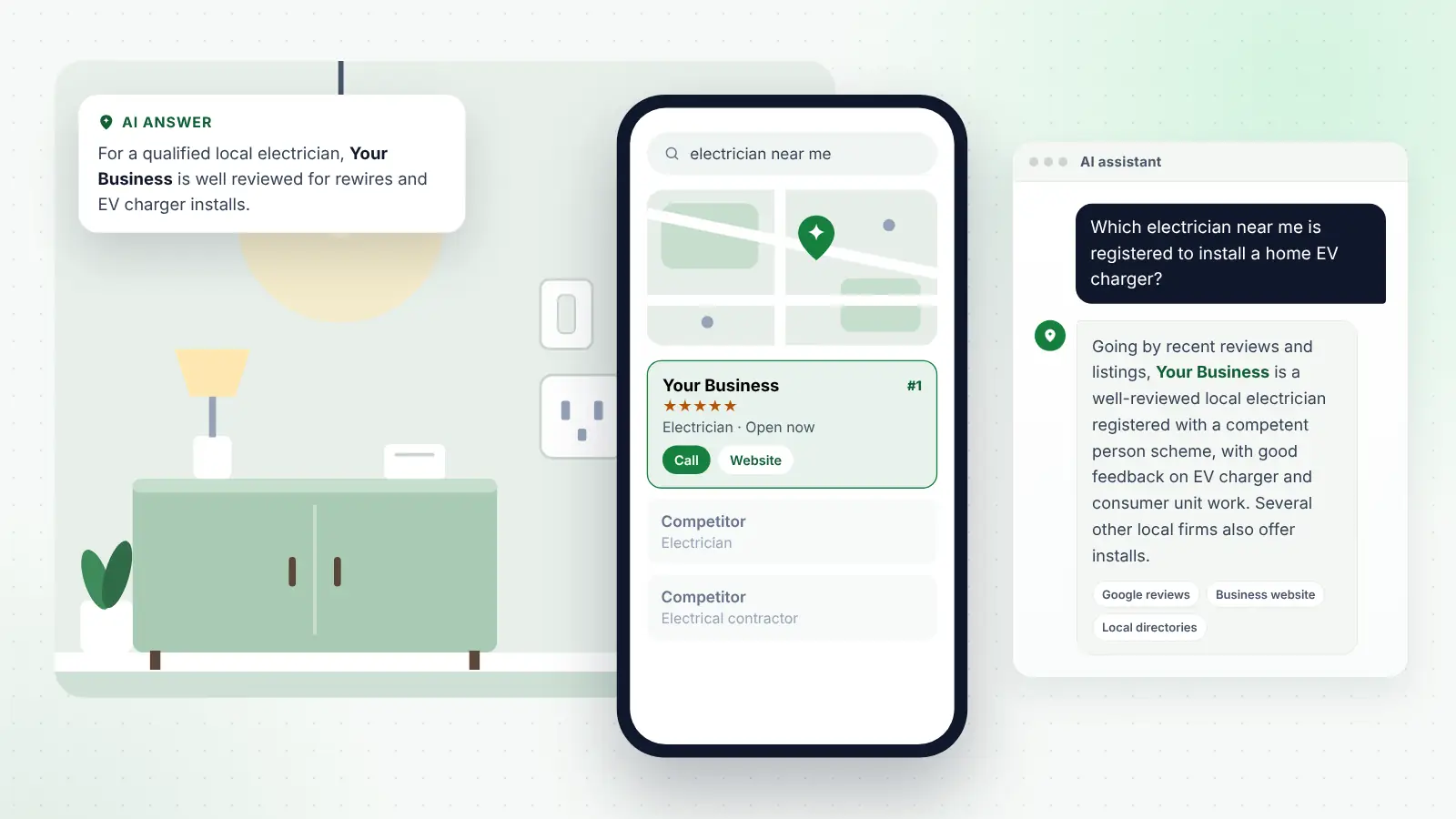
More homeowners and landlords are asking AI assistants for advice before they call anyone. Typical questions include “Do I need an electrician to replace my consumer unit, and who’s good locally?”, “Which electrician near me is approved to install an EV charger?” or “How often does a landlord need an EICR, and who can do one in [town]?” ChatGPT, Gemini, Perplexity, Microsoft Copilot and Google’s AI Overviews all answer questions like these, often naming specific businesses.
AI tools build their answers from information they can find and trust: your website, Google profile, scheme listings, reviews across several platforms and mentions on reputable local or industry websites. Answer engine optimisation (AEO) means making that information complete and consistent.
For an electrical business, that means:
- Stating your scheme registration and qualifications clearly, in the same wording on your website, Google profile and listings.
- Describing services precisely. “We install home EV chargers, including tethered and untethered models from several major brands, across [towns]” gives an AI tool something concrete to work with.
- Answering real questions on your website. How long does a rewire take? Will I need to move out? What certificate will I get? Do you offer EICRs for HMOs? Short, honest answers help customers and AI tools alike.
- Keeping information current. If you stop offering a service or change your coverage area, update it everywhere.
- Earning mentions on trusted sites, such as local news, supplier installer directories and trade body listings.
None of this is about gaming the system. It is about making sure that when an AI assistant looks for a qualified electrician in your area, the information it finds about you is accurate and persuasive.
Growing your electrical business
Once you have a steady flow of work, think about where you want to grow.
- Build trade relationships. Kitchen and bathroom fitters, builders, loft conversion firms and property developers all need reliable electricians.
- Develop landlord accounts. A handful of letting agents can provide regular EICRs and remedial work all year.
- Add renewable and storage work. Solar PV and battery installations often require additional certification, such as MCS for some customers to access certain schemes. Research the requirements carefully.
- Take on help. An apprentice or second electrician increases capacity, but check your scheme requirements for supervision and qualified supervisors.
Tip
Photograph every consumer unit, charger install and rewire before you leave site. A steady stream of neat, real photos is one of the most persuasive things you can add to your website and Google profile.
Frequently asked questions
Do I have to join a competent person scheme?
It is not a legal requirement to be a member, but without one, notifiable domestic work in England has to be approved through local building control. Scheme membership lets you self-certify, saves your customers time and money and is required for some funded work, such as OZEV grant installations. Most domestic electricians find it essential.
Which scheme should I choose, NICEIC or NAPIT?
Both are well-known and widely recognised by customers. Compare fees, assessment processes, the categories of work covered and the support offered. If you plan to move into EV chargers, solar or commercial work, check that the scheme covers those activities.
Do I need to update to Amendment 4 of BS 7671?
Yes. Since 15 October 2026, BS 7671:2018+A4:2026 is the standard for new design, installation and certification. Make sure your knowledge, certificates and software reflect it. Your scheme will expect it at your next assessment.
How do I win more rewires and fewer small jobs?
Make rewires and consumer units prominent on your Google profile, website and van. Add photos and reviews that mention those jobs, explain the process clearly and publish rough guide prices. If a homeowner sees rewires first on your van and profile, they will take rewiring to be your speciality.
Can I do EICRs straight away?
You should hold a recognised inspection and testing qualification and have the experience to carry out inspections competently. Landlords and agents rely on your report to meet legal requirements, so accuracy matters. Many schemes also assess inspection and testing separately.
Final thoughts
Starting an electrical contracting business is a realistic goal for a qualified, experienced electrician. Get registered with a competent person scheme, keep up to date with BS 7671, sort out your insurance and business structure, and price your work so it pays properly. Then put real effort into being found — a complete Google profile, steady reviews, clear service pages and consistent information everywhere — so that local homeowners, landlords and AI assistants all point towards your business when someone needs an electrician.