Cleaning is one of the most accessible businesses to start in the UK. You do not need a formal qualification, the equipment costs are modest, and demand is steady in almost every town. People need homes cleaned every week, tenants need deep cleans when they move out, and offices, shops and surgeries need cleaning whatever the economy is doing.
That low barrier to entry cuts both ways. It is easy to start, which means there is plenty of competition, and the businesses that last are the ones that look professional from day one: properly insured, clear about what they do, careful with chemicals and keys, and priced so the numbers actually work once travel, products and quiet weeks are factored in.
This guide walks through the decisions and paperwork involved in starting a cleaning business, from choosing between domestic and commercial work to hiring your first cleaner and getting found by local clients online.
Key points
- Decide early whether you are focusing on domestic, commercial or specialist cleaning, because each needs different pricing, insurance and marketing.
- Register with HMRC, take out public liability insurance, and add employers’ liability insurance as soon as you take on staff.
- Follow COSHH principles for the products you use: read safety data sheets, assess risks, and train anyone who works for you.
- Price by the hour for regular cleans and by the job for one-off work, and build in travel time, products and cancellations.
- A complete Google Business Profile, steady reviews and clear service pages are what most new clients see before they call.
In this guide
- Choose your market: domestic, commercial or specialist
- Get the paperwork right before the first clean
- Understand COSHH and health and safety
- What a cleaning kit costs to start
- How to price your cleaning services
- Taking on staff
- Win your first clients
- Local SEO: being the cleaner people find first
- AI search: how clients now ask for recommendations
- Common mistakes to avoid
- Frequently asked questions
- Next steps
Choose your market: domestic, commercial or specialist
The first decision shapes almost everything else, so it is worth thinking it through before you buy a single mop.
Domestic cleaning
Domestic cleaning means regular weekly or fortnightly cleans in people’s homes, plus one-off deep cleans. It is the most common starting point because you can begin on your own, work school hours if you need to, and build a round of loyal clients in a small area. The trade-off is that each client is a relatively small amount of money, so you need a good number of them, and cancellations or holidays can leave gaps.
Trust matters more here than anywhere else. You will often have keys or alarm codes, and you will be working around people’s belongings, pets and sometimes children. Clients want to know who is coming, that they are vetted, and that the business is insured.
Commercial cleaning
Commercial cleaning covers offices, shops, gyms, schools, dental practices, communal areas in blocks of flats and similar premises. Contracts tend to be larger and more predictable, often with early morning or evening hours. Buyers are usually more formal: they may ask for risk assessments, method statements, proof of insurance, staff vetting, and references before they award a contract.
Commercial work can be more profitable per hour, but you need to be confident you can cover the hours reliably, including when someone is off sick.
Specialist and one-off work
End-of-tenancy cleans, after-builders cleans, carpet and upholstery cleaning, oven cleaning and window cleaning are all specialisms that can be run on their own or added to a regular cleaning service. They usually command higher prices but are less predictable. Many cleaning businesses use one-off work to fill gaps and to win clients who later move onto a regular arrangement.
| Type of work | Typical clients | Strengths | Watch out for |
|---|---|---|---|
| Regular domestic | Households, busy professionals, older people | Loyal, recurring income | Small job values, cancellations |
| Commercial contracts | Offices, shops, clinics, managing agents | Larger, predictable contracts | Unsocial hours, formal tendering |
| End-of-tenancy | Tenants, landlords, letting agents | Higher value per job | Deadlines, deposit disputes |
| After-builders | Builders, homeowners after renovations | Good margins | Dust, heavy work, specialist kit |
Get the paperwork right before the first clean
Choose your structure and register with HMRC
Most cleaners start as sole traders because it is simple and inexpensive. You register for Self Assessment with HMRC, keep records of your income and expenses, and pay Income Tax and National Insurance on your profits. You need to register by 5 October after the end of the tax year in which you started trading, but there is no reason to wait.
Some owners set up a limited company instead, which separates business and personal finances and can be more tax-efficient at higher profit levels. It also brings more admin, such as annual accounts and filings with Companies House. A short conversation with an accountant before you decide is worth the cost.
Keep an eye on the VAT registration threshold as you grow. Many cleaning businesses stay under it for some time, but commercial contracts can push turnover up quickly, and you must register once you go over it.
Open a separate bank account
Even as a sole trader, a separate business account makes bookkeeping, tax returns and proving your income much easier. It also makes you look more established when commercial clients pay by bank transfer.
Get the right insurance
Insurance is the one thing you should not cut corners on. The main types to consider are:
- Public liability insurance, which covers you if you damage a client’s property or someone is injured because of your work. It is not legally required, but most clients and nearly all commercial buyers will expect it.
- Employers’ liability insurance, which is a legal requirement in most cases once you employ staff. It must normally be for at least £5 million and you need to display or make the certificate available to employees.
- Key cover, which pays for replacing locks if you lose a client’s keys. This is easily overlooked and can be expensive without cover.
- Equipment and tools cover for your vacuum cleaners, steam cleaners and carpet machines.
- Business use on your car or van insurance, because driving between clients is usually not covered by a standard social policy.
Specialist cleaning business insurers often bundle these together. Check the policy wording for things like damage to items you are cleaning, as some policies exclude it or set limits.
Tip
Put your insurance details on your website and in every quote. A short line such as “fully insured, including public liability and key cover” answers one of the first questions clients ask and helps you stand out from cleaners who never mention it.
DBS checks
A DBS check is not a legal requirement for most cleaning work, but for domestic cleaning it is one of the main things clients look for. Individuals can apply for a basic DBS check on themselves through the government’s online service, and employers can request basic checks for staff through a registered provider. In Scotland and Northern Ireland, basic checks come from Disclosure Scotland and AccessNI instead. A basic check shows unspent convictions. Higher-level checks are only available for specific roles, such as some work involving children or vulnerable adults, so do not promise a level of check you are not eligible for.
If you clean in homes where vulnerable people live, or in schools and care settings, talk to the client about what vetting they require.
Understand COSHH and health and safety
The Control of Substances Hazardous to Health Regulations, usually shortened to COSHH, apply to cleaning businesses because many everyday products, such as bleach, descalers, oven cleaners and some floor products, can harm skin, eyes or lungs. The Health and Safety Executive publishes guidance on what employers need to do.
In practice, COSHH for a small cleaning business usually means:
- Making a list of the products you use and keeping the safety data sheet for each one, which suppliers provide.
- Assessing the risks of each product in the way you use it, including mixing, dilution and ventilation.
- Deciding on controls, such as using the least hazardous product that does the job, diluting correctly, and providing gloves or eye protection where needed.
- Training anyone who works for you on safe use, storage and what to do if something goes wrong.
- Reviewing your assessments when you introduce new products or methods.
Never mix products, particularly bleach with acidic cleaners or ammonia-based products, as this can release dangerous gases. Store chemicals in their original labelled containers, not decanted into unlabelled spray bottles.
Wider health and safety duties also apply. If you employ five or more people, you need a written health and safety policy and written risk assessments. Even if you work alone, thinking through risks such as slips, working at height on stepladders, manual handling and lone working is sensible, and commercial clients will often ask to see your risk assessments.
If you remove waste from a client’s premises, for example after a builders’ clean, check whether you need to register as a waste carrier.
What a cleaning kit costs to start
One of the advantages of cleaning is that you can start with relatively little. Many domestic cleaners begin with a car, a good vacuum and a box of products. Costs vary a lot depending on whether you provide products and equipment yourself or use the client’s.
| Item | Rough guide | Notes |
|---|---|---|
| Commercial-grade vacuum | Typically £150–£400 | Durable models last far longer than domestic ones |
| Products, cloths, mops, buckets | Can range from £100–£300 to start | Colour-coded cloths help avoid cross-contamination |
| Insurance | Varies widely by cover and size | Get several quotes |
| Branded uniform or tabards | Typically under £100 to start | Makes you look professional on the doorstep |
| Website and booking setup | From free to several hundred pounds | A simple, clear site is enough to begin |
| Steam cleaner or carpet machine | Several hundred pounds upwards | Only if you offer these services |
Costs vary by area and supplier, so treat these as rough starting points rather than a budget.
Decide early whether you will bring your own products. Many clients prefer you to, and it lets you use products you know are effective and safe. If clients supply them, agree in writing what you will and will not use, especially on delicate surfaces.
How to price your cleaning services
Pricing is where many new cleaning businesses go wrong. It is tempting to undercut everyone to win the first few clients, but low prices are hard to raise later and leave nothing for travel, products, holiday or growth.
Hourly or fixed price
Regular domestic cleaning is usually priced by the hour, with a minimum visit length, often two or three hours. One-off work such as end-of-tenancy and after-builders cleans is usually quoted as a fixed price based on property size and condition, because clients want certainty and you want to be paid for the job rather than the time.
Commercial contracts are often priced per visit or per month, based on an estimate of hours plus products, equipment and a margin.
What to build into your price
Before you set your rates, work out:
- Travel time and fuel between jobs, which is real working time.
- The cost of products and equipment per clean.
- Insurance, phone, software and marketing costs spread across the year.
- Time off for holidays and illness, when you will not be earning.
- Cancellations, and what your cancellation policy will be.
- If you employ people, their wages, holiday pay, employer pension contributions and employer National Insurance where it applies.
Look at what other well-reviewed cleaners in your area charge, but do not simply copy the cheapest. Clients who choose purely on price are also the most likely to leave.
Tip
Offer a first “reset” clean at a higher rate or fixed price for homes that have not been cleaned professionally for a while. It brings the home up to a standard you can maintain in the regular time slot, and it sets expectations from the start.
Put it in writing
A simple set of terms covering what is included in a standard clean, minimum visit length, cancellation notice, key handling, how breakages are dealt with and payment terms prevents most disputes before they start.
Taking on staff
Many cleaning businesses grow by employing cleaners rather than taking on more hours themselves. This is where the business side becomes more demanding.
Employed or self-employed
Some cleaning businesses use self-employed cleaners, but employment status is decided by how the working relationship actually operates, not by what the contract calls it. If you control when, where and how someone works, provide their equipment and they cannot send a substitute, they are likely to be an employee or worker. Getting this wrong can lead to back-payments of tax, holiday pay and minimum wage. HMRC has an online tool to check employment status for tax.
Your duties as an employer
When you take on employees, you will normally need to:
- Register as an employer with HMRC and run payroll through PAYE.
- Check that each person has the right to work in the UK before they start.
- Pay at least the National Minimum Wage or National Living Wage for their age. Be aware that time spent travelling between client appointments generally counts as working time for minimum wage purposes.
- Give a written statement of employment particulars from the first day.
- Provide paid holiday, which for most workers is 5.6 weeks a year.
- Enrol eligible staff into a workplace pension.
- Take out employers’ liability insurance.
Recruitment, training and keeping good cleaners is often the biggest challenge in a growing cleaning business. Paying fairly, giving consistent rounds and treating people well tends to reduce turnover, which in turn keeps clients happy because they see the same face each week.
Win your first clients
Your first clients often come from people who already know you: friends, neighbours, former colleagues and local community groups. Beyond that, the most effective routes tend to be:
- Letting agents and landlords, who need reliable end-of-tenancy cleans and will send repeat work if you meet deadlines and standards.
- Builders and decorators, for after-builders cleans.
- Local businesses, approached directly with a short, professional proposal for regular cleaning.
- Referral incentives, such as a discounted clean for both the existing client and the person they refer.
- Leaflets and local noticeboards in the specific streets you want to work in, so your round stays compact.
Keeping your clients close together matters more than it might seem. A tight round means less unpaid travel and makes it easier to cover for staff.
Local SEO: being the cleaner people find first
When people need a cleaner, most of them search on Google, often on their phone, using phrases such as “cleaners near me”, “end of tenancy cleaning [town]” or “office cleaning company near me”. The results that appear in the map pack at the top of the page get a large share of the attention, and that is decided by local SEO rather than by advertising.
For a cleaning business, local search is particularly valuable because each regular client can stay for years. Winning a handful of extra clients through search each month adds up quickly.
Build a Google profile for a cleaning round
This free listing is what shows up when someone nearby searches Google or Maps for a cleaner. Most cleaners do not have premises customers visit, so set the profile up as a service-area business, which hides your home address and shows the areas you cover instead. Then:
- Choose the most accurate primary category, such as house cleaning service or commercial cleaning service, and add secondary categories for other work you do.
- List each service separately, with a short description of what is included.
- Add the towns and neighbourhoods you genuinely cover.
- Upload real photos of your team, branded vehicle and finished work, with the client’s permission.
- Post updates occasionally, such as seasonal deep-clean availability.
Reviews
Reviews are one of the strongest signals for both rankings and conversion. Ask every client, ideally after their second or third clean, when they are confident in your work. Make it easy by sending a direct link. Reply to every review, briefly and politely, including the occasional negative one.
The same details on every cleaning directory
Your business name, phone number and website should be identical on your Google profile, website, social media and directories such as Yell, Thomson Local and local listing sites. Inconsistent details make it harder for search engines to be confident about who you are.
Pages for each clean type and each patch
A simple website with a separate page for each main service, such as regular house cleaning, end-of-tenancy cleaning and office cleaning, helps you appear for those specific searches. If you cover several towns, a page for each area that genuinely describes your work there can help too. Every page should mention insurance, vetting, what is included and how to get a quote.
Local links and mentions
Links from local websites, such as a residents’ association, a local business directory, a community sponsorship page or a letting agent’s recommended suppliers list, help show that you are an established local business.
Local SEO takes time and consistency. Many owners do it themselves at first; if you would rather have specialists handle it, you can read about our approach to local SEO for cleaning companies and cleaners. Either way, results usually build over three to six months rather than overnight.
AI search: how clients now ask for recommendations
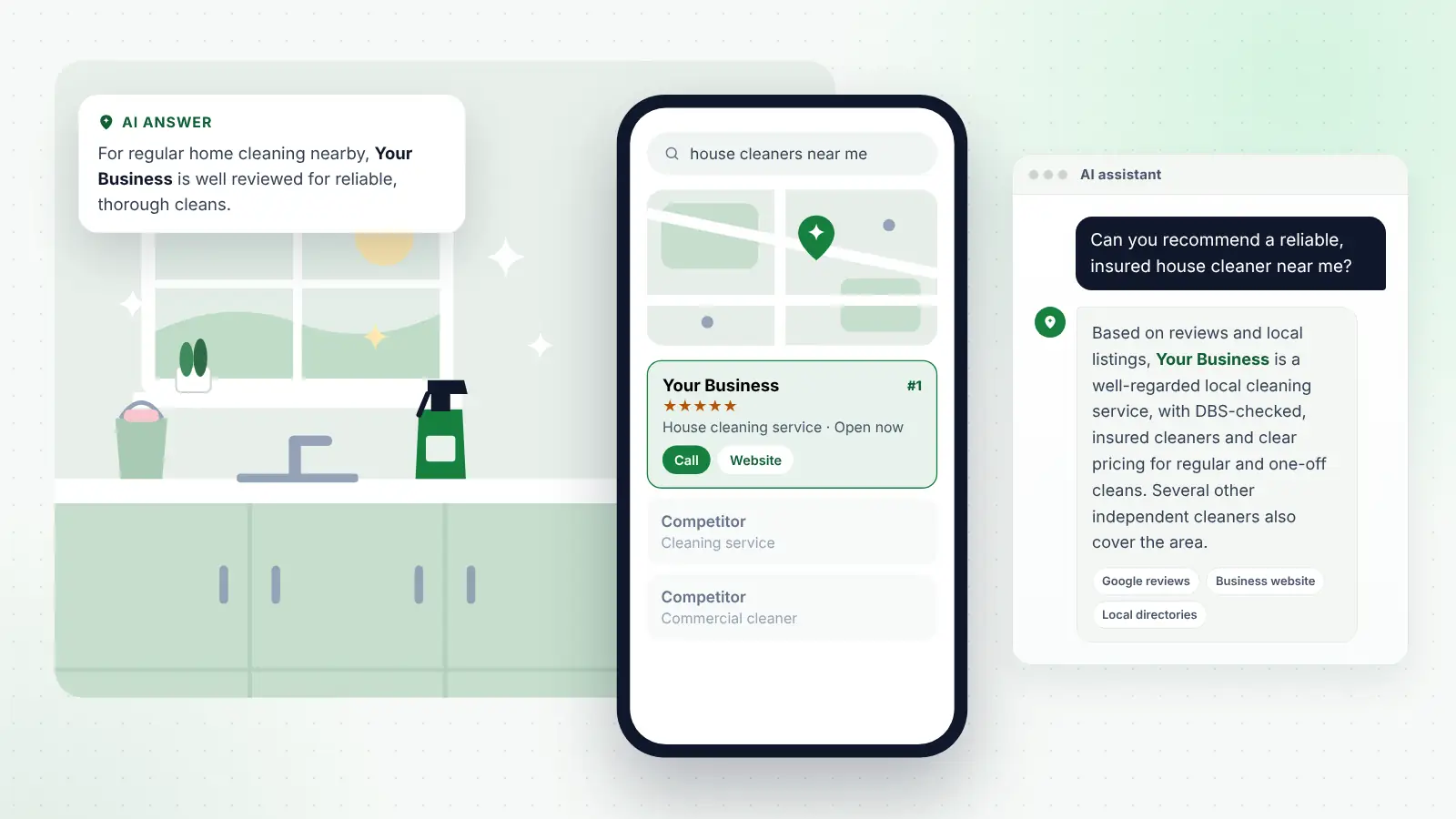
Alongside Google, more people now ask AI assistants such as ChatGPT, Gemini, Perplexity, Microsoft Copilot and Google’s AI Overviews for help choosing local services. Instead of typing “cleaners near me”, they ask full questions, for example:
- “Can you recommend a reliable cleaner in Leeds who brings their own products?”
- “Which end of tenancy cleaning companies near me offer a deposit-back guarantee?”
- “Who does eco-friendly office cleaning in Bristol?”
An assistant only suggests a cleaner it can find solid, matching information about across several sites, which is why answer engine optimisation, or AEO, matters for cleaning businesses. The things that help most are:
- Consistent information about your name, services and areas on your website, Google profile and directories.
- Reviews that mention specific things, such as reliability, thoroughness or the same cleaner each week.
- Clear service descriptions that state exactly what is included, which areas you cover and whether you are insured and DBS-checked.
- An FAQ section on your website answering the questions clients actually ask, in plain language.
- Mentions on reputable local and industry sites, such as local news, business groups or trade associations.
The practical upside is that the same work that helps your local SEO also helps AI tools understand and recommend you. Clear, specific, honest information is what both reward.
Tip
Write down the ten questions new clients ask you most often, then answer each one on your website in two or three sentences. These answers help clients, search engines and AI assistants at the same time.
Common mistakes to avoid
- Underpricing to win work, then struggling to raise rates later.
- Accepting clients spread across a wide area, so travel eats the profit.
- Not having key cover, or keeping keys labelled with clients’ addresses.
- Treating staff as self-employed when the relationship looks like employment.
- Using products without understanding the risks, or mixing chemicals.
- Neglecting reviews and the Google profile once the diary feels full, then finding gaps hard to fill when clients move away.
Frequently asked questions
Do I need a licence to start a cleaning business?
There is no general licence needed to run a cleaning business in the UK. You do need to register with HMRC, follow health and safety and COSHH rules, and have employers’ liability insurance if you employ staff. Some specialist work, such as removing waste, may need additional registration, so check before offering it.
Do I need a DBS check to be a cleaner?
It is not usually a legal requirement, but many domestic clients expect it. A basic DBS check is straightforward to obtain and is worth mentioning clearly on your website and listings.
How much should I charge per hour?
Rates vary widely by region, with higher prices in London and the South East. Look at well-reviewed local competitors, then work out your own costs, including travel, products and time off, so your rate covers them with a margin.
Should I bring my own cleaning products?
Many clients prefer it, and it lets you control quality and safety. If you do, factor the cost into your prices and keep safety data sheets for everything you use.
How do I get commercial cleaning contracts?
Start with smaller local businesses, approach them directly with a clear proposal, and have your insurance certificates, risk assessments and references ready. Reliability on the first contract leads to referrals for the next.
Next steps
Start by deciding which type of cleaning you want to focus on, register with HMRC, arrange insurance and put together your COSHH assessments. Set a price that covers your real costs, write simple terms, and build a compact round of clients close to home.
From there, a complete Google Business Profile, a steady flow of reviews and clear information on your website will help new clients find and trust you, whether they search on Google or ask an AI assistant. Done consistently, that groundwork supports a cleaning business that grows steadily for years.