Many successful independent estate agencies are started by people who have spent years working for someone else. You know the local market, you have built relationships with buyers, sellers and landlords, and you believe you could offer a better service on your own terms. With the right preparation, that belief can become a sustainable business.
Estate agency has a low barrier to entry compared with many professions. There is no legal requirement to hold a formal qualification, and you can start from a small office or even from home. But it is still a regulated activity. You must belong to a redress scheme, be supervised for anti-money laundering, follow consumer protection law on how you market properties and, if you offer lettings, meet a separate set of rules on client money, fees and tenancies that changed significantly in 2026.
This guide covers the practical steps: choosing your business model, understanding your legal obligations, setting up lettings properly, deciding how to use the property portals, winning your first instructions and making sure sellers and landlords find you on Google and through AI assistants. It is general information, so check the details with the relevant bodies and take professional advice where needed.
Key points
- No formal qualification is legally required to be an estate agent, but you must follow the Estate Agents Act 1979 and consumer protection law.
- Estate and letting agents must belong to a government-approved redress scheme, such as The Property Ombudsman or the Property Redress Scheme.
- Estate agency businesses must be supervised by HMRC for anti-money laundering, and letting agents need to register if they handle higher-value lettings.
- Letting agents in England who hold client money must belong to an approved client money protection scheme, and the Renters’ Rights Act has changed how tenancies work from May 2026.
- Sellers choose an agent long before a property reaches a portal, so local SEO and AI search visibility help win valuations and instructions.
In this guide
- Choose your business model
- Understand the legal framework
- Redress and anti-money laundering
- Setting up lettings properly
- Marketing properties accurately
- Professional standards and your set-up checklist
- Portals and your own website
- Winning your first instructions
- Local SEO: how sellers and landlords find you
- AI search: how homeowners now ask for recommendations
- Frequently asked questions
- Final thoughts
Choose your business model
Start by deciding exactly what kind of agency you want to run. The main options are:
- Sales only. Simpler to set up, with income tied to completions. Cash flow can be uneven, especially in the early months.
- Lettings and property management. More regulation and more admin, but recurring monthly income from managed properties.
- Sales and lettings combined. The most common model for independents, balancing transactional sales income with steady lettings revenue.
- High street, hybrid or home-based. A visible office builds local presence, while a home-based or hybrid model keeps costs low but relies more on your online presence and personal network.
Think about your patch, too. A tightly defined area where you genuinely know the streets, schools and property types is easier to win in than a sprawling territory. Many independents succeed by being the clear local expert in a few neighbourhoods.
Understand the legal framework
The Estate Agents Act 1979
The Estate Agents Act 1979 is the core legislation for estate agency work in the UK. Powys County Council is now the lead enforcement authority for estate agency work across the UK, working alongside local trading standards, and it can issue warning and prohibition orders. Under the Act, undischarged bankrupts can only do estate agency work as someone else’s employee, and anyone subject to a prohibition order cannot carry out the work covered by the order.
Under the Act and related regulations, you must:
- Give clients clear written terms, including your fees and when they become payable, before they are committed to instructing you.
- Disclose any personal interest you or your connected persons have in a property or transaction.
- Pass on all offers to the seller promptly and in writing, unless the seller has told you not to pass on certain types.
- Avoid discriminating against buyers who choose not to use your other services, such as mortgage referrals.
Consumer protection law
Consumer protection rules, now set out in the Digital Markets, Competition and Consumers Act 2024, apply to how you advertise and sell. Misleading actions and the omission of material information are unfair commercial practices, as are fake reviews and concealed incentivised reviews. Pricing must be clear, with mandatory charges shown upfront.
Redress and anti-money laundering
Redress schemes
Estate agents must belong to a government-approved redress scheme, and letting agents and property managers in England must too. The two main schemes are The Property Ombudsman (TPO) and the Property Redress Scheme (PRS). Membership gives clients an independent route for complaints, and failing to join can lead to fines and enforcement. Display your membership clearly on your website, in your office and in your terms of business.
Anti-money laundering supervision
Estate agency businesses fall within the Money Laundering Regulations and are supervised by HMRC. Letting agency businesses must also register with HMRC if they handle lettings with a monthly rent at or above the equivalent of €10,000. Apply in good time before you trade, as HMRC can take several weeks to review a new application.
Once registered, you will need a written risk assessment, policies for customer due diligence on sellers and, increasingly, buyers, a nominated officer for suspicious activity reports, staff training and proper record keeping. HMRC actively checks estate agents and has issued penalties for failures, so treat AML as a core part of your process rather than an afterthought.
Tip
Build AML checks into your instruction process from day one. Verifying the seller’s identity and ownership before marketing a property is easier than chasing documents once a buyer has been found.
Setting up lettings properly
If you offer lettings or property management, there is a further layer of regulation. The main areas in England are:
- Client money protection. Letting agents and property managers who hold client money, such as rent, deposits or repair funds, must belong to a government-approved client money protection scheme. You must display your certificate in your office and on your website, and tell clients in writing if your membership changes. The National Trading Standards Letting Agency Team’s guidance on client money protection scheme membership sets out the detail.
- Tenant fees. The Tenant Fees Act 2019 bans most fees charged to tenants, so your income comes mainly from landlords.
- The Renters’ Rights Act. From 1 May 2026, section 21 no-fault evictions ended for most tenancies in England, most tenancies became periodic, rent increases are limited to once a year with notice, and rental bidding is banned. You cannot ask for more than the advertised rent or more than one month’s rent in advance, and you must not refuse tenants because they have children or receive benefits. Further stages, including a private rented sector database and a landlord ombudsman, are due to be introduced from late 2026, with changes to housing standards to follow.
- Safety and compliance. Landlords’ obligations around gas safety, electrical safety, smoke and carbon monoxide alarms, energy performance and deposit protection often fall to you as managing agent.
Wales and Scotland have their own regimes. Letting agents in Wales must be licensed through Rent Smart Wales, and letting agents in Scotland must be registered. Check the rules for every area you operate in.
The scale of recent change is a real opportunity for a well-organised agency. Many landlords are looking for an agent who understands the new rules and can manage compliance for them.
Marketing properties accurately
Every property listing must give buyers and tenants the information they need to make an informed decision. Trading Standards previously published detailed guidance on material information, split into Parts A, B and C. That guidance was withdrawn in May 2025, after the consumer protection rules it was based on were replaced by the Digital Markets, Competition and Consumers Act 2024, but the underlying duty not to omit material information remains, and a misleading omission can still be an unfair commercial practice.
In practice, good listings include:
- Price or rent, council tax band (or rates in Northern Ireland) and tenure.
- Property type, construction, rooms, utilities, broadband and mobile coverage, and parking.
- Any issues that apply, such as flood risk, restrictive covenants, building safety concerns, rights of way or planning matters.
- Accurate photographs, floor plans and descriptions that do not exaggerate.
Collecting this information at the valuation or instruction stage saves time, reduces wasted viewings and helps sales progress more smoothly. It also builds trust with buyers, who may become your next sellers.
Professional standards and your set-up checklist
Propertymark is the main professional body for estate and letting agents. Membership is voluntary, but it is widely recognised, includes professional qualifications and offers client money protection for letting agents through its own scheme. Many independents see membership as a useful signal of standards, especially when they are new.
Before you open, work through a checklist like this:
| Area | What to arrange |
|---|---|
| Business set-up | Structure, bank account, accountant and business insurance |
| Redress | Membership of an approved redress scheme |
| AML | HMRC supervision, risk assessment and due diligence process |
| Lettings | Client money protection, client account and up-to-date tenancy documents |
| Insurance | Professional indemnity, public liability and office cover |
| Terms of business | Written terms covering fees, contract length and any personal interest |
| Systems | Property software, CRM, e-signature and secure document storage |
| Data protection | Policies and the ICO data protection fee, if it applies |
| Marketing | Portal accounts, website, photography and boards |
Portals and your own website
The major property portals are where most buyers and tenants browse, and for a new agency they are hard to do without. But it is worth being clear about what they do and do not do for you.
Portals help you market properties you have already won. They bring buyers and applicants, and sellers do look at which agents are active on them. They rarely help you win the instruction in the first place, because sellers usually choose an agent before their home is listed anywhere. Portal fees can also be one of your largest fixed costs, so check contract terms carefully.
Your own website does a different job. It is where sellers research you, book valuations and judge whether you are the right agent. It should include:
- Clear valuation booking, on every page.
- Your areas covered, with useful local information rather than generic text.
- Your team, with real photos and short biographies.
- Recently sold and let properties, and reviews from sellers and landlords.
- Your fees, or at least a clear explanation of how you charge.
- Redress, client money protection and professional body details.
Winning your first instructions
Instructions start with valuations, and valuations start with trust. In the early months, focus on:
- Your existing network of past clients, friends and local contacts.
- Introductions from solicitors, mortgage brokers, financial advisers and local builders.
- Local market updates and “recently sold” letters to homeowners on nearby streets, following data protection and direct marketing rules.
- Visible boards, a well-presented office window if you have one, and a consistent local brand.
- Honest valuations. Overvaluing to win an instruction can damage your reputation when the price has to come down.
Communication is what sellers praise most often, and what they complain about most often when it goes wrong. Regular updates, even when there is little news, set you apart.
Local SEO: how sellers and landlords find you
Sellers and landlords research agents online before they pick up the phone. They search for terms like “estate agents near me”, “house valuation near me”, “best estate agents in [town]”, “letting agents near me”, “property management company” and “how much is my house worth”.
Local SEO helps your agency appear in Google’s map results and local listings at that early research stage. For an estate agency, the key elements are:
- Google Business Profile. Use real estate agency or estate agent as your primary category, adding letting agent or property management company if relevant. Add your services, opening hours, valuation booking link, team photos and regular posts about recent sales and lettings. Set up a profile for each branch.
- Reviews. Ask sellers, buyers, landlords and tenants for reviews at natural points, such as completion or the start of a tenancy. Reply to every review professionally. Never buy reviews, write them yourself or offer rewards for positive ones.
- Consistent details. Keep your agency name, address and phone number identical across your website, Google, Apple Maps, Bing, property directories and redress scheme listings.
- Area and service pages. Write genuinely useful pages for each area you cover, including property types, local amenities and market observations, plus pages for valuations, sales, lettings and management.
- Local links and mentions. Sponsoring local events, contributing market comments to local news and supporting community organisations all build authority.
Some agents handle this in-house, while others bring in a team experienced in SEO for estate agents and letting agents. Grow With SEO is one option, but whoever does the work, expect visibility to build over three to six months.
AI search: how homeowners now ask for recommendations
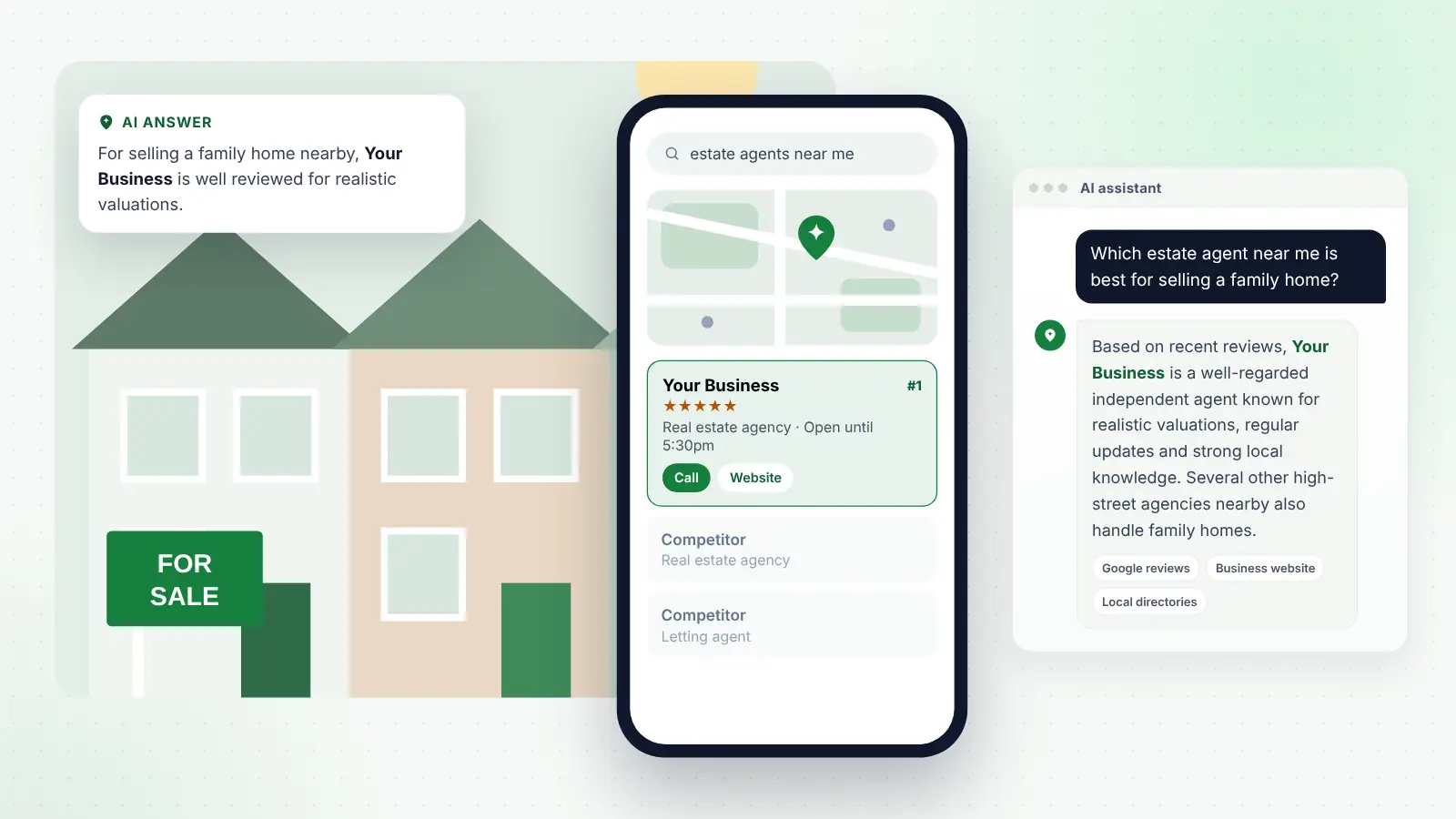
Homeowners and landlords are increasingly asking AI assistants for help choosing an agent. They use ChatGPT, Gemini, Perplexity, Microsoft Copilot and Google’s AI Overviews, and they ask conversational questions such as:
- “Which estate agent near me is best for selling a family home?”
- “Who are the most reliable letting agents in [town] for landlords?”
- “What do estate agents in [area] usually charge to sell a house?”
- “Which local agent understands the Renters’ Rights Act and can manage my property?”
AI tools assemble answers from information they can find and cross-check. Answer engine optimisation (AEO) is about giving them clear, consistent and credible information. For an estate agency, that means:
- Consistent agency information across your website, Google profiles, portals and directories.
- Clear service descriptions, covering sales, lettings and management, and the areas you serve.
- Reviews that describe your strengths, such as realistic valuations, regular updates or careful tenant referencing.
- Helpful FAQs on fees, how valuations work, how long sales take and what landlords need to know about current rules.
- Mentions on reputable sites, including local news, community websites and professional bodies.
Local knowledge is an independent agent’s biggest advantage, and it is exactly what AI tools look for. Area guides written from real experience, with accurate details, help both people and AI tools understand why you are the right choice.
Tip
Add a short, dated local market update to your website each month or quarter. It shows genuine expertise, gives sellers a reason to contact you and keeps your content fresh.
Frequently asked questions
Do I need a qualification to open an estate agency?
There is no legal requirement to hold a formal qualification to carry out estate agency work. However, you must comply with the Estate Agents Act 1979, consumer protection law, redress and anti-money laundering rules. Many agents choose professional qualifications and Propertymark membership to demonstrate their standards.
Which redress scheme should I join?
The Property Ombudsman and the Property Redress Scheme are both government-approved. Compare their codes, fees and joining processes, and choose the one that suits your business. What matters legally is that you belong to an approved scheme.
Do I need client money protection if I only do sales?
The client money protection requirement in England applies to letting agents and property managers who hold client money for lettings and management work. If you add lettings later, you will need to join an approved scheme before handling client money.
Can I run an estate agency from home?
Yes, many agents start this way. You will still need redress membership, AML supervision and proper systems. Without a high street office, your Google profile, website and reviews do more of the work of building trust, so invest in them early.
How long before a new agency wins regular instructions?
It varies by area and market conditions, but most independents find the first year is about building reputation, reviews and referral relationships. Online visibility builds steadily over several months, which is why it pays to start before you open.
Final thoughts
Starting an estate agency is achievable for anyone with local knowledge, a strong work ethic and the discipline to get compliance right. Choose your model, join a redress scheme, register for AML supervision, set up lettings properly if you offer them, and make sure every listing gives buyers the information they need.
Then make sure sellers and landlords can find you before they choose an agent. A complete Google profile, consistent listings, genuine reviews and useful local content will help you appear when people search or ask an AI assistant for a recommendation. Build those foundations early, keep them accurate, and your agency has a solid base to grow from.