Most small business owners have never thought of reviews as a legal matter. Asking a few friends to leave a review when you first open, offering a discount to anyone who posts five stars, or quietly leaving the critical comments off your website can all feel like ordinary marketing. Since 6 April 2025, every one of those can put a business on the wrong side of UK consumer law, as well as breaching the rules of the platforms where the reviews appear.
The rules are not complicated once they are set out plainly, and most of what they require is what a fair-minded business would do anyway. The trouble is that the boundaries are not always where people assume. Some things owners think are banned are allowed, and some things that look harmless are not.
This guide explains what the law says, how it is enforced, how Google’s own review policies add to it, the extra rules some professions face and what to do if a competitor is the one breaking the rules. It finishes with a checklist you can share with staff. It is a general guide, not legal advice; if you are unsure about a specific situation, speak to a solicitor or your trade body.
Key points
- Since 6 April 2025, fake reviews and reviews that hide an incentive have been banned in all circumstances under the Digital Markets, Competition and Consumers Act 2024.
- The Competition and Markets Authority can now enforce consumer law directly and fine businesses up to 10% of global turnover, and the rules apply to businesses of every size.
- Asking customers for honest reviews is fine; paying, rewarding, scripting, gating, swapping or buying reviews is not.
- Undisclosed reviews from staff are a legal risk, and Google treats reviews from staff and close family as a conflict of interest whether disclosed or not.
- Google tightened its policies in April 2026 to cover staff review quotas and requests for reviews that name staff members.
- Solicitors, doctors, dentists and psychotherapists have extra professional rules on confidentiality and testimonials.
In this guide
- What changed on 6 April 2025
- Who enforces the rules and what the penalties are
- What counts as an incentive
- Staff, family, friends and review swaps
- Review gating and suppressing negative reviews
- Reviews you publish yourself
- Google’s review policies, including the 2026 changes
- Extra rules for regulated professions
- If a competitor is posting fake reviews
- How the rules affect your Google Maps visibility
- How compliance connects to AI assistants
- Allowed and not allowed: a checklist
- Frequently asked questions
- Final thoughts
What changed on 6 April 2025
The Digital Markets, Competition and Consumers Act 2024, often shortened to the DMCC Act, rewrote the UK’s consumer protection rules. Part of that rewrite is a list of commercial practices that are treated as unfair in all circumstances, regardless of whether a particular customer was actually misled. From 6 April 2025, that list includes a set of practices relating to consumer reviews.
In broad terms, it is banned to:
- Submit or commission a fake review. A fake review is one that claims to be based on a genuine experience when it is not. This covers both fake positive reviews of your own business and fake negative reviews of someone else’s.
- Submit or commission a concealed incentivised review. This is a review where someone was given something in return for writing it, and that fact is not made clear.
- Publish reviews, or information drawn from them, in a misleading way. For example, hiding genuine negative reviews or showing a star rating that has been inflated.
- Offer services to traders that do any of the above, or that help them do it.
Businesses that publish reviews, including on their own websites, must also take reasonable and proportionate steps to prevent and remove fake and concealed incentivised reviews.
The ban applies whether a review is online or offline, written, spoken in a video or shown as a star rating. It applies to marketing agencies, freelancers and anyone else acting for you, and to you if you hire them. The Competition and Markets Authority’s guidance on fake reviews (CMA208), published on 4 April 2025, sets out how the CMA interprets the rules, with examples.
Who enforces the rules and what the penalties are
Before April 2025, the CMA generally had to go through the courts to enforce consumer law. The DMCC Act gave it the power to investigate, decide whether the law has been broken and impose penalties itself. For breaches of consumer law, the CMA can fine a business up to 10% of its global turnover. There are further fines for breaching undertakings given to the CMA and for failing to cooperate with an investigation. Local Trading Standards services also enforce consumer protection law.
The CMA has been active on reviews since the new rules started:
- In 2025 it secured commitments from Google and Amazon about how they tackle fake reviews. As part of Google’s commitments, UK businesses found to have used fake reviews to boost their ratings can face sanctions on Google, including warning alerts on their profiles.
- It reviewed more than 100 businesses that publish reviews and sent advisory letters to 54 of them, setting out where they needed to improve.
- On 27 March 2026 it announced its first formal investigations into fake and misleading reviews under the new regime, covering five businesses. The issues included whether staff had been asked to write positive reviews, whether customers were offered discounts for five-star reviews without disclosure, and how negative reviews and star ratings were handled. When the CMA updated the case timetables in September 2026, the investigations were still ongoing, with no findings made, and opening an investigation does not mean the CMA has found any wrongdoing.
There is no exemption for small businesses. The CMA’s guidance says that even a small trader publishing only reviews from its own customers is expected to take proportionate steps.
What counts as an incentive
This is where most confusion lies. The law does not ban incentivised reviews outright. It bans incentivised reviews that hide the incentive, and it bans anything that turns a review into something other than the reviewer’s genuine experience.
According to the CMA’s guidance, commissioning a review is not limited to paying money. It can include asking someone to write a review in exchange for:
- Money or commission
- Discounts or vouchers
- Free products, free stays or free services
- Loans or leases on better terms than the public gets
- Invitations to events
Asking a member of staff to write a review of your business also counts as commissioning.
Some examples the CMA gives of commissioning banned reviews are particularly relevant to local businesses: offering a free or discounted product in exchange for a five-star review, posting on social media offering freebies for five-star reviews, and contacting a customer who has left a negative review to offer a refund or gift card if they change it.
Prize draws
The CMA’s guidance says that entering reviewers into a prize draw, where there is no guaranteed benefit, is unlikely to count as commissioning under the law. That does not make prize draws safe on every platform. Google’s policy prohibits incentivised reviews, so a prize draw for Google reviews still risks the reviews being removed.
Disclosure on platforms that allow incentivised reviews
Where a platform permits incentivised reviews, the CMA says they must be clearly identifiable as incentivised to anyone who sees them. Usually that means a prominent label, such as marking the review as an advert, placed where it will be seen and not hidden behind a “learn more” link. The review must still reflect the reviewer’s genuine experience. Where a platform does not allow incentivised reviews at all, as Google does not, submitting one is likely to be misleading in itself.
For most local businesses the practical answer is simple: do not offer anything in return for a review on Google or any platform that bans it, and if you run a programme on a platform that allows it, make sure every review is clearly labelled.
Tip
If you want to put things right for an unhappy customer, make the refund or gesture unconditionally and do not mention the review at all. The moment it depends on the review changing, it becomes an incentive.
Staff, family, friends and review swaps
Staff reviews
The CMA’s guidance treats a review from someone with a financial interest in the business, such as an employee or shareholder, as one where that connection must not be hidden. In practice, an undisclosed staff review of your own business is a clear risk. Google goes further: its policies prohibit content based on a conflict of interest, which includes current or former employment, so staff reviews of their employer are not allowed on Google at all, disclosed or not.
That does not stop staff helping. They can ask customers for reviews, hand out cards with your review link and mention it at the end of an appointment, within the limits Google set in 2026, described below.
Family and friends
A review from a relative or friend is fine under the law if it genuinely reflects their experience as a customer. It becomes a fake review if they have never used the business, and it could be misleading if they are reviewing at your request without the relationship being clear. Google’s conflict of interest rules specifically mention family relationships, so even genuine reviews from close family can be removed.
Review-swap groups
Some social media groups and forums exist so that business owners can review each other’s businesses. These reviews are not based on a genuine experience, and the arrangement is itself an exchange of value, so they are fake reviews by any reasonable reading of the rules. The CMA specifically lists running social media groups to recruit people to post fake or concealed incentivised reviews as an example of a banned service.
Buying reviews
Buying reviews, whether from a website, a freelancer or a so-called reputation agency, is commissioning fake reviews. The CMA’s examples include buying reviews generated by software and an SEO service that promises to improve a rating by generating fake reviews. If a supplier offers to “boost your reviews”, ask exactly how. The legitimate answer involves helping you ask real customers.
Review gating and suppressing negative reviews
Review gating means filtering who gets asked for a public review, typically by sending a satisfaction survey first and only showing the Google link to people who score you highly. Google’s policies say businesses must not discourage or prohibit negative reviews or selectively solicit positive ones. The CMA’s guidance also describes encouraging only satisfied customers to leave reviews as a form of cherry-picking that can make published reviews misleading.
Suppressing negative reviews goes wider than gating. The CMA says businesses should not:
- Threaten legal action or other harm to stop people posting negative reviews.
- Prevent genuine customers from leaving reviews.
- Start and stop review invitations arbitrarily, for example pausing them after a bad week.
- Make an offer to resolve a dispute conditional on the customer not leaving a negative review.
- Edit, withhold or remove genuine negative reviews to limit their impact.
This does not mean you must leave fake or abusive reviews up. Reporting reviews that genuinely break a platform’s rules is legitimate. The line is between removing reviews that are not genuine and hiding reviews that are genuine but unwelcome.
Reviews you publish yourself
If you show reviews or ratings on your own website, in brochures or on social media, you are a publisher of consumer reviews under the law, and the CMA expects you to take proportionate steps so that what you show is not misleading.
In practice, for a small business, that means:
- Do not cherry-pick. Showing a selection of positive quotes presented as typical, while a significant number of negative reviews exist elsewhere, risks misleading customers.
- Keep ratings accurate. If you display your Google star rating, keep it up to date rather than showing a figure from two years ago.
- Do not mix up services. Showing reviews of one service on the page for a different service can mislead.
- Have a simple written policy if you collect reviews directly, saying that fake reviews are not accepted and how incentivised reviews are handled.
- Remember advertising rules too. Testimonials used in ads and marketing must be genuine and should not be presented misleadingly. The Advertising Standards Authority publishes guidance on testimonials and endorsements.
Using a third-party widget to display reviews is generally safer than copying out quotes by hand, as long as it shows the full picture and you are satisfied with the provider’s own checks.
Google’s review policies, including the 2026 changes
Google’s rules for reviews on Maps and Business Profiles sit alongside the law and, in some areas, are stricter. Breaking them can lead to reviews being removed, your profile being restricted from receiving new reviews and, in the UK, a warning on your profile.
The main rules are:
- No fake engagement, including paid reviews, reviews posted from multiple accounts and reviews that do not reflect a genuine experience.
- No incentives, such as payment, discounts or free goods or services, in exchange for a review, or for changing or removing a negative one.
- No conflicts of interest, including reviews from owners, staff, former staff, competitors and close family.
- No discouraging negative reviews or selectively asking happy customers.
- No requiring or pressuring customers to review while they are on your premises.
- No requests for specific content in reviews.
In April 2026, Google added two further points to its review policies. Businesses must not ask staff to solicit a certain number of reviews, which rules out review quotas and targets. And they must not ask staff to solicit reviews that include specific content, including content that identifies a member of staff. That catches the common practice of asking customers to “mention Sarah by name” or running a leaderboard of staff mentions.
What remains allowed is asking every customer, in the same way, for an honest review, without offering anything and without steering what they write.
Extra rules for regulated professions
Some professions have regulators whose rules add to the general law. These are the main points that could be verified at the time of writing; always check your own regulator’s current guidance.
- Solicitors (SRA). The Solicitors Regulation Authority’s guidance on engaging with online reviews encourages firms to invite clients to leave reviews and to respond professionally, but says replies must not disclose confidential or privileged information, and that firms should check whether a review is genuine before treating it as fake. It also says firms should not pressure clients or review sites to remove negative reviews.
- Doctors (GMC). The General Medical Council’s guidance on responding to criticism says that criticism does not remove a doctor’s duty of confidentiality, and that a public response should usually be limited to explaining that duty. Doctors must not give an account of a patient’s care without consent.
- Dentists (GDC). The General Dental Council’s guidance on advertising requires information about dental services to be accurate and not misleading, and its expectations on patient confidentiality apply to public replies as much as anywhere else.
- Psychotherapists (UKCP). The UK Council for Psychotherapy’s Code of Ethics and Professional Practice says registrants must not include testimonials from clients in any advertising. That makes displaying client reviews as marketing on a psychotherapist’s website a particular concern.
Similar caution applies to other health and care professions, accountants, financial advisers and anyone else bound by confidentiality. Write every reply as if you cannot confirm the reviewer is a client.
If a competitor is posting fake reviews
It can be infuriating to see a competitor’s rating climb on reviews you are fairly sure are not genuine, or to receive a cluster of one-star reviews from accounts that have never been near your business. Fake negative reviews are covered by the same ban as fake positive ones.
A measured approach:
- Gather evidence before acting. Screenshot the reviews, note dates and reviewer names, and look for patterns such as many reviews posted in a short period, reviewers who have only ever reviewed one business, or near-identical wording.
- Report the reviews to the platform. Google allows anyone to flag a review that breaks its policies, and business owners can use its review management tools for reviews on their own profile. Choose the most accurate policy reason.
- Stay factual in any public reply. On your own profile, a neutral line such as “We have no record of this visit; please contact us directly” is enough. Do not accuse a named competitor in public.
- Consider the CMA. If you have evidence that a business is systematically using fake reviews, you can send it to the CMA through its general enquiries contact. The CMA does not resolve individual disputes, but information from businesses can inform its work.
- Take advice for serious cases. If fake reviews are causing real financial harm, a solicitor can advise on options such as defamation or malicious falsehood, which are expensive routes and rarely the first step.
Whatever happens, do not respond in kind. Posting negative reviews about a competitor, or boosting your own rating to compensate, would put you in breach of the same rules.
How the rules affect your Google Maps visibility
Reviews are one of the signals Google uses to judge how prominent a business is in local search, alongside how relevant it is to the search and how close it is to the person searching. That is exactly why fake reviews are tempting, and why getting caught is costly.
If Google removes a batch of reviews it believes are fake or incentivised, your review count and possibly your rating drop overnight. If it restricts your profile from receiving new reviews, you lose the steady flow of fresh feedback that keeps you competitive. A warning alert on your profile tells every potential customer, at the moment they are deciding, that something was wrong.
Compliant review habits are therefore not just about avoiding fines. A steady, genuine flow of reviews from every customer, replies to each one and a clean record with Google are what sustain visibility over time. If you want help building that into a wider plan, local SEO and AI search services for small businesses can take on the profile, listings and review process while keeping everything within the rules.
How compliance connects to AI assistants
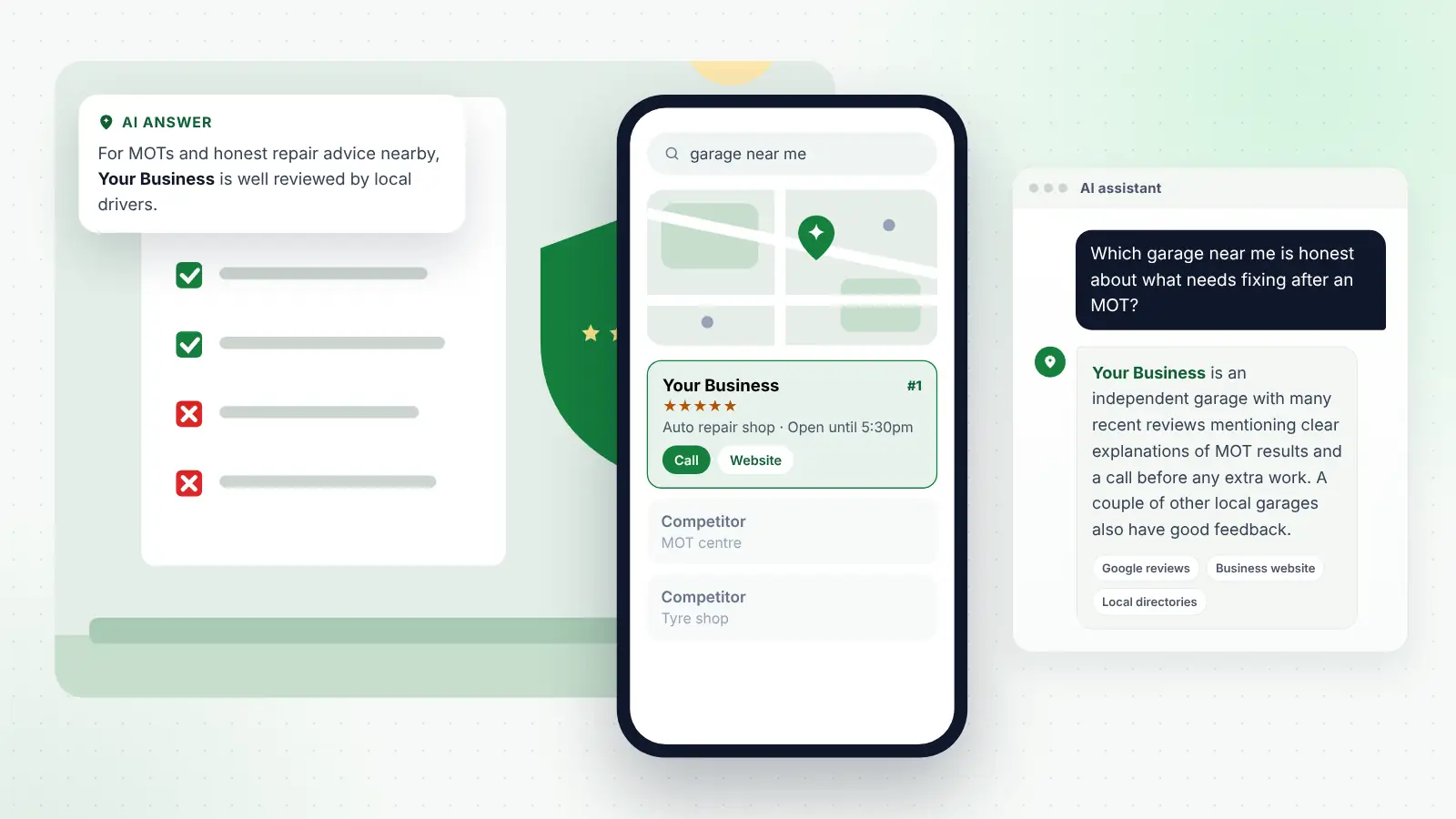
Customers increasingly ask ChatGPT, Gemini, Copilot, Perplexity and Google’s AI Mode for local recommendations, and the answers often summarise what reviewers say. That makes the integrity of your reviews matter in a new way.
The CMA’s guidance itself recognises this. It says that when a publisher removes fake reviews, it should also correct information derived from them, specifically including AI-generated review summaries, as well as review counts and ratings. In other words, regulators already treat AI summaries as part of the review information that must not mislead.
There are practical points too. Fake reviews tend to be vague, which gives an assistant little to work with; genuine reviews tend to mention real services, real staff behaviour and real outcomes, which is what AI descriptions are built from. If fake reviews are later removed, any description that relied on them can change. And clear, honest information elsewhere, such as a pricing page that sets out typical costs or a page explaining how you handle complaints, gives assistants accurate material that does not depend on reviews at all.
Allowed and not allowed: a checklist
Use this table as a quick reference for yourself and your staff. It reflects UK law and Google’s policies as at October 2026; other platforms have their own rules, which you should check.
| Practice | Allowed? | Notes |
|---|---|---|
| Asking every customer for an honest review | Yes | Ask everyone the same way, with a direct link |
| Asking customers to mention a particular service or detail | No | Google says businesses should not request specific content; leave the wording to the customer |
| Offering a discount or freebie for a Google review | No | Banned by Google; unlawful if the incentive is hidden |
| Offering an incentive on a platform that allows it | Only with clear disclosure | Must be prominently labelled and genuine |
| Prize draw for reviews | Risky | The CMA says it is unlikely to count as commissioning, but Google bans incentives |
| Staff reviewing their own employer | No | Conflict of interest on Google; must be disclosed under the law |
| Friends or family who were genuine customers | Take care | Google may remove reviews from close family |
| Review-swap groups with other businesses | No | Fake reviews |
| Buying reviews from any source | No | Fake reviews; agencies offering this are also breaking the law |
| Surveying first and only sending happy customers to Google | No | Review gating |
| Staff review quotas or leaderboards | No | Banned by Google since April 2026 |
| Asking customers to name a staff member | No | Banned by Google since April 2026 |
| Refund on condition the review is changed | No | A form of commissioning |
| Reporting reviews that break platform rules | Yes | Report genuine breaches, not genuine criticism |
| Showing only positive reviews on your website as if typical | No | Misleading publication |
| Replying publicly to reviews | Yes | Protect personal and confidential information |
Frequently asked questions
Do these rules apply to a sole trader or a very small business?
Yes. The DMCC Act rules on reviews apply to traders of every size, and the CMA’s guidance says even small businesses publishing their own customers’ reviews must take proportionate steps. The scale of what is expected is smaller for a small business, but the basic bans apply in full.
Can I still ask customers for reviews in person?
Yes. Asking for an honest review is allowed under the law and by Google. Google says you should not require or pressure customers to leave a review while they are on your premises, so offer a card or send a link they can use later rather than waiting while they do it at the counter.
Is it illegal to ask my staff to collect reviews?
No. Staff can ask customers for reviews. What Google now prohibits is setting staff a target number of reviews or asking them to get reviews that mention particular content, including their own names. Staff writing reviews of the business themselves is a different matter and should be avoided.
What if a past review was incentivised before April 2025?
Platform rules applied before the law changed, and Google may remove incentivised reviews whenever it finds them. If you know some reviews on your profile were obtained with incentives, stop the practice now. If you are unsure whether you need to take any further step, take advice.
Can my marketing agency be responsible instead of me?
Both can be. The law bans offering services that create fake or concealed incentivised reviews, so an agency can be in breach, but a business that commissions or benefits from such reviews is also at risk. Ask any supplier exactly how they generate reviews and keep their answer in writing.
Final thoughts
The UK rules on reviews come down to a simple principle: reviews must reflect real customers’ genuine experiences, and anything that distorts that, whether by paying for praise, hiding criticism or inventing feedback, is now unlawful as well as against platform rules. Within that principle there is plenty of room to build a strong review profile. Ask every customer, make it easy, reply to everyone, fix what customers complain about and keep the record clean.
Share the checklist with anyone in your business who deals with customers or marketing, check your website for cherry-picked testimonials, and review any supplier who handles reviews for you. If you are in a regulated profession, read your regulator’s guidance alongside this. Done properly, compliant reviews are not a constraint on growth but one of the most durable foundations for it.