Tutoring is one of the most accessible businesses to start in the UK. If you know your subject well and can explain it clearly, you can begin with a handful of students, a laptop and a quiet room, and grow into a full diary, a team of tutors or a tuition centre. The work is rewarding too: few things beat seeing a student who was struggling walk out of an exam feeling confident.
It is also a crowded market. Parents can choose from independent tutors, tuition centres, national agencies and online platforms, and they are careful about who they trust with their children. The tutors who build lasting businesses combine good teaching with sensible business habits: clear prices, professional safeguarding, honest communication with parents and a reputation that makes them easy to find and recommend.
This guide covers how to start a tutoring business in the UK, from choosing your model and subjects to DBS checks, pricing, platforms, data protection and using local search and AI search to win students directly.
Key points
- Choose your model early: one-to-one tutoring in person, a tuition centre, online lessons, or a mix, because each has different costs and ways of finding students.
- Specialise by subject, level and exam, such as GCSE maths, A level chemistry or 11+ preparation, because that is how parents search.
- Private tutors are not generally required by law to hold a DBS check, but since January 2026 self-employed tutors in eligible roles can apply for an enhanced check through an umbrella body.
- Set clear prices, lesson terms and a cancellation policy in writing before the first lesson.
- You will be handling personal information about children, so take data protection seriously and check whether you need to pay the ICO’s data protection fee.
- Detailed parent reviews, clear subject pages and a complete Google profile help you win students directly rather than paying platform commission.
In this guide
- Is tutoring right for you?
- Solo tutor, agency or tuition centre?
- Choosing your subjects, levels and exams
- Safeguarding, DBS checks and working with children
- Setting up the business
- Pricing your lessons
- Platforms and agencies or going direct
- Building a reputation parents recommend
- Local SEO for tutors
- AI search: how parents find tutors now
- Frequently asked questions
- Final thoughts
Is tutoring right for you?
Strong subject knowledge is essential, but it is not enough on its own. Good tutors can diagnose why a student is stuck, adapt explanations for different learners, keep a nervous child motivated and communicate clearly with parents. Many successful tutors are qualified teachers, but plenty are not: graduates with a strong subject background, retired professionals and specialists in areas such as music or languages also build good businesses.
Be realistic about the working pattern. Most demand falls after school, in the early evening and at weekends, and it is seasonal. Enquiries tend to rise in September, before mock exams and in the run-up to the summer exam season, while the summer holidays can be quiet unless you offer catch-up or 11+ preparation. Plan your income around those peaks and troughs.
Solo tutor, agency or tuition centre?
There are three main ways to run a tutoring business, and many tutors combine them.
| Model | How it works | Advantages | Things to weigh up |
|---|---|---|---|
| One-to-one in person | You teach at your home or the student’s home | Low costs, personal relationships, premium rates | Travel time, limited hours, your home address |
| Tuition centre | Small groups or one-to-one at dedicated premises | Higher capacity, visible local brand | Rent, staff, more regulation and responsibility |
| Online tutoring | Lessons by video call with a shared whiteboard | No travel, wider reach, flexible scheduling | More competition, stronger tech and safeguarding needs |
One-to-one tutoring
This is where most tutors start. It keeps costs low and lets you charge for your expertise directly. Decide whether you will teach at home, travel to students or both. If you teach at home, think about a quiet, professional space, parking and how parents will drop off and collect. If you travel, build travel time into your prices and limit your area.
Tuition centres
A centre lets you teach more students at once, often in small groups, and employ other tutors. It also adds rent, business rates, insurance, staffing and more formal safeguarding responsibilities. Check with your local council whether the premises have the right planning use before you sign a lease. Tuition that is purely focused on teaching a subject is generally not the kind of provision that needs Ofsted childcare registration, but if you plan to offer care for younger children beyond lessons, such as holiday clubs, check Ofsted’s registration rules first.
Online tutoring
Online lessons remove travel and let you teach students anywhere in the country. You will need a reliable internet connection, a good camera and microphone, a digital whiteboard and a clear policy on recording, cameras and parents being present for younger children. Online tutors still benefit from local visibility, because many parents prefer someone who knows their area’s schools and exams.
Choosing your subjects, levels and exams
Parents rarely search for “a tutor”. They search for a subject and level: “GCSE maths tutor”, “A level biology tutor”, “11+ tutor”, “primary reading tutor” or “dyslexia support”. The more clearly you specialise, the easier you are to find and choose.
Common areas of demand include:
- 11+ and entrance exams. Preparation for grammar school and independent school tests, which vary by area and school. Learn the format used locally.
- GCSE. Especially maths, English, the sciences and languages, where a grade can affect sixth form and college choices.
- A level. More specialist, often commanding higher rates, particularly for maths, the sciences and economics.
- Primary. Reading, writing, phonics, times tables and confidence, often for children who have fallen behind.
- Special educational needs. Tutors with experience of dyslexia, dyscalculia, autism or ADHD are often in high demand.
- Adult learners. Functional skills, GCSE resits, languages and university entrance.
Know the exam boards and specifications you teach, and keep up to date with changes. Parents notice when a tutor understands exactly what their child’s school is teaching.
Tip
Pick two or three subjects and levels where you are genuinely strong and make those the centre of your marketing. A tutor who is clearly the local GCSE and A level chemistry specialist is easier to recommend than one who offers everything.
Safeguarding, DBS checks and working with children
You will be working closely with children and young people, often one to one, so safeguarding is central to your reputation and your students’ safety.
The legal position on DBS checks
In England and Wales, there is no general legal requirement for a self-employed private tutor to hold a DBS check, but many parents expect one and some ask for it before the first lesson. The position on getting one changed in January 2026. Before then, self-employed people could apply for a basic DBS check themselves, but generally needed an organisation to apply for a standard or enhanced check on their behalf.
Since 21 January 2026, self-employed workers and personal employees in eligible paid roles can apply for an enhanced DBS check themselves, including a children’s barred list check where the role qualifies, through a registered DBS umbrella body. The DBS specifically mentions private tutors offering lessons directly to children as people who can benefit. Parents cannot apply for a check on your behalf, so you need to apply yourself. Read the details on GOV.UK’s news story on enhanced DBS checks for self-employed workers, and use the GOV.UK tool to find an umbrella body that accepts self-employed applicants.
If you work for a tuition agency, school or centre, they may arrange your check instead. In Scotland the equivalent is the PVG scheme run by Disclosure Scotland, and in Northern Ireland checks are handled by AccessNI.
The DBS Update Service
DBS certificates do not have an official expiry date, so parents may ask how recent yours is. Subscribing to the DBS Update Service lets parents or organisations check, with your permission, whether anything has changed since your certificate was issued. Mention that you subscribe on your website and profile.
Good safeguarding practice
- Write a simple safeguarding policy and know who to contact locally if you have a concern about a child.
- Consider safeguarding training, even if no one requires it.
- Agree clear rules for online lessons, such as using a parent’s account for younger children and keeping lessons in shared family spaces.
- Keep communication professional and, for younger students, go through parents.
- If you employ other tutors, check their suitability properly and keep records.
Setting up the business
Registering with HMRC
Most tutors start as sole traders, which means registering for Self Assessment with HMRC and keeping records of your income and expenses. As you grow, particularly if you employ tutors or open a centre, you may consider a limited company. An accountant can help you decide what suits you and what expenses you can claim.
Insurance
Public liability insurance is worth having, particularly if you teach in your own home or run a centre. Professional indemnity insurance can protect you if a client claims your advice or teaching caused them a loss. If you employ staff, employers’ liability insurance is generally a legal requirement. Check that your home insurance is not affected if students visit your home.
Data protection
You will hold personal information about children and their families, such as contact details, school reports and notes about learning needs. Under UK data protection law you need to keep it secure, collect only what you need, tell families how you use it and delete it when you no longer need it. Many small businesses that process personal data need to pay a data protection fee to the Information Commissioner’s Office, so use the ICO’s online self-assessment to check whether you do. Ask permission before sharing photos, work samples or reviews that could identify a child.
Terms and conditions
Put your terms in writing before the first lesson. Cover your fees, payment timing, lesson length, cancellation notice, missed lessons, holidays, block bookings and how either side can end the arrangement.
Pricing your lessons
Rates vary widely depending on your area, subject, level, experience and whether you teach in person or online. Before setting prices, look at what established local tutors charge for similar subjects and levels. As a rough guide, specialist exam preparation, A level and SEN tutoring usually command higher rates than primary homework support, and qualified teachers and examiners can often charge more.
When setting your prices, decide on:
- Your standard hourly rate, and whether lesson lengths vary by age.
- Whether you charge differently for online and in-person lessons, and whether travel is included.
- Group rates if you run small classes.
- Block booking or termly payment options.
- A clear cancellation policy, such as charging for lessons cancelled with less than a set amount of notice.
Avoid competing purely on price. Families who choose you for your expertise, reliability and communication tend to stay longer and recommend you to others.
Tip
Send parents a short written update after every few lessons covering what you worked on, what is going well and what comes next. It reassures them they are getting value, and it is one of the most common reasons parents recommend a tutor.
Platforms and agencies or going direct
Online tutoring platforms and agencies can help you find your first students quickly. They handle marketing, matching and sometimes payments and safeguarding checks. In return, they typically take a commission or fee, and they may have rules about taking students outside the platform.
Many tutors use platforms to get started and gradually build direct relationships with families. Going direct means you keep the full fee and control your prices, but you are responsible for finding students yourself. Before joining any platform or agency, read the terms carefully, particularly any restrictions on working directly with families you meet through them.
Building a reputation parents recommend
Tutoring is a word-of-mouth business. Parents talk to each other at the school gate, in local groups and online. A strong reputation comes from:
- Reliability. Turning up on time, every time, and keeping to the lesson plan.
- Clear progress updates. Parents want to know what they are paying for.
- Honesty. Telling a parent what is realistic is better for everyone than over-promising.
- Specialisms. Being known locally for the 11+, a particular GCSE or SEN support.
- Care with claims. If you mention past results, such as grade improvements or exam passes, make sure they are accurate and fairly presented. Advertising must not mislead.
Ask for reviews at natural moments, such as when results come out or when a student moves on, and make it easy with a direct link.
Local SEO for tutors
Most parents start by searching online. Typical searches include “maths tutor near me”, “GCSE English tutor [town]”, “11 plus tutor near me”, “A level chemistry tutor”, “primary tutor near me”, “dyslexia tutor near me” and “tuition centre [area]”. Parents often search on their phones in the evening, and they look closely at reviews and how clearly a tutor explains what they offer.
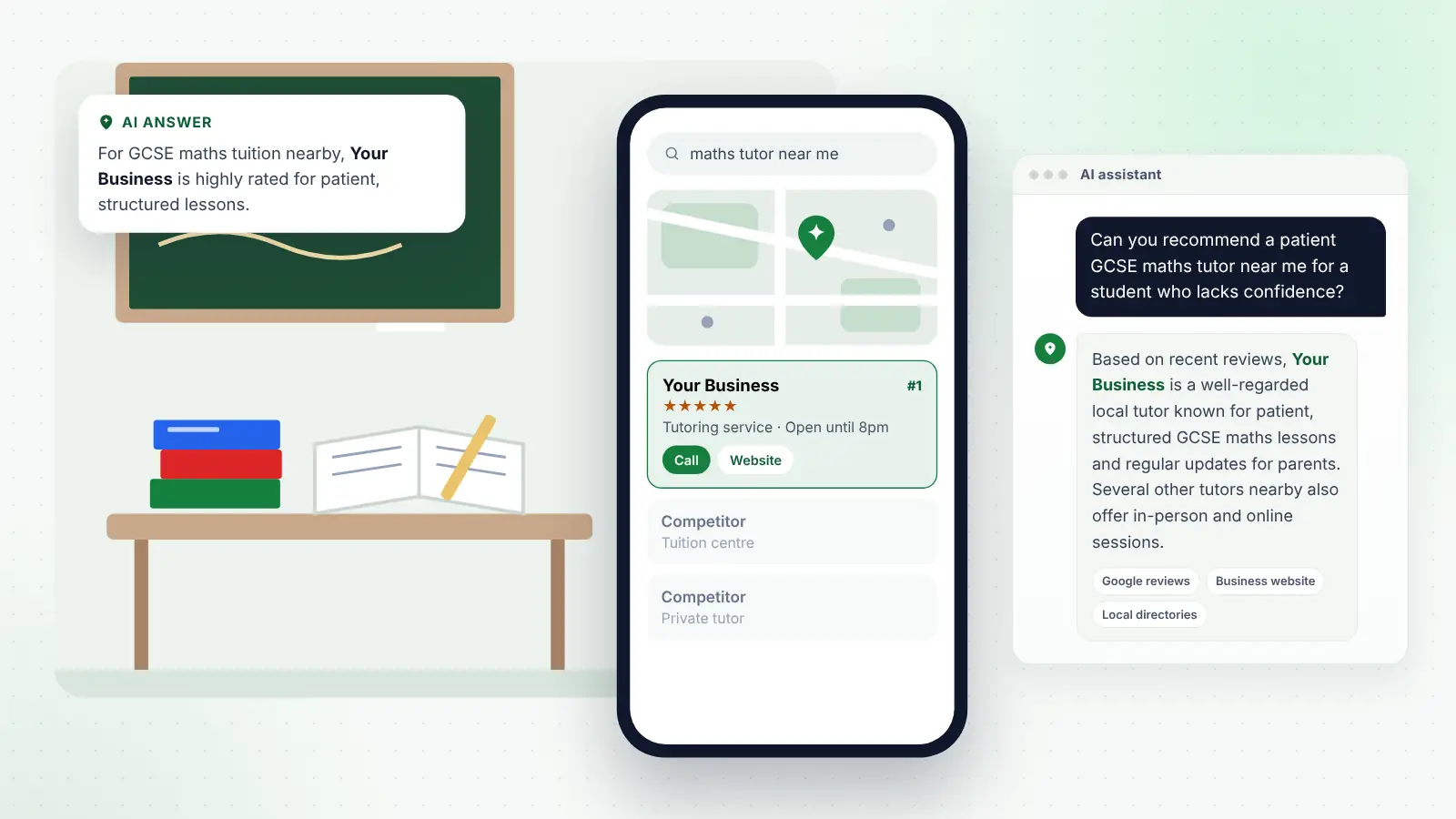
The map results at the top of these searches are valuable because they show nearby tutors and centres with ratings, photos and a call button. National agencies and platforms appear in many searches, but a well-reviewed local tutor with a complete profile can appear among them and win the enquiry directly.
Google Business Profile
If you teach at a centre that students visit, list its address. If you teach in students’ homes or online, set up your profile as a service-area business, hide your home address and list the towns you cover. Choose the most accurate primary category, add your subjects and levels as services, and describe your lesson options clearly. Add photos of your teaching space, resources and yourself. Show the after-school, evening and weekend slots you actually teach, and update them when your timetable changes.
Reviews
Reviews that mention the subject, the level, how the student’s confidence or understanding changed and how you communicated with parents are especially persuasive. Reply to every review politely, and never share details about a student in your reply.
Consistent details
Make sure your business name, phone number, address or service area and website match across your Google profile, tutoring directories, social media and any local listings. Old details from a previous platform or address can confuse parents and search engines alike.
A website with subject and area pages
A simple, fast website should include:
- A page for each main subject and level, such as GCSE maths or 11+ preparation, explaining your approach and the exam boards you know.
- Pages for the main towns or areas you cover, with genuinely local detail, such as the local grammar school tests.
- Clear prices, lesson formats and your cancellation policy.
- Your qualifications, teaching experience and DBS status.
- Helpful guides, such as when to start 11+ preparation or how to revise for a particular exam.
Local links
Links and mentions from local schools’ parent associations, libraries, community groups, local news and parenting sites all help show you are an established local tutor. You can build these yourself over time, or consider local SEO for tutors and tuition centres from a specialist team if you would rather spend your time teaching. Either way, links of this kind take time to count, typically three to six months depending on how many tutors compete nearby.
AI search: how parents find tutors now
More parents and students now ask AI assistants for help, including ChatGPT, Gemini, Perplexity and Microsoft Copilot, and Google often shows an AI Overview above the normal results. They ask questions such as “Can you recommend a good GCSE maths tutor near me?”, “When should my child start 11+ preparation?”, “Is online tutoring as effective as in person?” or “Which tutors near me have experience with dyslexia?”
Before an assistant suggests a tutor, it looks for facts it can find and trust in several places. For tutors, that usually means:
- Consistent information about your name, subjects, levels and area across your website, Google profile and directories.
- Reviews from parents naming the subject, how the student improved and how well you kept them informed.
- Clear service descriptions stating what you teach, to which levels and exam boards, in person or online, and your prices.
- Helpful FAQs that honestly answer parents’ questions about exams, lesson formats and safeguarding.
- Mentions in trusted places, for example local news, school community pages and education directories.
The aim is to make it easy for an AI tool to understand exactly who you help and why parents recommend you. A tutor whose website clearly says “GCSE and A level chemistry tuition, in person in [town] and online”, and whose reviews say the same, is far easier to recommend than one with a vague homepage.
Frequently asked questions
Do I need qualifications to become a tutor?
There is no legal requirement to hold a teaching qualification to work as a private tutor in the UK. Parents, however, look for strong subject knowledge and evidence of teaching ability, so a relevant degree, qualified teacher status or experience as an examiner can all help you stand out.
Do I need a DBS check to tutor children?
It is not generally a legal requirement for a self-employed private tutor, but many parents expect one. Since January 2026, self-employed tutors in eligible roles can apply for an enhanced check themselves through a registered DBS umbrella body, and anyone can apply for a basic check.
How much should I charge for tutoring?
It depends on your subject, level, experience and area. Research what established local tutors charge for similar lessons, and remember that specialist exam preparation and A level tuition usually command higher rates than general homework help.
Should I tutor online or in person?
Both can work well. In-person lessons suit younger children and families who want a local tutor, while online lessons remove travel and widen your reach. Many tutors offer both, which also helps when students move away or have busy schedules.
How quickly will local SEO fill my timetable?
A stronger Google profile and accurate listings can bring the first extra enquiries within weeks, but higher map positions and AI recommendations generally take three to six months, depending on local competition. Starting in the summer helps you be visible for the September rush.
Final thoughts
Starting a tutoring business is straightforward, but building one that lasts takes more than subject knowledge. Choose a clear model and specialism, take safeguarding and data protection seriously, put your prices and terms in writing and keep parents informed about progress.
Then make sure families can find you. Keep your Google profile and website accurate, explain your subjects and levels clearly, collect honest reviews and answer the questions parents are really asking. Do that consistently and your reputation will grow on the map, in AI answers and through the recommendations of the families you already teach.