A pottery wheel taster, a life drawing class, a silver ring workshop or a paint-your-own pottery session all offer something people increasingly want: a few hours away from screens, making something real with their hands. That demand makes a creative studio an appealing business.
It also has more moving parts than it first appears. You will run a timetable of classes, sell gift vouchers months in advance, fire kilns, manage clay dust and glaze materials, host parties and, often, teach children. Each brings its own responsibilities. This guide covers the main steps for the UK, from choosing your offer and premises to kiln safety, COSHH, DBS checks, vouchers, booking terms and getting found on Google and by AI assistants.
In our UK local search study, businesses whose websites scored 80 or more in our checks were named by ChatGPT or Google AI Mode 46% of the time, against 27% for websites scoring under 60 and 19% for businesses with no website.
Key points
- Decide early how you will balance one-off experiences and regular courses, because it shapes your premises, pricing and marketing.
- Kilns need a proper electrical or gas installation, ventilation, safe positioning and an insurer who knows they are there.
- Clay and glazes contain hazardous substances, so a COSHH assessment and good control of silica dust are essential.
- Regular children’s classes are usually regulated activity, which means enhanced DBS checks and a clear safeguarding policy.
- Classes on a specific date are usually exempt from the 14-day cancellation right, so your own booking and voucher terms matter.
- Most new customers search for a class nearby or ask an AI assistant, so photos, reviews and clear class pages make a real difference.
In this guide
- Choose what kind of studio you are building
- Find the right premises
- Kiln safety and insurance
- COSHH, clay dust and materials
- Safeguarding and DBS checks for children’s classes
- Pricing, gift vouchers and booking terms
- Booking systems
- Events, parties and group bookings
- Social media and photo-led marketing
- Getting your studio found by people nearby
- When people ask AI where to try pottery or painting
- Frequently asked questions
- Final thoughts
Choose what kind of studio you are building
Most studios mix several types of booking, but the balance between them affects almost every other decision.
| Type of booking | Typical customers | Things to watch |
|---|---|---|
| Taster sessions | Beginners, couples, gift recipients | High turnover of first-timers |
| Multi-week courses | Local adults building a hobby | Filling a whole course before it starts |
| Parties and group events | Hens, birthdays, teams | Deposits, group sizes and late changes |
| Children’s workshops | Families, schools, holiday clubs | DBS, supervision and consent |
| Paint-your-own pottery | Families and drop-in visitors | Firing backlogs and collection times |
| Studio membership | Experienced makers | Fair sharing of kiln time and shelves |
Tasters and parties usually bring in new customers, while courses and memberships bring repeat income. Many studios use a taster as the first step and then invite happy customers onto a course. The same pattern works for painting, drawing and jewellery making. Remember that teaching beginners is a different skill from making good work, and a calm, encouraging tutor matters more to most customers than an impressive portfolio.
Find the right premises
When you view a unit, check:
- Floor space for wheels, tables or easels, with room to move safely.
- Sinks and drainage, with a clay trap so clay does not go straight down the drain.
- Power supply. Larger electric kilns may need a dedicated or three-phase supply, so ask an electrician before you sign.
- Ventilation for the kiln area and any soldering or solvent work.
- Storage for clay, glazes, work in progress and pieces awaiting collection.
- Lease terms, including whether classes, parties and kilns are allowed, and whether small business rate relief may apply.
Some tutors start in a shared space and pay a nearby studio to fire students’ work. That keeps risk low while you test demand, though it adds delays.
Kiln safety and insurance
A kiln is the heart of most pottery studios and its biggest single hazard. It reaches temperatures high enough to cause serious burns and fires, and it gives off fumes during firing.
- Installation. Have electric kilns connected by a qualified electrician, following the manufacturer’s instructions. Gas kilns should be installed and serviced by a suitably qualified gas engineer.
- Position. Keep the clearances the manufacturer advises, away from combustible materials, walkways and customers.
- Ventilation. The kiln room needs good ventilation, and many studios add a kiln vent or extraction.
- Access. Keep customers, especially children, out of the kiln area.
- Maintenance. Check elements, wiring, shelves and controllers regularly, and keep a firing log.
Businesses with premises also need a fire risk assessment, and the kiln should be central to it. For insurance, look for public liability cover, employer’s liability insurance (usually a legal requirement once you employ staff), equipment and contents cover for kilns and wheels, business interruption cover, and cover for parties, children’s classes and off-site workshops.
Tip
Tell your insurer exactly what kilns you have, where they are and how you use them, and ask about any rules on inspection or unattended firing. It is far easier to meet those requirements from the start than after a claim.
COSHH, clay dust and materials
Clay, glazes and many craft materials fall under the Control of Substances Hazardous to Health Regulations (COSHH). The Health and Safety Executive publishes COSHH guidance for the ceramics industry, including advice sheets on glaze preparation and kiln loading.
Many clays and glaze powders contain crystalline silica. The fine dust is invisible and can reach deep into the lungs, where over time it can cause silicosis, a serious and irreversible disease, and raise the risk of lung cancer. Dried clay on floors, tables and clothing keeps releasing dust long after a class ends. HSE’s guidance points to a few practical habits:
- Never dry sweep or use compressed air on surfaces, clothing or skin.
- Clean with wet methods or a suitable vacuum, with HSE suggesting at least an M-class vacuum for dry dust.
- Wash down work areas regularly, ideally at the end of each day.
- Keep aprons and work clothes in the studio, and wash them regularly.
- Ask people to wash their hands before eating, drinking or leaving.
Glazes can also contain substances such as lead, cobalt or cadmium, which need their own assessment. Mixing glazes from powder creates far more dust than using ready-mixed glazes, so many teaching studios use ready-made glazes for customer classes. Keep safety data sheets for every product. Other crafts have their own hazards, such as soldering and pickling solutions in jewellery making or solvents in painting, so include them in your written assessment. If customers take home mugs or bowls, use glazes the manufacturer describes as suitable for food and drink, and follow their firing instructions.
Safeguarding and DBS checks for children’s classes
Teaching or supervising children counts as regulated activity when it happens frequently, such as weekly, or on more than three days in a 30-day period. People in regulated activity are eligible for an enhanced DBS check with a children’s barred list check. A tutor running a weekly after-school club is likely to qualify; a one-off birthday party may not, though parents will still expect you to take safeguarding seriously.
Since January 2026, self-employed people in eligible paid roles can apply for enhanced checks themselves through a registered DBS umbrella body. The government’s guidance on eligibility for enhanced checks with children explains which roles qualify. Alongside DBS, have a written safeguarding policy with a named lead, clear drop-off and collection procedures, sensible ratios, child-friendly materials and consent forms covering allergies, medical needs and photographs.
Pricing, gift vouchers and booking terms
Work out the true cost of each session, including tutor time, clay, glazes, firing, packaging and the hours spent glazing and firing pieces after the class, then compare with local studios. Prices vary widely by area, length and group size. Be clear about what is included, such as glazing, firing and postage, and how long people will wait for finished pieces.
Gift vouchers
Vouchers are a major source of sales, particularly before Christmas, Valentine’s Day and Mother’s Day. Show what each voucher covers, put a clear expiry date on the voucher and in your terms, make redeeming easy with a code that works in your booking system, and send reminders before vouchers expire. Plan capacity too, because a wave of December vouchers often becomes a rush of bookings in spring. The VAT treatment of vouchers depends on whether they are single-purpose or multi-purpose, so if you are VAT-registered, check with your accountant.
Cancellation and rebooking terms
People who book services online usually have 14 days to cancel under the Consumer Contracts Regulations, but services related to leisure activities on a specific date or within a specific period are exempt. A class or hen party booked for a fixed date will usually fall within that exemption, so your own terms do the work. Explain what happens if a customer cancels, misses a class, wants to move their date or arrives late, and what happens if you cancel. Keep charges fair and in proportion to your actual loss. An open-dated voucher may be treated differently, so take advice if you are unsure.
Tip
For parties, a deposit with the balance due a set number of days before the event is easy to explain. Put the dates, deposit and minimum numbers in the booking confirmation so nobody is surprised.
Booking systems
A good booking system saves hours of admin and lets people book on impulse. Look for live availability, online payments and deposits, gift voucher sales and redemption, automatic reminders with what to wear and where to park, waiting lists and simple reports. Make sure you can link straight to individual classes from your website, Google profile and social media. Your system holds customer data, so publish a privacy notice and check whether you need to pay the data protection fee to the Information Commission.
Events, parties and group bookings
Hen parties, birthdays, baby showers, team-building days and Christmas socials often book well in advance and fill a whole session at once. Package them with a price per person, a minimum group size, what each guest makes and how long it takes, plus a few add-ons such as private hire or postage of finished pieces. Employers often book on weekdays, which helps fill quieter days.
Be careful with drinks. Selling alcohol requires authorisation under the Licensing Act 2003, so if drinks are part of what customers pay for, even within a package, speak to your council’s licensing team first. If guests bring their own, check your lease and insurance and set sensible house rules around wheels and tools.
Social media and photo-led marketing
What you do is visual, which is a real advantage. Show the experience as well as the finished work, share pieces made by beginners so first-timers know what to expect, post class dates with a direct booking link, and use short videos of throwing, glazing and opening the kiln. Get consent before posting photos of customers, and written consent from parents for children.
Social media builds personality, but most people ready to book still search on Google or ask an AI assistant, so link your profiles to a website and Google profile that do the rest.
Getting your studio found by people nearby
Most people want a class they can reach easily, so they search on their phone and choose from the first few studios they see. Common searches include “pottery classes near me”, “pottery wheel experience [town]”, “life drawing class near me”, “paint your own pottery”, “jewellery making workshop”, “pottery hen party” and “kids art club half term”. The map results, with photos, reviews and a booking link, often decide who gets the booking, especially before Christmas and in January.
Build a Google profile that shows the studio
If you have your own studio, list it at that address with the most accurate primary category, such as “Art studio” or “Art school”. If you only teach in hired halls or cafés, Google’s guidelines do not allow a profile for an ongoing class at a venue you do not own or have authority to represent, so focus on your website and listings for now. Add your classes, a booking link and real photos of the studio, tutors and students’ work, with permission.
Collect detailed reviews
Reviews are a strong local signal and one of the first things a nervous beginner reads. Ask customers when they collect their finished pieces, which is when they are happiest, and give them a direct link. Reviews that mention tutors, class types and occasions such as hen parties help you appear for related searches.
Keep details consistent and build a useful website
Use the same name, address, phone number and website on Google, Apple Maps, Bing, social media, booking platforms and experience sites. On your website, create a page for each class, course and party, explaining what happens, who it suits, what to wear, what is included and when pieces are ready, plus tutor profiles, a voucher page and your terms.
Earn local links
Mentions from local news, what’s-on guides, wedding and hen party sites, schools and local arts organisations show search engines your studio is part of the community. Open studios events, exhibitions of students’ work and charity workshops often lead to them naturally.
Fuller midweek classes from search tend to come over two to three months, not overnight. If you would rather spend your time teaching, specialist local SEO for art and pottery classes can look after your profile, listings, content and links.
When people ask AI where to try pottery or painting
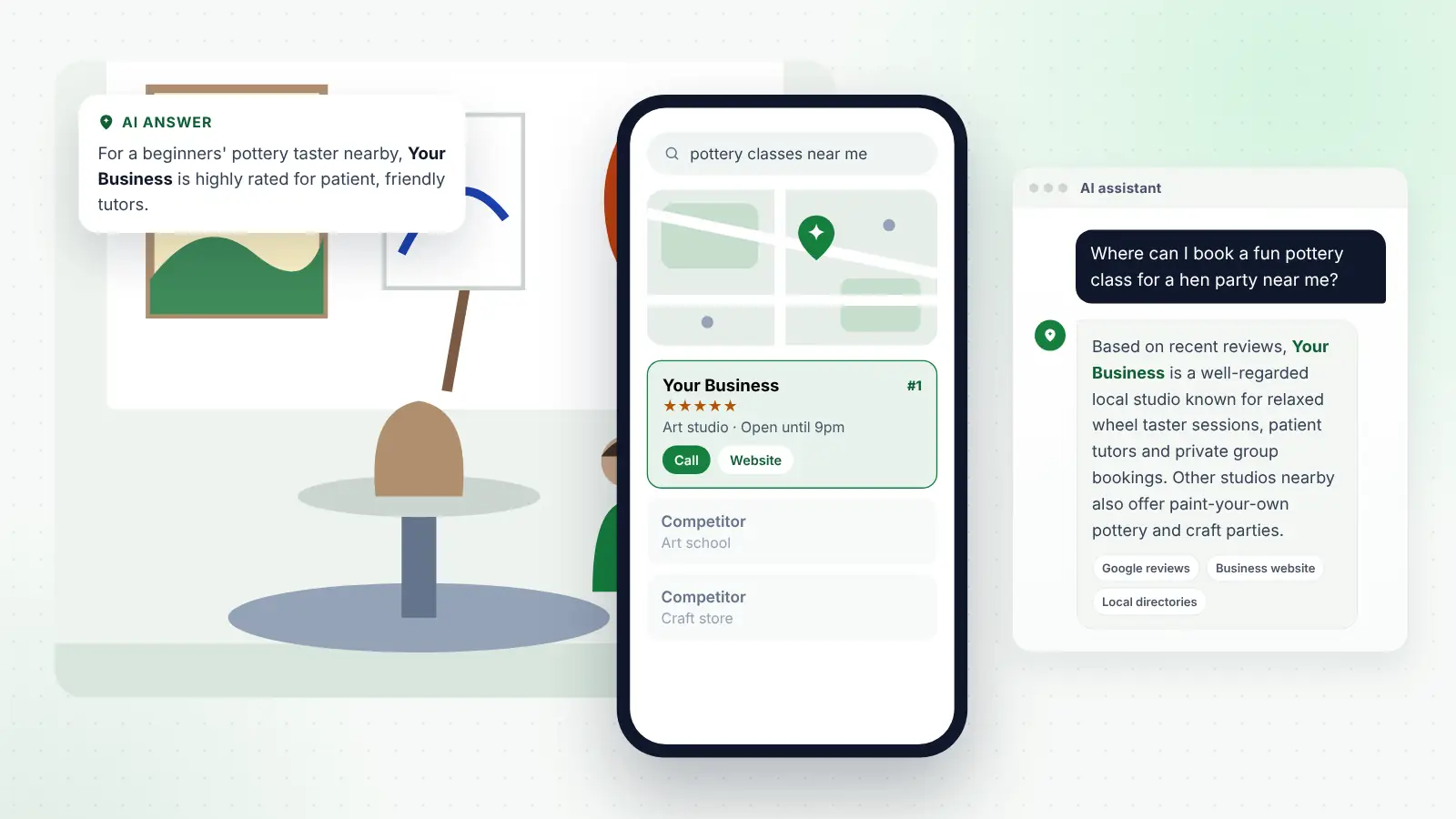
More people now ask AI assistants for ideas. Someone might ask ChatGPT “Where can I book a fun pottery class for a hen party near me?”, ask Gemini for “a beginners’ watercolour course on weekday evenings in [town]”, or ask Perplexity or Copilot for “a kids’ art workshop near me during half term”. Google’s AI Overviews also summarise options for searches like these.
These tools aim to give a specific answer, so they rely on information they can find and check:
- Consistent details across your Google profile, website, booking platforms and directories.
- Reviews that describe the experience, such as “perfect for complete beginners” or “brilliant for our hen party”.
- Clear class descriptions, with level, length, group size and price.
- FAQs about what to wear, how long firing takes, vouchers and cancellations.
- Mentions on reputable sites, such as local news, what’s-on listings and events websites.
Shaping what assistants say about your studio is known as answer engine optimisation (AEO), and detail wins. A studio whose website, profile and reviews all describe small wheel tasters for private groups of up to eight is far more likely to be suggested for a hen party question than one that just says “creative classes for all”.
Frequently asked questions
Do I need a qualification to teach art or pottery classes?
There is no legal requirement for a specific teaching qualification for adult classes. Customers and insurers will want relevant experience, and art, design or adult teaching qualifications can help. First aid training is worth having for every tutor.
Can customers cancel a class they booked online within 14 days?
Usually not, if the class is on a specific date. Leisure services on a specific date or within a specific period are exempt from the 14-day right under the Consumer Contracts Regulations, so your own clear, fair terms apply instead.
Do I need a DBS check to run children’s workshops?
If you teach or supervise children frequently, such as weekly, or on more than three days in a 30-day period, the role is usually regulated activity and eligible for an enhanced check with a children’s barred list check. Self-employed tutors in eligible paid roles can apply through a registered umbrella body.
How do I manage clay dust safely?
Avoid dry sweeping and compressed air, clean with wet methods or a suitable vacuum, wash down surfaces regularly and keep work clothes in the studio. Carry out a COSHH assessment covering clay, glazes and other materials, and follow HSE’s guidance for ceramics.
Final thoughts
Starting an art or pottery studio takes more than a beautiful space and a kiln. Choose the right mix of tasters, courses, parties and children’s workshops, find premises that can support them safely, and put the essentials in place: kiln safety, insurance, COSHH, safeguarding and clear booking and voucher terms. Then make it easy for people to find you, with a strong Google profile, steady reviews, real photos and clear, honest information that search engines and AI assistants can trust.