Most established tutors know the pattern. September brings a rush of enquiries, the diary is full by half term, January brings a second wave after mocks, and by late June half the students have finished their exams and the evenings fall quiet. Then the cycle starts again, with a fresh set of families to find. For a small tuition centre, the same pattern plays out across rooms and tutors, with rent to pay through the gaps.
Getting more students is rarely about volume of advertising. It is about being clearly known for something parents are searching for, planning around the exam year, pricing in a way that keeps students through the quieter months, and building enough trust that families recommend you to each other. Tutoring is a high-trust purchase: a parent is choosing someone to spend time with their child, often one to one, and often at a stressful point in their education.
This guide is for independent tutors and small tuition centres who are already teaching and want a fuller, steadier diary. It covers niches, the teaching year, pricing blocks, online and in-person lessons, the advertising rules on results claims, safeguarding, referrals, VAT basics and how local search and AI search fit in.
Key points
- Parents search by subject, level and exam, so a clear specialism such as 11+, GCSE maths, A level chemistry or SEN support is easier to find and recommend.
- Plan the year around term dates and exam seasons, and fill summer and post-exam gaps with deliberate offers rather than waiting.
- Termly or block pricing, with clear terms, smooths income and keeps students engaged between assessments.
- Results claims in ads and on websites must be accurate and evidenced under the CAP Code; the ASA has upheld a complaint about a tutoring “progress guarantee”.
- Since January 2026, self-employed tutors in eligible roles can apply for an enhanced DBS check through an umbrella body, which is a strong trust signal.
- Private tuition by an individual teacher acting independently can be VAT exempt, but a limited company or tuition centre generally cannot use that exemption, so take advice.
In this guide
- Plan the teaching year, not just the week
- Choose a niche parents actually search for
- Pricing blocks and clear terms
- Online, in person or both
- Results claims: what the advertising rules say
- DBS and safeguarding as trust signals
- Referrals from parents and schools
- VAT on private tuition: the basics
- Local SEO: being found by parents in your area
- AI search: what assistants say when parents ask for a tutor
- Frequently asked questions
- Final thoughts
Plan the teaching year, not just the week
A tutoring business runs on the school calendar. If you plan only week by week, you will always be reacting to the next rush or the next lull. Map out a full year instead, with the periods when demand rises, when students leave and when you need to be marketing.
| Period | What typically happens | What to do |
|---|---|---|
| Late summer | Parents plan for the new school year; 11+ tests approach in many areas | Publish autumn availability, open termly bookings |
| September to October | Main enquiry peak; new GCSE and A level years start | Respond quickly, fill regular slots, start waiting lists |
| November to January | Mock exams; worried parents after results | Offer mock review sessions and targeted short courses |
| February to April | Revision demand builds; Easter is busy for exam years | Run Easter revision groups, book summer term blocks |
| May to June | Exam season; Year 11 and Year 13 students finish | Line up replacements from younger year groups |
| July to August | Quieter, except catch-up and 11+ preparation | Summer courses, next year’s bookings, marketing work |
The biggest single drop for many tutors comes when exam-year students finish in May and June. If a large share of your students are in Year 11 or Year 13, you can lose much of your income in a few weeks. A healthy diary has a mix of year groups, so plan to recruit Year 10 and Year 12 students in spring and Year 5 students for 11+ preparation where it applies locally.
Tip
Look at your current student list by year group. If more than about half will finish exams this summer, start promoting to the year below now, not in September when everyone else does.
Choose a niche parents actually search for
Parents rarely search for “a tutor”. They search for “GCSE maths tutor [town]”, “11 plus tutor near me”, “A level chemistry tutor online” or “dyslexia tutor”. A tutor or centre that is clearly known for two or three specific things is far easier to find and far easier to recommend than one that offers every subject to every age.
11+ and entrance exams
Where grammar schools or selective independent schools exist, 11+ preparation is a strong, predictable niche with a defined calendar. It rewards local knowledge: which tests the local schools use, when registration opens and when tests take place. Families often start well before the test year, so this niche also helps fill the quieter months. Be careful with claims about pass rates, as covered below.
GCSE
GCSE maths, English and the sciences are where most demand sits. Knowing the exam boards your local schools use and the difference between foundation and higher tier matters to parents. Many tutors specialise further, for example in students aiming to secure a grade 4 or 5, or high achievers aiming for grades 8 and 9.
A level
A level tuition is more specialist and often commands higher rates. Students and parents look for detailed specification knowledge, exam technique and, for some, help with university applications and admissions tests in relevant subjects.
SEN and additional needs
Tutors with genuine experience of dyslexia, dyscalculia, autism, ADHD or anxiety are often in high demand. Describe your experience and training accurately, and do not imply qualifications or diagnostic roles you do not have. Parents of children with additional needs often become your most loyal clients and strongest advocates.
Pricing blocks and clear terms
Pay-as-you-go lessons are simple, but they make income unpredictable and make it easy for families to drift away after a good report or a busy fortnight. Many established tutors and centres move to termly or half-termly blocks.
- Termly or half-termly blocks. Families commit to a regular slot for a term, paid in advance or by instalments. This protects your diary and keeps students engaged between assessments.
- Short courses. Mock review weeks, Easter revision groups or summer 11+ courses with a fixed number of sessions and a clear outcome.
- Small groups. For tuition centres in particular, groups of a small, fixed size can make tuition more affordable for families and more efficient for you, while still allowing individual attention.
- Online and in-person rates. Decide whether these differ, and whether travel is included for home visits.
Whatever you choose, put your terms in writing: lesson length, payment dates, the notice needed to cancel a lesson, what happens with missed lessons, holidays and how either side can end the arrangement. Clear terms prevent most disputes with parents, and consumer law expects them to be fair and transparent. Avoid competing purely on price. Families who choose you because you understand their child’s exam and communicate well tend to stay longer and refer others.
Online, in person or both
Online tuition widens your reach and removes travel, but it also puts you into competition with tutors across the country and large national platforms. In-person tuition is limited by geography and evenings, but many parents, especially of younger children, strongly prefer it.
For most established tutors a mix works best: in person for younger students and local families, online for older students, families further away and for continuity when students go away or schedules change. Make each option clear on your website and Google profile. For online lessons, have a written policy covering parental presence for younger children, whether lessons are recorded, how materials are shared and how you communicate between sessions.
Local visibility still matters for online tutors. Many parents prefer someone who knows their child’s school, the local 11+ tests and the exam boards in use nearby, even if lessons take place online.
Results claims: what the advertising rules say
Results are the most persuasive thing you can share, and the area where tutors most often get into trouble. Advertising in the UK, including your website, social media and leaflets, must follow the CAP Code, which is enforced by the Advertising Standards Authority (ASA). The code requires that ads do not mislead, that you hold evidence for objective claims before you make them, and that you do not exaggerate.
In a 2013 ruling, the ASA upheld a complaint against a tutoring franchise that advertised a guarantee of progress for every child, finding that the advertiser could not show any child would progress regardless of ability or circumstances. You can read the ASA ruling on tutoring progress guarantees for the detail.
In practice:
- Avoid guarantees of grades, passes or improvement.
- Only quote results you can evidence, such as records of students’ actual grades, and make clear what the figures cover, for example which year and how many students.
- Do not present your best results as typical, or leave out students who did not achieve their target grade if that changes the picture.
- Be careful with 11+ pass claims. Say how many of your students sat the test and how many passed, rather than a percentage based on a small or selective group.
- Ask permission before naming a student or sharing their results, and never identify a child without clear consent from their parents.
Honest, specific results build more trust than big claims. A sentence such as “last summer, most of my Year 11 maths students achieved their target grade or above” is only safe if it is true and you can show it, but it is far more believable than “guaranteed results”.
DBS and safeguarding as trust signals
There is no general legal requirement in England and Wales for a self-employed private tutor to hold a DBS check, but many parents now expect one and some will not book without it. Since 21 January 2026, self-employed workers in eligible paid roles, including private tutors working directly with children, can apply for an enhanced DBS check with a barred list check where the role qualifies, through a registered DBS umbrella body. If you previously only held a basic check, this is worth doing.
If you run a tuition centre and employ tutors, check their suitability properly, keep records and train them in your safeguarding procedures. In Scotland the equivalent scheme is PVG through Disclosure Scotland, and in Northern Ireland checks are handled by AccessNI.
Make your safeguarding visible:
- State your DBS status on your website and profile, and whether you subscribe to the DBS Update Service.
- Publish a short safeguarding statement and your online lesson policy.
- Mention any safeguarding training you have completed.
- Describe how you communicate with students and parents, especially for under-18s.
These details reassure parents and answer questions before they are asked. They also give search engines and AI assistants clear facts to repeat.
Referrals from parents and schools
Word of mouth is still how many tutors fill most of their places. Parents talk at the school gate, in local groups and online, and a recommendation from a trusted friend often decides the choice.
- Ask at the right time. After good mock results, at the end of a term or when a student finishes exams, ask your parents to recommend you and to leave a review.
- Make sharing easy. A short message parents can forward, with your subjects, levels and how to get in touch.
- Siblings and friends. Families with younger children are a natural source of next year’s students.
- Schools and SENCOs. Some schools keep informal lists of local tutors or are asked by parents for suggestions. Introduce yourself professionally, explain your specialisms and safeguarding, and do not expect referrals straight away.
- Other tutors. Tutors in different subjects often pass enquiries to each other. A trusted network of a few local specialists can be valuable.
Be careful about rewards for referrals. A small thank-you is common, but be transparent, and never offer rewards in exchange for reviews.
VAT on private tuition: the basics
VAT is an area where tutors and small centres often make assumptions, so it is worth understanding the outline and taking professional advice for your situation.
Under UK VAT law, private tuition can be exempt from VAT when it is in a subject ordinarily taught in a school or university and is given by an individual teacher acting independently of an employer. HMRC’s guidance explains this in its VAT education manual on private tuition.
What that means in practice:
- An independent sole trader teaching GCSE maths, for example, may be making exempt supplies.
- HMRC’s guidance says the exemption does not cover tuition supplied by a limited company that employs a teacher, even if the teacher is the company’s only shareholder.
- Tuition centres that employ tutors, and some agency arrangements, may therefore fall outside this exemption, and standard VAT rules may apply once taxable turnover reaches the registration threshold.
- Whether a particular subject counts as “ordinarily taught” in a school or university can need judgement.
If you are thinking of incorporating, opening a centre or taking on tutors, speak to an accountant before you make the change, because the VAT position can affect your prices and your profit.
Local SEO: being found by parents in your area
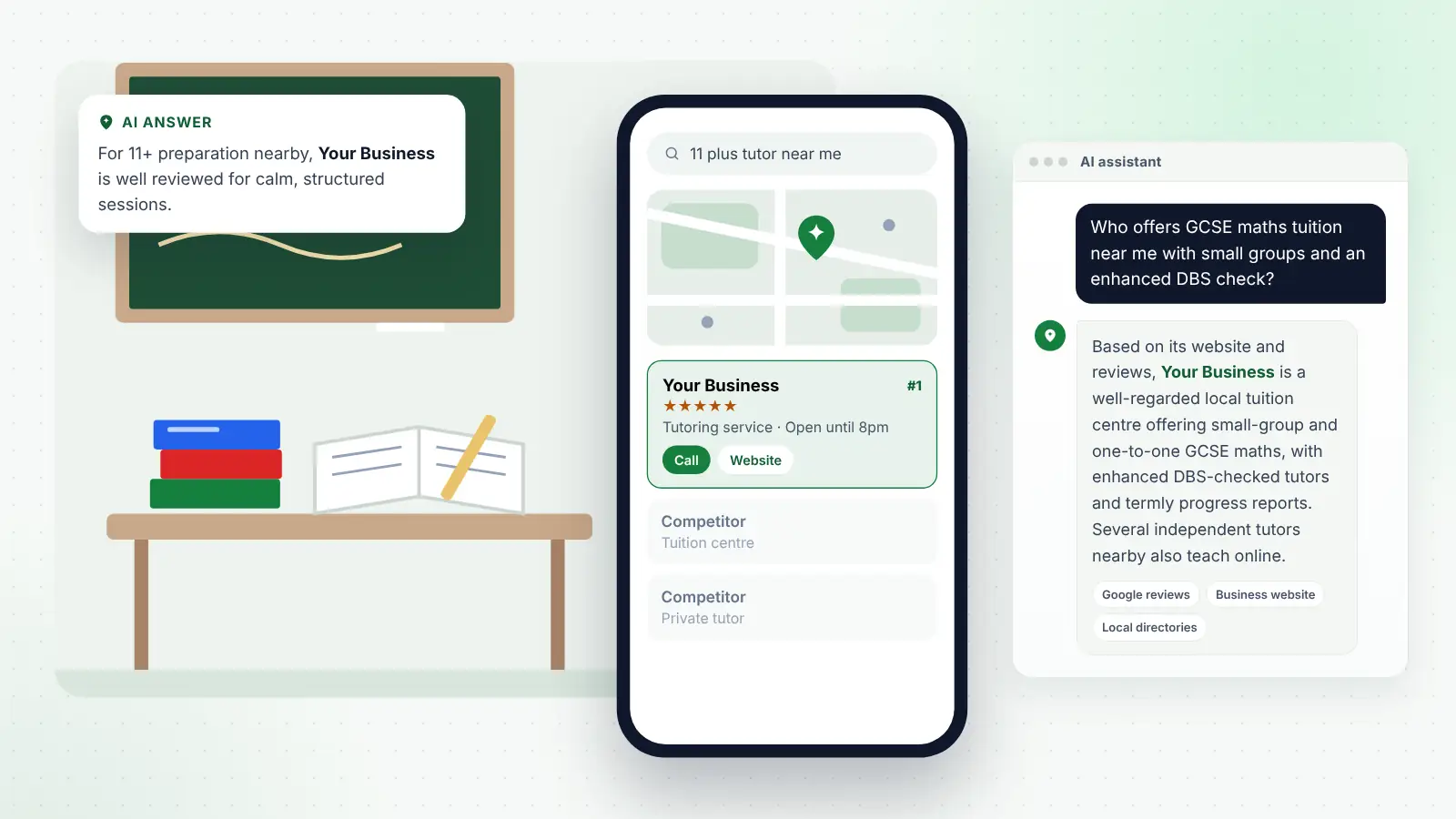
Most parents start by searching on their phone, often in the evening after a worrying parents’ evening or mock result. Typical searches include “maths tutor near me”, “GCSE English tutor [town]”, “11 plus tutor [area]”, “A level chemistry tutor online”, “tuition centre near me”, “dyslexia tutor [town]” and “Easter revision classes GCSE”. The map results at the top of these searches show nearby tutors and centres with ratings, photos and a call button, and they are where many parents make their shortlist.
National platforms and agencies appear in many of these searches, but a well-reviewed local tutor or centre with a complete, specific profile can appear among them and win the enquiry directly, without paying platform commission.
Google Business Profile
If students come to your centre, list its address. If you teach in students’ homes or online, set up as a service-area business, hide your home address and list the areas you cover. Choose the most accurate primary category, add each subject and level as a service and keep your hours accurate, including evenings and weekends. Use posts for seasonal offers, such as mock review sessions, Easter revision groups or summer 11+ courses.
Reviews
Reviews that mention the subject, the level, how the student’s confidence or grades changed and how you kept parents informed are the most persuasive. Ask at natural moments through the year, and reply to every review without sharing any details about a student.
Consistent details
Keep your name, phone number, address or service area and website the same across your Google profile, tutoring directories, social media and local listings. Old details from a previous platform or a former address are a common cause of lost enquiries.
Subject, exam and area pages
- A page for each main subject and level, naming the exam boards you teach.
- A page for 11+ preparation if you offer it, explaining the local tests and your approach.
- Area pages for the towns you serve, with genuinely local detail such as nearby schools and test dates.
- Clear pricing structures, termly blocks and your terms.
- Your qualifications, DBS status and safeguarding statement.
- Seasonal pages for revision courses, updated each year.
Local links
Mentions from school parent associations, libraries, community groups, local news and parenting sites help show you are an established local provider. If you would rather spend your evenings teaching, specialist local SEO for tutors and tuition centres can handle the profile, pages and local links for you. Either way, expect results to build over three to six months, so start before the September and January peaks.
AI search: what assistants say when parents ask for a tutor
More parents and students now ask AI assistants such as ChatGPT, Gemini, Perplexity and Microsoft Copilot for help, and Google often shows an AI Overview above the normal results. The questions are usually specific: “Who is a good 11+ tutor near me who knows the local tests?”, “Is there a GCSE maths tuition centre in [town] with small groups?”, “Which tutors near me have experience with dyslexia?”, “How much does A level tutoring cost?” or “Should my child have online or in-person tuition for GCSE science?”
An AI assistant choosing which tutors to name relies on details it can find and cross-check. For tutors, that typically means:
- Consistent facts about your subjects, levels, exam boards, area and lesson formats across your website, Google profile and directories.
- Reviews that describe the subject, the student’s progress and your communication.
- Clear service pages that say exactly who you teach and how, rather than a general “all subjects, all ages” homepage.
- Honest FAQs about lesson length, termly bookings, safeguarding and online lessons.
- Trust details such as your DBS status and safeguarding statement, stated plainly.
- Mentions on reputable sites, such as local news, community pages and education directories.
Because assistants repeat what they find, accuracy matters. Inflated results claims can be repeated in answers about you, and an outdated page about last year’s courses can confuse parents. Keep seasonal pages current and your claims measured, and the information assistants share about you will be the kind that persuades careful parents.
Tip
Write one detailed page for your strongest niche, such as “11+ preparation in [town]”, covering the local tests, when to start, lesson formats and your terms. It answers parents’ real questions and gives AI assistants a clear, specific description to work from.
Frequently asked questions
How do I fill my diary after exam season?
Recruit from the year groups below your exam students in the spring, and offer summer courses such as 11+ preparation or catch-up for students starting GCSE or A level. Opening next year’s termly bookings in July also helps you start September with a full diary.
Can I say my students get top grades?
Only if it is accurate and you can evidence it, and only if you present it fairly. Avoid guarantees, explain what any figures cover and do not present your best results as typical. The CAP Code applies to your website and social media as well as paid ads.
Do I need an enhanced DBS check as a private tutor?
It is not generally a legal requirement for a self-employed tutor, but many parents expect one. Since January 2026, self-employed tutors in eligible roles can apply for an enhanced check through a registered umbrella body.
Do I need to charge VAT on tutoring?
Tuition by an individual teacher acting independently, in a subject ordinarily taught in schools or universities, can be exempt. A limited company or a centre employing tutors generally cannot use that exemption, so take advice from an accountant before changing your structure.
When will local SEO start bringing in new tutees?
Profile and listing improvements can help within weeks, but stronger visibility and AI recommendations usually build over three to six months. Starting in late spring or summer gives you the best chance of being visible for the September peak.
Final thoughts
An established tutoring business grows most reliably when it is clearly known for something, planned around the school year and trusted by local families. Choose your niche, map your year, use termly blocks and clear terms, and keep a balance of year groups so exam season does not empty your diary.
Then make that reputation easy to find. Be accurate about results, open about safeguarding, specific on your website and profile, and steady about asking for reviews and referrals. Done consistently, those habits bring in the right students each term and keep them for years.