Most dance schools start small. A teacher hires a church hall on a Saturday morning, runs a pre-school ballet class and a tap class, and builds from there. Within a few years, with the right teaching and a good reputation among local parents, that can grow into a full weekly timetable of ballet, tap, jazz, street dance and adult classes, with exams, shows and a loyal following of families.
Running a dance school is rewarding, but it carries more responsibility than many small businesses. You are looking after other people’s children every week, so safeguarding, checks and insurance matter from day one. You also need a timetable that suits families, fees and terms that are fair and clear, and a steady flow of new pupils to replace those who move on.
This guide covers each of those steps for the UK, from teaching qualifications and exam boards to DBS checks, insurance, venues, music licensing, child performance licences for shows and getting found by local families online, including through AI assistants.
Key points
- Dance teaching is not regulated by law, but parents, venues, insurers and exam boards expect a recognised teaching qualification and membership of a body such as the RAD, ISTD, IDTA or BBO.
- Teaching children week in, week out normally counts as regulated activity, so you need an enhanced DBS certificate that includes the children’s barred list, plus a written safeguarding policy and training.
- Insurance is essential, and many dance teaching bodies offer schemes covering public liability, employers’ liability and shows.
- Playing recorded tracks during lessons generally means buying TheMusicLicence from PPL PRS, and children in your shows may need a child performance licence from their local council.
- Many new families search for classes nearby or ask an AI assistant, so a strong Google profile, parent reviews and clear class information make a real difference.
In this guide
- Get a recognised teaching qualification
- Choose your exam board
- Keeping pupils safe: DBS and safeguarding
- Insurance
- Venues: hiring halls or opening a studio
- Build a timetable around families
- Set clear fees and terms
- Music licensing
- Shows, competitions and child performance licences
- Local SEO: getting found by local families
- When parents ask AI for a dance school
- Keep pupils coming back
- Frequently asked questions
- Next steps
Get a recognised teaching qualification
There is no legal licence to teach dance in the UK, but in practice a recognised teaching qualification is what opens doors. Parents increasingly check, venues and insurers often ask, and you cannot enter pupils for graded exams with the main exam boards without the right teaching status.
Most dance teachers qualify through one of the established dance teaching and awarding organisations, usually alongside years of their own training. Teaching qualifications are typically available at different levels, with a Level 4 diploma in dance teaching or dance education being a common benchmark for teaching graded syllabi. Some teachers come through a dance degree or vocational training and then complete an access route with an exam board.
Think about what you want to teach. A classical ballet school built around graded exams needs teachers qualified in that syllabus. A street dance or commercial school may focus less on exams and more on experience, performance and choreography, but parents will still want to know your background and training.
Keep learning
Exam boards expect continuing professional development, and syllabi change over time. Many teachers also add specialist training in pre-school dance, teaching pupils with additional needs, acrobatic arts or adult classes, which can help you fill quieter slots on the timetable.
Choose your exam board
Graded exams give pupils something to work towards, give parents a sense of progress and give your school a clear structure. Many graded dance exams are regulated qualifications, and the main boards in the UK include:
| Exam board | Known for | Things to know |
|---|---|---|
| Royal Academy of Dance (RAD) | Classical ballet | Only RAD Registered Teachers can enter pupils for RAD exams |
| Imperial Society of Teachers of Dancing (ISTD) | Ballet, tap, modern, national and many other faculties | Full teaching membership lets you enter students for ISTD exams |
| International Dance Teachers’ Association (IDTA) | Ballet, tap, freestyle, theatre and ballroom styles | Offers graded exams across a wide range of genres |
| British Ballet Organization (BBO, now known as bbodance) | Ballet, tap, jazz and more | Registered Teachers can enter students and must hold up-to-date enhanced DBS, safeguarding and first aid certificates |
Each board has its own membership routes, fees and requirements, and some recognise qualifications from the others. The Royal Academy of Dance, for example, has a route for teachers who already hold a recognised Level 4 qualification from another awarding society. Check the current requirements directly with each board before you plan your syllabus.
Many schools offer more than one board, such as RAD for ballet and ISTD or IDTA for tap and modern. That works well, but it adds membership costs, more syllabus training and more exam sessions to organise, so start with what you know and expand when demand is there.
Tip
Tell parents clearly which exam board each class follows and whether exams are optional. Many families like exams, but some simply want their child to enjoy dancing, and knowing they have a choice makes them more likely to join.
Keeping pupils safe: DBS and safeguarding
Safeguarding is the most important part of running a dance school, and it is one of the first things careful parents look for.
DBS checks
Teaching or instructing children regularly, such as once a week or more, or on more than three days in any 30-day period, usually counts as regulated activity with children. For people in regulated activity, the employing organisation can request an enhanced DBS check with a check of the children’s barred list. It is against the law to let someone who is barred from working with children carry out regulated activity.
If you are self-employed, the position has recently improved. Since 21 January 2026, self-employed people working in eligible roles with children have been able to apply for an enhanced DBS check themselves through a registered DBS umbrella body. Joining the DBS Update Service within 30 days of your certificate being issued keeps it current and lets venues and organisations you work with check it, with your permission.
If you employ teachers or assistants, you are responsible for checking them. Rules for volunteers changed on 1 September 2026, when the exemption for supervised volunteers was removed, so check the current DBS guidance before parents or older pupils help out with classes or shows.
A written child protection policy and staff training
A DBS check alone is not enough. Most well-run schools have:
- A written safeguarding policy, shared with parents and staff, covering how concerns are reported and handled.
- A designated safeguarding lead, trained to an appropriate level, and safeguarding training for every teacher.
- Clear rules on contact, such as how teachers communicate with pupils, changing arrangements and collection at the end of class.
- A photography and social media policy, with written consent from parents before any images of children are shared.
- Up-to-date first aid training for teachers.
Exam boards often build these into their own membership requirements. The BBO, for example, asks Registered Teachers for an enhanced DBS certificate and recent safeguarding and first aid certificates.
Insurance
Insurance protects you, your pupils and your venues, and most halls and schools will ask to see your certificate before you teach. A policy for a dance school usually includes:
- Public liability insurance, covering injury to pupils, parents or members of the public, or damage to property.
- Professional indemnity insurance, covering claims arising from your teaching or advice.
- Employers’ liability insurance, which the law normally requires from the day you take on paid assistant teachers or other staff.
- Cover for shows and events, which may have limits on audience size, venue type or stage lighting.
- Equipment and contents cover if you own your studio, sound system, costumes or portable flooring.
Several dance teaching bodies offer insurance schemes for members. The ISTD’s scheme, for example, includes public liability, employers’ liability and cover for shows within set conditions. Compare these with specialist policies, and check that every style, venue and activity you run is covered, including shows, competitions and online classes.
Venues: hiring halls or opening a studio
Where you teach shapes your costs, your timetable and how quickly you can grow.
Hiring halls and community spaces
Most new schools start in church halls, community centres, school halls or leisure centres. Costs are lower and you can test demand before committing. The trade-offs are limited availability at peak times, sharing the space with other groups, little storage and floors that may not suit dance.
Your own studio
A studio of your own gives you full control over the timetable, flooring, mirrors, barres and atmosphere, and lets you run more classes each week. The trade-off is a lease, sprung floor and mirror fit-out, business rates and rent due every month, even through the summer holidays. When you look at premises, think about:
- Floor space and ceiling height for the class sizes and styles you teach.
- Flooring. A sprung floor with a suitable dance surface is important for safety, especially for jumps and tap.
- Waiting areas, toilets and changing space, and arrangements for parents at drop-off and collection.
- Soundproofing, particularly for tap and evening classes near homes.
- Drop-off parking for parents, bus routes and step-free entry.
- Planning use and lease terms, and whether any business rates relief may apply.
Get professional advice before signing a lease. Many owners build a full timetable in hired halls before moving into a dedicated studio.
Build a timetable around families
A dance school timetable is driven by the school day. Weekday classes usually run from after school into the early evening, with Saturday mornings often the busiest time of the week.
- Group classes by age and level, such as pre-school, 5–7, 8–11 and teens, then by grade as pupils progress.
- Put younger children first after school and older pupils later in the evening.
- Use daytime and late evening slots for pre-school classes and adult classes.
- Offer back-to-back classes so siblings, or one child doing ballet and tap, can attend in one trip.
- Keep it consistent from term to term, because families plan around your timetable.
Adult classes are often overlooked. Adult ballet, tap, contemporary and commercial classes for beginners and returners can fill evenings once younger pupils have gone home, and adults often become some of your most loyal pupils.
Set clear fees and terms
Fees vary widely by area, class length and style, so research what other schools nearby charge and position yourself honestly. Most schools charge by the term, by the month or in a block of classes, with the option of a trial class first.
Keep your structure simple and write clear terms covering:
- What the fee includes, and the likely extra costs, such as uniform, exam fees, show costumes and tickets.
- Payment dates, how to pay and what happens if payment is late.
- Notice periods and refunds, including for missed classes or illness.
- Discounts, such as for siblings or multiple classes.
- Your uniform requirements, with a clear list for each class so parents are not caught out.
Being upfront about the full cost of a year, including exams and the show, builds trust and avoids difficult conversations later.
Music licensing
If you play recorded music in your classes, you will usually need TheMusicLicence from PPL PRS, which covers playing music in public, including in dance classes. PPL PRS has published guidance for fitness, exercise and dance classes, and it notes that PRS for Music currently has a discretionary policy for some dance tuition that leads to a regulated qualification. Ask PPL PRS how this applies to your classes.
If you teach in a hall or leisure centre, ask whether the venue’s licence covers your classes, because arrangements vary. Online classes and filming classes or shows to share or sell have separate rules, so check the current position before you stream or record anything with music.
Shows, competitions and child performance licences
A show is often the highlight of the dance school year, and it is a powerful way to keep families involved. It also brings rules that many new schools do not expect.
Children taking part in performances may need a child performance licence from the council where each child lives. There are exemptions. Under the “four day rule”, a child who has performed on no more than three days in the previous six months may take part on one more day without a licence, provided they are not paid and do not miss school. Alternatively, the organiser can apply to the council where the performance takes place for a Body of Persons Approval, which covers the performance where no child is paid. Councils usually need several weeks’ notice for these applications.
Chaperone rules also apply. Children in licensed performances must be supervised by a parent or a chaperone approved by the council, and there are limits on how many children each chaperone can look after. Contact your local council’s child employment or entertainment team early in your show planning, and check the venue’s own requirements for insurance, music licensing and safety.
Tip
Ask the council for the area where your show takes place about a Body of Persons Approval as soon as you book the theatre. Leaving it until the costumes are ready is one of the most common show-planning mistakes.
Local SEO: getting found by local families
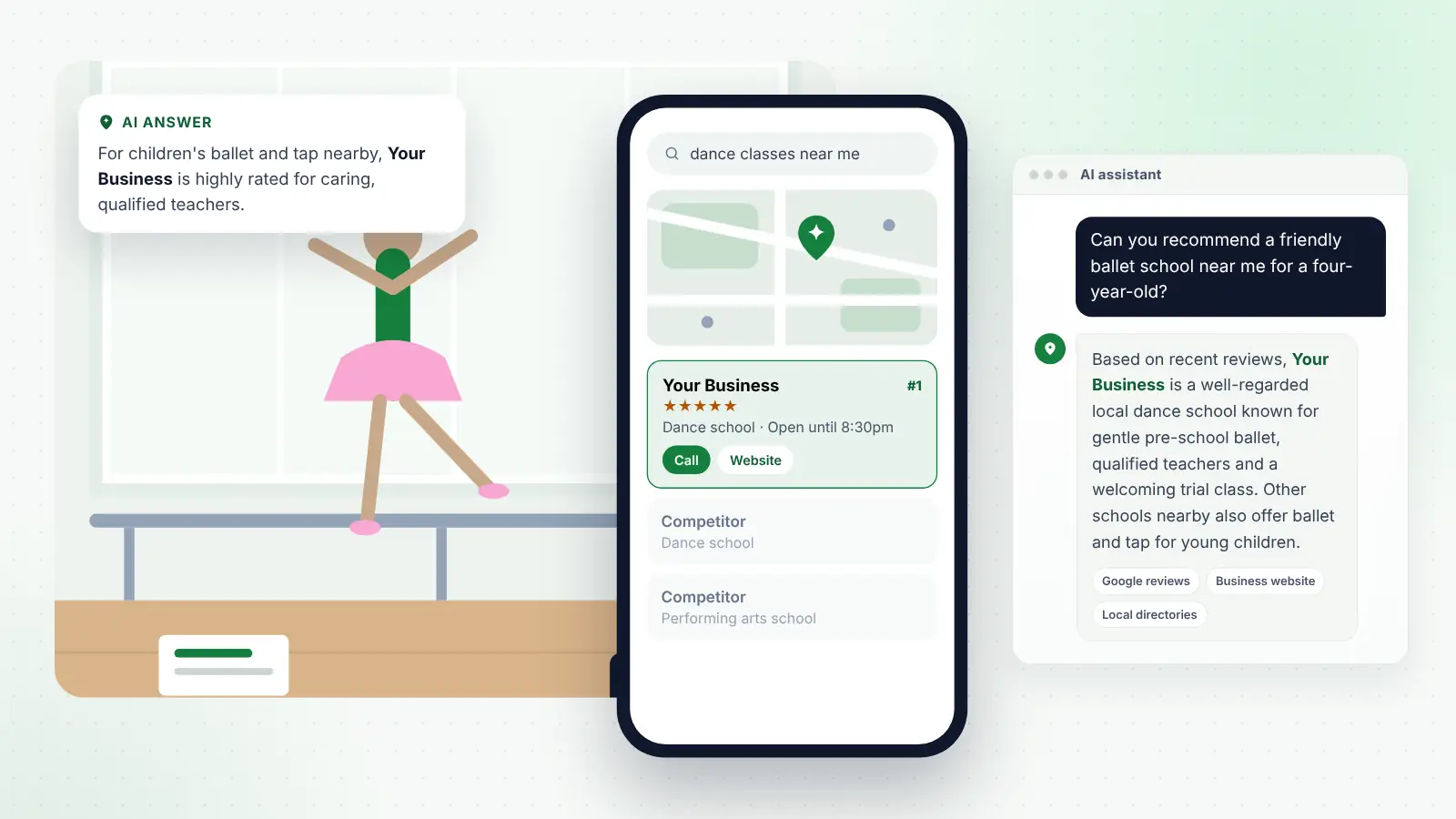
Dance is a local, weekly activity. Parents want a school they can reach easily after school or on a Saturday morning, and adults want a class near home or work. Common searches include “dance classes near me”, “ballet classes for kids [town]”, “toddler ballet near me”, “street dance classes for teenagers”, “adult tap classes” and “RAD ballet school near me”. Local SEO gets your studio in front of those families and adult beginners, and makes it look like a safe, friendly place to dance.
The map results at the top of Google, with photos, reviews, opening times and a link to your timetable, often decide which school gets the trial booking. Being visible there matters most in late summer before the September term, and again in January.
Give your studio a complete Google profile
Where you rent or own a dedicated studio, use that studio’s address on the profile. If you teach in hired halls, be careful: Google’s guidelines say an ongoing class at a location you do not own or have the authority to represent is not eligible for a Business Profile, so check the current guidelines before creating a profile at a venue you do not run, and focus on your website and directory listings until you have premises of your own. Choose an accurate primary category, such as “Dance school”, list the styles and age groups you teach, link to your timetable and trial booking page, and add real photos of your studio and classes, only using images of children with written parental consent.
Collect reviews from parents and adult pupils
Reviews are one of the strongest local search signals and one of the first things a parent reads. Ask families after a show, exam results or a child’s first term, and give them a direct link. Reviews that mention teachers, styles and how a child has grown in confidence help you appear for related searches.
Use identical details on every class listing
Use the same school name, address, phone number and website on Google, Apple Maps, Bing, Facebook, class-booking platforms, family activity directories and your exam board’s teacher listing. Inconsistent details confuse search engines and parents alike.
Build a useful website
Create a page for each main style and age group, explaining what happens in class, who it suits, what to wear and the next step. Add teacher profiles with qualifications and exam board membership, a clear fees page, your safeguarding policy, and a page for new families that answers common questions about trial classes, uniform and exams.
Earn local links
Links and mentions from local nurseries, primary schools, theatres, community festivals, family websites and local news show search engines your school is an active part of the community. Performing at a summer fair or a charity event is a natural way to earn one.
Expect your dance school’s visibility to grow gradually over three to six months, so starting before the September and January rush pays off. If you would rather spend your time teaching, specialist local SEO for dance schools can look after your profile, listings, content and links.
When parents ask AI for a dance school
More parents now ask AI assistants for recommendations. Someone might ask ChatGPT “Can you recommend a friendly ballet school near me for a four-year-old?”, ask Gemini for “street dance classes for a 12-year-old in [town] on Saturdays”, or ask Perplexity or Copilot for “adult beginner tap classes near me”. For lots of these class searches, Google also shows an AI Overview listing nearby studios.
Because AI assistants want to name a specific school with confidence, they lean on facts about your classes that they can verify on several sites. For a dance school, that usually means:
- Matching details for your studio on Google, your website, class-booking apps and family directories.
- Reviews that describe classes, teachers and atmosphere, such as “lovely pre-school ballet” or “great for nervous beginners”.
- Clear class descriptions with styles, ages, levels and days, so the tool can match you to requests like “four-year-old”, “teenagers” or “adult beginners”.
- FAQs that answer real questions about trial classes, uniform, exams, fees and safeguarding.
- Mentions on reputable sites, such as exam board teacher directories, local news, theatre listings and partner pages of schools and nurseries.
Marketers call this AEO, short for answer engine optimisation. Being specific helps most. A school whose website, profile and reviews all clearly describe Saturday morning pre-school ballet with qualified teachers is far more likely to be suggested for that question than one that simply says “classes for all ages”.
Keep pupils coming back
Retention is what makes a dance school sustainable. Families stay when their child is happy, making progress and has something to look forward to. Give every pupil a goal, such as a medal test, a graded exam, a show or moving up to the next class. Keep parents informed with short, regular updates, and make re-enrolment simple before each term ends.
Watch for the points where pupils tend to leave, such as the move to secondary school, exam pressure or a clash with other activities, and offer alternatives like a later class, a different style or a performance troupe. Sibling discounts and adult classes for parents can keep whole families involved for years.
Frequently asked questions
Do I need a qualification to open a dance school?
There is no legal requirement, but parents, venues and insurers expect a recognised dance teaching qualification, and you need the right teaching status to enter pupils for exams with boards such as the RAD, ISTD, IDTA or BBO.
Do dance teachers need a DBS check?
Regular teaching of under-18s is usually regulated activity, which calls for an enhanced DBS check covering the children’s barred list. Self-employed teachers can now apply through a registered umbrella body, and joining the DBS Update Service keeps your certificate current.
Do I need a music licence for dance classes?
Using recorded music for warm-ups, exercises or routines usually requires TheMusicLicence from PPL PRS. If you teach in someone else’s venue, ask whether their licence covers your classes, and check separately before streaming or recording classes with music.
Do children in our show need a performance licence?
They may. Children taking part in performances often need a licence from the council where they live, unless an exemption applies, such as the four day rule or a Body of Persons Approval where no child is paid. Speak to your council early in your show planning.
Should I start in a hall or open my own studio?
Hiring halls keeps costs and risk low while you build a following. A studio of your own gives you control over the floor, timetable and atmosphere, but you need enough regular pupils to cover the rent every month, so many owners wait until their hall classes are consistently full.
Next steps
Starting a dance school is about more than great teaching. Get qualified and join an exam board that suits your styles, put safeguarding, DBS checks and insurance in place before your first class, and build a timetable and fee structure that work for local families. Then plan ahead for music licensing and show licences so the busiest moments of the year run smoothly.
Finally, make sure families searching for a class nearby can find you, understand what you offer and see what other parents say. A strong Google profile, steady reviews and clear, honest information across the web will help both search engines and AI assistants send the right pupils through your door.