Many martial arts schools begin the same way. An experienced black belt starts teaching two evenings a week in a leisure centre or community hall, a handful of students become twenty, a kids’ class fills up, and before long the instructor is looking at industrial units and wondering whether to go full time. Done well, that path can lead to a busy academy with a full timetable, loyal members and a real place in the local community.
It is also a business with more responsibility than most. You teach physical contact skills, often to children, so safeguarding, safe practice and insurance matter from your first session. You need a structure that keeps beginners coming back, membership terms that are fair and clear, and a steady flow of new students to replace the ones who move on.
This guide covers each of those steps for the UK, whether you teach karate, taekwondo, judo, Brazilian jiu-jitsu, kickboxing, Muay Thai or self-defence: qualifications and governing bodies, DBS checks, insurance, venues, pricing, the new subscription rules, music licensing and getting found online, including through AI assistants.
In our latest research on Google Maps and AI search, businesses whose websites scored 80 or more in our checks were named by ChatGPT or Google AI Mode 46% of the time, against 27% for websites scoring under 60 and 19% for businesses with no website.
Key points
- There is no legal licence to teach martial arts in the UK, but parents, venues and insurers expect a recognised grade, coaching qualifications and affiliation to a governing body or association.
- If you teach children regularly, you will usually be in regulated activity, which means an enhanced DBS check with a children’s barred list check, plus safeguarding training, a welfare officer and clear policies.
- Insurance for instructors, clubs and students is essential, and many governing bodies build it into membership.
- If you sell rolling memberships, new subscription contract rules are due to start in January 2027, so review your sign-up process and terms now.
- Most new students search for a class nearby or ask an AI assistant, so a strong Google profile, reviews and clear class information make a real difference.
In this guide
- Get qualified and choose a governing body
- Safeguarding children in your club
- Insurance
- Venues: hiring a hall or opening a dojo
- Build a timetable that works
- Pricing, memberships and the new subscription rules
- Music licensing
- Local SEO: getting found by local families and adults
- Getting suggested when parents ask AI for a club
- Keeping students training past their first grading
- Frequently asked questions
- Next steps
Get qualified and choose a governing body
No law says who can teach martial arts, and that is exactly why credentials matter. Anyone can rent a hall and call themselves a sensei, so careful parents and adult beginners look for evidence that you are properly graded, trained to coach and accountable to someone.
That accountability usually comes from a governing body or association. Several martial arts have national bodies recognised by the sports councils, and many venues, schools and youth organisations will only work with clubs affiliated to a recognised body. Examples include:
| Style | Example body | What affiliation typically involves |
|---|---|---|
| Judo | British Judo | Coach membership, coaching qualifications, DBS, safeguarding and first aid kept up to date |
| Taekwondo | British Taekwondo | Lead coach of at least 1st Dan with coach membership, disclosure check, safeguarding and concussion training |
| Karate | British Karate Federation, home nation bodies and member associations | Membership through an affiliated association, with grading and coaching structures |
| Brazilian jiu-jitsu | UK Brazilian Jiu Jitsu Association | DBS checks and safeguarding training for instructors and staff, plus insurance |
| Kickboxing and Muay Thai | Various national associations | Requirements vary, so compare what each one asks of clubs |
Requirements change, so check directly with the body you plan to join. British Taekwondo’s guide to starting a new club, for example, sets out its coach, safeguarding, welfare officer and insurance requirements in detail.
Coaching qualifications are not the same as a black belt
A high grade shows what you can do. A coaching qualification shows you can teach it safely to other people, including beginners, children and people with injuries or additional needs. Most governing bodies run tiered coaching awards, often starting with an assistant or Level 1 award and building to qualifications that let you run your own club. If you trained in a style without a national body, such as some traditional or hybrid systems, consider recognised generic coaching courses alongside your lineage and grade.
Keep learning
Plan for continuing training: refreshed safeguarding and first aid, concussion awareness, coaching children and teaching people with disabilities. These help you run safer classes and open up new timetable slots, such as adaptive classes or sessions for older adults.
Safeguarding children in your club
Safeguarding is the first thing a careful parent will ask about, and in a contact activity it deserves extra care.
DBS checks
Teaching or coaching children regularly, such as once a week or more, or on more than three days in any 30-day period, usually counts as regulated activity with children. People in regulated activity can have an enhanced DBS check with a check of the children’s barred list, and it is against the law to let someone who is barred from working with children carry out regulated activity. DBS checks cover England and Wales; Scotland uses the PVG scheme through Disclosure Scotland, and Northern Ireland uses AccessNI.
If you are self-employed, applying has become easier. Since 21 January 2026, self-employed people in eligible roles have been able to apply for an enhanced check themselves through a registered umbrella body, rather than needing an employer to do it. Many governing bodies also process checks for their members. Joining the DBS Update Service within 30 days of your certificate being issued keeps it current and lets venues check it with your permission. If you employ instructors or use assistant coaches and volunteers, check the current DBS guidance for each role.
Safeguarding policy and training
A DBS check on its own is not enough. A well-run school usually has:
- A written safeguarding policy, shared with parents and staff, setting out how concerns are reported and handled.
- A club welfare officer, trained in safeguarding and, ideally, not a close relative or partner of the head coach, so parents have an independent person to talk to.
- Clear rules on physical contact, explaining how instructors demonstrate techniques and correct positions, and how partners are matched by age, size and grade.
- Rules on communication and collection, such as no private messaging with children and a clear process at the end of class.
- A photography and social media policy, with written parental consent before any images of children are shared.
- Up-to-date first aid training, a stocked first aid kit and a simple accident book.
Safe practice on the mat
Martial arts carry a higher injury risk than many activities. Write down your approach to warm-ups, sparring and contact levels for each age group, and how you deal with head knocks. Several governing bodies now require concussion training for coaches, which is worth doing even if yours does not.
Tip
Put your safeguarding policy, welfare officer and DBS details on your website, not just in a folder at the club. Parents often decide which school to trial before they ever visit, and visible safeguarding is one of the strongest reasons to choose you.
Insurance
Most halls and leisure centres will want to see your certificate before you teach. Cover for a martial arts school usually includes:
- Public liability insurance, for injury to students, parents or visitors, or damage to property.
- Professional indemnity insurance, for claims arising from your instruction or advice.
- Employers’ liability insurance, which is usually a legal requirement as soon as you employ staff.
- Personal accident or member-to-member cover, which some associations require for students so that injuries during partner training are covered.
- Equipment and contents cover for mats, bags, pads and sound equipment if you own them.
Many governing bodies include instructor insurance in coach membership and student cover in licence fees, but the limits, styles and activities covered vary. Check that sparring, competitions, gradings, holiday camps, self-defence workshops at other venues and online classes are all included.
Venues: hiring a hall or opening a dojo
Hiring halls and leisure centres
Most new schools start in community centres, school halls, church halls or leisure centre studios. It keeps costs low while you build numbers. The downsides are limited peak-time slots, setting up and packing away mats every session, little storage and floors that may not be safe for throws or groundwork without proper matting.
Your own premises
A dedicated dojo or academy, often in an industrial or trade unit, lets you leave mats down, run more classes, add open mat sessions and build a stronger identity. It also brings a lease, fit-out, business rates and fixed monthly costs. When you look at premises, consider:
- Matted area and ceiling height for your styles, class sizes and any throwing or kicking.
- Changing rooms, toilets and a waiting area for parents.
- Noise and neighbours, particularly for bag work and late classes.
- Parking, public transport and step-free access.
- Planning use class and lease terms, and whether any business rates relief may apply.
Take professional advice before signing a lease. Many owners wait until their hall classes are consistently full before taking on a unit.
Build a timetable that works
A martial arts timetable is driven by school hours for children and working hours for adults.
- Group children by age, such as 4–6, 7–10 and 11–15, because coordination, attention span and safe partner work vary so much.
- Run children’s classes after school and on Saturday mornings, with adult classes later in the evening.
- Offer beginner-only sessions or a starter course so new adults are not thrown straight into a mixed class.
- Add lunchtime or early morning classes if you have your own premises and local workers nearby.
- Keep it consistent, because families and adults plan their week around your slots.
Adult classes are often where the most loyal members come from. A clear “complete beginners welcome” message, a women-only class or a fitness-focused kickboxing session can fill quieter evenings.
Pricing, memberships and the new subscription rules
Most schools charge a monthly membership by direct debit, sometimes with a joining fee, and offer a free or low-cost trial. Research what other clubs nearby charge and price for the value you offer, such as class frequency, instructor experience and facilities.
Write clear terms that cover:
- What the membership includes, such as the number of classes per week and which styles.
- Extra costs, including uniform, sparring kit, association licence fees, grading fees and competition entries.
- Minimum terms, notice periods and how to cancel.
- Freezes for injury or holidays, and what happens to missed classes.
- Discounts for families or students.
Subscription contracts from January 2027
New subscription contract rules under the Digital Markets, Competition and Consumers Act 2024 are due to come into force in January 2027. In broad terms, businesses selling rolling or auto-renewing contracts to consumers will need to give clear information before sign-up, send reminders before certain renewals and at the end of free or discounted trials, offer cooling-off rights in more situations and provide a straightforward way to cancel, including online where the contract was taken out online.
A trial that rolls into a paid membership, or a 12-month contract that renews automatically, is exactly the kind of arrangement these rules target. Review your sign-up forms, trial offers and cancellation process now, check what your membership software can do, and take advice on how the detail applies to your school. Unfair or hidden terms already risk breaching consumer law, so simple, fair terms are worth having regardless.
Tip
Make cancelling as easy as joining. A clear notice period and a simple way to leave builds more trust, and more referrals, than a contract people feel trapped in.
Music licensing
If you play recorded music in classes, such as during warm-ups, fitness kickboxing or pad work, you will usually need TheMusicLicence from PPL PRS. Its guidance for fitness, exercise and dance classes explains that instructors running classes in venues such as church halls or community centres need a licence in place. If you hire a leisure centre, ask whether its licence covers your sessions, and contact PPL PRS if you are unsure how it applies to your classes. Traditional classes with no music may not need one.
Local SEO: getting found by local families and adults
Martial arts is a local, weekly habit. Parents want a club they can reach after school, and adults want one near home or work. Common searches include “martial arts near me”, “kids karate classes [town]”, “BJJ near me”, “judo club for children”, “kickboxing classes for beginners” and “self defence classes near me”. Local SEO is about making sure your school appears for those searches and looks like a safe, welcoming choice.
The map results at the top of Google often decide which school gets the trial booking. Being visible there matters most in January, when adults make new year resolutions, and in September, when families sign children up for new activities.
Build a Google profile for your dojo
If you have your own dojo, list it at that address, choose an accurate primary category such as “Martial arts school” and add secondary categories for specific styles where they fit. Be careful if you only hire halls: Google’s business eligibility guidelines say an ongoing class at a location you do not own or have the authority to represent is not eligible for a profile. Until you have premises of your own, focus on your website and listings instead. Add real photos of your mats, instructors and classes, only using images of children with written parental consent, and link to your timetable and trial booking page.
Collect reviews from members and parents
Reviews are one of the strongest local signals and one of the first things a nervous beginner reads. Ask after a grading, a competition or a child’s first few months, and give people a direct link. Reviews that mention instructors, styles and how someone has grown in confidence or fitness help you appear for related searches.
Match your club details on every listing
Use the same name, address, phone number and website on Google, Apple Maps, Bing, Facebook, booking platforms, family activity directories and your governing body’s club finder. Inconsistent details confuse search engines and people alike.
Build a useful website
Create a page for each style and age group, explaining what happens in class, who it suits, what to wear and how to book a trial. Add instructor profiles with grades, coaching qualifications and affiliation, a clear pricing page, your safeguarding policy and a page for beginners that answers common worries, such as fitness levels, contact and sparring.
Earn local links
Mentions from local schools, youth groups, community events, local news and your governing body show search engines your school is an active part of the area. A demonstration at a summer fair or a charity self-defence workshop is a natural way to earn one.
Don’t expect overnight change: for most clubs, stronger local visibility builds over two to three months. If you would rather spend your time on the mat, specialist local SEO for martial arts schools can look after your profile, listings, content and links.
Getting suggested when parents ask AI for a club
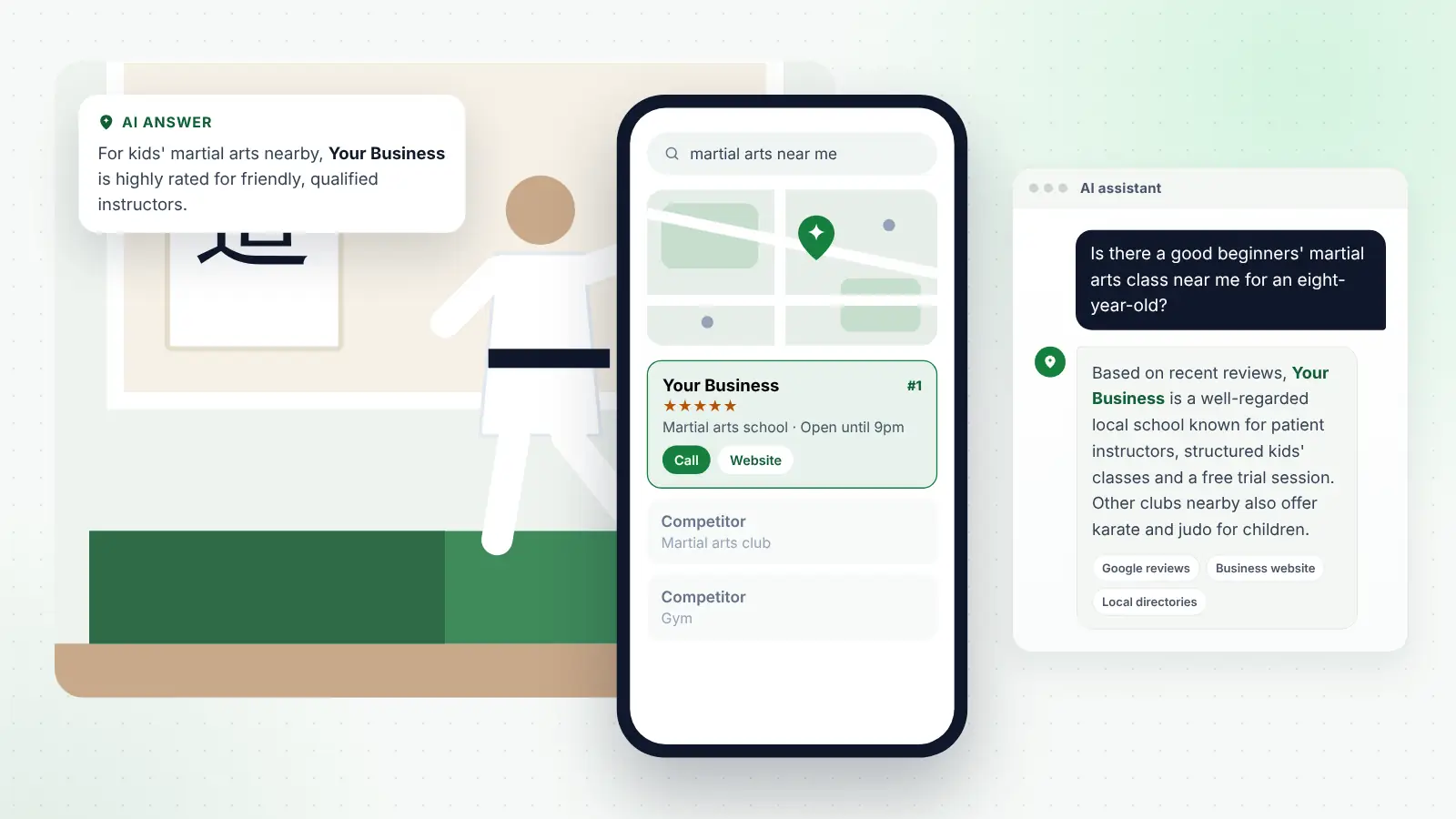
More people now ask AI assistants which club to try. A parent might ask ChatGPT “Is there a good beginners’ martial arts class near me for an eight-year-old?”, an adult might ask Gemini for “BJJ classes for complete beginners in [town]”, or someone might ask Perplexity or Copilot for “women’s self-defence courses near me”. Google’s AI Overviews also summarise local options for many of these searches.
These tools aim to give a specific, confident answer, so they rely on information they can find and cross-check across the web. For a martial arts school, that usually means:
- Matching club details on your Google profile, website, governing body club finder, booking platforms and directories.
- Reviews that describe classes and instructors, such as “brilliant with nervous kids” or “great for older beginners”.
- Clear class descriptions with styles, ages, levels and days, so the tool can match you to requests like “eight-year-old”, “over 40” or “no-gi”.
- FAQs that answer real questions about trials, kit, gradings, contact, pricing and safeguarding.
- Mentions on reputable sites, such as governing body club finders, local news, school newsletters and community event pages.
Making your club easy for these tools to recommend is known as answer engine optimisation (AEO). Being specific helps most. A school whose website, profile and reviews all clearly describe Saturday morning judo for 5 to 8-year-olds with qualified, DBS-checked coaches is far more likely to be suggested for that question than one that simply says “martial arts for all ages”.
Keeping students training past their first grading
Retention is what makes a martial arts school sustainable. The riskiest period is usually the first few months, before a new student feels part of the club. A structured beginners’ course, an instructor who learns their name, a check-in message after their first week and an early goal, such as a first grading or stripe, all help people settle.
For children, regular gradings, progress updates to parents and age-appropriate competitions give them something to aim for. For adults, the people they train with are often what keeps them coming. Watch for the points where students tend to leave, such as moving up from a kids’ class, exam season or an injury, and offer alternatives like a teen class, a membership freeze or a lower-contact session.
Frequently asked questions
Do I need a licence to open a martial arts school?
There is no statutory licence to teach martial arts in the UK. In practice, parents, venues and insurers expect a recognised grade, coaching qualifications and affiliation to a governing body or association, along with DBS checks, safeguarding training, first aid and insurance.
Do martial arts instructors need a DBS check?
Teaching children on a regular basis normally counts as regulated activity, so instructors need an enhanced DBS check that includes the children’s barred list. Self-employed instructors can now apply through a registered body, and many governing bodies arrange checks for members.
Can I run classes in a hall I hire?
Yes, and many schools start that way. Check the venue’s insurance, matting and music licence arrangements. Bear in mind that Google’s guidelines do not usually allow a Business Profile for an ongoing class at a venue you do not run, so your website and listings will do more of the work.
Will the new subscription rules affect my memberships?
If you sell rolling or auto-renewing memberships to consumers, they probably will. The rules are due to start in January 2027 and cover pre-contract information, renewal reminders, cooling-off and cancellation. Review your terms and sign-up process and take advice.
Should I offer a free trial?
Most schools do, because people are nervous about their first class. Keep it simple, explain what to wear and what will happen, and follow up afterwards. If a trial converts automatically into a paid membership, make that clear at sign-up.
Next steps
Starting a martial arts school is about more than great technique. Get your coaching qualifications and affiliation in order, put DBS checks, safeguarding and insurance in place before your first class, and build a timetable and membership structure that are fair, clear and ready for the new subscription rules.
Then make sure people searching for a class nearby can find you, understand what you offer and see what other students and parents say. A strong Google profile, steady reviews and clear, honest information across the web will help both search engines and AI assistants send the right people onto your mats.

