Opening a day nursery is one of the most meaningful businesses you can run. You look after children during the years that shape them most, and you make it possible for their parents to work. It is also one of the most regulated small businesses in England, with rules on staffing, premises, safeguarding, learning and food that you must meet before the first child walks through the door.
Demand has changed in recent years too. The expansion of government-funded childcare means many more families with babies and toddlers are now looking for places, while nurseries face rising staff costs and recruitment challenges. A successful setting needs a realistic business plan, a strong team and a steady flow of families who choose it.
This guide covers the essentials of opening a day nursery in England: registering with Ofsted, meeting the early years foundation stage (EYFS) requirements, staffing and ratios, funded hours, premises and planning, and how to use local search and AI search to fill your places. If you plan to open in Scotland, Wales or Northern Ireland, the rules and regulators are different, which we touch on below.
In our study of 8,320 Google Maps listings, AI tools named 52% of businesses with 300 or more Google reviews, against 26% of those with fewer than 20.
Key points
- Day nurseries in England must register with Ofsted on the Early Years Register before caring for children under five, and must follow the EYFS statutory framework.
- Staff-to-child ratios and qualification rules are set in the EYFS, including the optional 1:5 ratio for two-year-olds introduced in September 2023.
- Since September 2025, eligible working parents can get 30 hours of funded childcare from when their child is nine months old, which has increased demand for baby and toddler places.
- Ofsted now inspects early years settings using report cards with grades for several evaluation areas, introduced from November 2025.
- Premises, planning, food registration and insurance all need sorting well before opening, and Ofsted suggests allowing several months for registration.
- Parents search early and compare carefully, so a complete Google profile, honest reviews and clear information on fees and funding help you fill places.
In this guide
- Is opening a nursery right for you?
- Registering with Ofsted
- The EYFS statutory framework
- Staffing, ratios and qualifications
- Government-funded childcare
- Premises and planning
- Policies, systems and running the setting
- Ofsted inspections and report cards
- Filling your places: what parents look for
- Local SEO for nurseries
- AI search: how parents ask for childcare recommendations
- Frequently asked questions
- Final thoughts
Is opening a nursery right for you?
Before you commit to premises, be clear about what kind of setting you want to run and what role you will play in it. Some owners are experienced early years practitioners who want to manage the nursery themselves. Others come from a business background and employ an experienced, qualified manager. Both can work, but the EYFS sets qualification and experience requirements for the manager, so if you are not suitably qualified you will need to recruit someone who is.
Think about:
- The type of setting. A full day nursery, a sessional pre-school, a nursery attached to a school, or wraparound care such as breakfast and after-school clubs.
- The ages you will care for. Baby rooms need more staff per child and more space for sleep, so they cost more to run, but they are in high demand.
- Opening hours. Many working parents need care from early morning to early evening, all year round.
- Size. A smaller setting is easier to fill and staff, while a larger one spreads fixed costs over more places.
- Your local market. Look at existing nurseries and childminders, their occupancy, their fees and their inspection outcomes. Your local authority’s early years team and family information service can often tell you about local demand.
Registering with Ofsted
In England, if you provide childcare for children from birth to the 31 August after their fifth birthday, you must register on Ofsted’s Early Years Register. If you also care for older children up to their eighth birthday, such as in an after-school club, you will usually need the compulsory part of the Childcare Register as well. Ofsted also has a voluntary part of the Childcare Register for care that does not need to be registered.
Registration involves:
- Applying online. Group providers, such as nurseries, apply using Ofsted’s application process for childcare on non-domestic premises.
- Suitability checks. Ofsted checks the people responsible for the setting, including enhanced DBS checks. These can take several weeks, so start early.
- A registration visit. Where one is needed, an inspector visits to check that you understand and can meet the requirements, and that your premises are suitable.
- Paying fees. There is an application fee, and registered providers pay an annual fee.
Ofsted aims to complete applications for group providers within about 12 weeks of accepting them, and suggests allowing at least four months before your planned opening date. Further checks can take longer, so build in a buffer, particularly if you are aiming to open in time for a September intake. You can find the current details in Ofsted’s early years blog post on applying to register with Ofsted.
Opening a nursery in Scotland, Wales or Northern Ireland
The rules above apply to England. Childcare in Scotland is registered and inspected by the Care Inspectorate, in Wales by Care Inspectorate Wales, and in Northern Ireland by the early years teams of the local health and social care trusts. Each nation has its own standards, staffing rules and funded childcare schemes, so check with the relevant regulator before you plan.
Tip
Have your premises, policies and key staff largely in place before you apply. Inspectors at the registration visit want to see that you understand the requirements in practice, not just on paper.
The EYFS statutory framework
Every registered early years provider in England must follow the statutory framework for the early years foundation stage. There are two versions: one for group and school-based providers, which applies to day nurseries, and one for childminders. Make sure you read the right one.
The framework has two main parts:
- Learning and development requirements, covering the seven areas of learning, the early learning goals and assessment, including the progress check for children aged two.
- Safeguarding and welfare requirements, covering child protection, staff suitability, staff qualifications and ratios, the key person system, health, food and drink, premises, risk assessment, policies and record-keeping.
The framework is updated from time to time, and the version effective from September 2026 brought further changes, including on safer sleep, enhanced checks for volunteers, reporting allegations of harm, and having regard to new guidance on screen use. Always work from the version currently in force on GOV.UK, and check the Department for Education’s Help for early years providers service for practical guidance.
Staffing, ratios and qualifications
Staffing is the biggest cost in any nursery and the area where the rules are most detailed.
Ratios
The EYFS sets minimum staff-to-child ratios for group settings. In outline:
| Age of children | Minimum ratio | Notes |
|---|---|---|
| Under two | 1 adult to 3 children | Additional qualification rules apply in baby rooms |
| Two-year-olds | 1 adult to 5 children | Changed from 1:4 in September 2023 |
| Three and over | 1 adult to 8 children | Can be 1:13 in some circumstances with a suitably qualified graduate or teacher working directly with the children |
These are minimums, and the framework sets conditions on who counts towards ratios. Many settings staff above the minimum, particularly in baby rooms or when children are settling in. The move to 1:5 for two-year-olds is optional, so think carefully about what is right for your children and staff rather than treating it as an automatic saving.
Qualifications and experience
The EYFS requires the manager of a group setting to hold an approved full and relevant level 3 early years qualification and to have suitable experience. It also sets requirements for the proportion of other staff who hold approved qualifications, and for staff working with the youngest children. The Department for Education publishes the early years qualifications list, so check that any qualification you rely on is on it.
Paediatric first aid and safeguarding
At least one person with a current paediatric first aid certificate must be on the premises and available at all times when children are present, and accompany children on outings. Newly qualified staff must also complete paediatric first aid training to count in ratios at level 2 or 3. You need a designated safeguarding lead, clear safeguarding policies and training for all staff.
DBS and suitability
Staff working with children need enhanced DBS checks with a children’s barred list check, and the EYFS sets out the suitability checks and records you must keep. Since September 2026, the EYFS also requires enhanced checks for volunteers, including supervised volunteers, and new employees cannot start work until their check has been received. Build time for checks into your recruitment, because a delayed check means a delayed start date.
Tip
Recruitment is often the hardest part of opening. Start advertising for your manager and room leaders early, and talk to local colleges and apprenticeship providers about trainees.
Government-funded childcare
Funded childcare is now central to most nursery business plans. In England, the main entitlements are:
- Universal 15 hours for all three and four-year-olds.
- 15 hours for some two-year-olds whose families receive certain support.
- 30 hours for eligible working parents, which since September 2025 covers children from nine months old until they start school.
Funded hours are usually based on 38 weeks a year, and many providers offer them stretched across more weeks. Working parents apply through GOV.UK’s Childcare Choices service, receive a code and must reconfirm their eligibility regularly.
Funding is paid by your local authority at its own hourly rates, which vary by area and age group. You will sign a provider agreement with the local authority setting out the rules, including what you can and cannot charge parents for. Additional charges, for example for meals or consumables, must follow Department for Education guidance, so read it carefully and be transparent with parents.
Model your income carefully. Compare the local authority’s funding rates with your own costs per hour, and work out what mix of funded hours, paid hours and optional extras your setting needs to be sustainable.
Premises and planning
Finding the right building is often slower than owners expect. A suitable nursery building needs enough indoor space for the number and ages of children you plan to care for, sleep areas for babies and toddlers, safe outdoor play space, suitable toilets and nappy-changing facilities, a kitchen and secure access.
Planning permission
Day nurseries fall within Use Class E in England, which can make some changes of use simpler, but this depends on the building’s existing lawful use, any conditions attached to it and whether you are making building works. Your local planning authority may also have views on parking, drop-off traffic and noise. Speak to your council’s planning team early, before you sign a lease.
Other permissions and checks
- Building regulations and fire safety. You will need a fire risk assessment, suitable escape routes and appropriate fire safety measures.
- Food registration. If you provide meals or snacks, register with your local council as a food business at least 28 days before you start serving food.
- Insurance. Public liability and employers’ liability insurance are essential, and many nurseries add buildings, contents and business interruption cover.
- Accessibility. Think about access for children, parents and staff with disabilities.
Startup costs at a glance
Costs vary enormously depending on the building, its condition, your area and the size of the setting, so treat the following as categories to budget for rather than figures to rely on.
| Cost area | What it covers | Notes |
|---|---|---|
| Premises | Lease, deposit, legal fees, rates | Rent and rates vary widely by area |
| Refurbishment | Adaptations, toilets, kitchen, flooring | Often the largest upfront cost |
| Equipment | Furniture, cots, toys, outdoor equipment | Buy for durability and safety |
| Registration | Ofsted fees, DBS checks | Allow time as well as money |
| Staffing before opening | Recruitment, training, early salaries | Staff are usually needed before income starts |
| Working capital | Running costs while you fill places | Most settings take time to reach full occupancy |
Policies, systems and running the setting
Before you open you will need a full set of policies and procedures, including safeguarding, behaviour, complaints, health and safety, medicines, accidents, admissions, special educational needs, data protection, mobile phone and camera use, and safer eating.
You will also need systems for:
- Registering children and recording attendance.
- Invoicing parents and claiming funding from your local authority.
- Tracking children’s learning and development, and sharing it with parents.
- Staff rotas that meet ratios across the whole day, including breaks.
- Keeping records securely and in line with data protection law.
Nursery management software can handle much of this, and many systems include a parent app for daily updates and photos.
Ofsted inspections and report cards
Once registered, you will be inspected regularly. From 10 November 2025, Ofsted introduced a new inspection framework for early years settings in England, replacing the single overall grade with a report card. Settings receive a grade on a five-point scale, from exceptional to urgent improvement, for each of several evaluation areas, which include inclusion, curriculum and teaching, achievement, behaviour, attitudes and establishing routines, children’s welfare and well-being, and leadership and governance. Safeguarding sits outside the scale and is recorded simply as met or not met.
For a new setting, the practical message is that inspectors look at the whole experience of children, not just paperwork. Strong leadership, well-trained staff, a thoughtful curriculum and good relationships with parents matter. When you describe your inspection outcome on your website or in marketing, use the current wording accurately and link to the published report.
Filling your places: what parents look for
Parents often start looking for childcare during pregnancy or parental leave, months before they need a place. They typically shortlist a few settings, book show-rounds and compare carefully. Common deciding factors include:
- Location and hours. Close to home, work or the commute, with hours that fit their jobs.
- Warmth and stability of staff. Parents notice whether staff seem happy and whether they have been there long.
- Inspection outcome. Many parents read the Ofsted report before visiting.
- Fees and funding. Clear information on how funded hours work at your setting and what extra costs apply.
- Food, outdoor space and routines. Meals cooked on site, a garden and daily outdoor play are frequent questions.
- Reviews and recommendations. Comments from other local parents carry a lot of weight.
Make booking a show-round easy, follow up promptly and give parents a short pack covering fees, funding, settling in and what to bring.
Local SEO for nurseries
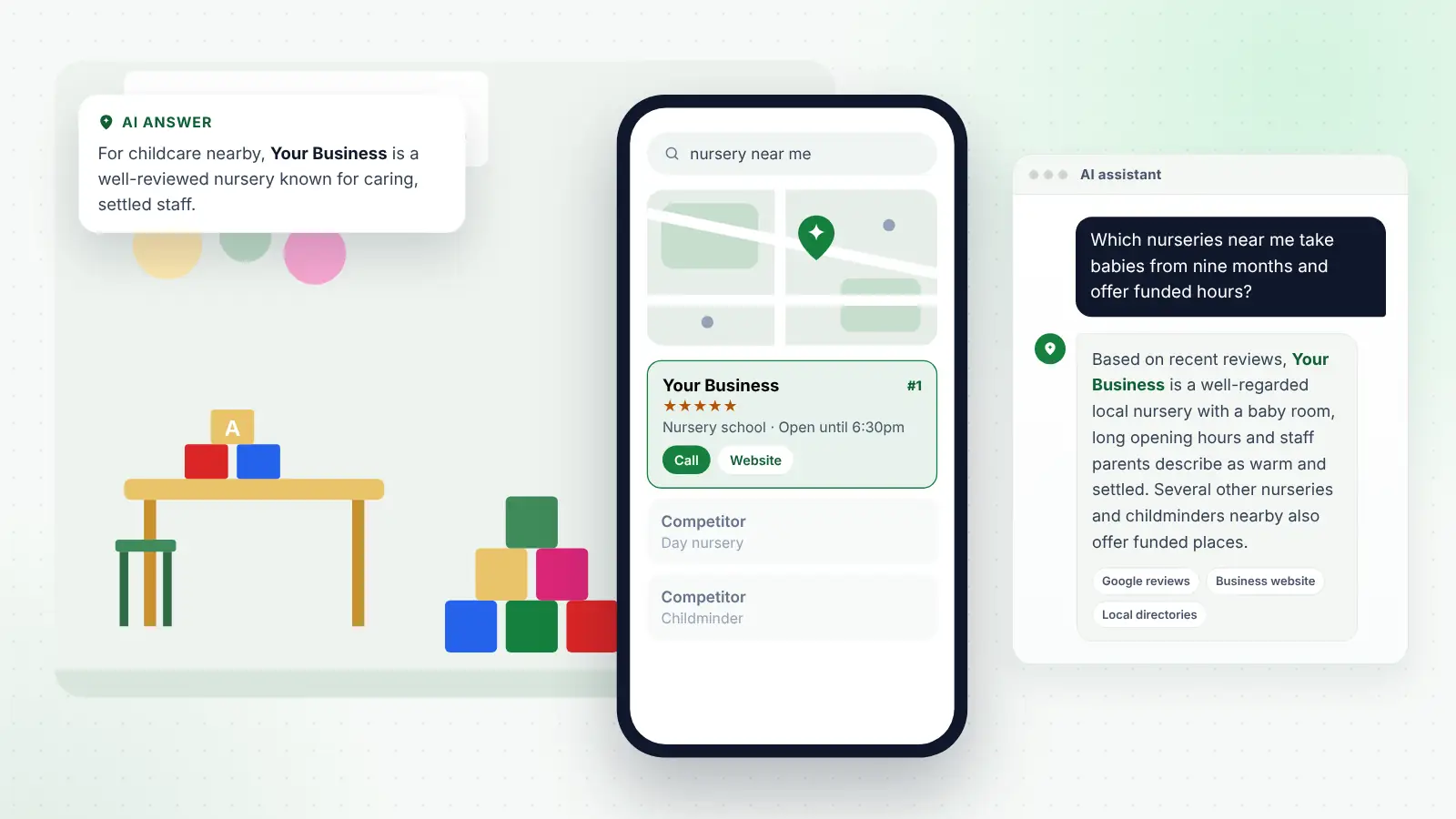
Almost every family looking for childcare searches locally. Typical searches include “nursery near me”, “day nursery [town]”, “nursery for babies near me”, “nursery that takes 30 hours funding”, “pre-school near me”, “nursery open 7.30am” and “after school club [area]”. Parents often search from their phone, and they look closely at the map results, photos and reviews before deciding which settings to visit.
The map pack at the top of these searches is especially valuable because it shows nearby settings with ratings, opening hours and a link to call or visit the website. Larger nursery groups are visible in many areas, but a well-reviewed independent nursery with a complete, accurate profile can appear alongside them.
Google Business Profile
Claim and verify your profile and choose the most accurate primary category. Add your address, phone number, website and accurate opening hours, including any closures for bank holidays. Describe the ages you care for, your rooms, sessions and whether you offer funded places. Add good photos of your rooms, garden and kitchen, without showing children’s faces unless you have clear written consent from parents. Use the booking or appointment link for show-rounds if you can.
Reviews
Ask parents for a review at natural moments, such as after a child has settled in, at a parents’ evening, or when a child leaves for school. Reviews that mention caring staff, communication, food, outdoor play and how happy children are tend to be most helpful for other parents. Reply to every review politely, and never share details about a child or family in a reply.
Consistent details
Make sure your nursery’s name, address, phone number and hours match across your Google profile, website, social media, childcare directories and your local authority’s family information service. Inconsistent details can confuse parents and search engines alike.
A website with clear room and service pages
A helpful nursery website should include:
- A page for each room or age group, describing routines, staff and activities.
- Clear information on fees, funded hours and any additional charges.
- Your Ofsted registration details and a link to your latest report.
- Information about food, outdoor play, settling in and what parents receive each day.
- Pages or sections for any wraparound care, holiday clubs or extra services.
- A simple way to book a show-round or join the waiting list.
Local links
Mentions and links from local schools, family hubs, baby groups, community organisations, local news sites and parenting websites all help show that your setting is established and trusted locally. You can build these yourself over time, or consider specialist SEO for nurseries and childcare settings if you would rather spend your time on the children and your team. Either way, expect results to build over two to three months rather than straight away.
AI search: how parents ask for childcare recommendations
More parents now ask AI assistants for help, including ChatGPT, Gemini, Perplexity and Microsoft Copilot, and Google often shows an AI Overview above its normal results. They ask questions such as “Which nurseries near me take babies from nine months?”, “Is there a nursery with long opening hours near [station]?”, “How do 30 hours of funded childcare work?” or “What should I ask on a nursery show-round?”
An assistant recommending childcare pieces its answer together from details it can find and trust about each setting. For nurseries, that usually means:
- Consistent information about your name, location, ages and hours across your website, Google profile and directories.
- Reviews that describe what parents value, such as staff, communication and children’s happiness.
- Clear descriptions of your rooms, sessions, funded places and fees.
- Helpful FAQs that honestly answer parents’ questions about settling in, funding, food and routines.
- Mentions on reputable sites, such as local news, family hubs, community groups and childcare directories.
The aim is to make it easy for an AI tool to understand who you care for, where you are and why parents recommend you. A nursery whose website clearly says it has a baby room from nine months, opens at 7.30am and offers funded hours, and whose reviews say the same, is far easier to recommend than one with a vague homepage.
Tip
Write a plain-English page explaining how funded hours work at your nursery, with a simple example week. Parents find it genuinely useful, it reduces repeated questions, and it gives AI assistants accurate information to share.
Frequently asked questions
How long does it take to open a day nursery?
It depends mainly on finding and preparing premises, recruiting staff and completing Ofsted registration. Ofsted suggests allowing at least four months for registration alone, and finding and adapting a building can take considerably longer, so many owners plan for a year or more from first idea to opening.
Do I need to be qualified to own a nursery?
You do not need to be qualified yourself to own a nursery, but the EYFS requires the manager of a group setting to hold an approved level 3 qualification and have suitable experience. If you are not qualified, you will need to employ a manager who is, and you will still need to pass Ofsted’s suitability checks as a person responsible for the setting.
Can I open a nursery in my own home?
Most people who care for children in their own home register as childminders, which has its own version of the EYFS and different ratios. A larger setting on domestic premises has additional rules, so check with Ofsted and your local council before you plan.
How does funded childcare affect my income?
Your local authority pays you for funded hours at its own rates, which vary by area and age group. Model these rates against your costs carefully, and make sure any additional charges to parents follow Department for Education guidance and your provider agreement.
How long does local SEO take to fill places?
A better Google profile and cleaner listings can make a difference within weeks, while stronger map positions and AI recommendations generally take two to three months, depending on how many settings compete in your area. Because parents plan early, it pays to start well before you open or before your September places become available.
Final thoughts
Opening a day nursery takes careful planning: a suitable building, Ofsted registration, a qualified and caring team, and a business model that works with funded childcare. Owners who succeed treat the regulations as the foundation of good care rather than a box-ticking exercise, and invest in their staff, because parents choose nurseries for the people in them.
Then make sure families can find you. Keep your Google profile and website accurate, explain your fees and funding clearly, collect honest reviews from parents and answer the questions they are really asking. Do that consistently and your reputation will grow on the map, in AI answers and through the recommendations of the families you already care for.