If you have been fitting kitchens and bathrooms for a few years, you probably have a familiar frustration. You spend an evening on a design visit, measure carefully, send a detailed quote, and then hear nothing. Weeks later you drive past and see another firm’s van outside. The customer did not necessarily choose someone cheaper. Often they chose someone who made the decision feel easier: clearer about what was included, more confident about the timetable, and better at showing what the finished room would look like.
Winning more installations is rarely about lowering your price. It is about removing the reasons a customer hesitates between the design visit and the deposit. That means being clear about what you sell, running consultations that build commitment, taking payments in a way that is fair and legal, managing other trades so the job runs to plan, and building a body of finished work that does the persuading for you.
This guide is written for fitters and small kitchen and bathroom companies that are already trading. It covers the commercial decisions and habits that most affect your conversion rate, along with how customers now find and shortlist fitters on Google and through AI assistants.
Key points
- Decide clearly whether each job is supply-and-fit or fit-only, and price and contract each one differently, because customers compare them in different ways.
- Treat the design consultation as the start of the project, not a free sales visit, and leave the customer with something tangible to keep.
- Contracts agreed in the customer’s home usually carry a 14-day cancellation right; work should not start in that period unless the customer expressly asks in writing.
- Tie staged payments to visible milestones, and explain the schedule before the customer signs.
- Most lost projects go wrong in coordination with other trades and suppliers, so a written programme is a sales tool as well as a management one.
- Photograph and document every finished room, because it feeds your quotes, your Google profile and what AI assistants say about you.
In this guide
- Where good fitters lose projects they should have won
- Supply-and-fit or fit-only: be clear about what you sell
- Running a design consultation that builds commitment
- Showroom, virtual consultation or both
- Deposits, staged payments and cancellation rights
- Project management with other trades
- Warranties, guarantees and aftercare
- Showcasing finished work properly
- Showing up when people search for a new kitchen or bathroom
- AI search: what assistants say when customers compare fitters
- Frequently asked questions
- Next steps
Where good fitters lose projects they should have won
Before changing anything, look honestly at where enquiries drop out. For most established fitters the leaks happen in a few predictable places.
- Slow first response. Customers often contact several firms in one evening. The one that replies first with a clear next step usually gets the first home visit.
- A quote that is hard to compare. A single total with a vague list of inclusions forces the customer to guess what is missing. They often assume the worst.
- No sense of timing. “We are booking about eight weeks out” is far more reassuring than “we will let you know”.
- Silence after the quote. Many customers are waiting for a reason to go ahead. A polite follow-up with a revised layout option or a confirmed start date often provides it.
- Uncertainty about money. When a customer does not understand when they will be asked to pay, or how much, they delay.
- Nothing to look at. Customers who cannot picture the finished room, or cannot see examples of similar rooms you have fitted, hesitate longer.
Keep a simple record for a few months: enquiry date, source, whether you visited, quote value, outcome and, if lost, the reason given. Even twenty or thirty entries will show you which of these points is costing you most.
Supply-and-fit or fit-only: be clear about what you sell
Most established fitters do both, but many present them in the same way. Customers do not see them as the same purchase, and treating them identically costs you work on both sides.
| Fit-only | Supply-and-fit | |
|---|---|---|
| What the customer is buying | Your labour and skill | A finished room, including products |
| How they compare you | Day rate or fixed fitting price against other fitters | Total project cost against retailers and other installers |
| Main customer worry | Will you fit someone else’s products properly | Will the products and the fitting both be right |
| Your main risk | Missing or damaged parts from the retailer delaying the job | Ordering errors, supplier delays, price changes |
| Who handles faulty products | Usually the retailer the customer bought from | Usually you, as the supplier |
| What wins the job | A clear fixed price, a firm start date, a survey that spots problems in advance | Design quality, product knowledge, a single point of responsibility |
Winning more fit-only work
Fit-only customers have often bought, or are about to buy, from a large retailer or an online supplier. Their concern is whether you will take responsibility when things do not line up. Win them by being specific: survey before you quote, check the plan they have been given against the room, flag anything the retailer’s plan has missed (such as filler panels, pipe positions or extraction routes), and say exactly what happens if parts arrive damaged or short. A short written note on “what we need from you before we start” prevents most fit-only disputes.
Winning more supply-and-fit work
Supply-and-fit customers are buying an outcome. They want one person responsible for the whole room. Lead with that. Explain which suppliers you use and why, what you check when deliveries arrive, and what happens if something is faulty. Under the Consumer Rights Act 2015, goods you supply must be of satisfactory quality and as described, and your services must be carried out with reasonable care and skill, so as the supplier you are the customer’s first point of contact if something goes wrong. Many customers see that single point of responsibility as worth paying for, but only if you tell them about it.
Tip
Give fit-only and supply-and-fit quotes their own templates. A fit-only quote should list exactly what is and is not included in your fitting price; a supply-and-fit quote should show the product specification line by line so the customer can see the value.
Running a design consultation that builds commitment
The design consultation is where most projects are won or lost. Treat it as the first stage of the job.
Before the visit
- Ask a few questions by phone or form: which room, rough budget range, timing, whether they want fit-only or a full design, and any photos of the existing room.
- Send a short confirmation with your name, the time, roughly how long you will stay and what you will do. It sets the tone that you are organised.
- Bring sample doors, worktop offcuts or tile samples relevant to what they have told you.
During the visit
- Listen first. Ask how they use the room, what annoys them about it now and who uses it. Customers remember the fitter who understood that the toilet position matters because of an elderly parent, or that the kitchen needs room for two cooks.
- Measure and inspect properly. Check walls for square, floors for level, the position of soil pipes and services, the condition of plaster and what is under old tiles if you can see it. Explain anything that might add cost now, not after they sign.
- Talk through the process. Walk them through the stages from strip-out to handover, how long they will be without the room and what you can do to reduce disruption.
- Agree what happens next. Say when the design and quote will arrive, and in what form.
After the visit
Send the quote when you said you would. Include a layout drawing or a 3D render where you can, a clear specification and a programme. A week or so later, follow up with something useful rather than “just checking in”: an alternative layout, an answer to a question they raised, or confirmation that you can hold a start date.
Some firms charge a design fee for detailed design work and deduct it from the project price if the customer goes ahead. That can filter out customers collecting free designs to take elsewhere. If you do this, state it before the visit, put the terms in writing and remember that consumer cancellation rules may still apply to the design service itself.
Showroom, virtual consultation or both
Customers want to see and touch what they are buying, but that does not mean you need your own showroom.
Your own showroom
A showroom gives you a permanent place to meet customers, show displays and build credibility, but it brings rent, rates, staffing and the cost of keeping displays current. It works best when you have enough supply-and-fit volume to justify it and a location customers can easily reach.
Supplier showrooms and trade counters
Many manufacturers and distributors have showrooms or display areas that trade customers can use. Arranging to meet the customer there, with the products you intend to supply on display, gives many of the benefits without the overheads. Check what your suppliers offer.
Virtual consultations and design tools
A video call is a sensible first step for customers who want an idea of cost and options before inviting you round. Share your screen with a few relevant past projects, discuss the layout using their photos and agree whether a home visit makes sense. Design software that produces 3D renders lets customers see the finished room before committing, which is often the point where they decide.
Your finished rooms
Some of your most persuasive “showrooms” are past customers who are happy to show their room or speak to someone considering you. Only ask customers who have offered, keep it occasional and never share their details without permission.
Deposits, staged payments and cancellation rights
Money is one of the main reasons customers delay, and it is also where many fitters get the law wrong. Get this right and it becomes a reason to choose you.
Cancellation rights on off-premises contracts
If you agree a contract with a consumer away from your business premises, such as at their kitchen table after a design visit, it is usually an off-premises contract under the Consumer Contracts (Information, Cancellation and Additional Charges) Regulations 2013. The key points are:
- For a services contract, the customer generally has 14 days from the date the contract is made to cancel.
- You must give them clear information about that right, with a cancellation form. Failing to give this information for an off-premises contract can be a criminal offence.
- If you do not provide the information, the cancellation period is extended, by up to 12 months.
- You should not start work during the 14 days unless the customer expressly requests it. For off-premises contracts, that request must be made on a durable medium, such as a signed form or an email.
- If they asked you to start early and then cancel, they pay a proportionate amount for what has been supplied up to that point. If you did not give the right information, they may owe nothing for that work.
Goods made to the customer’s specifications or clearly personalised are an exception to the right to cancel, which can be relevant to bespoke furniture or cut-to-size worktops. Most kitchen and bathroom contracts combine goods and services, so how the rules apply to your particular contracts is worth checking with a solicitor or your trade association. Do not assume that “made to order” protects a whole contract.
Building a fair payment schedule
There is no single legal rule on how much deposit you can take, but customers increasingly compare payment terms and are wary of large upfront payments. A schedule tied to visible milestones is easier to accept than one tied to dates. A supply-and-fit kitchen schedule might, for example, look like this:
| Stage | What the customer can see | What the payment covers |
|---|---|---|
| Contract signed and cancellation period ended | Final design and specification agreed | Commitment and design work |
| Products ordered | Order confirmation from the supplier | A share of product costs |
| Products delivered and checked | Units and materials on site or in storage | The balance of product costs |
| First fix and installation complete | Units fitted, services in place | A share of labour |
| Handover and snagging complete | Finished room, certificates handed over | The final balance |
The proportions are a business decision for you. What matters is that the customer understands the schedule before they sign, that each payment matches something they can see, and that your contract explains what happens if they cancel at each stage.
Tip
Explain your payment schedule in the consultation, not just in the small print. A customer who already knows when each payment falls is far less likely to stall at the deposit.
Project management with other trades
Customers rarely complain about the quality of a fitter’s joinery. They complain about the day nobody turned up, the electrician who arrived before the plasterer had finished, or the worktop template that was delayed a week. Coordination is where reputations are made.
The trades you depend on
- Electrician. Notifiable electrical work, such as new circuits or work in bathroom special locations, must meet Part P in England and Wales. Most fitters use an electrician registered with a competent person scheme who can certify the work.
- Gas engineer. Any work on gas hobs, cookers or boilers must be done by someone on the Gas Safe Register.
- Plasterer. Making good after first fix and before tiling often sets the pace of the job.
- Tiler. If you do not tile yourself, the tiler’s availability can decide your finish date.
- Worktop templating and fitting. Stone and quartz worktops are usually templated after units are fitted and installed some days later. Customers need to know this gap exists.
A written programme
Give every customer a simple day-by-day or stage-by-stage programme before the job starts, naming which trade is due when. Share it with your subcontractors too. When something slips, update it and tell the customer the same day. A customer who hears “the plasterer is a day late, which moves tiling to Thursday” is usually fine. A customer who discovers it for themselves is not.
Keeping the house liveable
Small things win reviews: a temporary sink, keeping a toilet working wherever possible, protecting floors and stairs, removing waste daily and leaving the room secure at the end of each day. Say in your quote which of these you provide.
Warranties, guarantees and aftercare
Someone paying thousands for a new kitchen or bathroom wants to know who will put things right if a door drops or a seal leaks. Be precise about what you offer.
- Your workmanship guarantee. State the period, what it covers and what it does not, such as damage from misuse or alterations by others.
- Manufacturer warranties. Units, appliances, taps, showers and sanitaryware often carry their own warranties, sometimes conditional on registration or professional installation. Register products on the customer’s behalf where you can, or give them a list to register.
- Insurance-backed or deposit protection. Some trade associations and schemes, such as the Kitchen Bathroom Bedroom Specialists Association (KBSA) and TrustMark-registered scheme operators, offer or require protection for deposits or guarantees. Check what your membership includes and explain it plainly.
- Certificates. Hand over electrical and gas certificates, building control completion certificates where relevant, and care instructions in one pack.
A short return visit a few weeks after handover to adjust doors, check silicone and answer questions costs little and is often when customers mention a friend who needs a new bathroom.
Showcasing finished work properly
Every completed room is evidence for the next customer, but only if you capture it well.
- Photograph in daylight, with the room clean and personal items moved aside. Shoot the whole room from the doorway, then details: worktop joints, tile lines, storage solutions.
- Take before photos from the same position as the after photos. Before-and-after pairs are among the most persuasive things you can show.
- Write a short case study for each project: the problem, the design solution, products used, how long it took and any challenge you solved.
- Ask permission before using photos publicly and avoid showing house numbers, family photos or anything that identifies the address.
- Use the same material everywhere: in your quotes, on your website, on your Google profile and in follow-ups.
Showing up when people search for a new kitchen or bathroom
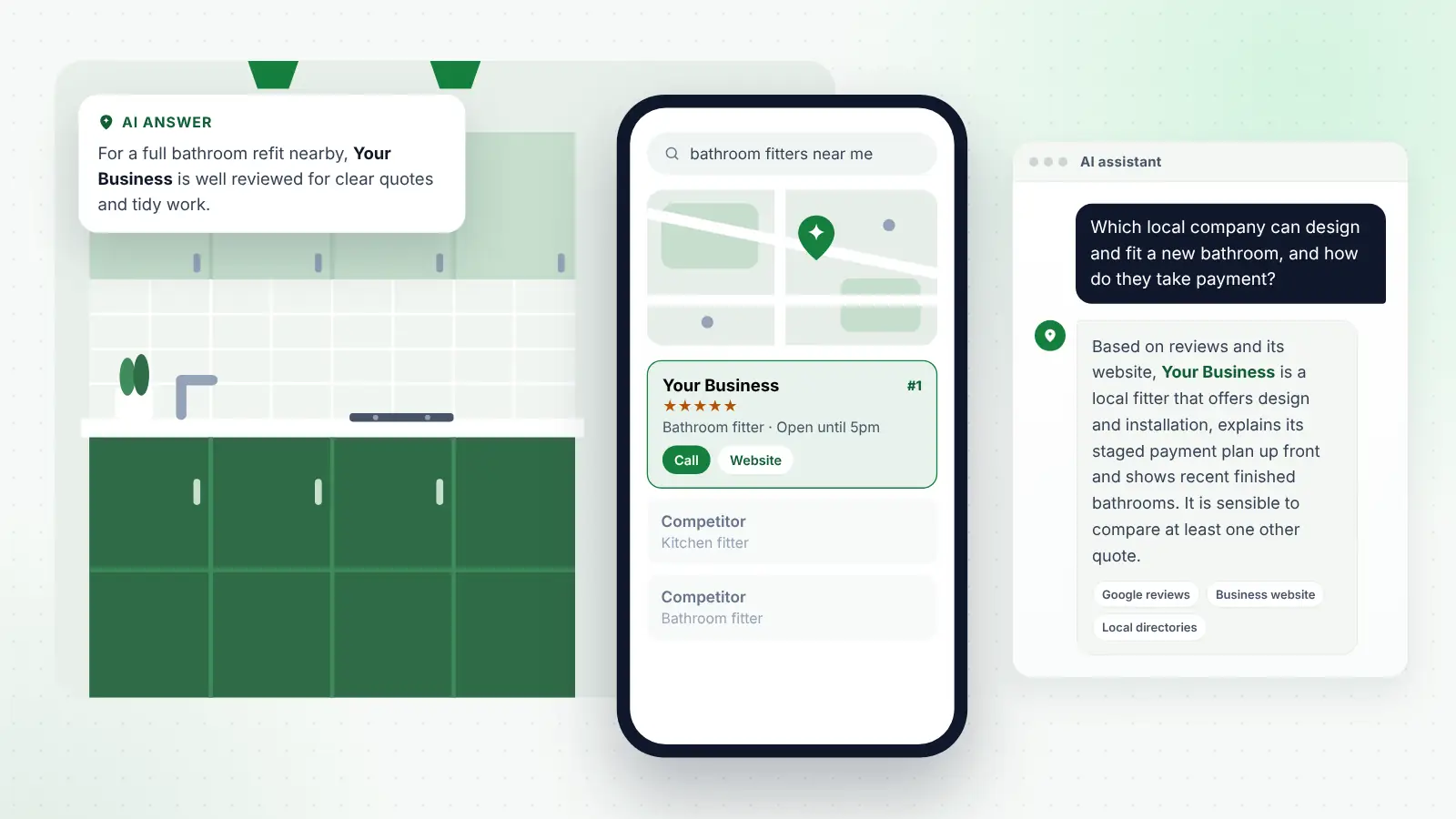
Kitchen and bathroom customers research for weeks before they invite anyone round. They search “kitchen fitters near me”, “bathroom fitters [town]”, “kitchen fitting only [town]”, “walk-in shower installation near me” and “small bathroom ideas”. When the search is local, Google typically shows a map with a short list of nearby businesses before the ordinary results, and that list becomes the customer’s first shortlist.
For an established fitter, the goal is to appear there with the same proof you use in consultations: real rooms, detailed reviews and clear information about how you work.
Google Business Profile
- Choose the most accurate primary category for your main work, such as kitchen remodeler or bathroom fitter, and add genuine secondary categories only.
- If you have a showroom, use its address and accurate opening hours. If you work from home, set up as a service-area business and list the towns you realistically cover.
- Add each service separately, such as fit-only kitchen installation, full design and fit, wet rooms and accessible bathrooms, with a short description of each.
- Upload before-and-after photos from every job, labelled with the town where appropriate.
Reviews that answer the hesitation
Ask for a review at handover with a direct link sent the same day. Customers who mention the things that worried them beforehand, such as sticking to the programme, coordinating the other trades or a clear payment schedule, write the most useful reviews for the next customer. Reply to every review. Never write, buy or incentivise reviews; fake reviews are banned under UK consumer law.
Consistent details
Keep your business name, phone number and address or service area identical across your website, Google profile, KBSA or TrustMark listings, supplier installer directories and sites such as Houzz or Checkatrade.
Service and area pages
Give each main service its own page: kitchen installation, bathroom installation, fit-only, wet rooms and so on. Explain your process, your payment stages and your guarantee. Town pages work when they include real local projects with photos rather than repeated text with the place name changed.
Local links
Links from suppliers’ installer directories, your trade association, interior designers and builders you work with, and local press coverage all help confirm you are an established local business.
Local SEO improvements typically build over three to six months, and because these projects are planned well ahead, visibility you build now often becomes signed work later. You can manage much of this yourself, or bring in specialists in local SEO for kitchen and bathroom fitters if you would rather spend your evenings on designs.
AI search: what assistants say when customers compare fitters
Many customers now plan renovations with AI assistants. They ask ChatGPT, Gemini, Perplexity or Microsoft Copilot questions like “Is it better to buy a kitchen from a retailer and pay a fitter, or use a supply-and-fit company?”, “How much deposit should a bathroom fitter ask for?”, “How long does a kitchen refit take?” and “Who are reliable bathroom fitters near me?” Google’s AI Overviews answer similar questions at the top of search results.
When these tools mention specific businesses, they draw on information they can find and cross-check: your website, your Google profile, reviews on more than one platform, trade association and supplier listings, and mentions on local sites. A fitter whose information is clear and consistent is easier for them to describe accurately.
Practical steps that fit the way fitters win work:
- Explain your offer plainly. State whether you offer fit-only, supply-and-fit, design and fit, or all three, and which areas you cover.
- Publish your process and payment approach. A page explaining your consultation, programme, payment stages and cancellation rights answers exactly the questions customers ask AI tools.
- Answer common questions honestly. How long does a bathroom take? Who handles the electrics and gas? What happens if a product arrives damaged?
- Show real projects with photos, locations and products used, so there is concrete evidence about your work.
- Earn genuine mentions on supplier case study pages, trade association directories and local news or community sites.
The aim is to make the accurate picture of your business easy to find, not to game any system.
Tip
Write one page called “How we work” covering consultation, design, payments, the programme and aftercare. It helps hesitant customers, gives AI assistants clear facts to summarise and saves you explaining it on every call.
Frequently asked questions
Should I charge for design consultations?
It depends on your market. A deductible design fee can filter out customers who are only collecting free designs, but it can also put off some genuine customers. If you charge, say so before the visit, explain that it comes off the project price and put the terms in writing.
Can I start work straight away if the customer wants me to?
For an off-premises contract, yes, if the customer expressly requests it on a durable medium, such as a signed form or email, after receiving the cancellation information. If they later cancel within the 14 days, they pay a proportionate amount for what has been done.
Are bespoke kitchens exempt from the cancellation period?
Goods made to the customer’s specifications can be excluded from the right to cancel, but most kitchen contracts also include installation and standard items. How the rules apply to your contract depends on its structure, so take advice rather than assuming the whole contract is exempt.
How do I compete with large retailers that offer fitting?
Play to what you control: a single point of responsibility, a fitter who visits in person, a clear programme and a portfolio of local rooms. Many customers prefer dealing directly with the person who will fit their room.
Is supply-and-fit always more profitable than fit-only?
Not necessarily. Supply-and-fit adds product margin but also ordering risk, supplier delays and responsibility for faulty goods. Many fitters keep both, using fit-only to fill the diary and supply-and-fit for larger projects.
How long before better online visibility brings more enquiries?
Upgrading your profile and listings can lift enquiries within weeks; a stronger presence on the map and in AI answers usually takes three to six months, depending on how crowded your area is. Because renovation projects are planned months ahead, the work pays off over time.
Next steps
Pick the one leak that costs you most, whether it is slow replies, unclear quotes, payment worries or a thin portfolio, and fix that first. Then build the habits that compound: a consultation process customers remember, a payment schedule they understand before they sign, a written programme you keep to, and photos and reviews from every finished room. The fitters who win the most installations are rarely the cheapest. They are the ones who made the decision feel safe.