Artificial grass has gone from a novelty to a mainstream garden choice. Families want somewhere for children to play that isn’t a mud bath by November, dog owners want a lawn that survives daily wear, and flat owners want a green space on a terrace that could never support real turf. Schools, nurseries, pubs and offices use it for play areas, beer gardens and roof spaces. For a well-organised installer, that adds up to steady, valuable work.
It is also a trade where the difference between a good and a bad job is mostly hidden. The grass on top looks much the same on day one whatever lies underneath, but a poor sub-base, weak edging or bad drainage shows up within months as puddles, dips, lifting seams and smells. Customers have heard the horror stories, and many are wary of anyone quoting a suspiciously low price per square metre.
This guide covers the practical steps: choosing your market, groundwork, pets, warranties, balcony fire safety, planning, honest environmental claims, pricing, and getting found on Google and in AI assistants.
Key points
- The quality of an artificial lawn depends far more on excavation, sub-base, drainage and edging than on the grass itself, so build your reputation on groundwork.
- Keep the manufacturer’s product warranty and your own installation guarantee clearly separate, in writing, so customers know who covers what.
- Balconies and roof terraces on residential buildings can be subject to strict fire safety rules on combustible materials, so check with the building owner before quoting.
- Environmental claims such as “eco-friendly” or “recyclable” must be specific and backed by evidence, and the ASA has ruled against artificial grass adverts that fell short.
- Local SEO and AI search visibility matter because customers compare photos, reviews and guide prices before inviting anyone to quote.
In this guide
- Decide what kind of artificial grass business you want to run
- Skills, experience and training
- Groundwork and drainage: where installations succeed or fail
- Pet-friendly lawns
- Manufacturer warranties versus installation guarantees
- Balconies, roof terraces and fire safety
- Front gardens, planning and permeability
- The environmental debate and honest green claims
- Start-up costs and equipment
- Pricing per square metre and seasonality
- Local SEO for artificial grass installers
- When homeowners ask AI about artificial lawns
- Frequently asked questions
- Next steps
Decide what kind of artificial grass business you want to run
Your focus affects your equipment, insurance, suppliers and marketing.
- Domestic lawns. Back and front gardens for homeowners are the core of most businesses. Jobs are usually completed in one to three days with a small team.
- Pet-friendly installations. Dog owners are a large and loyal segment who care about drainage, hygiene and durability more than almost anything else.
- Roof terraces and balconies. Higher-value, specialist work that involves lightweight build-ups, access challenges and fire safety checks.
- Schools and nurseries. Play areas, outdoor classrooms and sports surfaces, often with impact-absorbing shockpads under climbing equipment and work scheduled for school holidays.
- Commercial and hospitality. Pubs, hotels, offices, show homes, events and retail displays. Clients value reliability, speed and work outside opening hours.
Many installers start with domestic lawns and add specialist work as they gain experience.
Skills, experience and training
There is no licence required to install artificial grass, but it is genuine groundwork. You need to be comfortable excavating, levelling and compacting, judging falls and drainage, seaming turf so joins disappear, and finishing edges neatly. Most installers learn with an established company or come from landscaping or paving. Some manufacturers run installation training, and a few link their full warranty to approved installers, so ask your intended suppliers what they offer.
Groundwork and drainage: where installations succeed or fail
Customers recommend you based on how a lawn performs two winters later, and that comes down to the build-up beneath it.
A typical domestic installation follows a sequence like this:
- Remove the existing turf and soil to a suitable depth, allowing for the sub-base and laying course.
- Check the soil type and existing drainage, and look for low spots where water collects.
- Install timber, steel or composite edging so the base and grass are held firmly in place.
- Lay and compact a crushed stone sub-base in layers, building in gentle falls where water needs to move away.
- Add a finer laying course, such as granite dust or grit, and screed it to a smooth, even level.
- Lay a weed membrane where appropriate, then roll out, cut, seam and fix the grass.
- Add sand infill if the product requires it, brush the pile up and leave the site clean.
The right depth and materials depend on the soil and the use. Heavy clay may need extra drainage measures, and a lawn over old concrete usually needs a drainage layer or shockpad and a route for water to escape. Getting this wrong causes more complaints than anything else.
Tip
Photograph every stage of your groundwork — excavation depth, compacted sub-base, edging and drainage. These photos explain to customers why your quote is higher than a cheaper one, and they make excellent content for your website and Google profile.
If you transport soil, turf or rubble from customers’ properties, you need to register as a waste carrier with the environmental regulator and dispose of it properly. Showing your registration is also a useful trust signal.
Pet-friendly lawns
Dog owners are one of your most important customer groups. They want to know whether urine will drain, whether the lawn will smell in summer and how to clean it.
Good answers usually involve:
- A free-draining sub-base and laying course, rather than a dense layer that holds liquid.
- Grass with a backing that drains well across its whole surface, not only through occasional holes.
- Sensible infill choices, explained honestly. Some installers recommend specific infills for pet areas; make sure any claims about odour control come from the manufacturer’s own evidence.
- Clear aftercare advice: removing solid waste promptly, rinsing regularly, and using cleaners suitable for artificial grass.
Avoid promising that a lawn will “never smell”. Explain what reduces odour and what the owner needs to do; that honesty earns better reviews than a promise that later proves wrong.
Manufacturer warranties versus installation guarantees
Customers often confuse these, and misunderstandings lead to disputes.
| Cover | Who provides it | What it usually covers | What it usually excludes |
|---|---|---|---|
| Product warranty | The turf manufacturer | Fading from UV, fibre or backing defects | Installation faults, misuse, burns, heavy staining |
| Installation guarantee | You, the installer | Workmanship: levels, seams, edging, drainage | Damage by the customer, ground movement outside your control |
| Insurance-backed guarantee | An insurer, arranged through you | Your guarantee if your business stops trading | Depends on the policy terms |
A ten-year product warranty does not protect the customer if the groundwork fails. Put both in writing, with their length and conditions, such as following aftercare guidance.
Customers also have statutory rights. Under the Consumer Rights Act 2015, services must be carried out with reasonable care and skill. If you agree contracts in the customer’s home, cancellation rules for off-premises contracts generally apply, so take advice on your terms before you start trading.
Balconies, roof terraces and fire safety
Roof terraces and balconies are higher-value work, but this is where you need to be most careful. After the Grenfell Tower fire, rules on combustible materials on residential buildings were tightened significantly.
As things stand, the building regulations in England require balconies on relevant buildings (residential buildings with a storey at least 18 metres above ground) to be built from materials meeting the highest fire performance classifications, A1 or A2-s1,d0. There are limited exceptions, such as a top floor layer that meets the equivalent floor classification over an imperforate substrate. Government guidance in Approved Document B sets a similar expectation for balconies on residential buildings with a storey over 11 metres. Standard artificial grass is a plastic product and will not usually meet those classifications.
For existing blocks of flats, the position depends on the building, its fire risk assessment and the lease. Many freeholders and managing agents now prohibit combustible coverings on balconies altogether. Before you quote:
- Ask the customer to confirm in writing that the building owner or managing agent permits the installation.
- Ask for any relevant fire safety requirements from the building’s fire risk assessment.
- Obtain the fire test classification documents for the product you propose to use.
- Check the load the roof or terrace can carry if you are adding a sub-base or shockpad.
Scotland, Wales and Northern Ireland set their own building rules, so check them separately. If in doubt, decline the job: combustible material on the wrong building could put residents at risk.
Front gardens, planning and permeability
Artificial lawns in front gardens raise questions about drainage and planning. In England, the Planning Portal’s guidance on paving front gardens explains that you generally do not need planning permission if a new or replacement surface is permeable, or if rainwater runs off onto a lawn or border to drain naturally. Covering more than five square metres with an impermeable surface that drains onto the road usually requires permission.
The guidance does not specifically address artificial grass, and whether an installation counts as permeable depends on the whole build-up. Flats, maisonettes and properties with extra planning restrictions may also be treated differently. Never tell customers permission is definitely not needed; advise them to check with their local planning authority, and design front gardens to drain freely into the ground.
The environmental debate and honest green claims
Artificial grass divides opinion. Critics point to lost habitat for insects and birds, surface heat, plastic waste and microplastics. Supporters point to less watering, mowing and fertiliser. Some customers will ask you directly.
This is an area where marketing can easily go wrong. The ASA has ruled against artificial grass adverts that described products as “eco-friendly”, “eco-grass” or “recyclable” without adequate evidence. An unqualified green claim needs evidence covering the product’s whole life cycle, from manufacture and transport to use and disposal. The CMA’s Green Claims Code sets out similar principles: claims must be truthful, clear, not leave out important information, make fair comparisons, consider the full life cycle and be substantiated. The CMA can now fine businesses directly for breaching consumer protection law.
Practical rules for your website and social media:
- Avoid “eco-friendly”, “green” and “sustainable” as general descriptions of artificial grass.
- If a product is recyclable, say so only if recycling is genuinely available to your customers in practice, and explain how.
- If a manufacturer makes a claim, such as recycled content, check their evidence before repeating it.
- Be careful with infill. The EU has restricted the future sale of loose plastic infill for synthetic sports surfaces, with a transition period running to October 2031. Great Britain has its own chemicals rules, so check the current position with your suppliers. Many domestic lawns use sand instead, but check what you are using.
- Talk about practical, verifiable benefits instead: no mowing, usable all year, suitable for shady spots or heavy wear.
Tip
Run every environmental statement on your website past a simple test: could you send the evidence to the ASA tomorrow if someone complained? If not, reword or remove it.
Start-up costs and equipment
Your costs depend on whether you buy new or used equipment, and whether you start alone or with a small team. These are rough guides only and vary by area and supplier.
| Item | Typical cost | Notes |
|---|---|---|
| Van and trailer | £8,000–£25,000 | Used is fine to start; needs to carry rolls and aggregate |
| Plate compactor | £400–£1,200 | Essential for the sub-base |
| Turf cutter and mini digger | Hire or £1,000+ | Hiring keeps early costs down |
| Hand tools, knives, power brush | £300–£1,000 | A power brush gives a better finish |
| Public liability insurance | Varies | Higher cover may be needed for commercial work |
| Branding, website and signage | £500–£3,000 | Van graphics are cheap, effective marketing |
| Initial stock and samples | £1,000–£5,000 | Samples for home visits are important |
Once you take on staff, employers’ liability insurance is a legal requirement for most employers.
Pricing per square metre and seasonality
Customers usually think in price per square metre, and many have already seen low figures from online retailers and DIY kits. Supplied and fitted artificial grass typically ranges from around £40 to £100 or more per square metre in many parts of the UK, depending on the grass quality, the amount of groundwork, access and the area. Small or awkward gardens usually cost more per square metre because setup time and waste are spread over less ground.
When you price, account for:
- Excavation depth and waste removal, including skips or tipping fees.
- Sub-base, laying course, edging and membranes.
- Access, especially gardens with no side access.
- Shape and offcut waste for curves and narrow strips.
- Travel, labour and a fair margin.
Show what each quote includes, line by line, so customers can see why a much cheaper price might mean less groundwork.
The trade is seasonal. Demand rises from late winter and slows in late autumn. To smooth the year, take deposits for spring dates, offer modest winter discounts, pursue school projects during holidays, and sell maintenance such as deep cleaning and re-brushing.
Local SEO for artificial grass installers
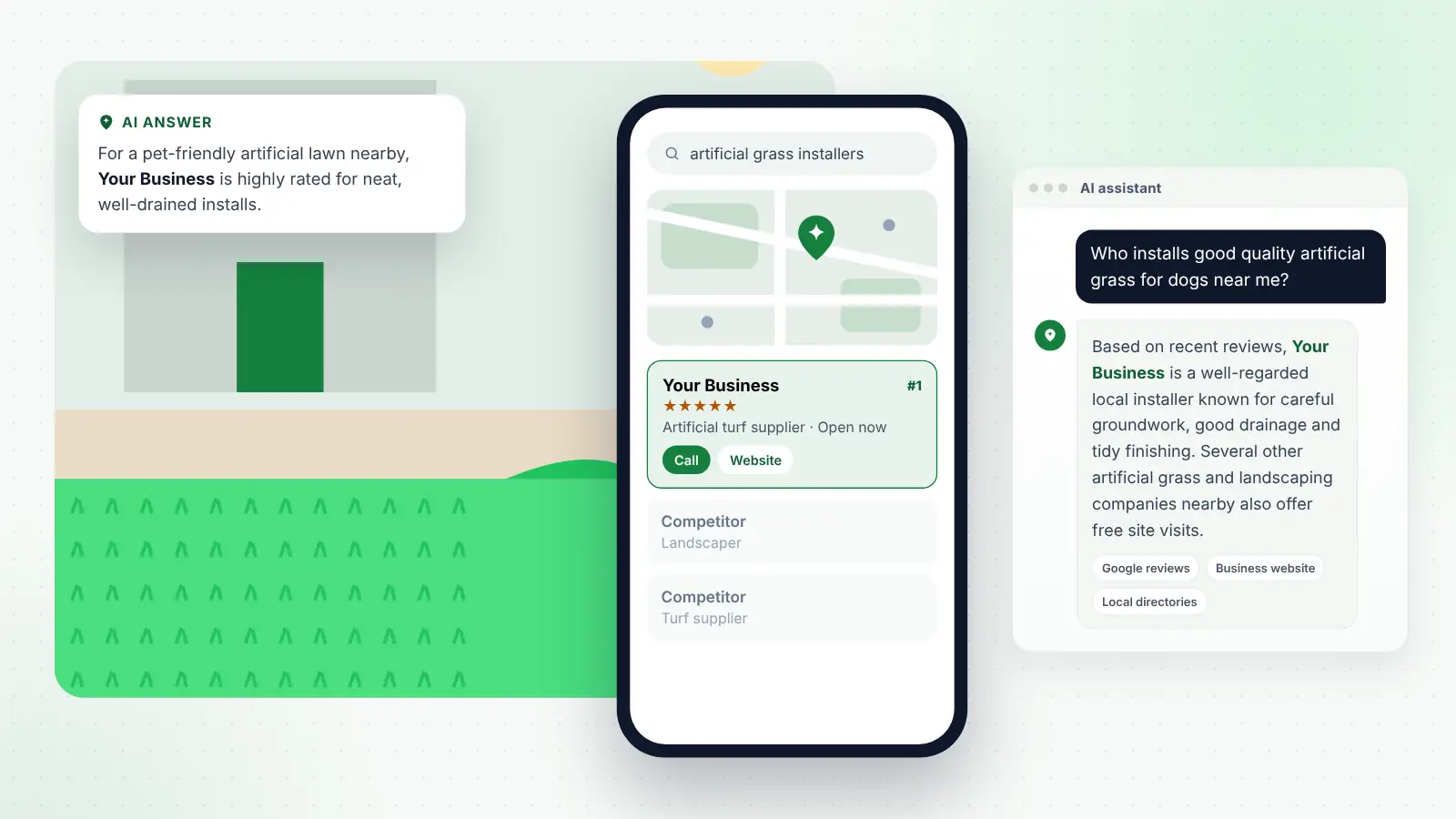
Most customers start with a search like “artificial grass installers near me”, “artificial grass fitters [town]” or “artificial grass for dogs”. They check the map results, scroll through photos, read reviews and invite two or three installers to quote.
The essentials are:
- Google Business Profile. Choose accurate categories, set your service area rather than showing a home address, list each service, and add plenty of real photos. Before-and-after shots and groundwork photos are particularly persuasive.
- Reviews. Ask every happy customer, ideally a week or two after installation once they have used the lawn. Reviews that mention drainage, dogs, tidy work and communication are especially helpful.
- Consistent details. Use the same business name, phone number and service area on your website, directories, trade listings and social profiles.
- A website with service and area pages. Create clear pages for domestic lawns, pet-friendly installs, roof terraces, schools and commercial work, plus pages for the main towns you cover. Include guide prices, your guarantees and real project photos.
- Local links. Mentions from local business groups, schools you have worked with, garden designers and community sites help your visibility.
If you would rather focus on installations, specialist help with SEO for artificial grass installers and synthetic turf companies can take care of your profile, listings, content and links while you work.
When homeowners ask AI about artificial lawns
More customers now ask AI tools such as ChatGPT, Gemini, Perplexity, Copilot and Google AI Overviews for help before they contact anyone. Their questions are often more detailed than a typical search: “Who installs artificial grass for dogs near me?”, “Is artificial grass worth it on clay soil?”, “How much does artificial grass cost per square metre in my area?” or “Can I put artificial grass on my balcony?”
An assistant can only name installers it finds described clearly and consistently online. To improve your odds:
- Keep your business details consistent everywhere, so AI tools can confidently identify you.
- Build a strong base of genuine reviews that describe the work you do.
- Publish clear service descriptions and FAQs that answer real questions about drainage, pets, warranties, costs and balconies.
- Be accurate. Measured, honest content on fire safety and environmental claims is more likely to be trusted than marketing language.
- Earn mentions on reputable local, home and garden websites.
This matters because customers are trying to understand a product they rarely buy. If an AI tool names you as a well-reviewed local option, you start the conversation with some trust already in place.
Frequently asked questions
How long does a typical installation take?
A typical domestic lawn takes one to three days, depending on size, access and excavation. Commercial and roof terrace jobs take longer.
Can artificial grass be laid on concrete or patios?
Often, yes, but it needs the right approach. Drainage is the main concern, so installers typically use a shockpad or drainage layer and make sure water has somewhere to go.
Is artificial grass suitable for school and nursery play areas?
It is widely used for play areas. Where there is equipment children could fall from, schools usually need impact-absorbing surfacing designed for the fall height, so use products with suitable test documentation and discuss requirements with the school.
Should I describe my artificial grass as eco-friendly?
It is best not to. General green claims need strong, whole-life-cycle evidence, and the ASA has ruled against artificial grass adverts that used them. Focus on specific, verifiable facts instead.
Next steps
Build your reputation on careful groundwork, be clear about warranties, take fire safety and environmental claims seriously, and price so customers can see what they are paying for. Then make sure local customers can find you, with a strong Google profile, genuine reviews and accurate information across the web.