Chiropractors and osteopaths often reach the same point in their careers: after years of working as an associate or renting a room in someone else’s clinic, they want to set their own hours, choose how they treat and keep more of what they earn. Opening your own clinic gives you that control. It also makes you responsible for registration, insurance, data protection, premises, advertising rules and, above all, a reliable flow of new patients.
The two professions are different, but the business side of running a clinic is very similar. Both are statutorily regulated, both carry protected titles, and both face the same advertising rules about what you can and cannot say about the conditions you help with. Patients searching for help with back pain, neck pain or sciatica will often compare chiropractors, osteopaths and physiotherapists side by side, so the clinics that do best are the ones that are easy to find, easy to trust and easy to book.
This guide covers the practical steps for starting a chiropractic or osteopathy clinic in the UK, with a focus on England where the rules differ between nations. It is written for registered practitioners and for anyone planning a clinic who will employ them.
Key points
- “Chiropractor” and “osteopath” are protected titles: practitioners must be registered with the General Chiropractic Council (GCC) or the General Osteopathic Council (GOsC) to use them.
- Professional indemnity insurance is a requirement of registration for both professions, so check your cover before you treat your first private patient.
- The ASA and CAP accept only a defined list of conditions that chiropractors and osteopaths can refer to in advertising, and claims about conditions specific to babies, children and pregnancy are unlikely to be acceptable without a robust body of evidence.
- A standalone chiropractic or osteopathy service in England is generally outside the scope of CQC registration, but adding doctors, nurses or other regulated activities can change that.
- Patients usually search for a symptom, such as “osteopath for back pain near me”, so build your local SEO and AI search visibility around the conditions you can advertise.
In this guide
- Confirm your registration and protected title
- Arrange professional indemnity and other insurance
- Understand CQC registration in England
- Patient notes, consent and data protection
- Choose your clinic model and premises
- Pricing, care plans and patient retention
- Advertise within the ASA and CAP rules
- Local SEO: getting people in pain to find your new clinic
- AI search: when patients ask an assistant about their back pain
- Frequently asked questions
- Final thoughts
Confirm your registration and protected title
The Chiropractors Act 1994 and the Osteopaths Act 1993 protect the titles “chiropractor” and “osteopath” throughout the UK. Anyone who describes themselves as a chiropractor or osteopath, whether directly or by implication, must be on the relevant register. For chiropractors that is the General Chiropractic Council, and for osteopaths it is the General Osteopathic Council. Using the title without registration is a criminal offence.
Patients, insurers and referrers can check both registers online, so make sure your entry is current and your practice details are correct. Registration also brings ongoing obligations: you must meet your regulator’s standards of practice, complete continuing professional development (CPD) and renew each year.
If you plan to employ or contract other practitioners, you are responsible for checking that every chiropractor or osteopath working in your clinic is registered, and that receptionists, website copy and directory listings never describe anyone using a protected title they do not hold.
Professional associations
Membership of a professional association is voluntary but worthwhile. Chiropractors often join the British Chiropractic Association, the McTimoney Chiropractic Association, the United Chiropractic Association or the Scottish Chiropractic Association. Osteopaths commonly join the Institute of Osteopathy. These bodies offer practice guidance, support, CPD, insurance arrangements and directory listings, and their names are recognised by many patients and referrers.
Arrange professional indemnity and other insurance
Both regulators require registrants to hold professional indemnity insurance. If you have been working as an associate, check whether the clinic’s policy covered you and what happens when you leave. Many practitioners arrange cover through their professional association, but whichever route you choose, make sure it covers self-employed private work, every technique you use and every location where you treat, including home visits.
Other insurance to consider:
- Public liability insurance, if it is not already included, covering injury to patients or visitors on your premises.
- Employer’s liability insurance, which the law normally requires as soon as you take on a receptionist, associate or other employee.
- Buildings, contents and equipment cover, depending on your lease and what you own.
- Business interruption or income protection, which matters a great deal for a solo practitioner who cannot work through injury or illness.
If you add services such as acupuncture or dry needling, sports massage or exercise classes, confirm that they are covered and that you hold the right training. Some local councils license certain treatments, so check with yours before offering anything outside your core practice.
Tip
Keep your registration certificate, indemnity schedule, association membership and training certificates in one folder. Insurers, referrers, corporate clients and landlords will ask for them, and having them ready saves time.
Understand CQC registration in England
The Care Quality Commission (CQC) oversees providers in England that carry out specified “regulated activities”, one of which is the treatment of disease, disorder or injury. Whether you need to register depends on who provides the treatment and which services you offer, not simply on the fact that you treat patients.
Chiropractors and osteopaths are not among the healthcare professionals listed in the scope for that activity, so a clinic where only chiropractors or osteopaths provide treatment does not normally need to register with the CQC. That position can change, so check carefully if:
- Your team includes listed professionals, such as doctors, registered nurses or paramedics, who provide or supervise treatment.
- You take on listed professionals as employees or contractors to provide treatment as part of what your clinic offers.
- You provide other regulated activities, such as certain diagnostic imaging or screening procedures.
Scotland, Wales and Northern Ireland have their own healthcare regulators and rules. If you are planning a multi-disciplinary clinic, read the CQC’s scope of registration guidance or contact the CQC before you open, rather than after.
Patient notes, consent and data protection
You will hold health information about every patient, which is special category data under UK data protection law. You need a lawful basis for processing it, appropriate security and a clear privacy notice that explains what you collect, why and for how long. Most organisations that process personal data must pay the data protection fee to the Information Commissioner’s Office (ICO) unless they are exempt, and the ICO’s self-assessment will tell you whether it applies to you.
Practical steps include:
- Use secure clinic management software with encrypted storage, access controls and reliable backups.
- Keep clinical records that meet your regulator’s standards, and set a retention policy.
- Obtain valid consent for examination and treatment, and record it, particularly for any intimate examination or manual technique patients may not expect.
- Get separate consent for marketing emails and for sharing information with insurers or referrers.
- Train any staff on confidentiality and on handling data requests.
Choose your clinic model and premises
Most practitioners start in one of four ways, and many move between them as they grow.
| Model | How it works | Advantages | Things to watch |
|---|---|---|---|
| Room rental | Rent a treatment room by the session, day or month | Low start-up cost, shared reception | Less control over branding and hours |
| Home visits | Treat patients in their homes | Very low overheads, suits less mobile patients | Travel time, portable couch, lone working |
| Gym or wellbeing centre | Base yourself in a gym, leisure centre or studio | Steady flow of active patients | Agree terms clearly and keep your own records |
| Own clinic | Lease and fit out premises | Full control, room to add a team | Higher fixed costs and responsibilities |
Choosing premises
People in pain need easy access: step-free entry, nearby parking or public transport, and ground-floor or lift access. Treatment rooms need privacy, space for a couch and for movement or rehab exercises, and good hand-washing facilities. Confirm the building’s planning use allows a treatment clinic, find out from the council what business rates will apply, and get a solicitor to go through the lease before you sign. If you play music in waiting areas, you will usually need a music licence.
Rough start-up costs
These costs are ballpark figures; a single-room osteopathy practice and a multi-practitioner chiropractic clinic will look very different, and prices vary by region.
| Item | Typical cost | Notes |
|---|---|---|
| Treatment couch | Can range from a few hundred to several thousand pounds | Electric height-adjustable or specialist chiropractic tables cost more |
| Clinic management software | Monthly subscription | Notes, booking, reminders and invoicing |
| Indemnity and other insurance | Annual premium | Often arranged through your association |
| Registration and membership fees | Annual fees | Regulator and association fees are separate |
| Room rental or lease | Varies by area | Sessional rental keeps early costs low |
| Website and branding | One-off build or monthly fee | Include practitioner profiles and prices |
Pricing, care plans and patient retention
Set clear prices for an initial consultation and for follow-up treatments, and publish them. Say how long each appointment lasts and what it includes, such as a case history, examination, explanation of findings and treatment. Patients who know what to expect are more likely to book and less likely to cancel.
Care plans are where the two professions attract the most criticism, so handle them carefully. A sensible plan explains your findings, what you expect to do, how you will review progress and when you might refer elsewhere. Avoid pressuring patients into large prepaid packages or implying they need indefinite maintenance care. Honest plans build long-term trust, better reviews and more referrals than hard selling ever will.
Simple systems help patients complete their care: online booking with reminders, offering to book the next appointment before they leave, and home exercise advice they can follow between visits.
Referral partners and insurers
Relationships with local GPs, personal trainers, Pilates and yoga studios, running clubs, sports teams and employers can bring a steady flow of patients. Offer something genuinely useful, such as a talk on posture and desk set-up, injury advice for a running club or clear letters to referrers (with patient consent).
Some private health insurers recognise chiropractors and osteopaths. Each sets its own criteria and fees, which are often lower than self-pay rates, so decide how much insured work suits your clinic.
Advertise within the ASA and CAP rules
This is the area where chiropractors and osteopaths most often run into trouble. All advertising, including your website, Google profile, social media posts and leaflets, must follow the CAP Code, which is enforced by the Advertising Standards Authority (ASA). Both the GCC and the GOsC expect registrants to comply, so a complaint about an advert can also become a regulatory matter.
The ASA and CAP accept that there is enough evidence for chiropractors and osteopaths to refer to a defined list of conditions. The lists are similar but not identical, and both include general, acute and chronic back pain (not arising from injury or accident), lumbago, sciatica, mechanical neck pain, headache arising from the neck, joint pains, generalised aches and pains, minor sports injuries, muscle spasms, cramp, migraine prevention and tension and inability to relax. The chiropractic list also includes conditions such as short-term management of ankle sprain and plantar fasciitis, rotator cuff and other shoulder complaints (but not frozen shoulder), and limits sciatica to general references rather than pain reduction claims, while the osteopathy list includes others, such as arthritic and rheumatic pain, fibromyalgia, neuralgia and frozen shoulder. Read the current CAP advice on chiropractic or the equivalent advice on osteopathy before writing any condition content.
In practice:
- Stick to the accepted conditions. Claims about anything else need robust clinical evidence, which in practice most clinics do not hold.
- Be very careful with babies, children and pregnancy. You can say you treat these groups, but claims about conditions specific to them, such as infant colic or morning sickness, are unlikely to be acceptable unless you hold a robust body of evidence.
- Do not imply a cure or guaranteed result. “Can help with” or “we treat” is very different from “fixes” or “eliminates”.
- Do not discourage people from seeking medical advice. Explain red flag symptoms and when someone should see a GP or seek urgent care.
- Use titles carefully. If you use “Dr”, make clear you are not a registered medical doctor, for example by adding “Chiropractor” alongside your name. Osteopaths without a medical qualification should avoid “Dr” altogether.
- Remember testimonials count. Patient stories and reviews you share in your marketing cannot be used to support claims you could not make yourself.
Tip
Audit everything once a year: website, Google services, social bios, directory listings and printed leaflets. Old pages written by a previous designer are a common source of ASA complaints.
Local SEO: getting people in pain to find your new clinic
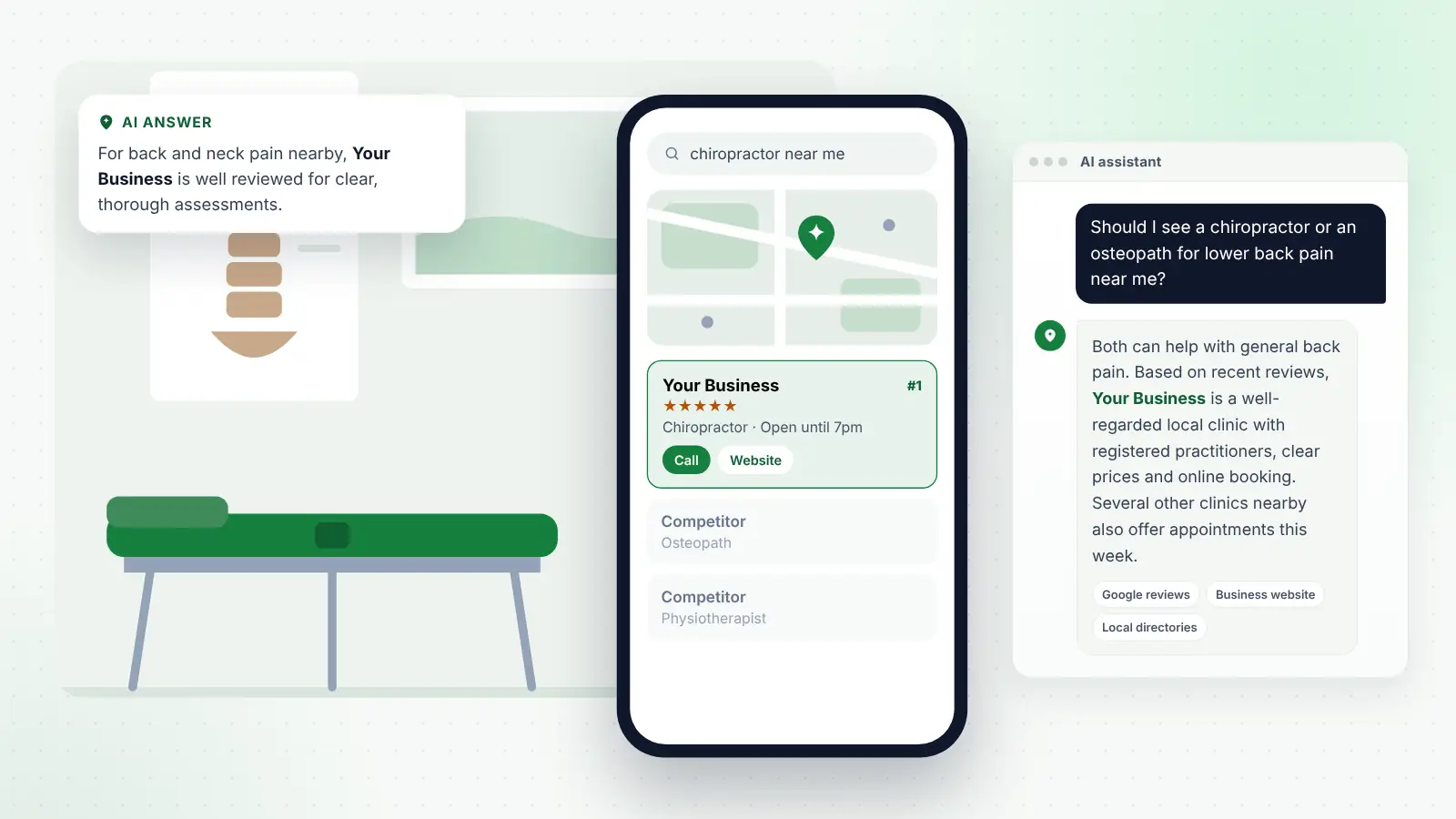
Most people in pain do not search for a profession in the abstract. They search for help with their problem, close to home or work: “chiropractor near me”, “osteopath for back pain [town]”, “sciatica treatment near me”, “osteopath open Saturday”, “chiropractor stiff neck [area]”. Many are in discomfort and want an appointment soon, so they choose quickly from the clinics they see first, usually in the Google Maps results with ratings, opening hours and a booking button.
That is why local SEO matters so much for this type of business. You are competing not only with other chiropractors or osteopaths, but with physiotherapy and sports injury clinics appearing for the same searches.
Set up the clinic’s Google profile with categories, treatments and booking link
Choose “Chiropractor” or “Osteopath” as your primary category, and add accurate secondary categories only if they genuinely apply. List your services, such as initial consultation, spinal assessment, sports massage and home visits, with descriptions that stay within the advertising rules. Add opening hours, accessibility details, an online booking link and real photos of your clinic and team. Practitioners who only treat in patients’ homes should use a service-area profile with the home address hidden.
Ask patients for reviews without breaking the rules
Reviews influence both where you appear and whether a nervous first-time patient books. Ask patients after a few appointments, when they have noticed progress, and send a direct link. Never offer discounts or incentives for reviews. When replying, do not confirm that someone is a patient or discuss their treatment, because that would breach confidentiality. A short, warm thank-you is enough.
Match your listings to your register entry
Use exactly the same clinic name, address, phone number and website on Google, Apple Maps, Bing, health directories, your association’s practitioner finder and insurer directories. Your regulator’s register entry should match too. When a practitioner finder lists an old address, patients turn up at the wrong door and Google loses confidence in your details.
Build condition, service and area pages
Your website should have a clear page for each main condition you can advertise, written in plain English: what the problem is, how you assess it, what treatment might involve and when to see a GP instead. Add a “first appointment” page, practitioner profiles with registration numbers and special interests, clear prices and a page for each area you serve.
Earn links from running clubs, gyms and health sites
Links and mentions from local running and sports clubs, gyms, community health events, local news and your professional association show search engines that your clinic is real, established and trusted.
Search visibility for a new clinic grows step by step, typically over three to six months before the effect is obvious in your diary. If you would rather spend your time with patients, specialist local SEO for chiropractors and osteopaths can manage your profile, listings, compliant condition content and links.
AI search: when patients ask an assistant about their back pain
More people now describe their symptoms to an AI assistant before they book. Someone might ask ChatGPT “Should I see a chiropractor or an osteopath for lower back pain?”, ask Gemini for “an osteopath near [town] who does evening appointments”, ask Perplexity “Is there a chiropractor near me who treats sciatica and takes online bookings?” or ask Copilot to compare local clinics. On Google itself, an AI Overview now sits above the results for plenty of symptom and “near me” searches.
Because health questions carry risk, AI tools lean heavily on information they can cross-check. For a chiropractic or osteopathy clinic, that typically includes:
- Consistent clinic details across Google, your website, health directories and association listings.
- Reviews that describe the problems patients came with and the experience they had.
- Clear service and condition descriptions, so the tool can match you to a specific request such as “neck pain” or “minor sports injury”.
- FAQs that answer real questions: do I need a GP referral, what happens at the first appointment, how long does it last, is it suitable during pregnancy, what should I wear.
- Mentions on reputable sites, such as your regulator’s register, your association’s directory, local news and sports club partner pages.
- Evidence of registration, with GCC or GOsC registration shown clearly on practitioner profiles.
Making your clinic easy for these tools to recommend is known as answer engine optimisation (AEO). For chiropractors and osteopaths, the advertising rules and AEO point in the same direction: measured, accurate, specific information. A clinic that explains which conditions it helps with, who its practitioners are, what a first visit involves and how to book is far easier for an AI assistant to recommend than one with vague or exaggerated claims.
Frequently asked questions
Do I need to register with the CQC to open a chiropractic or osteopathy clinic?
In England, a clinic where only chiropractors or osteopaths provide treatment is generally outside the scope of CQC registration. That can change if you add listed professionals such as doctors or nurses, or provide other regulated activities. Check the CQC’s scope of registration guidance for your situation before you open.
Can I call myself a chiropractor or osteopath while my registration is pending?
No. The titles are protected by law, and you can only use them once you are on the GCC or GOsC register. Until then, do not use either title on your website, profile or marketing.
Can I advertise treatment for babies or pregnant women?
Claims about conditions specific to babies, children and pregnant women, such as colic or morning sickness, are unlikely to be acceptable under ASA and CAP guidance unless you hold a robust body of evidence. You can say that you see patients of different ages, but avoid linking that to specific conditions without robust evidence, and check the current CAP advice first.
As a chiropractor or osteopath, do I need my own PI cover?
Yes. Professional indemnity cover is a requirement of registration for both chiropractors and osteopaths. If you are leaving an associate role, check whether the clinic’s policy covered you and arrange your own cover before you start treating patients independently.
Do patients need a GP referral?
Not for self-pay appointments. Patients can usually book directly. Some insurers require a GP referral before they will fund treatment, so explain this on your website and booking pages.
Final thoughts
Starting a chiropractic or osteopathy clinic builds on clinical skills you already have, but it also asks you to run a careful, compliant business. Keep your registration and indemnity in order, understand where CQC scope applies, look after patient data, choose a clinic model you can sustain and keep every advert within the ASA guidance.
Then make sure the people searching for help with their back, neck or shoulder can find you. A complete Google profile, steady patient reviews, clear condition pages and consistent information across the web will help both search engines and AI assistants point new patients to your door.