Solar panels have moved from a niche interest to a mainstream home improvement. Energy prices, falling equipment costs, home batteries and electric cars have all made more homeowners think seriously about generating their own electricity, and government policy is pushing in the same direction. For an electrician, roofer or experienced renewables engineer, starting a solar installation business can be a sound opportunity.
It is also a sector with a mixed reputation. Hard-sell tactics, inflated savings claims and poorly installed systems have left many homeowners cautious, and the businesses that do well are usually the ones that are straightforward about what solar can and cannot do. Certification, grid connection rules, building regulations and consumer protection all shape how you work.
This guide explains what you need to know to start a solar PV installation business in the UK, with a focus on domestic and small commercial work. It covers certification, the rules you must follow, realistic costs, selling honestly and how to make sure local homeowners can find you on Google and through AI assistants.
Key points
- MCS certification is the benchmark customers look for, and small installations generally need it to qualify for Smart Export Guarantee payments.
- MCS has redeveloped its installer scheme, with installers moving across through 2026 and consumer code membership no longer mandatory, though many installers keep RECC or HIES membership.
- Grid connections must follow the distribution network operator’s process, using G98 notification or a G99 application depending on the size of the system.
- Installing solar panels and batteries on homes in Great Britain is currently zero-rated for VAT, but that is due to end on 31 March 2027.
- Local SEO and AI search visibility help you win direct enquiries from homeowners who have already researched you, rather than relying on shared leads.
In this guide
- Decide what kind of solar business you want to run
- Skills, qualifications and the team you need
- MCS certification and why it matters
- Building regulations, Part P and grid connection
- VAT relief on solar panels and batteries
- Policy in 2026: Future Homes Standard and the Warm Homes Plan
- Batteries and EV chargers
- Startup costs
- Selling honestly: avoiding mis-selling
- Local SEO for a new solar installation company
- AI search: how homeowners now research solar
- Growing your solar business
- Frequently asked questions
- Final thoughts
Decide what kind of solar business you want to run
Solar installation covers more ground than it first appears. Deciding where to focus helps you choose the right certifications, insurance and equipment, and makes your marketing far clearer.
- Domestic solar PV — rooftop systems for homeowners, usually the largest part of the market for a new installer.
- Battery storage — added to new solar systems or retrofitted to existing ones. Retrofit batteries are a strong source of work because many homes already have panels.
- EV chargers — often bought alongside solar and batteries by the same customers.
- Small commercial — shops, farms, workshops and offices. Larger systems, more design work and a different sales process.
- Repairs, servicing and maintenance — inverter replacements, fault-finding, bird proofing and health checks on systems installed years ago, sometimes by firms that no longer exist.
Many new businesses start with domestic solar and batteries, then add EV chargers and servicing. If you already run an electrical or roofing business, think about how solar fits around your existing work and who on your team will handle design, surveys and customer advice.
Skills, qualifications and the team you need
A solar installation combines roof work and electrical work, so you need competence in both. The electrical side must be carried out by qualified electricians who understand the wiring regulations, including the requirements for solar PV and battery systems, and who can test and certify their work. Most installers also complete specific solar PV and battery training, along with manufacturer training for the inverters and batteries they fit.
Roof work brings its own risks. You need safe working at height practices, suitable access equipment or scaffolding, and people who understand how to fix mounting systems without damaging tiles or compromising the roof. Many electrical firms partner with a reliable scaffolder and, for complex roofs, an experienced roofer.
You also need someone who can carry out a proper survey and design: checking roof orientation, shading, structure and the existing electrics, then sizing a system that suits the household’s usage. Good design is where honest installers stand out.
MCS certification and why it matters
The Microgeneration Certification Scheme (MCS) is the quality scheme for small-scale renewable installations in the UK. Certified installers are assessed on their design, installation and commissioning processes, and each installation they complete is registered with MCS so the customer receives an MCS certificate.
For customers, MCS certification matters for practical reasons as well as reassurance. Under the Smart Export Guarantee (SEG), electricity suppliers pay households for the electricity they export to the grid, and small installations generally need to be MCS certified, or certified under an equivalent scheme, to qualify. An installer without MCS may therefore leave the customer unable to earn export payments. Some funding schemes and lenders also expect MCS certification.
The redeveloped MCS scheme
MCS has redeveloped its installer scheme, and certification bodies are moving existing installers across in phases throughout 2026. The changes include longer windows for registering installations (30 days rather than 14), centralised complaints handling and the removal of the requirement to be a member of a consumer code. You can read about the changes on the MCS redeveloped installer scheme page, and your certification body will tell you when and how your business needs to transition.
If you are starting out now, speak to several MCS certification bodies about the process, fees and timescales. Expect to show your competence, procedures, insurance and examples of work before you are certified.
Consumer codes: RECC and HIES
The Renewable Energy Consumer Code (RECC) and Home Insulation and Energy Systems (HIES) are consumer codes approved by the Chartered Trading Standards Institute. They set standards for how members sell and contract with consumers, including pre-sale information, deposits, contracts and complaints, and give customers access to dispute resolution.
Although consumer code membership is no longer a requirement of the redeveloped MCS scheme, many installers keep it, and many customers look for it. It is worth weighing the cost against the reassurance it gives, and checking any requirements attached to finance providers or funding schemes you plan to work with.
Tip
Display your MCS certification number and any consumer code membership in the same wording on your website, Google profile, quotes and van. Customers and AI assistants both look for these details, and inconsistencies raise doubts.
Building regulations, Part P and grid connection
Part P and electrical certification
In England, installing a solar PV system in a home usually involves new circuits, which makes it notifiable electrical work under Part P of the Building Regulations. Registering with a competent person scheme such as NICEIC or NAPIT lets you self-certify that work rather than going through local building control. Battery installations also involve notifiable work in most cases. Rules differ in Wales, Scotland and Northern Ireland, so check the requirements for each area you cover.
Your installation must meet BS 7671, the IET Wiring Regulations. The current version is BS 7671:2018+A4:2026, which became the standard for new installations from 15 October 2026 and includes a new chapter on stationary batteries used for energy storage. Make sure your team, design tools and certificates are up to date.
Structural checks and planning
Panels add weight and wind load to a roof. Your survey should consider whether the roof structure is suitable and, where there is doubt, involve a structural engineer. Many domestic rooftop installations in England are permitted development, but there are conditions and exceptions, including for listed buildings, conservation areas and flat roofs. Check with the local planning authority when a property falls outside the straightforward cases.
DNO notification: G98 and G99
Every system that connects to the grid must follow the process set by the local distribution network operator (DNO). Smaller systems, generally those up to 16 amps per phase, can usually be connected under Engineering Recommendation G98, with the DNO notified after commissioning. Larger systems, or a combination of solar and battery whose output exceeds those limits, usually need a G99 application and approval before installation. Export limitation can sometimes help a larger system fit within connection limits.
Build the DNO process into your sales timeline. G99 applications can take weeks, and customers need to know that in advance.
VAT relief on solar panels and batteries
Installing qualifying energy-saving materials, including solar panels and batteries, in residential accommodation in Great Britain is currently zero-rated for VAT. Since 1 February 2024, the relief has also covered batteries retrofitted to existing systems and standalone batteries connected to the grid. The zero rate is due to end on 31 March 2027, after which the reduced rate of 5% is set to apply.
The relief has conditions. It applies to installation of qualifying materials in residential property, and the materials and installation are treated together. Northern Ireland has its own rules and dates. Speak to an accountant who understands the relief, and keep your quotes clear about how VAT has been applied.
When the zero rate ends, homeowners may rush to complete installations before the deadline. Plan your capacity and avoid making promises about completion dates you cannot keep.
Policy in 2026: Future Homes Standard and the Warm Homes Plan
Government policy is creating new opportunities for solar installers. In January 2026, the government published its Warm Homes Plan, which put rooftop solar and batteries at the centre of a large home upgrade programme, including support for low-income households and government-backed low or zero-interest loans for others. Details of how the loans and grants will work are still being developed, so check the latest guidance before mentioning them to customers.
The Future Homes Standard for new homes in England has also been confirmed, with requirements for on-site renewable generation, typically solar panels, and low-carbon heating. It is due to come into force from March 2027, with a transition period before it applies to all new homes. If you want to work with housebuilders, this is worth watching closely, though new-build work involves very different pricing and contracts from retrofit.
Batteries and EV chargers
Batteries are now one of the most common reasons homeowners contact a solar installer. Some want to store daytime generation for the evening, others want to charge from the grid on cheaper overnight tariffs, and many with existing panels want to add storage. Be clear about how a battery will be used, how its benefit depends on tariffs and usage, and what the warranty covers.
EV chargers are a natural addition. Customers who have panels and a battery often want to charge their car from solar where possible. If you plan to install chargers funded by government grants, you will need to become an authorised installer with the Office for Zero Emission Vehicles, which requires competent person scheme membership. Charge points sold for home use in Great Britain must also meet smart charge point regulations.
Startup costs
These figures are rough guides only and vary considerably by area, supplier, the size of your team and whether you already own equipment.
| Item | Typical cost | Notes |
|---|---|---|
| Van | £8,000–£25,000 | Used is fine; needs racking for panels and ladders |
| Tools and test equipment | £2,000–£6,000 | Includes PV and electrical testers |
| Access equipment | Varies | Many installers hire scaffolding per job |
| MCS certification and assessment | Varies | Certification body fees plus annual costs |
| Competent person scheme | Varies | Registration and annual fees |
| Training and manufacturer courses | Varies | Ongoing as products change |
| Insurance | Several hundred to a few thousand pounds a year | Roof work raises premiums |
| Design and quoting software | Monthly subscription | Shading analysis and performance estimates |
| Website and branding | £0–£3,000 | Clarity and trust signals matter most |
Cash flow needs careful thought. Panels, inverters and batteries are expensive, and you may need to buy stock or pay scaffolding before you are paid. Deposits must be handled in line with any consumer code you belong to, and taking large deposits without protection is one of the quickest ways to lose customer trust.
Selling honestly: avoiding mis-selling
The solar industry has seen complaints about doorstep selling, exaggerated savings, finance agreements customers did not understand and systems that never performed as promised. The best long-term strategy is simply to be honest.
- Base savings estimates on the customer’s real usage, roof orientation and shading, and explain the assumptions you have used.
- Avoid guaranteed payback periods. Energy prices, export rates and household usage all change.
- Explain export payments accurately. SEG rates vary between suppliers and can change.
- Give written quotes with full details, including panel and inverter models, battery capacity, warranties, scaffolding and any extras.
- Respect cancellation rights. Contracts agreed in a customer’s home or online generally carry a 14-day cancellation period, and customers must be told about it.
- Be careful with finance. Offering consumer credit usually requires FCA authorisation, either directly or through a credit broker arrangement, and finance must be explained clearly.
UK consumer law prohibits misleading actions, misleading omissions and aggressive selling, and the Digital Markets, Competition and Consumers Act 2024 gave the Competition and Markets Authority stronger powers to enforce these rules directly. Honest marketing is not just good practice; it protects your business.
Tip
Include a short “how we estimated this” note on every quote. It shows customers you have done the work properly and gives you a record if questions arise later.
Local SEO for a new solar installation company
Most homeowners start their solar research online, and local searches are where buying intent shows. People search for “solar panel installers near me”, “solar panels [town]”, “add battery to existing solar panels”, “solar panel repair near me” and “MCS installer [county]”. Local SEO is about making sure your business appears in the map results and local listings when they do.
Solar is a researched purchase, so customers often look at several installers over a few weeks. Being visible at each stage, with reviews and information that build confidence, matters more than a single click.
Setting up your solar company’s Google profile
Your Google Business Profile is free and can bring a steady flow of enquiries. To get the most from it:
- Choose the category that best describes your main work, such as a solar energy category, and add genuine secondary categories that apply.
- If customers do not visit your premises, set up as a service-area business with a realistic list of towns or counties.
- Add each service separately — solar PV, battery storage, EV chargers, repairs and servicing — with short, plain descriptions.
- Upload photos of real local installations: neat arrays, tidy cable runs, battery and inverter installs.
- Keep opening hours accurate and post occasional updates about recent projects.
Reviews that name the system size and the town
Reviews matter enormously for a purchase this size. Ask every customer, ideally after the system has been commissioned and they have seen it working. Reviews that mention the system and the area, such as “installed panels and a battery on our bungalow in Shrewsbury”, help you appear for those searches. Never write fake reviews or offer incentives for positive ones; it breaks Google’s rules and UK consumer law.
Matching details on MCS, consumer code and installer-finder listings
Make sure your business name, address or service area and phone number are identical on your website, Google profile, MCS listing, consumer code listing, scheme directories, manufacturer installer finders and social media. When every one of those listings agrees, Google has good reason to treat you as a real installer with roots in the area.
Separate pages for PV, batteries, chargers and each area you cover
Give each main service its own page explaining what is involved, how you survey and design, the factors that affect cost, typical timescales and what paperwork the customer receives. Add pages for the main towns you cover if you have genuine installations and reviews there. A clear page on batteries for existing solar customers is often worthwhile.
Local links and mentions
Links from local businesses, community energy groups, suppliers, trade partners and local news coverage of community projects help build your authority. Quality matters far more than quantity.
Expect search enquiries to grow over roughly three to six months, rather than straight after you get MCS certified. If you would rather focus on surveys and installations, you can work with a specialist provider of SEO for solar panel installers and renewable energy firms that looks after your profile, listings, content and links each month.
AI search: how homeowners now research solar
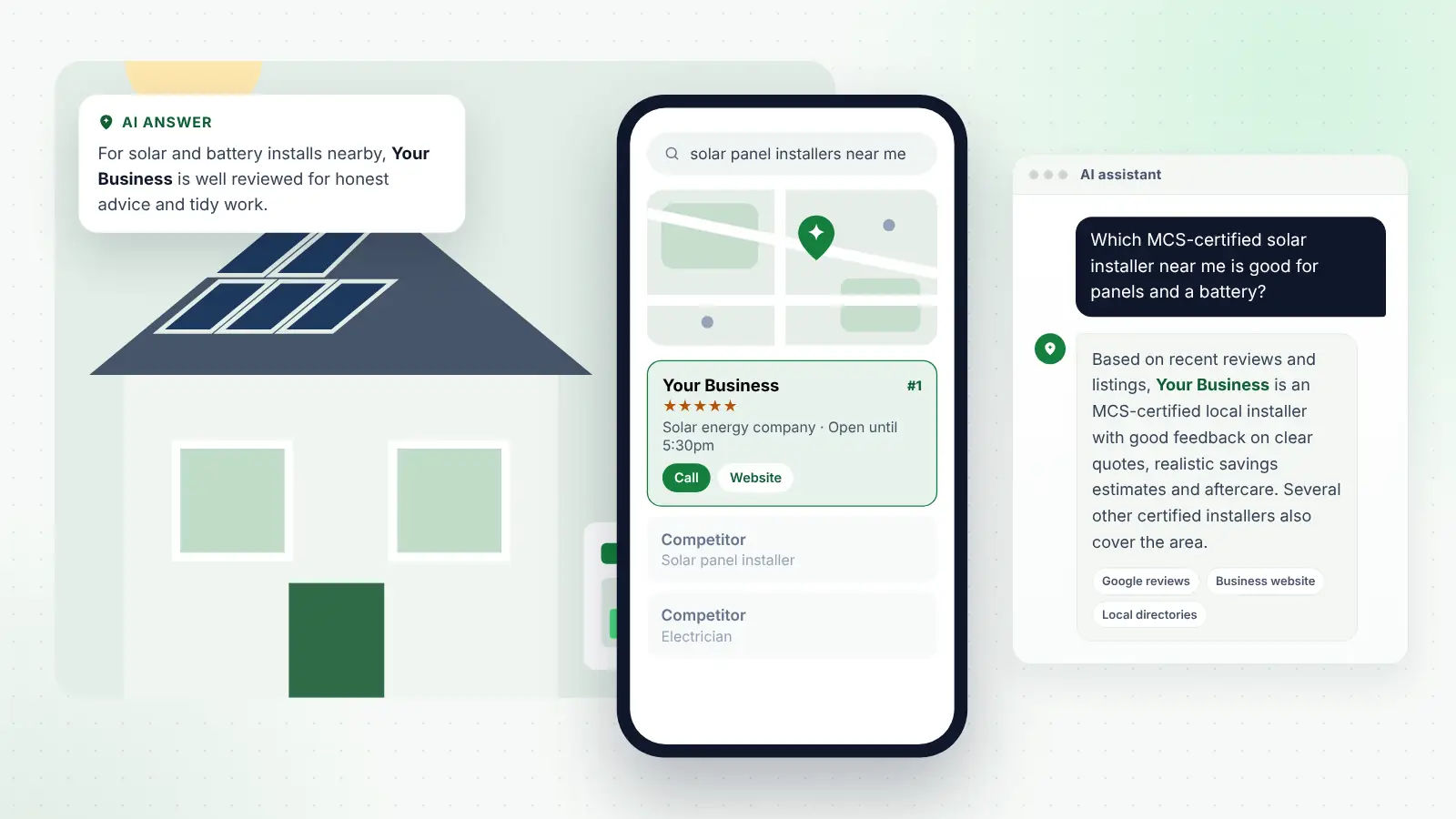
More homeowners are asking AI assistants about solar before contacting anyone. Typical questions include “Is it worth adding a battery to my existing solar panels?”, “Which MCS-certified solar installers near me have good reviews?”, “How does the Smart Export Guarantee work?” or “Who installs solar panels and EV chargers in [town]?” ChatGPT, Gemini, Perplexity, Microsoft Copilot and Google’s AI Overviews all answer questions like these, and often name specific businesses.
AI tools build answers from information they can find and trust: your website, Google profile, MCS and scheme listings, reviews on several platforms and mentions on reputable local and industry websites. Answer engine optimisation (AEO) means making that information complete, consistent and easy to understand.
For a solar installer, that means:
- Stating certifications clearly, including MCS, competent person scheme and any consumer code membership, in the same wording everywhere.
- Describing services precisely. “We design and install solar PV and battery systems for homes across [towns], including retrofit batteries for existing panels” gives an AI tool something concrete to work with.
- Answering real questions on your website. How long does installation take? Do I need scaffolding? What happens with the DNO? Will I get an MCS certificate? Brief, straight replies to these reassure homeowners and give AI assistants something solid to quote.
- Keeping claims realistic. Measured, well-explained information is more likely to be trusted and repeated than bold promises.
- Earning mentions on trusted sites, such as manufacturer installer directories, local news and community energy groups.
The aim is not to game AI tools. It is to make sure that when someone asks for a trustworthy local installer, the information about your business is accurate and persuasive.
Growing your solar business
Once the business is established, think about where to grow.
- Serve your existing customers. Batteries, EV chargers, system health checks and inverter replacements all build repeat work.
- Offer servicing for orphaned systems. Many homeowners have panels installed by firms that have since closed and need someone to look after them.
- Build trade partnerships. Roofers, builders, electricians and heating engineers all meet customers who are considering solar.
- Consider small commercial work. Farms, workshops and offices with daytime usage can be a strong fit, but need careful design and contracts.
Grow carefully. Taking on more work than your team can install well is a common way for solar businesses to damage their reputation.
Frequently asked questions
Do I need MCS certification to install solar panels?
It is not a legal requirement to install panels, but most domestic customers expect it. Small installations generally need MCS certification to qualify for Smart Export Guarantee payments, and many funding schemes and lenders expect it. Without MCS, you will struggle to win most domestic work.
Do I still need to join RECC or HIES?
Consumer code membership stopped being compulsory when MCS was redeveloped. Plenty of installers still choose to join because it reassures customers and provides access to dispute resolution. Check the requirements of any finance provider or funding scheme you work with.
Do I need DNO permission before installing?
It depends on the size of the system. Smaller systems can usually be connected under G98 with notification after commissioning, while larger systems, including some solar and battery combinations, need a G99 application approved before installation. Check with the DNO if you are unsure.
Will VAT go up on solar installations?
The current zero rate for qualifying residential installations in Great Britain is due to end on 31 March 2027, after which the 5% reduced rate is set to apply. Keep an eye on HMRC guidance in case anything changes.
How long before a new solar business is properly up and running?
It varies, but expect to spend several months on certification, scheme registration, insurance and supplier accounts before taking your first jobs. Building a steady flow of direct enquiries through reviews, referrals and local search usually takes longer.
Final thoughts
Starting a solar installation business is a realistic goal for qualified electricians and renewables engineers who are prepared to do things properly. Get certified, follow the DNO and building regulations processes, understand the VAT position and sell honestly. Then put real effort into being found — a complete Google profile, steady reviews, clear service pages and consistent information everywhere — so that homeowners and AI assistants both point towards your business when someone is ready to invest in solar.