A good dry cleaner or tailor becomes part of someone’s routine. They drop off shirts on a Monday, bring in a coat at the start of winter, need a hem taken up the week before a wedding and come back years later with a christening gown. The shops that grow are rarely the cheapest. They are the ones customers trust with clothes they care about, who explain honestly what can and cannot be done and who make it easy to keep coming back.
The trade has changed, though. Hybrid working means fewer suits and shirts coming over the counter, collection apps compete for busy customers, and many people now find a cleaner by searching on their phone or asking an AI assistant rather than walking past a shop. If your business is hard to find online, or your website says little about services, prices and turnaround, people go elsewhere without knowing you exist.
This guide covers your service mix, pricing, permits, solvents and green claims, care labels and damage claims, commercial contracts, collection and subscriptions, reviews, and how to appear in local search and AI recommendations.
Key points
- Balance everyday work such as shirts and service washes with higher-value items such as duvets, wedding dresses and alterations.
- Dry cleaning with organic solvents usually needs an environmental permit from your local council in England and Wales.
- Describe wet cleaning and alternative solvents accurately, and avoid broad green claims you cannot back with evidence.
- Inspect and record garments at the counter, because clear tickets and risk notes prevent most damage disputes.
- Commercial contracts, collection services and subscriptions can smooth out seasonal peaks and dips.
- A full Google profile, reviews that mention specific garments and a page for each cleaning service make your shop easier for Google Maps and AI assistants to suggest.
In this guide
- Balance shirts, alterations and specialist cleaning
- Pricing and turnaround
- Permits and solvents
- Wet cleaning, alternative solvents and green claims
- Care labels, inspection and damaged garments
- Trade associations and credentials
- Commercial laundry contracts
- Collection, delivery, apps and subscriptions
- Reviews and recommendations from regulars
- Local SEO for dry cleaners and tailors
- AI search: when customers ask who can clean a wedding dress
- Frequently asked questions
- Final thoughts
Balance shirts, alterations and specialist cleaning
Most successful shops combine three kinds of work: everyday items that bring people in regularly, specialist items that raise order values, and alterations that give customers a reason to choose you over a cleaner without a tailor.
| Service type | Examples | Why it matters |
|---|---|---|
| Everyday cleaning | Shirts, suits, dresses, service washes | Regular visits and predictable income |
| Bulky household items | Duvets, pillows, curtains, throws | Higher order values and seasonal demand |
| Specialist cleaning | Wedding dresses, leather, suede, silk | Fewer competitors and strong word of mouth |
| Alterations and repairs | Hems, zips, taking in, invisible mending | Often urgent, and builds loyalty |
| Commercial work | Hotels, salons, gyms, restaurants | Contracted volume outside retail peaks |
Service washes suit students, busy families and people without a tumble dryer. Duvets and curtains are hard to clean at home and are often needed quickly, before guests arrive or at the end of a tenancy, so say which sizes and fillings you accept. Alterations are searched for at short notice, usually with an event in mind, and a perfect fit is exactly what people mention in reviews. If you have no tailor in-house, a reliable partnership with a local seamstress can work, as long as you are clear about timescales.
Review your till data every few months. A service you barely promote, such as zip replacement or duvet cleaning, may deserve a place on your window, website and Google profile.
Pricing and turnaround
Customers compare dry cleaners on price, speed and trust, and missing information makes them assume the worst. Publish guide prices for the items people ask about most:
- Common items: shirts, two-piece suits, trousers, dresses and coats.
- Household items: duvets by size, and curtains by size or weight.
- Alterations: trouser hems, sleeve shortening, zip replacement and taking in a dress.
- Specialist items: “from” prices for wedding dresses and leather, noting that fabric, detail and condition affect the final price.
- Turnaround: your standard time, any same-day or express service and its cut-off.
Prices vary by area, fabric and the amount of hand finishing involved, so set yours on your real costs rather than copying a competitor. Under the Digital Markets, Competition and Consumers Act 2024, the headline price must include any mandatory charges, so do not add unavoidable extras at the counter.
Tip
Show your same-day cut-off on your Google profile, website and window, for example “in by 9am, ready by 5pm”. Customers searching in a hurry choose the shop that tells them clearly it can help.
Permits and solvents
If you run dry cleaning machines that use organic solvents, you will usually need an environmental permit. In England and Wales, dry cleaning is regulated under the Environmental Permitting (England and Wales) Regulations 2016, and permits for high street dry cleaners are issued and inspected by the local council, usually its environmental protection team. Government process guidance for dry cleaning sets out the standards councils expect.
A permit application and its conditions typically cover:
- Each machine and the solvent it uses, such as perchloroethylene (perc) or a hydrocarbon solvent.
- How solvents, residues and waste are stored.
- A maintenance and checking schedule for each machine.
- Records of the weight of garments cleaned and the solvent used.
- Training for staff who operate the machines.
Councils charge an application fee and an annual subsistence charge. If you are buying an existing business, check the permit is in place and will transfer to you. If you are adding a machine, changing solvent or moving premises, speak to your council first, as the permit may need varying. Scotland and Northern Ireland have their own regimes, so check with the relevant regulator. Good solvent records have a practical benefit too: a machine using more solvent than usual often has a maintenance problem.
Wet cleaning, alternative solvents and green claims
Many customers now ask what chemicals are used on their clothes. More shops offer professional wet cleaning, which uses water, specialist detergents and controlled machines to clean garments traditionally dry cleaned, and others use alternatives to perc. These can be a genuine point of difference, but how you describe them matters.
Environmental claims must be accurate, clear and not misleading under UK consumer law, and the Competition and Markets Authority’s Green Claims Code explains what that means: claims should be truthful, clear, complete, fair in any comparison, consider the full life cycle and be backed by evidence. For a dry cleaner, that means:
- Describe what you actually do. “We offer professional wet cleaning for suitable garments” is clear and verifiable.
- Avoid vague labels. “Eco”, “green” or “chemical-free” are hard to substantiate, and water-based cleaning still uses detergents and energy.
- Be honest about scope. If only some garments are wet cleaned, say so.
- Keep evidence. Keep supplier information for your solvents, detergents and equipment.
Explaining which method suits which garment, and why, persuades customers and AI tools far more than a green badge.
Care labels, inspection and damaged garments
Most disputes start with a garment that was already fragile, mislabelled or stained before it reached you. A careful intake routine protects your customers and your reviews.
Inspect at the counter
Check items in front of the customer where you can. Look for stains, worn areas, loose buttons, beading and missing care labels, and ask what caused any stain and how old it is. Note anything significant on the ticket, and agree a risk note before accepting higher-risk items, such as heavily embellished dresses or garments with no label. Photographing high-value items at drop-off takes seconds and can settle a dispute later.
Read care labels, but use your judgement
Care labels give the manufacturer’s guidance, usually with standard symbols for washing, drying, ironing and professional cleaning. Follow them, and be wary of items marked “do not dry clean” or with no label at all. Labels are sometimes wrong, so testing a hidden seam, or declining a job, beats guessing.
Your legal duty
Under the Consumer Rights Act 2015, a service must be performed with reasonable care and skill, and a notice saying you accept no responsibility does not remove that duty. Where damage is your fault, compensation is generally based on the item’s value when handed in, allowing for age and condition, rather than the cost of a new one. Where a garment was faulty or wrongly labelled, responsibility may lie with the retailer or manufacturer. Display a short complaints procedure at the counter and online, respond quickly and keep a record of what was agreed.
Trade associations and credentials
Association membership can reassure customers, but the picture has changed. The Textile Services Association (TSA) is the trade body for the UK textile care industry and now focuses mainly on commercial laundries and textile rental. It previously supported dry cleaners with a code of practice and dispute service, but its dry cleaning members transferred to UK Fashion and Textile (UKFT) in 2018, and UKFT announced in early 2021 that it would no longer represent dry cleaners.
So before you mention a code of practice or display a logo, check exactly what you currently belong to and what it covers, and remove old stickers and badges. The Guild of Cleaners and Launderers, a registered charity, offers education and qualifications in garment care. Other trust signals worth showing include staff training, insurance for customers’ goods, your complaints procedure, real photographs of your team at work and how long you have traded locally.
Commercial laundry contracts
Commercial customers give you steady volume when retail work is quiet. Hotels and guest houses need bed linen and towels, salons and gyms need towels, restaurants need table linen and chef whites, and care providers need resident clothing returned to the right person.
- Know your capacity. Volumes can be large and urgent, so be realistic about machines, staff and vans before you quote.
- Price clearly. Per item or per kilo, with collection frequency, turnaround, minimum volumes and charges for lost items.
- Agree the schedule in writing. Reliability matters more to most businesses than a small saving.
- Track every batch. Counting items in and out avoids arguments about missing towels.
- Ask about hygiene requirements. Healthcare and care providers may have specific infection control expectations.
A dedicated commercial laundry page listing the sectors and areas you serve helps local businesses find you.
Collection, delivery, apps and subscriptions
Collection apps have shown that many customers will pay for convenience, but you do not need your own app to compete. An online booking form, text confirmations and a clear collection area are often enough.
- Define your collection area by postcode or town, and the days you cover each.
- Set a minimum order or delivery charge so short trips stay worthwhile.
- Offer subscriptions or bundles, such as a weekly shirt plan or monthly service wash.
- Open accounts for local businesses and regular households.
- Consider drop points at offices or gyms.
Your terms should cover cancellations, missed collections and items left uncollected. Keep subscriptions simple, make cancelling easy and remind customers before renewals, as new subscription contract rules under the Digital Markets, Competition and Consumers Act 2024 are expected to come into force in 2027.
Reviews and recommendations from regulars
A review saying “they got a red wine stain out of my wedding dress” or “my trousers were taken up in a day and fit perfectly” says far more than a star rating, and helps AI assistants match you to specific questions. Ask at collection, when the customer sees the result, with a direct link to your Google review form.
Never offer incentives for positive reviews, never write reviews yourself or ask staff to, and reply politely to every review, including critical ones. The Digital Markets, Competition and Consumers Act 2024 bans fake reviews, so a steady flow of genuine ones is the only safe approach. Bridal shops, menswear retailers, wedding venues and letting agents can also bring regular referrals.
Local SEO for dry cleaners and tailors
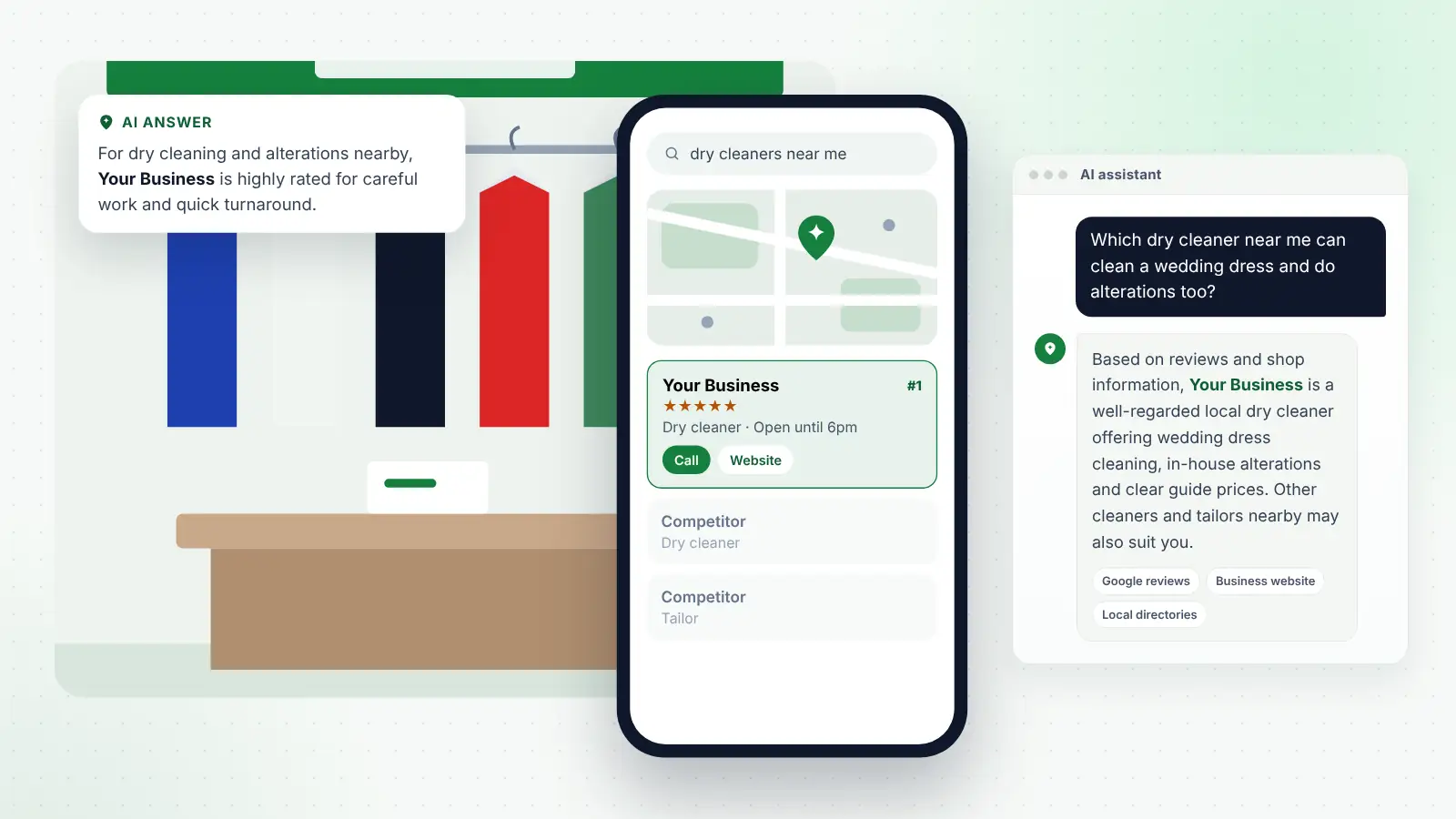
When someone searches “dry cleaners near me”, “alterations near me”, “duvet cleaning [town]” or “same day dry cleaning”, Google shows a map with a small number of businesses. Most customers want a shop close to home or work, so those map positions decide where many people take their clothes, often for years.
The essentials of local SEO for a dry cleaner or tailor are:
- A complete Google Business Profile. Choose the most accurate primary category, such as Dry cleaner, Laundry or Tailor, add secondary categories that genuinely apply, and fill in hours, services and collection area.
- Real photographs, added regularly. Your shop front, counter, team at work and finished items, such as a boxed wedding dress.
- Steady, detailed reviews. A regular flow of genuine reviews, with replies, matters more than a sudden burst.
- Consistent details everywhere. Name, address, phone number and hours should match across your website, Google, Apple Maps, Bing and directories.
- A page for each service. Dry cleaning, shirts, service washes, duvets and curtains, wedding dresses, leather, alterations, collection and commercial laundry, each with guide prices and turnaround.
- Local links. Mentions from wedding suppliers, business groups, community websites and local news.
If you would rather have specialists handle this, our local SEO for dry cleaners and tailors covers your profile, listings, service content and links on a rolling monthly plan.
Common mistakes include Google hours that do not match the shop on bank holidays, no prices anywhere online, alterations buried at the bottom of the page and no mention of collection areas.
Tip
Add alterations as a named service on your Google profile and give it its own page. Many people search for a tailor separately and never realise their dry cleaner can help.
AI search: when customers ask who can clean a wedding dress
More people now ask AI assistants such as ChatGPT, Gemini, Perplexity, Copilot and Google’s AI Overviews practical questions in full sentences: “who can clean and box a wedding dress near me?”, “where can I get a duvet cleaned by tomorrow in [town]?” or “is there a tailor near me who can take in a suit jacket?”
These tools draw on information they can cross-check across the web, and tend to favour businesses with consistent details, specific reviews and clear websites. For a dry cleaner or tailor, that means:
- Clear service descriptions. What you clean and alter, what you specialise in and what you do not accept.
- Helpful FAQs. Turnaround, stain removal, care labels, wedding dress preservation and how collection works.
- Guide prices and turnaround. AI assistants can only repeat information they can find.
- Current information. Old hours or out-of-date association badges can be repeated back to customers.
- Mentions on reputable sites. Local directories, wedding supplier lists and local news.
No one can guarantee an AI assistant will recommend you, but the work that makes your shop easy to choose is what these tools rely on. Ask a few typical questions yourself every few months to see how you are described.
Frequently asked questions
Do I need a permit to run a dry cleaners?
In England and Wales, high street dry cleaners using organic solvents usually need a permit from their local council under the Environmental Permitting Regulations. Check with your council before you start, buy a business, change solvent or replace machines.
Am I liable if a garment is damaged during cleaning?
You must carry out the service with reasonable care and skill, and a disclaimer notice does not remove that duty. If the damage is your fault, compensation is usually based on the item’s value when handed in. If the garment was faulty or wrongly labelled, responsibility may lie elsewhere.
Can I advertise my shop as eco-friendly?
Only if you can back the claim with evidence and make clear what it covers. Describing specific methods, such as wet cleaning for suitable garments, is safer and more useful than broad words like “eco”.
How long does local SEO take to work for a dry cleaner?
A refreshed profile and corrected listings can bring extra counter trade within a few weeks. Stronger map rankings and AI visibility usually build over three to six months, so start ahead of busy periods such as wedding season.
Final thoughts
Independent dry cleaners and tailors do not need the biggest shop or the latest app to thrive. They need careful work, honest prices and turnaround, a fair way of handling problems and a reputation customers share with friends. When your Google profile, website and reviews tell that story, customers and AI assistants are far more likely to point people to your counter. Start with an accurate profile, a published price list and a simple review request at collection.