Touring caravans and motorhomes are among the largest purchases many households ever make, and buyers rarely rush them. They spend months comparing layouts, berths and weights, visiting shows and reading owners’ forums before they choose a dealer. When they do buy, they are often buying into a long relationship: annual habitation services, repairs, accessories, storage and, a few years later, a part-exchange for the next one.
That makes a well-run dealership a business built on trust and repeat custom rather than one-off sales. It also brings responsibilities that general car dealers do not face, from gas and electrical safety on living accommodation to questions about whether a buyer can legally tow or drive what they are buying. If you already run a used car forecourt, much of the consumer law and finance regulation will be familiar, but the product, the buying journey and the aftercare are quite different.
This guide covers the main steps to starting a caravan and motorhome dealership in the UK, from choosing what to sell and setting up a workshop to industry schemes, licence questions, pricing rules and getting found by local buyers and owners.
Key points
- Decide early whether you will sell touring caravans, motorhomes and campervans, or both, because the stock values, buyers and workshop needs differ considerably.
- A workshop is central to the business: habitation services, damp repairs and accessory fitting bring owners back every year and smooth out seasonal sales.
- The National Caravan Council (NCC) runs an Approved Dealer scheme and, with the two major owners’ clubs, the Approved Workshop Scheme, both widely recognised by buyers.
- Buyers need clear, careful guidance on towing and driving licences, weights and payload, but you should never tell a customer what their own licence allows without checking.
- Arranging finance needs FCA authorisation, and advertised prices must include every compulsory fee under the Digital Markets, Competition and Consumers Act 2024.
- Buyers research for months and owners search locally every year, so a strong Google Business Profile, detailed reviews and clear website content matter as much as your stock listings.
In this guide
- Decide what kind of dealership you want to run
- Premises, insurance and the practical set-up
- Sourcing stock and checking every unit
- Your workshop: habitation checks, servicing and repairs
- Industry schemes and trust signals
- Licences, weights and towing: helping buyers safely
- Your legal duties when you sell
- Finance and on-the-road pricing
- Startup costs
- Seasonality and keeping the business steady
- Local SEO: getting found by local buyers and owners
- AI search: how buyers now ask for a dealer
- Frequently asked questions
- Next steps
Decide what kind of dealership you want to run
Leisure vehicle dealers vary widely, and your focus shapes your premises, capital and staffing.
- Touring caravans. Lower values than motorhomes and a strong used market, but each sale usually needs advice about the buyer’s tow car, weights and licence.
- Motorhomes. Higher values and margins per unit, with more capital tied up in stock. Buyers often travel long distances for the right layout.
- Campervans and van conversions. A popular market with younger buyers and couples, ranging from manufacturer models to converter-built vans.
- Franchised new dealer. Selling one or more manufacturers’ new ranges, which usually means meeting the manufacturer’s standards for premises, training and workshop.
- Used specialist. Buying and selling pre-owned vans, often with a strong part-exchange and sale-or-return offer.
- Workshop-led business. Starting with servicing, repairs and accessories, then adding sales once you have a customer base.
Many independents start with used tourers and a workshop, because the stock values are more manageable and the workshop builds a customer list from day one. Motorhomes and new franchises can follow once you have the capital and a reputation.
Premises, insurance and the practical set-up
Site and planning
Caravans and motorhomes take up a lot of space. You need room to display stock with enough space between units for buyers to walk around and open doors, room to manoeuvre, a secure compound and ideally covered space for preparation and handovers. Check with the local planning authority that your site has the right use before you sign a lease, as sales, storage and workshop activity may each be treated differently, and some sites have conditions on signage, lighting or opening hours.
Security
Leisure vehicles are an obvious target for theft. Most dealers invest in perimeter fencing, gated access, CCTV, good lighting and wheel clamps or hitch locks on stock. Your insurer is likely to set minimum security requirements, so ask before you commit to a site.
Insurance and trade plates
You will need motor trade insurance that covers the vehicles and caravans you hold, staff and customer test drives of motorhomes, and towing stock on the road, along with premises, public liability and employers’ liability cover. Policies vary, so check exactly who can drive, what can be towed and what is covered while units are on site. Trade plates from DVLA can be used on untaxed motorhomes for limited business purposes, just as with cars, provided the vehicle is roadworthy and insured.
Business structure and VAT
Most dealers trade as a limited company once stock levels grow. VAT on used caravans and motorhomes is often handled through a second-hand margin scheme, but the rules are detailed and the values involved are high, so take advice from an accountant who knows the motor or leisure trade before you start buying stock.
Sourcing stock and checking every unit
Profit is largely made when you buy. Common sources include:
- Part-exchanges from your own customers, often the best stock you will get because you can see its history.
- Buying direct from owners through a “sell your caravan” or “sell your motorhome” page on your website.
- Sale or return, where you sell an owner’s van for an agreed fee or margin.
- Trade-to-trade sales and auctions, including part-exchanges franchised dealers do not want.
- New stock ordered from manufacturers if you hold a franchise, usually with stocking finance.
History checks and CRiS
Touring caravans are not registered with DVLA, so there is no V5C logbook. Instead, UK-built tourers are registered on CRiS, the Central Registration and Identification Scheme, which was set up by the National Caravan Council in 1992. Each caravan carries a 17-digit Vehicle Identification Number, and the registered keeper receives a CRiS registration document. Before you buy a used tourer, run a CRiS history check to see whether it is recorded as stolen, written off or subject to outstanding finance, and make sure the VIN on the van matches the paperwork. Many caravan insurers expect CRiS registration, so record changes of keeper when you sell.
Motorhomes are road vehicles, so they have a V5C and an MOT history like a car, and the usual vehicle history checks apply. Check both the base vehicle and the habitation area: a motorhome can have a perfect engine and a damp problem that costs more to put right than the margin on the sale.
Damp and pre-sale preparation
Water ingress is the issue buyers worry about most, and for good reason. Every used unit should have a damp test with readings recorded, along with a check of the gas system, electrics, water system, appliances, windows, seals, tyres, chassis and running gear. Record what you test, what you find and what you put right.
Tip
Give every used caravan and motorhome a written pre-sale report, including damp readings and the date of its last habitation service, and hand a copy to the buyer. It helps you sell with confidence, reassures cautious buyers and gives you evidence if a dispute arises later.
Your workshop: habitation checks, servicing and repairs
A good workshop is what turns a one-off sale into a customer for many years. Typical work includes:
- Habitation checks and services. An annual inspection of the living area, covering gas, electrics, water, appliances, ventilation, fire safety and damp. Many manufacturers’ bodyshell or water ingress warranties depend on regular habitation servicing, so owners have a strong reason to book.
- Running gear servicing. Brakes, hitch, axle and suspension on touring caravans.
- Damp and bodywork repairs. Often the most specialist and valuable work you will do.
- Accessory fitting. Motor movers, solar panels, trackers, awnings, bike racks and leisure batteries.
- Pre-delivery inspections on new stock, and preparation of used units for sale.
- Motorhome base vehicle servicing and MOTs, which some dealers do in-house and others subcontract to a local garage.
Gas and electrical work on leisure vehicles needs technicians with the right training and competence, so build this into your hiring and budget for ongoing training. Mobile engineers can extend your reach to owners who keep their vans in storage or on seasonal pitches.
The Approved Workshop Scheme
The Approved Workshop Scheme (AWS) is a collaboration between the National Caravan Council, The Caravan and Motorhome Club and The Camping and Caravanning Club. Member workshops, fixed and mobile, are independently assessed and agree to a code of practice covering things such as published prices and labour rates, written estimates, using genuine parts where available and not carrying out work without the customer’s authority. Many owners specifically look for an AWS workshop for their habitation service, so it is worth working towards membership early.
Industry schemes and trust signals
Buyers of leisure vehicles are cautious and well informed, and many belong to an owners’ club. Recognised schemes help a new dealer earn trust before the reviews build up.
- NCC Approved Dealer. The National Caravan Council runs an Approved Dealer scheme for businesses selling touring caravans and motorhomes, with dealers assessed against the scheme’s standards. Approved status is a signal many buyers recognise.
- Approved Workshop Scheme. As above, for servicing and repairs.
- NCC approved vans. New caravans and motorhomes carrying the NCC approved badge were certified as meeting the relevant industry construction standards in force when they left the factory, which you can explain to buyers.
- Manufacturer franchises. If you hold one, show which brands and what that means for warranty work.
- FCA authorisation. If you arrange finance, show your firm reference number.
The NCC’s consumer information pages explain these schemes to buyers, so it is worth linking to them from your own website.
Licences, weights and towing: helping buyers safely
More sales are complicated by licences and weights than by price. You will be asked these questions daily, and the answers matter.
Towing a caravan
Since 16 December 2021, drivers in England, Scotland and Wales who passed a car test have been able to tow a trailer up to 3,500kg maximum authorised mass (MAM) with a category B licence, with BE added to licences automatically. Northern Ireland has separate rules. Beyond the licence, buyers need a tow car with a suitable towing limit, and clubs and towing experts generally advise keeping a caravan’s actual laden weight well below the car’s kerbweight, especially for less experienced towers. Explain the difference between a caravan’s mass in running order, its maximum technically permissible laden mass (MTPLM) and its payload, because buyers often underestimate how quickly payload is used up.
Driving a motorhome
A category B licence covers motorhomes up to 3,500kg MAM. Heavier motorhomes, up to 7,500kg, need category C1. Drivers who passed their car test before 1 January 1997 usually have C1 entitlement, although they may lose it at 70 unless they renew it with a medical. Drivers who passed later need to take a separate C1 test. Some motorhomes can be downplated to 3,500kg, but this must be done properly and registered with DVLA, and it reduces payload, so it is not always practical.
In June 2025 the rules changed to let category B licence holders drive some zero-emission vehicles up to 4,250kg without extra training, mainly aimed at electric vans. Whether this applies to a particular electric motorhome depends on the vehicle and the rules at the time, so check the latest gov.uk guidance before giving any advice. Petrol and diesel motorhomes over 3,500kg still need C1.
Tip
Train your sales team to ask buyers to check their own licence entitlement on DVLA’s online service rather than relying on memory. A sale that falls through at handover because the customer cannot legally drive or tow the van costs you far more than a careful conversation at the start.
Your legal duties when you sell
When you sell a caravan or motorhome to a consumer, the Consumer Rights Act 2015 applies. The goods must be of satisfactory quality, fit for purpose and as described, taking into account age and price. Buyers have a short-term right to reject faulty goods within 30 days, after which you usually get one opportunity to repair or replace, and faults that appear within six months are presumed to have been present at the time of sale unless you can show otherwise. A “sold as seen” sign does not remove these rights.
Damp is the classic dispute. A buyer who discovers water ingress a few months after purchase may well be entitled to a repair or more, which is another reason to test carefully and record the results. If you sell online with remote handover or delivery, buyers usually also have a 14-day right to cancel under the Consumer Contracts Regulations.
The handover
A proper handover is part of the product. Walk buyers through the gas system, water, electrics, heating, appliances, hitching and unhitching or the motorhome’s cab controls, and leave written instructions. Many dealers allow two to three hours. Rushed handovers are one of the most common causes of complaints and poor reviews in the industry.
Finance and on-the-road pricing
Credit broking
Many buyers use finance, and introducing customers to a lender is a regulated activity called credit broking, which needs FCA authorisation. The FCA has published guidance for motor dealers applying for credit broking permission, and dealers who own the goods they sell can often apply for limited permission as a secondary credit broker. Some dealers start as an appointed representative of an authorised firm instead. Be clear with customers that you are a broker, which lenders you use and how you are paid, and remember that the Consumer Duty requires finance to offer fair value. Taking part-exchanges that still have outstanding finance can bring in further permissions such as debt adjusting, and selling GAP or other insurance products may need further permissions too.
All-in prices
Leisure vehicle dealers have traditionally added charges for delivery, preparation, handover packs or “on-the-road” costs. Under the Digital Markets, Competition and Consumers Act 2024, drip pricing is banned: any compulsory charge must be included in the price you advertise, not revealed later in the buying process. Genuinely optional extras, such as a motor mover, awning or extended warranty, can be priced separately if you say clearly that they are optional. The Competition and Markets Authority can now fine businesses directly for breaches, so review your price boards, website and listing site adverts together.
Startup costs
Costs vary enormously by location, site and the type of stock. Treat these as rough guides only.
| Item | Rough guide | Notes |
|---|---|---|
| Stock | The largest cost by far | Motorhomes tie up far more capital than tourers |
| Premises and compound | Varies widely by area | Space, access and planning use matter most |
| Security | Varies by site | Fencing, gates, CCTV and lighting |
| Workshop equipment | Varies by scope | Damp meters, gas and electrical test kit, lifting and jacking |
| Technician training | Ongoing cost | Gas, electrical and habitation competence |
| Motor trade insurance | Varies by cover and drivers | Check towing and test drive cover |
| FCA authorisation | Application fee plus annual fees | Or use an appointed representative route |
| Listing sites and shows | Often a major ongoing cost | Budget for at least one regional show |
| Dealer management software | Typically a monthly subscription | Stock, workshop booking and invoicing |
Seasonality and keeping the business steady
Sales of leisure vehicles are strongly seasonal, peaking in late winter and spring as buyers prepare for the touring season, with many new orders placed around the major shows. Summer can be busy with handovers and quick repairs, while late autumn and early winter are often quieter on the forecourt.
The workshop is your best defence. Habitation services can be booked year-round, and autumn and winter are good times to promote damp repairs, accessory fitting, winterising and storage. Some dealers also run open weekends, first-time buyer evenings or towing confidence sessions with a qualified instructor, which bring in people who are months away from buying but will remember who helped them.
Local SEO: getting found by local buyers and owners
Most buyers start on listing sites, manufacturer websites and forums, but very few buy without checking the dealer. They search your name, read your Google reviews, look at photos of your forecourt and workshop and check how far you are from home. Many also search “caravan dealers near me”, “used motorhomes for sale [county]”, “4 berth caravan [town]” or “caravan part exchange near me” to see who is within reach.
Owners search locally too, and they do it every year: “caravan habitation check near me”, “motorhome service [town]”, “mobile caravan engineer”, “caravan damp repair” and “caravan storage near me”. These searches keep your workshop busy and introduce you to future buyers who bought their current van elsewhere.
Google Business Profile
- Choose the most accurate primary category, such as caravan dealer or recreational vehicle dealer, and add secondary categories only where they genuinely apply, such as a repair or storage category if you offer those services.
- Add accurate opening hours, including weekends and any seasonal changes, and keep workshop hours clear if they differ.
- Upload real photos of your forecourt, interiors of stock, your workshop, your accessory shop and your team, and refresh them regularly.
- Link to your stock pages and add a way to book a viewing, a habitation service or a handover.
- Use posts to highlight new arrivals, open weekends, show offers and workshop availability.
Reviews
Ask every buyer for a review once they have used the van for their first trip, using a direct link in a follow-up message, and ask workshop customers after each service. Reviews that mention the handover, how problems were handled and the quality of workshop work are especially persuasive. Reply to every review calmly, including negative ones, and never offer incentives in exchange for positive reviews.
Matching dealer details on every listing site
Keep your business name, address and phone number identical on your website, Google profile, listing sites, manufacturer dealer locators, the NCC and AWS directories, social media and local directories. Inconsistent details confuse buyers and search engines alike.
Website pages
Your website should be more than a stock feed. Create clear pages for new caravans, used caravans, motorhomes, part-exchange and buying from owners, finance, habitation services, damp repairs, accessories, storage and your handover process. A plain-English guide to towing licences, weights and payload, linking to official guidance, can be one of the most useful pages on your site.
Local links
Links and mentions from local caravan sites, storage yards, owners’ club groups, local news, community events and touring publications show search engines you are an established local business.
Some dealers handle this themselves; others prefer specialists to manage it, which is where local SEO for caravan and motorhome dealers can help. Either way, stronger map rankings usually build over three to six months.
AI search: how buyers now ask for a dealer
Buyers increasingly ask AI assistants such as ChatGPT, Gemini, Perplexity, Microsoft Copilot and Google’s AI Overviews for help with big decisions. Their questions are often detailed:
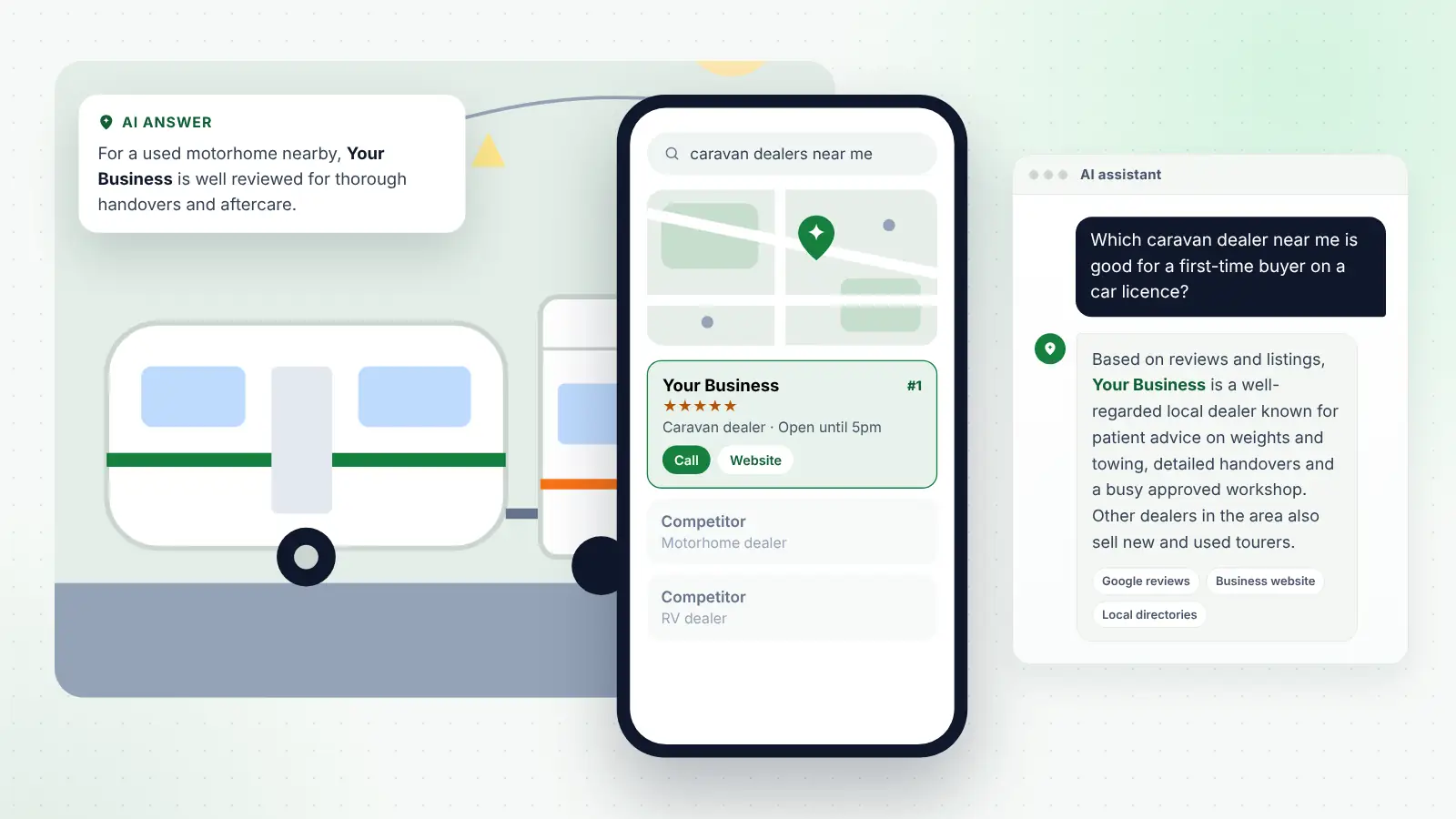
- “Which caravan dealer near me is good for a first-time buyer on a car licence?”
- “Where can I buy a used motorhome under 3,500kg near Harrogate with a damp report?”
- “Is there an approved workshop near Truro that does motorhome habitation checks?”
- “Which dealers in the Midlands give fair part-exchange prices on caravans?”
Answer engine optimisation, or AEO, is about making your dealership easy for these tools to understand and describe accurately. They tend to rely on:
- Consistent information about your location, opening hours, brands and services across your website, Google profile and directories.
- Reviews that mention specific experiences, such as handovers, damp checks, workshop quality and aftercare.
- Clear descriptions of what you sell and service, including tourers, motorhomes, campervans, storage and accessories.
- FAQs on your website answering the questions buyers ask, such as what a habitation check covers, whether you take part-exchanges with finance outstanding and what licence is needed for a heavier motorhome.
- Mentions on reputable sites, such as the NCC and AWS directories, manufacturer dealer locators, owners’ club pages and local news.
If you want to be recommended for lightweight tourers suitable for smaller tow cars, for example, say so clearly, list the models you stock and explain how you help buyers match a caravan to their car.
Frequently asked questions
Do I need a licence to sell caravans and motorhomes?
There is no general licence to sell leisure vehicles, but you need the right planning use for your site, suitable motor trade insurance and, to arrange finance, FCA authorisation for credit broking. You must also follow consumer law and pricing rules, and workshop staff need the right competence for gas and electrical work.
Is NCC Approved Dealer status worth having?
Many buyers recognise the scheme, and approved status can reassure people who have never heard of your business. It also shows a commitment to standards that helps with manufacturer franchises and owners’ clubs.
Do touring caravans have a logbook?
No. Touring caravans are not registered with DVLA. UK-built tourers are registered on CRiS instead, and the keeper holds a CRiS registration document. Always run a CRiS check before buying a used caravan.
Can my customers drive a motorhome over 3,500kg on a car licence?
Generally not. Most motorhomes over 3,500kg MAM need C1 entitlement, which many drivers who passed before 1997 have and later drivers must test for. The June 2025 change for some zero-emission vehicles up to 4,250kg is narrow, so check the current gov.uk guidance for any specific vehicle.
Are habitation checks a legal requirement?
There is no general legal requirement for a private owner to have a habitation check, but many manufacturer warranties depend on regular habitation servicing, and many owners and insurers expect it. That makes it one of the most reliable sources of repeat workshop work.
Next steps
Start by deciding what you will sell and finding a site with the space, security and planning use you need. Arrange motor trade insurance, build a workshop team with the right gas and electrical competence and work towards the Approved Workshop Scheme and NCC Approved Dealer status. If you plan to offer finance, start your FCA application or appointed representative arrangement early.
Then build trust: honest pre-sale reports, careful advice on licences and weights, all-in prices, thorough handovers and dependable aftercare, backed by a strong local presence on Google and across the web. Dealers who get these basics right tend to find that owners come back every year for their service, and again when it is time to upgrade.