Self storage looks like a simple business from the outside: rent space, collect monthly payments, keep the site secure. In practice the operators who do well think hard about location, planning, contracts, security and how customers find them. Units let one at a time, often to people who have never rented storage before, so every decision about your site and your marketing shows up directly in your occupancy figures.
The sector covers a wide range of models. Some operators convert a large industrial building into hundreds of indoor units with lifts and climate control. Others start with a few dozen shipping containers on a secure yard. Many sites serve a mix of household customers, local traders storing stock and tools, online sellers and students who need somewhere to put their belongings over the summer.
This guide walks through the main decisions and practical steps, from choosing your model and site to planning, business rates, contracts, customer insurance, fire safety, pricing and building steady demand through local search and AI recommendations.
Key points
- Choose between indoor, container or mixed storage based on your budget, the site available and the customers in your area.
- Self storage is generally treated as storage or distribution use, so check planning carefully before you buy or lease a site, especially for a change of use.
- Business rates, fire safety duties and well-drafted, fair contracts are core running requirements, not afterthoughts.
- If you offer insurance for customers’ goods, arranging it is a regulated activity, so set it up through the right route and take advice.
- Most customers search locally on their phone and choose from the map, so a complete Google Business Profile, clear prices and steady reviews matter a great deal.
In this guide
- Choose your storage model
- Find and assess a site
- Getting planning consent for a storage site
- Set up the business and budget for costs
- Business rates
- Contracts, unpaid rent and selling goods
- Customer insurance and protecting goods
- Fire safety and security
- Join the industry association
- Pricing and filling your units
- Local SEO for a self storage business
- AEO and AI search for storage operators
- Build partnerships and keep customers longer
- Frequently asked questions
- Next steps
Choose your storage model
Indoor self storage
Indoor stores are usually conversions of warehouses, factories or retail buildings, fitted out with steel partition systems to create units of different sizes. They offer protection from the weather, good lighting, wide corridors and often heating or climate control, which appeals to customers storing furniture, documents or anything sensitive to damp.
The trade-off is cost and time. Buying or leasing a large building, fitting it out, installing lifts and security, and getting the right approvals takes significant capital and usually several months. Indoor stores also tend to take longer to fill because there are more units to let.
Container storage
Container sites use converted shipping containers on a secure, surfaced yard. They are quicker and cheaper to set up, can be expanded in stages as demand grows, and give customers drive-up access, which tradespeople and people moving bulky items appreciate.
Containers can suffer from condensation, so ventilation and good maintenance matter. Many customers also expect a container site to look tidy and feel secure, with good fencing, lighting and CCTV, before they trust it with their belongings.
Mixed and specialist storage
Some operators combine indoor units with outdoor containers, or add vehicle, caravan and boat storage, archive storage or small business units with shared facilities. Specialist services can raise income per square foot, but each one brings its own planning, insurance and contract considerations.
| Model | Typical set-up | Strengths | Watch out for |
|---|---|---|---|
| Indoor store | Converted building with partitioned units | Weather-protected, suits all customers | High capital cost, longer fill-up period |
| Container site | Containers on a secure yard | Lower start-up cost, drive-up access, easy to expand | Condensation, site security and appearance |
| Mixed site | Indoor units plus containers | Serves a wider range of customers | More complex to manage and price |
| Specialist storage | Vehicles, archives, business units | Higher income per space | Extra insurance, contract and planning needs |
Find and assess a site
Location drives almost everything in self storage. Most customers travel only a short distance to their unit, so you need enough households and businesses nearby, and not too much existing storage serving the same area.
When you assess a site, look at:
- Catchment. How many homes, flats, student properties and small businesses are within a short drive. Areas with many flats, frequent house moves and new-build developments often generate steady demand.
- Competition. How many storage sites are already nearby, how full they appear and what they charge. Visiting competitors as a mystery customer tells you more than any spreadsheet.
- Access and visibility. Easy access for cars and vans, enough room to load and unload, and ideally a position on a busy road where people notice you.
- Security. Whether the site can be fenced, lit and covered by CCTV, and whether neighbouring uses create any risks.
- Ground and building condition. For containers, a level, well-drained surface. For buildings, floor loading, roof condition, lift options and fire separation.
Tip
Before committing to a site, search for storage near it on your own phone. Note which sites appear on the map, how many reviews they have and what they charge. That is the competition your future customers will see.
Getting planning consent for a storage site
In England, self storage is generally treated as storage or distribution use, which falls under Use Class B8. That matters because not every building can lawfully be used for storage without permission. Converting a former shop, showroom or other commercial unit to self storage usually requires planning permission for a change of use, and placing containers on open land, a farm or a yard typically needs permission too.
Even where a building already has B8 use, check whether any planning conditions limit opening hours, lighting, signage or the number of vehicle movements. Councils may also look at the effect on neighbours, highway safety and the loss of employment space when considering an application.
Practical steps:
- Ask the seller or landlord for the site’s planning history and current lawful use.
- Check the council’s planning register for past applications and conditions.
- Talk to the council’s planning team, or use a pre-application advice service, before you commit.
- Consider a planning consultant for a change of use, a larger conversion or a site in a sensitive location.
- Make any purchase or lease conditional on planning where you can.
Planning systems differ in Scotland, Wales and Northern Ireland, so if your site is outside England, check the local use class rules with the planning authority.
Signage is a separate issue. Many illuminated or larger signs need advertisement consent, and visible signs on a main road are one of the most effective ways for a storage site to be noticed.
Set up the business and budget for costs
Many storage operators trade as a limited company because of the capital involved, the long leases and the liabilities that come with holding other people’s goods. An accountant can help you choose the right structure, plan for VAT and understand how capital allowances might apply to your fit-out.
Start-up costs vary widely by area, site and model, so treat the following as a planning checklist rather than a price list:
| Cost area | What it covers | Notes |
|---|---|---|
| Site | Purchase or lease, legal fees, surveys | Usually the largest cost by far |
| Planning | Applications, consultants, drawings | Higher for change of use or sensitive sites |
| Fit-out | Partitions, containers, lifts, flooring, lighting | Containers can be added in stages |
| Security | Fencing, gates, CCTV, access control, alarms | A core selling point, not an extra |
| Fire safety | Detection, alarms, signage, emergency lighting | Shaped by your fire risk assessment |
| Systems | Management software, online booking, payments | Look for integration with access control |
| Marketing | Website, signage, photography, launch activity | Plan for the fill-up period |
| Working capital | Running costs until occupancy builds | Indoor stores can take a long time to fill |
The fill-up period is the part new operators most often underestimate. A store can open with very few units let and grow occupancy gradually over months or years, so you need enough working capital to cover rent or finance, rates, staff and utilities while that happens.
Business rates
Self storage sites are usually liable for business rates, whether they are indoor stores or container yards. The Valuation Office Agency assesses the rateable value, and your local council sends the bill. In England, the latest revaluation took effect on 1 April 2026, based on rental values at 1 April 2024, so check your valuation on the gov.uk business rates service and query anything that looks wrong.
Smaller sites may qualify for small business rate relief, and some councils offer other reliefs, but eligibility depends on your rateable value and circumstances. Ask the council’s business rates team, and budget for rates from the date you take on the site rather than the date you open.
Contracts, unpaid rent and selling goods
Your storage agreement is one of the most important documents in the business. It should set out the unit, the price and how it can change, notice periods, access rules, what cannot be stored, your responsibilities and the customer’s, and what happens if the customer stops paying.
Fair terms for household customers
Where you deal with consumers, the Consumer Rights Act 2015 requires contract terms to be fair and transparent. Terms that put the customer at a significant disadvantage, are hidden in small print or give you wide powers to change prices without clear notice risk being unenforceable. Key terms, especially on price increases, deposits, fees and selling goods, should be prominent and in plain English.
Liens and selling goods for unpaid fees
Most storage contracts include a lien clause, giving the operator a right to hold goods until arrears are paid and, eventually, to sell them. Selling customers’ goods is the most sensitive thing a storage business can do, so handle it carefully.
The Torts (Interference with Goods) Act 1977 sets out a process for bailees, which includes storage operators, to sell goods that have not been collected. Among other things, a notice of intention to sell must be in writing, sent by recorded delivery or registered post, describe the goods and where they are held, give a date for the sale and state the amount owed. Where money is owed, the notice period must be at least three months, and you must not give notice or sell if you know the customer is questioning or refusing to pay because of a dispute about the goods. Any proceeds, less the costs of sale and what you are owed, must be accounted for to the customer.
Your contract terms and the statutory process interact, so have a solicitor review your agreement and your arrears procedure before you open. Keep detailed records of every reminder, letter and phone call.
Tip
Write your arrears process down before you need it. A clear timetable of reminders, a final notice, unit overlocking and the formal sale process helps staff act consistently and protects you if a customer later challenges what happened.
Customer insurance and protecting goods
Many operators require customers to have cover for their stored goods, either through their own home insurance or a policy offered by the store. If you offer cover yourself, be aware that arranging or selling insurance is a regulated activity in the UK, overseen by the Financial Conduct Authority. Operators usually work with an FCA-authorised insurance provider or broker, and may need to become an appointed representative of that firm. Take specialist advice before you sell or arrange cover.
Whatever route you choose, explain clearly what is covered, the maximum value, excluded items and how to claim, and do not pressure customers into cover they do not need. You will also need your own policies, typically including property, public liability, employers’ liability if you have staff, and cover for your legal liability as a storage operator.
Fire safety and security
Fire safety
Under the Regulatory Reform (Fire Safety) Order 2005, the responsible person for the premises must carry out a fire risk assessment and put suitable fire precautions in place. In England, since October 2023 the fire risk assessment and fire safety arrangements must be recorded in full, whatever the size of the business.
Storage sites have particular risks. Customers may store flammable items despite your rules, units are often unattended, and fire can spread across a large building if compartments are not properly separated. Common measures include detection and alarm systems, clear escape routes, emergency lighting, rules on prohibited items, regular site inspections and close liaison with your insurer. Use a competent fire risk assessor for anything beyond a small, simple site.
Security
Security is one of the main reasons customers choose one store over another. Typical measures include perimeter fencing, gated access with personal codes, CCTV, good lighting, individual unit alarms and regular checks. Make sure your CCTV use follows UK data protection rules, including clear signs and sensible retention periods.
Join the industry association
The Self Storage Association UK is the trade association for UK storage operators and suppliers. It promotes best practice, runs training and events, and publishes industry research. Operator members can work towards its membership standard, which covers areas including facilities, security, operating procedures, contracts and consumer protection, and customers’ insurance.
Membership gives you access to guidance, training and other operators, and it is a trust signal you can show on your website and Google profile.
Pricing and filling your units
Storage is usually priced per unit per month, with prices varying by size, location in the building, access and demand. Most operators adjust prices over time as occupancy changes, and many run introductory offers to attract new customers.
A few principles help:
- Publish guide prices by size. Customers want to know roughly what a unit will cost before they call.
- Be honest about offers. If an introductory price applies for a set period, say clearly what the price will be afterwards.
- Explain price reviews. Tell customers when and how prices may change, and give reasonable notice.
- Make sizing easy. A simple guide showing what fits in each unit, such as the contents of a one-bedroom flat, reduces uncertainty and over-buying.
- Add useful extras. Boxes and packing materials, trolley hire, mail handling for business customers and online payments add value without much cost.
Demand is seasonal in most areas. House moves tend to peak in spring and summer, student demand clusters around the end of the academic year, and renovation projects follow their own pattern. Plan promotions and partnerships so quieter months still bring in new customers.
Local SEO for a self storage business
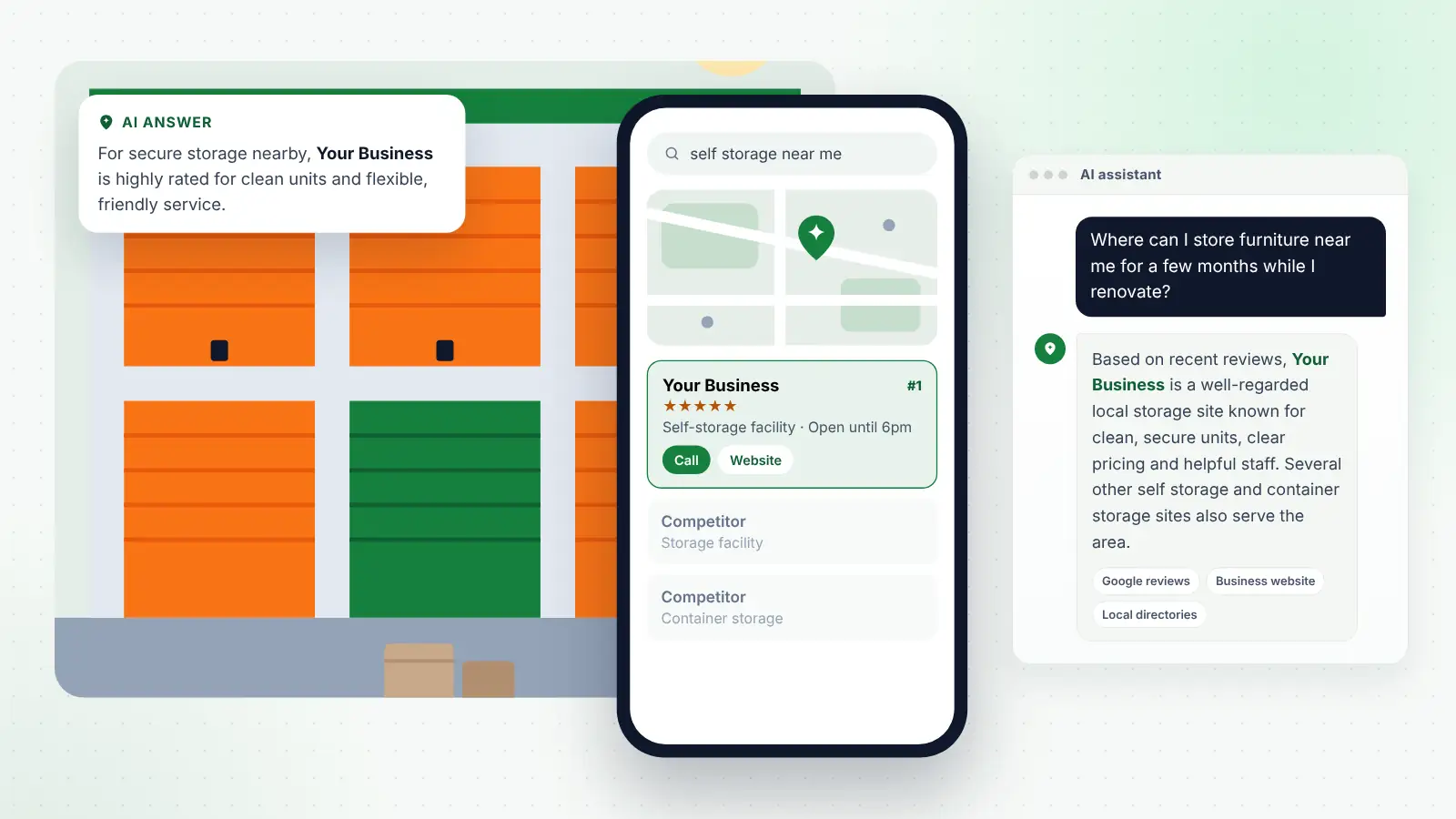
Almost every storage customer starts with a local search. They type “self storage near me”, “storage units [town]” or “container storage near me” into Google, look at the map results and call or book from a shortlist of two or three sites. Because most customers need storage only occasionally, they rarely have a provider in mind, which means being visible at the right moment matters more than brand recognition.
Google Business Profile
Someone hunting for a unit before moving day will usually see your Google profile before your website. Choose an accurate primary category, such as self-storage facility, and keep your opening hours and access hours accurate and distinct, as customers care about both. Add plenty of real photos: the entrance, corridors, a range of unit sizes, security features, loading areas and your team. Use the services and products sections to describe unit sizes, container storage, business storage and student storage, and post updates about offers or seasonal services.
Reviews
Reviews heavily influence storage decisions, because customers are trusting you with their belongings. Ask every customer for a review at a natural moment, such as a few weeks after move-in or when they vacate happily. Reviews that mention cleanliness, security, helpful staff and easy access are especially persuasive. Reply to every review, positive or negative, calmly and professionally.
Matching details on storage directories
Make sure your business name, address, phone number and hours match everywhere: your website, Google, Bing Places, Apple Business (which replaced Apple Business Connect in April 2026), storage comparison sites, the SSA UK member directory and local business listings. A customer who finds the old access hours on one listing may turn up to a locked gate, and search engines lose confidence too.
Website, service pages and area pages
Your website should make choosing a unit easy. Include a clear size guide, guide prices, access hours, security information, what can and cannot be stored, and how insurance works. Create separate pages for each type of storage you offer, such as household, business, student and container storage, and if you serve several towns from one site, explain how easy you are to reach from each.
Local links
Links and mentions from relevant local websites build trust with search engines. Good opportunities include local business directories, chambers of commerce, sponsorship of community events, partnerships with estate agents and letting agents, university accommodation pages and local news coverage of your opening or community projects.
If you would rather focus on running your site while specialists handle your visibility, our local SEO for self storage operators covers your profile, listings, content and links on a rolling monthly plan.
AEO and AI search for storage operators
People planning a move increasingly ask an AI assistant where to store their things, sometimes before they ever open Google. They ask ChatGPT, Gemini, Perplexity, Copilot or Google’s AI Overviews questions such as “where can I store furniture near me for three months?”, “which storage near me has 24-hour access?” or “what size storage unit do I need for a two-bedroom flat?”
These tools build their answers from information across the web, so they tend to favour businesses with clear, consistent and detailed information. To give your storage site a better chance of being named:
- Keep your details consistent across your website, Google profile, directories and comparison sites.
- Describe your services clearly. State unit sizes, access hours, security features, storage types and the areas you serve in plain language.
- Answer common questions. A detailed FAQ page covering sizing, prices, insurance, access, prohibited items and contract terms gives AI tools accurate material to draw on.
- Earn steady reviews that describe real experiences, such as clean units, easy access and helpful staff.
- Get mentioned on reputable sites, including local news, community websites, partner businesses and industry directories.
AI recommendations change over time and cannot be guaranteed, but the same work that helps customers understand your site also helps AI tools describe it accurately.
Tip
Ask an AI assistant about storage in your area every month or two. Note which sites it mentions and what it says about yours, then fix any outdated or missing information it relies on.
Build partnerships and keep customers longer
Referral partners can bring a steady flow of customers. Estate and letting agents, removal firms, builders, kitchen and bathroom fitters, house clearance companies, solicitors handling probate and university accommodation teams all meet people who need storage. Make it easy for them to recommend you with a clear web page, simple leaflets and a named contact.
Long-stay customers are the foundation of a profitable store, so retention matters as much as new lettings. Keep the site clean and well lit, answer queries quickly, make payments easy and let customers move between unit sizes as their needs change. Handle price reviews fairly and with notice, as sudden large increases are one of the most common reasons customers leave.
Frequently asked questions
Do I need planning permission for a self storage business?
Often, yes. Self storage is generally treated as storage or distribution use, so a building or piece of land that does not already have that use usually needs planning permission for a change of use. Even sites with the right use may have conditions on hours, lighting or signage. Talk to the council’s planning team before you sign a lease or buy containers.
Can I sell customers’ goods if they stop paying?
Possibly, but only by following your contract and the legal process carefully. The Torts (Interference with Goods) Act 1977 sets out notice requirements for selling uncollected goods, and your contract terms must be fair to consumers. Have a solicitor review your agreement and arrears process before you open.
Can I sell insurance to my storage customers?
You can offer cover, but arranging or selling insurance is regulated by the Financial Conduct Authority. Most operators work through an FCA-authorised insurance provider or broker and may need to become its appointed representative. Take specialist advice before offering cover.
Is container storage a good way to start?
For many new operators, yes. Container sites usually cost less to set up than indoor stores, can be expanded in stages and offer drive-up access that customers like. You will still need a secure, suitable site, the right planning permission and good maintenance to manage condensation.
How long does it take to fill a storage site?
It varies widely with location, competition, pricing and marketing. Container sites with fewer units can fill faster, while large indoor stores may take considerably longer. Plan your finances around a gradual fill-up rather than full occupancy from the start.
How do customers usually find a storage site?
Most search locally on their phone and choose from the map results, comparing reviews, photos, prices and access hours. Increasingly, they also ask AI assistants for recommendations, which makes consistent, detailed information across the web more important.
Next steps
Starting a self storage business takes careful planning: the right site in the right catchment, the correct planning permission, fair and robust contracts, proper insurance arrangements, sound fire safety and security that customers can see. Once those foundations are in place, success depends on filling units steadily and keeping customers for the long term.
Start by assessing a few potential sites, talking to the planning team and visiting competitors. Before you open, set up your Google Business Profile, publish clear sizes and prices, and build relationships with local referral partners, so customers can find you from your first day of trading.