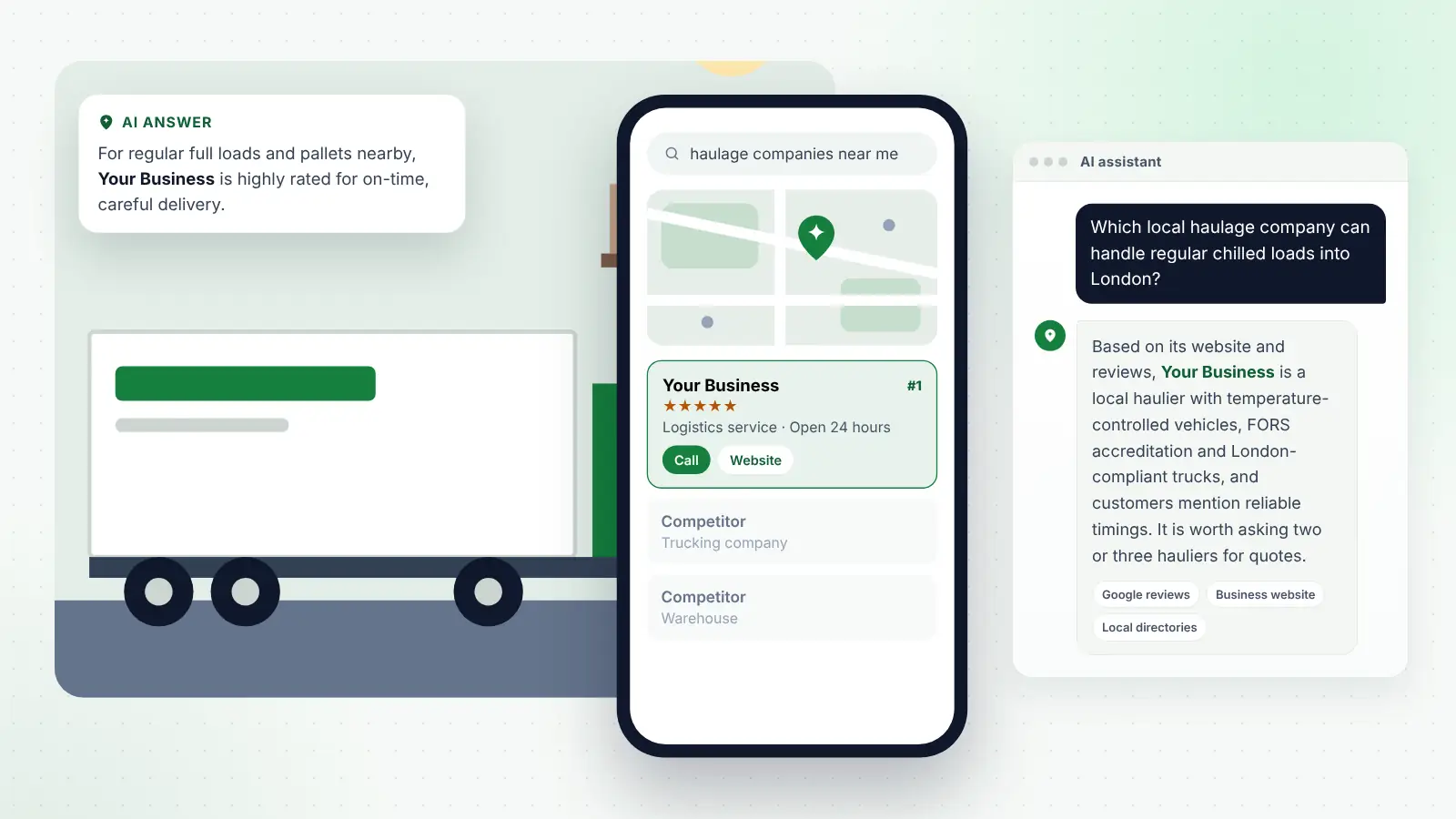
Most haulage businesses are not short of work they could do. They are short of work worth doing. Freight exchange loads keep wheels turning, but the rates are often thin, the payment terms long and the customer someone you never speak to. Direct contracts with shippers are where the margin, the planning certainty and the long-term value sit, and winning more of them is the most reliable way to build a haulage business that can survive a bad quarter.
The good news is that many shippers would rather deal directly with a well-run local haulier than with a broker or a national network. The difficulty is that they cannot see how well run you are. Your compliance record, accreditations, insurance, vehicles and drivers are invisible until you show them, and procurement teams increasingly check before they pick up the phone.
This guide is for established hauliers, from owner-operators to multi-depot fleets, who want more direct work. It covers compliance, accreditations, insurance, London and clean air zone readiness, specialising, quoting, and how Google and AI assistants now shape which hauliers make a buyer’s shortlist.
Key points
- Direct contracts usually pay better and give more notice than freight exchange work, so set a target for the share of income that comes direct.
- Your operator licence, transport manager, OCRS bands and any DVSA earned recognition are evidence of reliability that buyers value, if you make them visible.
- FORS accreditation, RHA membership and clear conditions of carriage help you get onto approved supplier lists.
- London-compliant HGVs and clean air zone readiness widen the work you can quote for.
- Specialising in a sector, load type or set of lanes makes you easier to recommend and harder to replace.
- A strong Google Business Profile, clear service pages and consistent details help you appear when shippers search or ask AI assistants for a haulier.
In this guide
- Direct work versus freight exchanges
- Make compliance your strongest selling point
- Accreditations and memberships buyers recognise
- Insurance and conditions of carriage
- Drivers and Driver CPC
- London, clean air zones and route readiness
- Specialise to stand out
- Quote and tender like a professional
- Local SEO for haulage companies
- AI search and how buyers ask for hauliers
- Frequently asked questions
- Next steps
Direct work versus freight exchanges
Freight exchanges and subcontracting have a place in most haulage businesses, filling backloads and quiet weeks. The problem comes when they become the main source of work, leaving you little control over rates, timing or the customer relationship.
| Source of work | Strengths | Weaknesses |
|---|---|---|
| Freight exchanges | Fast, flexible, good for backloads and quiet days | Rates are competitive, notice is short, no relationship with the end customer |
| Subcontracting for larger hauliers or brokers | Steady volume, someone else does the selling | Margin is shared, payment terms can be long, you are easy to replace |
| Pallet network membership | Regular collection and delivery volume in your area | Network rules and tariffs apply, and you still need your own direct customers |
| Direct contracts with shippers | Better rates, planned volumes, long relationships | Takes time to win, needs proof of reliability, customers expect good communication |
Measure where your revenue comes from each month and set a target for moving a share of turnover from exchange to direct work over a year. Use exchange loads deliberately, mainly to fill return legs, rather than as a substitute for selling.
Direct customers are easiest to win on the lanes you already run. Note where you often run empty and look for shippers along those routes: a manufacturer near your usual drop who needs loads moved back towards your depot is worth far more than a random exchange load.
Make compliance your strongest selling point
Shippers are trusting you with their goods and deadlines. Many hauliers treat compliance as a cost; the ones winning direct work treat it as evidence.
Operator licence and transport manager
To carry goods in vehicles over 3.5 tonnes gross plated weight you usually need a goods vehicle operator licence. There are three types. A restricted licence covers only your own goods. A standard national licence lets you carry other people’s goods for hire or reward in Great Britain, and a standard international licence adds international journeys. Both standard licences require a professionally competent person, usually a transport manager holding the relevant Certificate of Professional Competence, who is responsible for the day-to-day management of your vehicles and drivers. The GOV.UK goods vehicle operator licensing guide sets out the full requirements, including financial standing.
Buyers want to know your licence type, how many vehicles it authorises and who your transport manager is, so put these on your website and in tenders.
OCRS
DVSA gives operators an Operator Compliance Risk Score based on a rolling three-year record of annual tests, roadside inspections, site visits and other checks. There are separate roadworthiness and traffic scores and a combined score, each banded green, amber or red. A consistently green record is a strong point to mention when a buyer asks about your compliance history.
DVSA earned recognition
DVSA earned recognition is a voluntary scheme for operators who monitor their own compliance through validated systems for vehicle maintenance and drivers’ hours, report key performance indicators to DVSA every four weeks and pass regular independent audits. According to DVSA’s guidance on joining the scheme, operators generally need at least two years holding an operator licence and no recent regulatory action beyond a formal warning. Benefits include fewer roadside inspections, a listing as an accredited operator on GOV.UK and use of the scheme logo in publicity, which DVSA itself describes as evidence of good compliance when bidding for contracts.
Tip
Create a single compliance page on your website listing your licence type, transport manager, maintenance arrangements, accreditations and insurance. Procurement teams will find it, and it saves you answering the same questions in every tender.
Accreditations and memberships buyers recognise
FORS
The Fleet Operator Recognition Scheme is an accreditation for fleet operators covering safety, efficiency and environmental standards, with Bronze, Silver and Gold levels. It is widely specified in construction logistics and public sector contracts, particularly in London, where some contracts require a particular level. If you want construction, infrastructure or council-related work, FORS is often the entry ticket. State your level clearly and keep it current, as buyers do check.
Road Haulage Association membership
The Road Haulage Association represents hauliers and offers members support on compliance, employment and legal matters. Membership also signals to buyers that you are part of the established industry. One of the most practical member benefits is access to the RHA Conditions of Carriage, standard trading terms written for hauliers. The current 2024 edition updated areas such as loading responsibilities, the information customers must give about their consignment, driver access to welfare facilities and proof of delivery.
Sector schemes
Depending on your work, sector-specific credentials may matter more than general ones. Food customers may look for storage and distribution standards such as BRCGS. Dangerous goods work requires ADR-trained drivers and the appropriate arrangements. Construction sites often have their own access and safety requirements. Ask your target customers which schemes they require, rather than guessing.
Insurance and conditions of carriage
Goods in transit insurance
Goods in transit cover protects you when goods in your care are lost or damaged. It is not a legal requirement in the way motor insurance is, but most shippers expect it and many will ask for a copy of your certificate. What matters is the limit, which is usually expressed per vehicle or per consignment, and the exclusions. High-value loads, certain commodities, unattended vehicles and temperature failures are common areas where cover is limited.
If a shipper regularly sends loads worth more than your cover, discuss it before the first job, not after a claim.
Conditions of carriage
Your conditions of carriage set out what you are and are not liable for, how claims must be made and the limits that apply. They only work if they are properly incorporated into the contract, which usually means sending them with every quote and referring to them in your booking confirmation. RHA members using the RHA Conditions should state which edition they rely on. International work on CMR terms has its own liability regime, and your conditions and insurance need to line up with it.
Drivers and Driver CPC
Your drivers are the people your customers actually meet, and their professionalism often decides whether a shipper renews.
Professional HGV drivers need a Driver Certificate of Professional Competence, maintained with 35 hours of periodic training every five years. Since December 2024 drivers can choose between an International Driver CPC and a more flexible National Driver CPC for driving only in the UK, though the 35-hour requirement still applies. Many hauliers go beyond the minimum with training on customer sites, load security, fuel-efficient driving and vulnerable road users.
Tell customers about this. A short explanation of how you recruit, induct and train drivers is more persuasive than any slogan.
London, clean air zones and route readiness
Direct Vision Standard in London
HGVs over 12 tonnes need an HGV Safety Permit to operate in Greater London. Since 28 October 2024, vehicles must meet a minimum three-star Direct Vision Standard rating or be fitted with the Progressive Safe System, an updated set of safety equipment, to qualify. Operating without a valid permit, or without meeting its conditions, can lead to penalty charges of up to £550. If your fleet is compliant, say so prominently, because shippers sending loads into London need to know before they book.
Clean air zones
Several English cities, including Bath, Birmingham, Bradford, Bristol, Portsmouth, Sheffield and Tyneside, operate clean air zones that charge HGVs not meeting Euro VI emission standards. London has its own Low Emission Zone, and Scotland operates low emission zones in several cities. Check the GOV.UK clean air zone service for the current zones and charges. A Euro VI fleet removes this concern for customers, and it is worth stating clearly on your website and quotes.
Specialise to stand out
General hauliers compete on price with everyone; specialists compete on capability with a few.
- Pallet network members can use their network membership to offer national pallet delivery to local businesses, while building direct full-load and part-load work alongside network volumes.
- Temperature-controlled operators serve food producers, wholesalers and pharmaceutical customers who care about temperature records, cleanliness and reliable timings. Show your vehicle types, temperature monitoring and how you handle a refrigeration failure.
- Specialist and abnormal load hauliers win work on expertise: route planning, movement notifications to police, highway and bridge authorities, escort arrangements and experienced crews. Explain the types of load you handle and your planning process.
- Warehousing and distribution turns transport customers into long-term partners. Storage, cross-docking, pick and pack or consolidation make you harder to replace.
Whatever your specialism, give it its own page on your website with photos of the relevant vehicles and a clear description of what you handle and where.
Quote and tender like a professional
Many hauliers lose direct work on presentation and response time rather than price.
- Respond quickly. Acknowledge every enquiry the same working day, even if a full quote takes longer.
- Ask the right questions. Collection and delivery points, load type, weight, dimensions, pallet count, loading method, timings, frequency and any special requirements.
- Quote clearly. State the vehicle, timings, what is included, waiting time charges, fuel arrangements and the conditions of carriage you work under.
- Attach your credentials. Licence details, insurance, accreditations and a short company profile.
- Follow up. A polite call a few days later wins work that would otherwise drift to someone else.
For regular contracts, consider offering a trial on a single lane. It lets the customer test your service with little risk and gives you a chance to prove your reliability.
Local SEO for haulage companies
When a business needs a haulier, it usually starts with a search. A purchasing manager at a manufacturer, a site manager at a builders’ merchant or the owner of a growing e-commerce business types something like “haulage companies near me”, “pallet delivery Leeds”, “refrigerated transport Midlands” or “abnormal load haulage”. The businesses that appear on Google Maps and at the top of the results are the ones that get called.
Much direct work is regional, and shippers like a carrier with a nearby depot and a phone answered by someone who knows their account.
Google Business Profile
Choose the most accurate primary category, add secondary categories for services such as warehousing, and write a description that mentions your fleet, specialisms and main areas. Add real photos of your vehicles, yard, warehouse and team. Keep opening hours accurate, including out-of-hours contact if you offer it. Each genuine depot that is staffed and operates from its address can have its own profile.
Reviews from business customers
Reviews feel less natural in business-to-business work, but they help. Ask satisfied transport and operations managers for a short review mentioning what you moved and what they valued, and reply to every review professionally.
Consistent details
Make sure your company name, address and phone number match exactly across your website, Google profile, directories, trade association listings and network member pages.
A website with a page per service and lane
Give each main service its own page: general haulage, pallets, temperature-controlled, specialist loads and warehousing. Add pages for the regions and lanes you serve. Include your compliance page, fleet information and clear contact details on every page.
Local and industry links
Mentions from chambers of commerce, trade associations, industrial estate directories and sector websites help show that you are an established local business.
If you would rather focus on running the fleet, specialist local SEO for haulage companies and logistics firms can handle the profile, listings, content and links for you.
AI search and how buyers ask for hauliers
More buyers now ask AI assistants for recommendations rather than scrolling through search results. ChatGPT, Gemini, Perplexity, Copilot and Google AI Overviews are used to answer questions such as “which haulage companies near Doncaster handle chilled food?”, “who can move a 20-tonne excavator from Hull to Leeds?” or “what is a good pallet delivery company for a small business in Kent?”
These tools build their answers from what they can find and trust. For a haulier, that means:
- Consistent information about your company across your website, Google profile, directories and trade listings.
- Clear service descriptions that state exactly what you move, which vehicles you run and where you operate.
- Visible credentials, such as your operator licence type, FORS level, earned recognition status and memberships, written in plain text rather than only as logo images.
- Reviews that mention specific services and qualities.
- FAQs on your website that answer the questions buyers actually ask: lead times, insurance, tracking, London compliance, waiting time charges.
- Mentions on reputable sites, such as local business organisations and industry publications.
The questions are often specific, so a haulier with vague website copy is unlikely to be recommended for chilled loads into London, while one that clearly states its refrigerated fleet, DVS compliance and coverage has a much better chance.
Frequently asked questions
Is it worth joining a pallet network?
It can be. A network gives you regular collection and delivery volume in your postcode area and lets you offer national pallet delivery to local customers. It also comes with network rules, tariffs and service standards, so compare the commitments carefully and treat network work as a base to build direct customers on, not a replacement for them.
Do I need FORS to win contracts?
Not for every contract, but it is often specified in construction, infrastructure and public sector work, particularly in London. If you want that kind of work, check which FORS level your target customers require.
How do I get onto a shipper’s approved supplier list?
Ask what they require, then provide it promptly and completely. Most buyers want your licence details, insurance certificates, accreditations, health and safety policies and references. Having all of this ready in a single document saves time and shows professionalism.
How long does it take for local SEO to bring in enquiries?
A sharper Google profile and corrected depot listings can help within weeks. Higher map positions and AI recommendations take three to six months, depending on how many hauliers compete locally.
Next steps
Measure where your work comes from and set a realistic target for direct contracts. Make your compliance, accreditations, insurance and fleet visible on your website and Google profile, give each specialist service its own page, and sell hardest on the lanes you already run well. Hauliers that do this consistently tend to find more shippers coming to them, with work that is better paid and longer lasting.