Very few people look for a Japanese knotweed specialist out of curiosity. They search because something has gone wrong: a surveyor has flagged a suspicious plant, a buyer’s lender wants a report, a seller is stuck on the knotweed question on the property information form, or a developer has found canes on a site due to start next month. The enquiry is urgent, the customer is worried, and the business that answers clearly and quickly usually wins the job.
Your work sits where horticulture, environmental regulation and property law meet. Customers need someone who can identify the plant, assess it against the RICS framework, produce a management plan a lender will accept, treat or remove it lawfully and stand behind the work with a guarantee. Showing that you can do all of that before the first phone call is what separates the specialists who grow from those who compete on price.
This guide covers the rules customers will ask about, the trust signals that matter, pricing, referrals, and how to be found on Google and in AI assistants. It focuses on England; rules in Wales, Scotland and Northern Ireland differ in places.
Key points
- Most residential enquiries are triggered by a property sale, so understanding the TA6 form, RICS categories and lender expectations matters as much as treatment know-how.
- The RICS standard Japanese knotweed and residential property (2022) replaced the old seven-metre rule with four management categories based on actual impact.
- PCA membership and insurance-backed guarantees are the trust signals surveyors, conveyancers and lenders look for most.
- Knotweed waste is controlled waste, and burial, burning and off-site disposal all come with Environment Agency conditions.
- Local SEO and AI search matter because anxious homeowners search, compare reviews and ask assistants who to call, often on the day a problem is found.
In this guide
- Understand where the work comes from
- The property sale question
- Credentials and trust signals
- The law your customers will ask about
- Waste, burial and disposal
- Other invasive species
- Pricing surveys, treatment programmes and guarantees
- Working with conveyancers, agents and surveyors
- Local SEO for knotweed specialists
- How AI assistants answer knotweed questions
- Frequently asked questions
- Final thoughts
Understand where the work comes from
Knotweed businesses usually draw work from four groups.
Homeowners selling or buying. The largest source of residential enquiries. A seller needs a survey and management plan before a sale can proceed, or a buyer’s surveyor reports knotweed nearby. These jobs are time-sensitive because a completion date is at stake.
Homeowners with a garden problem. Some people notice an aggressive plant spreading from a neighbour’s garden or an embankment and want identification, advice and treatment.
Developers, builders and landowners. Sites need surveys, management plans and often excavation. These jobs are larger and tend to arrive through consultants and contractors.
Public and commercial clients. Councils, housing associations, utility and transport operators and estates managers need ongoing management across many sites, usually through tenders.
Most firms build a reputation through residential surveys and treatment plans, then develop commercial relationships as experience and capacity grow.
The property sale question
Because so much residential work starts with a sale, you need to understand the conveyancing side almost as well as your customers’ solicitors.
The TA6 property information form
In England and Wales, sellers usually complete the Law Society’s TA6 property information form. It asks whether the property is affected by Japanese knotweed and, if so, whether a management plan is in place. The Law Society’s explanatory notes have widened the question over time, so sellers are expected to consider knotweed near the boundary as well as inside it, and are cautioned against answering “No” unless they are sure no rhizome is present. Many sellers answer “Not known”, which often prompts the buyer to commission a survey.
That creates two kinds of enquiry: sellers who want certainty before they answer, and buyers who want reassurance before they exchange. Explaining both clearly on your website is one of the most useful things you can do.
RICS guidance and the management categories
The RICS professional standard Japanese knotweed and residential property took effect on 23 March 2022, replacing the 2012 information paper and its seven-metre rule. Valuers and surveyors now assess the actual impact of an infestation and assign one of four categories.
| Category | What it means | Likely lender response |
|---|---|---|
| A: Action | Causing visible material damage to a significant structure | Retention likely until a specialist report is provided |
| B: Action | No material damage, but prevents use of, or restricts access to, amenity space | Retention likely until a specialist report is provided |
| C: Manage | Present but not damaging structures or affecting amenity | No retention expected |
| D: Report | Growing on neighbouring land within three metres of the boundary | No retention expected |
RICS expects valuers and surveyors to report knotweed and recommend specialist advice, not to design the remediation. That is where you come in, and it is worth telling customers that a valuation or homebuyer survey is not a substitute for a specialist inspection.
What lenders tend to ask for
There is no single industry-wide lending policy. In practice, for category A and B cases, lenders commonly want a specialist report, a professional management plan and a treatment programme backed by an insurance-backed guarantee. Some will lend on category C and D properties with little further action. The right paperwork, produced promptly, is often what keeps a sale on track.
Tip
Write a plain-English page called something like “Selling a house with Japanese knotweed” that explains the TA6 question, the four RICS categories and what lenders typically need. It answers the exact questions anxious sellers ask, and conveyancers will happily send clients to it.
Credentials and trust signals
Customers are rarely experts, but the professionals advising them are, and they look for specific signals.
Property Care Association membership. The PCA is the trade association most closely associated with invasive weed control. Members of its invasive weed control group are vetted and assessed, work to its codes of practice and can offer independent insurance-backed guarantees. The PCA also publishes codes of practice and guidance on knotweed management, and many conveyancers ask whether a contractor is a member.
Qualified staff. Show your surveyors’ qualifications and confirm that anyone applying herbicides holds the relevant certificate of competence.
Insurance-backed guarantees. A contractor’s own guarantee is only as good as the business giving it. An insurance-backed guarantee is designed to remain valid if your company stops trading, which is why lenders prefer it. Explain how long it lasts, what it covers and whether it transfers to a new owner.
Insurance and documentation. Public liability insurance, COSHH assessments, waste paperwork and clear site records reassure commercial clients.
The law your customers will ask about
You do not need to be a lawyer, but your website should answer common legal questions accurately.
Wildlife and Countryside Act 1981. Japanese knotweed is listed in Schedule 9, making it an offence to plant it or otherwise cause it to grow in the wild. Government guidance says you do not legally have to remove knotweed from your own land unless it is causing a nuisance, but you must stop it spreading and can be prosecuted for causing it to spread into the wild.
Private nuisance. If knotweed spreads onto neighbouring land, the owner may face a nuisance claim. This is a common reason homeowners call, and it deserves a calm explanation rather than a dramatic one.
Community protection notices. Under the Anti-social Behaviour, Crime and Policing Act 2014, councils and the police can issue a community protection notice where someone’s conduct, which can include failing to control invasive plants, has a persistent and unreasonable detrimental effect on the quality of life of people in the area. Breaching a notice without reasonable excuse is a criminal offence. Councils tend to use these powers where the wider community is affected rather than a single neighbour.
Herbicide use. Only approved herbicides may be used, applied by a certificate holder or under direct supervision. Work near water needs Environment Agency agreement, and protected sites may need Natural England’s consent.
Waste, burial and disposal
Waste is where inexperienced contractors and DIY attempts most often go wrong.
Soil or plant material containing knotweed may be classed as controlled waste under the Environmental Protection Act 1990. Government guidance says knotweed waste cannot be covered by a waste exemption, contaminated soil must not be sold as topsoil, and material leaving site must go to a suitably permitted landfill or incineration facility using a registered waste carrier.
The Environment Agency’s regulatory position statement RPS 178 sets conditions for disposing of invasive plants on the site where they grew. For burying Japanese knotweed, they include:
- Burying only on the site where it was produced, on land of low habitat value likely to stay undisturbed.
- Burying at least 5 metres deep unsealed, or at least 2 metres deep in a suitable sealed geotextile membrane expected to last at least 50 years.
- Keeping more than 7 metres from a neighbouring landowner’s site.
- Notifying the Environment Agency in advance. The RPS asks for at least one week’s notice by email, but the general GOV.UK knotweed guidance says at least one month, so give a month’s notice or confirm with the Environment Agency.
- Keeping a management plan and records.
Burning needs a registered D7 exemption, and GOV.UK guidance asks businesses to tell the Environment Agency at least a week beforehand. Because rhizomes can survive, the remains must still be buried under the RPS or taken to a permitted facility. The RPS is due for review by August 2028, so check the current version of RPS 178 on GOV.UK.
Other invasive species
Broadening your services reduces reliance on one plant and one season.
Himalayan balsam is listed in Schedule 9 for England and Wales. It spreads along riverbanks and damp ground and is usually controlled by pulling or cutting before it sets seed, often for landowners and community groups.
Giant hogweed is also in Schedule 9. Its sap can cause severe blistering after exposure to sunlight, so it creates urgent enquiries from parents, schools and councils and needs careful handling.
Customers also search for help with related knotweeds and with bamboo, which is not legally controlled but causes similar worries. Give each species its own page so people searching for a specific plant can find you.
Pricing surveys, treatment programmes and guarantees
Knotweed pricing confuses customers because it combines a survey, a multi-year programme and a guarantee. Clear packages help.
| Service | What it usually includes | Pricing approach |
|---|---|---|
| Residential survey and report | Visit, identification, RICS category, mapping, recommendations | Fixed fee, varies by property and area |
| Herbicide treatment plan | Several seasons of treatment and monitoring, management plan | Package price with guarantee options |
| Excavation and removal | Dig-out, burial or off-site disposal, reinstatement | Quoted per project |
| Development site management | Survey, method statement, phased treatment, records | Quoted per project, often staged |
- Publish guide prices for common residential jobs and explain what changes them: stand size, access, proximity to structures, method and guarantee length.
- Explain that herbicide treatment works over several seasons, and government guidance expects repeat treatment for at least three years because rhizomes can stay dormant.
- Be honest that excavation is faster but more disruptive and costly.
- Avoid promising eradication. “Controlled” and “managed to the standard a lender requires” are more accurate.
Working with conveyancers, agents and surveyors
So many enquiries pass through professionals that referrals are the backbone of the business.
- Conveyancers. They see TA6 answers and survey reports. Offer a reliable turnaround and a simple referral route.
- RICS surveyors and valuers. They recommend specialist advice and keep short lists of trusted firms.
- Estate agents. A stalled sale costs them time and fees, so a quick survey keeps chains moving.
- Builders, groundworkers and landscapers. They uncover knotweed on site and need someone to call.
- Housing associations and councils. Ongoing multi-site work once you are approved.
Give referrers a one-page explainer they can forward, and keep them updated so they never have to chase you.
Local SEO for knotweed specialists
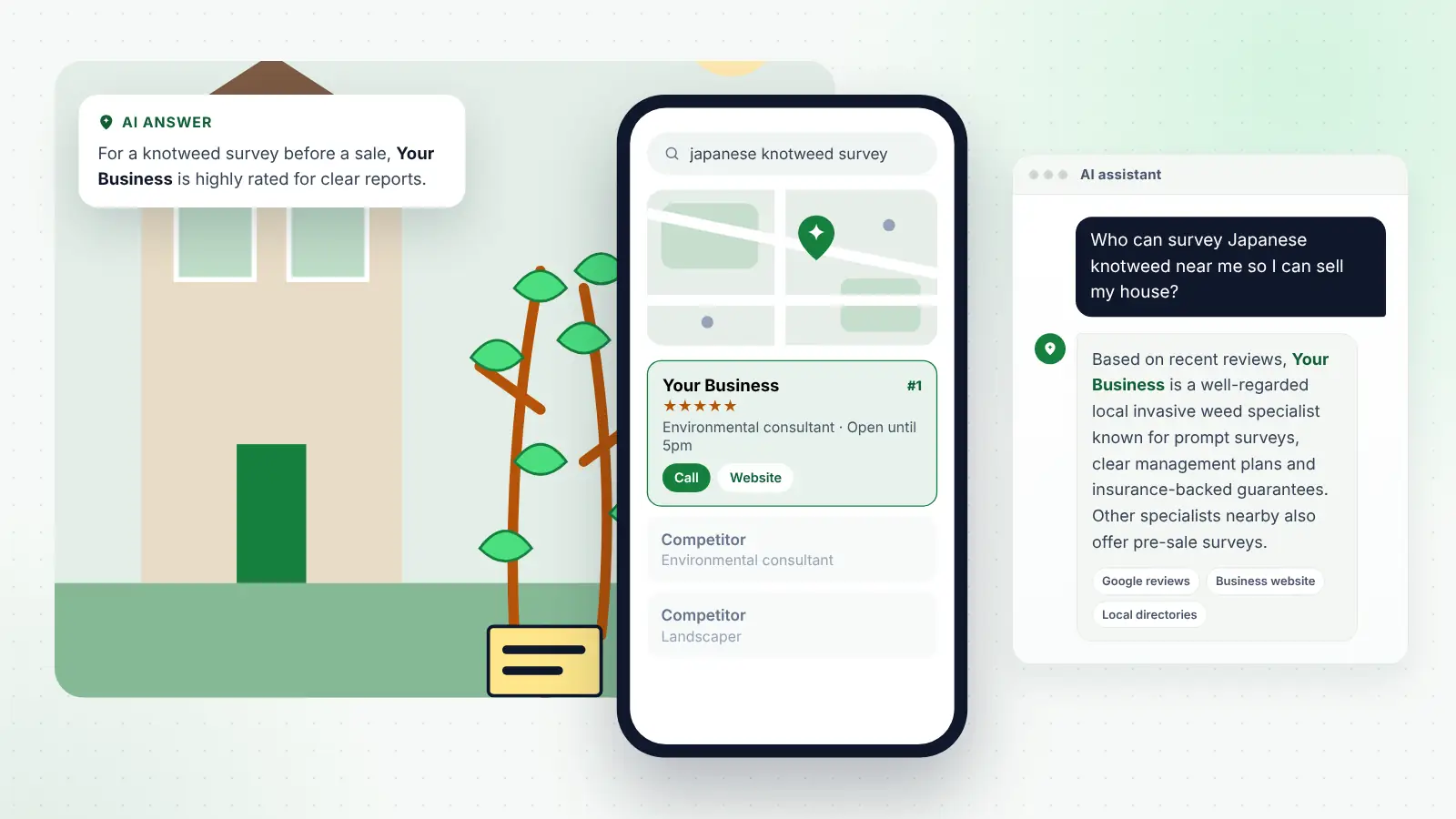
Local search is where most residential customers start. Someone who has just been told a property has knotweed will usually search on their phone within hours, and Google shows a map of nearby specialists first. The firms in that map pack with strong reviews and clear information receive most of the calls.
The searches are specific and urgent: “japanese knotweed survey near me”, “knotweed survey for mortgage”, “japanese knotweed treatment near me”, “knotweed removal cost”, “giant hogweed removal” and “knotweed in neighbour’s garden”.
Google Business Profile. Choose accurate categories, list each service separately, set a realistic service area and add photos of real sites, your team and vehicles. Mention PCA membership and guarantees in your description.
Reviews. Ask every residential customer for a review once the report is delivered or the first treatment done. Reviews mentioning quick visits, clear reports and lender acceptance are especially persuasive. Reply to every one.
Consistent details. Your name, address and phone number should match exactly across your website, Google, Bing, Apple Maps, trade association directories and UK listing sites.
Service and area pages. Create a page for each main service and each main town you cover, with genuinely local detail, plus pages on the property sale process and each species.
Local links. Links from conveyancers, surveyors, business groups, gardening clubs and community projects show Google you are a genuine local specialist.
This is time-consuming alongside site work. If you would rather have specialists handle it, our local SEO for Japanese knotweed specialists covers your profile, listings, content and links on a rolling monthly basis.
Tip
Ask customers whose sale completed to mention it in their review, for example “the buyer’s lender accepted the plan and the sale went through”. That one sentence answers the biggest fear of the next anxious seller.
How AI assistants answer knotweed questions
More people now ask AI assistants for help as well as searching Google. A seller might ask ChatGPT, “My surveyor found Japanese knotweed. What do I need to sell my house?” A buyer might ask Gemini or Copilot, “Can I get a mortgage on a house with knotweed in the garden?” A parent might ask Perplexity, “Who removes giant hogweed near me?” Google’s AI Overviews also answer many of these questions at the top of the results.
For a knotweed firm, assistants tend to lean on:
- Matching details for your firm on your website, Google profile, PCA listing and other directories.
- Reviews in which sellers and buyers describe the survey, the treatment and whether the sale went ahead.
- Clear service descriptions stating what you do, where and for which species.
- FAQ content that accurately answers real questions, such as what the RICS categories mean.
- Mentions on reputable sites, such as trade association directories, local news and property publications.
This matters especially for knotweed, because customers often ask an assistant to explain the problem before asking who can fix it. If your website gives the clearest, most accurate explanation and your details are consistent everywhere, you give AI tools both the answer and a credible local specialist to mention. Expect this to take three to six months, and remember nobody can promise an AI tool will name you.
Frequently asked questions
Do I need to be a PCA member to run a knotweed business?
It is not a legal requirement, but it is one of the strongest trust signals in the industry. Many conveyancers and surveyors look for it, and it allows members to offer the insurance-backed guarantees lenders often prefer.
Is it illegal to have Japanese knotweed on your property?
No. Government guidance says you do not legally have to remove it from your own land unless it is causing a nuisance, but you must stop it spreading, and causing it to grow in the wild is an offence under the Wildlife and Countryside Act 1981.
Does the seven-metre rule still apply?
No. The RICS standard that took effect in March 2022 replaced it with four management categories based on actual impact. Knotweed on neighbouring land within three metres of the boundary is reported as category D.
Can knotweed be buried on site?
Yes, under the Environment Agency’s RPS 178 conditions, including burial on the site where it grew, minimum depths, a distance from neighbouring land and advance notification to the Environment Agency. GOV.UK pages differ on the notice period (one week in the RPS, one month in the general guidance), so allowing a month is the safer approach.
How long before local SEO brings in more knotweed work?
A cleaned-up profile and accurate listings can help within weeks; map positions and AI visibility take three to six months, depending on local competition.
Final thoughts
Knotweed specialists succeed by making a stressful situation feel manageable: understanding the sale process, explaining RICS categories and lender expectations clearly, holding the credentials professionals trust, handling waste lawfully and standing behind the work with a proper guarantee. Combine that with a strong local search presence and accurate content AI assistants can draw on, and you become the business anxious sellers, buyers and conveyancers find first and recommend afterwards.