Most established accountancy practices do not have a shortage of work. They have a shortage of the right work. The diary fills every January, the inbox never empties, and yet a large share of the fee income comes from a minority of clients while a long tail of low-fee, high-effort clients absorbs the time that could go into advisory work or growth.
Winning more clients, for a practice that is already trading, usually means winning more of a particular kind of client: the ones who value what you do, pay a sensible monthly fee, keep their records in order and stay for years. That requires a clearer offer, prices that clients can understand before they call, an onboarding process that is quick without cutting compliance corners, and steady introductions from the professionals who see your ideal clients first.
This guide covers each of those areas, with particular attention to Making Tax Digital for Income Tax, which is reshaping demand for sole trader and landlord work in 2026, 2027 and 2028. It also looks at how local businesses and individuals now find accountants on Google and through AI assistants. It is general information, so check the details with HMRC, your professional body and your AML supervisor.
Key points
- Growth is easier when you choose the clients you want more of, and make that focus visible on your website and profiles.
- Packaged, fixed-fee services with clear scope often convert better than bespoke quotes and make the client’s decision simpler.
- Making Tax Digital for Income Tax started in April 2026 for qualifying income above £50,000, with the £30,000 group joining in April 2027 and the £20,000 group in April 2028.
- A well-designed onboarding process can complete AML checks, professional clearance and engagement letters quickly without weakening compliance.
- Banks, solicitors, brokers and financial advisers refer clients to accountants who are responsive, clear and easy to explain to their own clients.
- Your professional body’s ethical code and the advertising rules still apply online, including to reviews, comparisons and claims about your expertise.
In this guide
- Decide which clients you want more of
- Choose a sector niche clients can see
- Package your services so clients can buy them
- Making Tax Digital for Income Tax: where things stand in October 2026
- Onboarding that feels quick and stays compliant
- Referrals from banks, solicitors and other professionals
- Marketing within your professional body’s rules
- Local SEO for accountants: being found by the clients you want
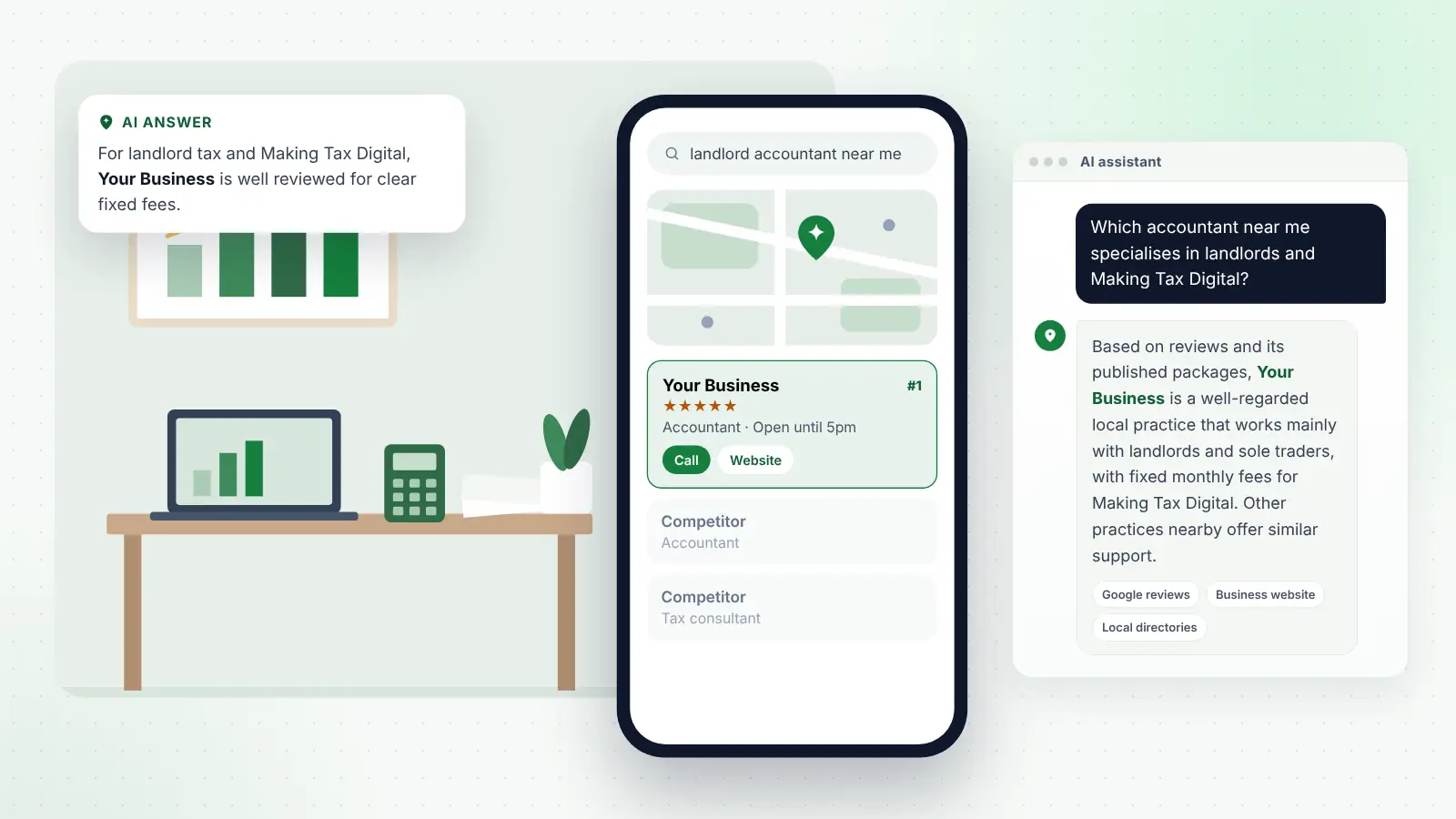
- AI search: how prospective clients now ask for an accountant
- Frequently asked questions
- Next steps
Decide which clients you want more of
Before you market anything, look at the clients you already have. A simple review of the client list, done once a year, often changes a practice’s whole approach to growth.
For each client, or each client type, note:
- Annual fee and how it compares with the time actually spent.
- Quality of records and how much chasing is needed.
- Responsiveness to deadlines and requests.
- Growth potential, such as a sole trader likely to incorporate or a landlord adding properties.
- Enjoyment, which matters more than practices admit. You will market best to clients you like working with.
Most practices find a pattern. Perhaps their most profitable and loyal clients are tradespeople under the Construction Industry Scheme, portfolio landlords, GPs and dentists, independent hospitality businesses or e-commerce sellers. That pattern is your growth plan. It tells you which sector pages to write, which referrers to approach, which software to master and what packages to build.
It also tells you which clients to reprice or let go. Growing a practice is not only about adding clients. Freeing capacity from unprofitable work is often what makes room for better ones.
Choose a sector niche clients can see
A niche only helps if prospective clients can tell you have one. Many practices have real sector expertise but a website that says “we work with businesses of all sizes across all sectors”. That message makes it hard for anyone, including search engines and AI assistants, to recommend you for anything specific.
Ways to make a niche visible:
- A dedicated sector page explaining the specific issues you handle, such as CIS deductions and refunds for subcontractors, or mortgage interest restrictions and jointly owned property for landlords.
- Sector-specific packages with names and contents that make sense to that audience.
- Examples of the problems you solve, written in general terms that do not identify any client.
- Sector reviews, where clients mention their type of business in their own words.
- Involvement in the sector, such as speaking at a local landlords’ association meeting or writing for a trade publication.
A niche does not mean turning away everything else. Most local practices still serve a mix of clients. The niche is what you lead with, so you become the obvious choice for one group rather than a possible choice for everyone.
Tip
If you are unsure which niche to choose, look at where your best referrals already come from. A practice that already receives regular introductions from a local letting agent probably has the beginnings of a landlord niche.
Package your services so clients can buy them
Prospective clients find accountancy pricing confusing. Many delay getting in touch because they assume they will be quoted a large, unpredictable fee. Clear packages remove that fear and also make your own workflow more efficient.
| Package | Who it suits | Typically includes | Pricing basis |
|---|---|---|---|
| Landlord MTD package | Individuals with rental income in or approaching Making Tax Digital | Software set-up, quarterly update support, final declaration, landlord tax queries | Fixed monthly fee, varying by number of properties |
| Sole trader essentials | Self-employed tradespeople and freelancers | Bookkeeping review, quarterly updates where required, self assessment, tax estimates | Fixed monthly fee by turnover band |
| Limited company core | Owner-managed companies | Year-end accounts, corporation tax return, directors’ self assessment, confirmation statement | Fixed monthly fee by turnover and transaction volume |
| Payroll add-on | Small employers | Payroll runs, RTI submissions, payslips, pension auto-enrolment support | Fixed fee per employee per run |
| Advisory review | Growing businesses | Management accounts, quarterly meeting, tax planning, cash flow forecast | Fixed monthly fee, agreed in advance |
What makes packages work:
- Clear inclusions and exclusions. List what is covered and what is charged separately, such as HMRC enquiries, capital gains computations or catch-up bookkeeping.
- Published starting prices. “From” prices, with a clear explanation of what changes the fee, reduce unsuitable enquiries and reassure good ones. Keep them current.
- A natural ladder. Each package should lead logically to the next as the client grows, such as sole trader to limited company, or core to advisory.
- Annual review. Revisit each client’s package once a year, so the fee keeps pace with the work.
A common mistake is building packages around the practice’s processes rather than the client’s language. A landlord understands “help with your quarterly updates and annual tax return”. They may not understand a package called “Compliance Plus”.
Making Tax Digital for Income Tax: where things stand in October 2026
Making Tax Digital for Income Tax has moved from a planned change to a live one. HMRC’s timetable is based on combined qualifying income from self-employment and property, meaning turnover before expenses rather than profit:
- From 6 April 2026, for qualifying income above £50,000.
- From 6 April 2027, for qualifying income above £30,000.
- From 6 April 2028, for qualifying income above £20,000.
HMRC works out who must join from previous tax returns. People within scope keep digital records in compatible software, send quarterly updates and then complete an end-of-year return.
For a practice looking to grow, this creates three distinct opportunities.
Clients already in the 2026 group
Some sole traders and landlords who joined in April 2026 and tried to manage alone may find quarterly updates harder than expected, and may look for help part-way through the year. A clear page explaining how you take over an existing MTD client, including software, records and the remaining updates for the year, speaks directly to them.
The April 2027 group
People with qualifying income above £30,000 are likely to be the biggest near-term opportunity. Many will start looking for help in the months leading up to April 2027, and practices that publish clear information and a defined package well before then are more likely to be found. Look at your own self assessment clients first: identify who is likely to be in scope, contact them with a plain explanation and a proposed package, and plan your capacity accordingly.
Landlords and mixed-income clients
Combined income from self-employment and property counts towards the threshold, which surprises many people with a modest business and a rental property. Jointly owned property and mixed-income situations generate many questions, and they suit a well-explained landlord package.
Check HMRC’s latest guidance before you publish anything about MTD, because exemptions, software requirements and details of the rules can change. Date your guidance pages so clients can see they are current.
Tip
Write one page aimed at the April 2027 group, titled in the client’s own words, such as “Do I need to do Making Tax Digital from April 2027?” Explain the threshold, what qualifying income means and what you offer, then keep it updated.
Onboarding that feels quick and stays compliant
New clients judge a practice in the first fortnight. If onboarding involves several emails asking for the same documents, a long wait for an engagement letter and confusion about who to speak to, some will quietly go elsewhere before the work begins.
Accountancy services fall within the Money Laundering Regulations, so every practice must be supervised for anti-money laundering purposes, either by a recognised professional body or by HMRC as the AML supervisor. Your onboarding has to include customer due diligence proportionate to the risk, and that cannot be skipped to save time. It can, however, be organised much better.
A streamlined onboarding sequence might look like this:
- Short initial call or meeting to understand the client’s situation, agree the package and confirm fees.
- One onboarding link that collects identity information, business details and consent for electronic identity checks in a single step.
- Client risk assessment recorded against your firm-wide risk assessment, with enhanced checks where the risk calls for it.
- Professional clearance from the previous accountant, following your professional body’s guidance on changes in professional appointment.
- Engagement letter sent for electronic signature, setting out scope, responsibilities, fees and complaints handling.
- Agent authorisation with HMRC so you can act on the client’s behalf.
- Software set-up and a named contact, with a clear note of what happens next and when.
Explain the AML checks to clients in plain English before they start. Most people accept them readily when told that every regulated accountant must carry them out, and that they protect the client as well as the practice.
Referrals from banks, solicitors and other professionals
Many of the best new clients arrive through other professionals. They are usually at a turning point, such as starting a company, buying a property, selling a business, separating or dealing with an estate, and they have asked someone they trust for a recommendation.
| Referrer | When they see your ideal client | What they need from you |
|---|---|---|
| Bank business managers | Account opening, lending applications, business growth | Fast, accurate accounts and forecasts for lending decisions |
| Solicitors | Company formations, property purchases, divorce, probate, business sales | Reliable figures, tax input and a clear point of contact |
| Mortgage brokers | Self-employed clients applying for mortgages | Accounts and tax calculations ready on time, in the format lenders expect |
| Financial advisers | Business owners planning extraction, pensions or retirement | Joint planning and clear communication with the client |
| Letting agents | Landlords with new or growing portfolios | Landlord expertise and help with MTD |
To become the accountant these people recommend:
- Respond quickly to introductions. A referrer’s reputation is at stake every time they pass on your name.
- Report back politely. Let the referrer know the introduction arrived and, with the client’s consent, whether you were able to help.
- Refer in return where it genuinely suits your clients, and be open with clients about any arrangement.
- Meet in person at least once a year, and offer short updates on topics their clients ask about, such as MTD or self-employed mortgage applications.
Solicitors have their own regulatory obligations when referring clients, including telling clients about any financial interest in a referral, so keep any arrangement simple, transparent and documented.
Marketing within your professional body’s rules
Accountants who belong to a professional body remain bound by its ethical code when marketing, including online. The codes of bodies such as ICAEW and ACCA are based on the international code of ethics for accountants, which expects marketing and promotion not to bring the profession into disrepute. In practice, that means being honest and truthful, avoiding exaggerated claims about your services, qualifications or experience, and not making disparaging references to or unsubstantiated comparisons with other firms. AAT members have similar professional obligations. Check your own body’s current code and guidance, including any rules on using its logo or designations such as “chartered accountants” in your firm’s description.
Advertising rules apply too. Marketing communications are covered by the UK advertising codes enforced by the Advertising Standards Authority, so claims such as “the area’s leading tax specialists” need to be substantiated or avoided.
For reviews and testimonials:
- Since April 2025, UK consumer law specifically prohibits fake reviews and concealed incentivised reviews. Never write reviews for the practice or offer rewards for positive ones.
- Get written consent before quoting a client by name on your website.
- Reply to reviews without disclosing anything about the client’s affairs, including in response to criticism.
Local SEO for accountants: being found by the clients you want
Many people look for an accountant locally, even if they never visit the office. They search for specific needs in a specific place: “accountant near me”, “small business accountant [town]”, “accountant for landlords near me”, “CIS tax refund accountant”, “Making Tax Digital accountant [town]” and “limited company accountant near me”. Google usually shows a map with a few practices before the ordinary results, and many clients shortlist from that alone.
For an established practice, local SEO is less about being visible at all and more about being visible for the work you want more of.
Google Business Profile
- Choose an accurate primary category, such as accountant, and add only relevant secondary categories.
- List each package and sector service separately with a short description, including MTD support, landlord tax and payroll if you offer them.
- Mention your professional body membership and your sector focus in the business description.
- Add genuine photos of the team and office, and keep opening hours accurate, including any extended hours in January.
- Post occasional updates on deadlines and changes, such as the April 2027 MTD start.
Reviews that describe the client type
A review that says “brilliant help moving my three rental properties onto Making Tax Digital” tells the next landlord far more than “great service”. When you ask for reviews, perhaps after the tax return is filed or the year-end accounts are signed off, it is reasonable to suggest that clients mention what you helped with.
Consistent details
Keep your practice name, address and phone number identical across your website, Google, Bing, Apple Maps, your professional body’s directory, software partner directories and local business listings. Practices that have merged, moved or rebranded often have old details scattered across the web.
Sector and service pages
Each niche and each package deserves its own page, with clear inclusions, starting prices where you publish them, and answers to the questions those clients actually ask.
Local links
Membership of a local chamber of commerce, talks for local business groups, landlord association involvement and contributions to local business news all build relevant local authority.
Results build over months rather than weeks, typically three to six. Start well before the autumn self assessment rush and, this year, before the April 2027 MTD group starts looking. If you prefer to keep partners focused on client work, a specialist providing SEO for accountants and local accountancy practices can manage profiles, pages and listings for you.
AI search: how prospective clients now ask for an accountant
More people now put their question to an AI assistant before they search. They use ChatGPT, Gemini, Perplexity and Microsoft Copilot, and see Google’s AI Overviews at the top of many searches. The questions are specific and often reveal exactly what the client needs:
- “Do I need an accountant for Making Tax Digital if I have one rental property and a part-time business?”
- “Which accountants near [town] specialise in CIS subcontractors?”
- “How much does an accountant cost for a small limited company?”
- “Can you recommend a local accountant who helps self-employed people get a mortgage?”
When an AI assistant recommends particular practices, it relies on information it can find and cross-check across the web. A practice with a clear niche, published packages and consistent details is much easier to describe accurately than one with a generic website.
Practical steps:
- State your specialisms plainly on your website, Google profile and directory listings, using the same wording everywhere.
- Publish package details in plain text, including what is included and starting prices if you show them.
- Answer common questions accurately, such as MTD thresholds, what qualifying income means, and what clients need to provide.
- Keep dates and figures current, because AI tools may repeat out-of-date content.
- Earn mentions on reputable sites, such as local business publications, professional body directories and software partner listings.
- Encourage specific reviews that mention the client’s situation and the help received.
Frequently asked questions
Should an established practice publish its fees?
Publishing starting prices for your main packages is usually helpful. It reassures prospective clients, filters out enquiries that would not proceed, and gives search engines and AI tools clear information to work with. Explain what affects the final fee.
When does Making Tax Digital for Income Tax apply to the next group?
From 6 April 2027 for people with qualifying income from self-employment and property above £30,000, and from 6 April 2028 for those above £20,000. It began on 6 April 2026 for qualifying income above £50,000. HMRC’s Making Tax Digital pages set out who is exempt and any recent changes.
Will choosing a niche cost us clients outside it?
Usually not. Most practices keep serving a mix of clients while leading with one or two specialisms. The niche mainly makes you more memorable and easier to recommend for the work you want more of.
How can we speed up onboarding without weakening AML checks?
Collect everything through a single onboarding step, use electronic identity verification where appropriate, request professional clearance and send the engagement letter promptly. Explain why the checks are needed. Speed comes from organisation, not from skipping steps.
Can we ask clients to mention specific services in reviews?
You can suggest what might be useful to mention, such as the type of help you provided, as long as the review is genuine and unincentivised. Never write reviews for clients or reward positive ones.
Next steps
Start with your client list. Identify the clients you want more of, then make that focus visible through a sector page, a clear package and a few specific reviews. Prepare a straightforward MTD offer for the April 2027 group, tidy up your onboarding so new clients feel looked after from day one, and invest a little time each month in two or three referral relationships.
Then check how your practice appears to someone searching locally or asking an AI assistant for an accountant. If your specialisms, packages and details are clear and consistent everywhere, you make it easier for the right clients to find you and choose you.