Most families choosing care have never done it before. The decision often arrives suddenly, after a fall, a hospital admission or a slow realisation that a parent can no longer manage alone. Within days, someone who has never read an inspection report is comparing care homes or home care agencies, trying to understand fees, talking to a social worker and wondering whether they are making the right choice for a person they love.
For an established care provider, this is the moment that matters. Your care may be excellent, but families can only judge what they can see and hear: what they find online, how the phone is answered, what they notice on a visit, and whether your fees and terms make sense. Services that make that process calm and clear tend to be chosen more often, and they tend to have fewer misunderstandings later.
This guide is for care homes and home care agencies that are already running and want to help more of the right families choose them. It covers what families actually compare, how to display inspection ratings properly, being open about fees under consumer law, first conversations and visits, introducing your team, reviews, working with local professionals, and how Google and AI assistants now shape the shortlist.
Key points
- Families compare a small number of things carefully: inspection rating, location, fees, the feel of a visit and how they are treated on the first call.
- In England, CQC requires providers to display their most recent rating on their premises and on every website they maintain, so check yours is current and correctly labelled.
- The CMA expects care homes to give clear fee information upfront, including on their website, and to use fair, plain contract terms.
- A warm, unhurried first conversation and a well-planned visit or assessment often decide the choice more than any brochure.
- Honest staff profiles, genuine reviews on Google and specialist care review sites, and good relationships with local professionals build trust over time.
- Consistent, accurate information online helps families find you on Google Maps and helps AI assistants describe your service correctly.
In this guide
- How families actually reach a decision
- What families compare
- Displaying your CQC rating properly
- Being open about fees
- The first phone call
- Visits, assessments and first conversations
- Staff stories: introducing the people families will meet
- Reviews on Google and specialist care sites
- Local partnerships with GPs, social workers and other professionals
- Local SEO: being found when families start searching
- AI search: what assistants tell families about care
- Frequently asked questions
- Next steps
How families actually reach a decision
It helps to picture the real journey, because it rarely matches the tidy funnel in a marketing plan.
A daughter gets a call from a hospital discharge team saying her father is medically fit to leave but cannot go home without support. She has a few days. She searches “care homes near me” or “home care [town]” on her phone that evening, opens several map listings, glances at ratings and photos, and reads a handful of reviews. She asks a friend who went through it last year. She may ask an AI assistant to explain the difference between residential and nursing care. Then she rings three or four providers, often during her lunch break.
Several things are true of almost every family in this position:
- They are short of time. A hospital discharge or a crisis at home compresses a big decision into days.
- They are anxious about money. Many have no idea what care costs, how funding works or whether savings will run out.
- They are wary of being sold to. They want guidance and honesty, not persuasion.
- They are often not the decision-maker alone. Siblings, the person needing care and sometimes a social worker all have views.
- They remember how they were treated. The tone of the first call stays with them.
Your job is not to persuade. It is to make it easy for a family to understand whether you are the right fit, and to leave them feeling respected whether or not they choose you.
What families compare
Families do not compare everything. They narrow their options quickly using a handful of signals, then look more closely at a shortlist. The table below sets out what they typically weigh up and what helps them.
| What families compare | What they are really asking | What helps them |
|---|---|---|
| Inspection rating | Is this place safe and well run? | Your current rating shown clearly, with a link to the full report |
| Location | Can we visit easily? Does it cover Mum’s village? | Clear address, areas covered and travel information |
| Fees and funding | Can we afford this, and what will change? | Published fees or clear ranges, what is included and how increases work |
| Type of care | Can you meet his needs now and later? | Plain descriptions of dementia, nursing, respite or live-in care |
| Staff and continuity | Who will actually look after her? | Manager and team profiles, how you keep the same carers |
| Atmosphere | Will he be happy here? | Real photos, an open invitation to visit, activities described honestly |
| Other families’ views | What is it like day to day? | Genuine reviews on Google and specialist sites |
| How quickly care can start | Can you help this week? | Honest availability and a clear explanation of next steps |
Look at your website, your Google listing and your enquiry process through this lens. If a family cannot find an answer to one of these questions within a minute or two, they will often move on to a provider who makes it easier.
Displaying your CQC rating properly
Your inspection rating is usually the first quality signal families check, and in England the rules on displaying it are specific.
Under Regulation 20A of the Health and Social Care Act 2008 (Regulated Activities) Regulations 2014, once CQC has rated your service you must display your most recent rating. In practice that means:
- At your premises. Each location where you provide regulated activity needs a legible sign showing its most recent rating, placed where people using the service and visitors can see it. Your principal place of business also needs to display the relevant ratings unless it is separately rated.
- On your website. Every website maintained by you or on your behalf must show your most recent rating, clearly labelled, together with the date it was given and where the full report can be found on CQC’s website.
- Promptly. CQC’s guidance expects ratings to be displayed within 21 calendar days of the report being published, and this still applies if you have asked for a review of the rating.
CQC’s own guidance on Regulation 20A and displaying ratings is worth rereading after every inspection. CQC provides an official ratings widget for websites, which updates automatically and avoids the common problem of an out-of-date rating left on an old page.
A few practical points that providers often miss:
- Check every website and microsite you control, including group sites, landing pages and old pages that still appear in search results.
- Do not paraphrase the rating or blend it with your own claims. Families and inspectors both notice when a description goes further than the report.
- If your rating has improved, explain briefly what changed. If it has fallen, a calm, factual note on what you are doing about it is more reassuring than silence.
Elsewhere in the UK the rules differ. In Wales, Care Inspectorate Wales has given ratings to care homes and domiciliary support services since April 2025, and most services must display them at their premises and on their website. In Scotland, the Care Inspectorate grades services and publishes its reports, and in Northern Ireland RQIA publishes inspection reports. Check your regulator’s current expectations, and make it easy for families to find your latest report either way.
Tip
After each inspection, set a calendar reminder to update your rating on the website, Google Business Profile description, brochures and any directory listings. An old rating left in one place can undermine trust in all the others.
Being open about fees
Money is often the hardest part of the conversation, and families notice quickly when information is vague.
The Competition and Markets Authority has published consumer law advice for care home providers, following its market study of care homes for older people. Among other things, it expects providers to give key information upfront, including on their website, so that people can compare homes. That includes clear information about fees, what they include and what costs extra, any deposits or upfront payments, and how and when fees can change. It also expects contract terms to be fair and written in plain language, and complaints procedures to be easy to find and use. The CMA’s care homes consumer law advice sets this out in full and is worth reading alongside your solicitor.
Since April 2025, the Digital Markets, Competition and Consumers Act 2024 has given the CMA stronger powers to enforce consumer law directly, so it is sensible to review your terms and website information now rather than wait for a complaint.
For home care agencies, the CMA advice is written for care homes, but general consumer law still applies, and the same principles help families compare: clear hourly or visit rates, minimum visit lengths, higher rates for evenings, weekends and bank holidays, notice periods and how cancellations are handled.
Practical ways to be transparent:
- Publish weekly fees or clear ranges for each type of room or care, with a short explanation of what affects the price.
- List what is included, such as meals, laundry, activities and hairdressing, and what is charged separately.
- Explain funding in plain terms, including the difference between self-funding, local authority funding and NHS Continuing Healthcare, and point families to their council for a needs assessment.
- Explain third-party top-ups where a council funds a place, without pressure.
- Say how fee reviews work, how much notice you give and on what basis increases are made.
Being clear about money does not lose you families. It tends to bring you the ones for whom your service is genuinely suitable, and it avoids painful disputes months later.
The first phone call
For many families, the first call is the moment they decide whether to visit. It is worth treating it as part of your care, not as sales.
The best first calls share a few qualities:
- Someone answers, or calls back quickly. A clear named contact and a realistic call-back time matter more than a script.
- The caller is allowed to explain. Let them describe the situation before you start talking about rooms or rates.
- Questions are about the person, not the sale. What matters to him? What does a good day look like? What worries the family most?
- Information is honest. If you cannot meet a need, or have no availability, say so and suggest where else they might look.
- Next steps are clear. A visit, an assessment, a fee sheet by email, or a call back from the manager, with a time agreed.
Make sure everyone who answers the phone, including weekend and evening staff, knows how to handle an enquiry kindly and where to log it. Families often call outside office hours, and a missed or rushed call is easily lost to the next provider on the list.
Visits, assessments and first conversations
For care homes
A visit is where families test what they have read. They notice whether staff greet residents by name, whether the home smells fresh, whether people are engaged or just sitting, and whether the manager has time for them.
- Offer flexible visiting times, including evenings and weekends, and welcome unannounced visits where practical. It signals confidence.
- Let the manager or a senior carer show families round, not only an administrator.
- Show the real home, not just the best room. Families appreciate honesty about what is available.
- Give a clear pack to take away, with fees, terms, your latest rating and what happens next.
- Follow up once, gently, a day or two later. Then leave the family space to decide.
For home care agencies
Home care families usually meet you at an assessment in the person’s home. This is where you show that care is built around the individual.
- Arrange the assessment at a time that suits the person, with family present if they wish.
- Talk to the person receiving care directly, not just about them.
- Explain how visits, timings and carer matching work, including what happens when a regular carer is on holiday.
- Be honest about capacity, including any areas or times you cannot cover reliably.
- Put everything in writing afterwards, including the care plan, rates and how to contact the office.
Staff stories: introducing the people families will meet
Families are not choosing a building or a brand. They are choosing the people who will care for someone they love. Introducing your team helps them picture that care.
Good ways to do this:
- A short profile of the manager, with their background, how long they have been with you and how families can reach them.
- Team pages with names, roles and real photos, with each person’s agreement.
- Short pieces in your team’s own words, such as why they chose care work, what they enjoy about the role or a training milestone they are proud of.
- Honest information about continuity, such as how long carers typically stay or how you match carers to clients, if you can support it.
Keep this genuine. Never invent staff stories or use stock photos of people who do not work for you, and always get consent before sharing a photo or story about a resident or client. Families can usually tell the difference between real people and marketing.
Reviews on Google and specialist care sites
Reviews carry particular weight in care because families are looking for evidence of everyday experience, not just inspection snapshots.
Many families look at specialist review sites as well as Google. In the care sector, carehome.co.uk and homecare.co.uk are widely used directories where residents, clients and relatives can leave reviews of care homes and home care providers. Check your listings there are accurate and complete, and that the contact details match your website and Google profile.
Gather reviews thoughtfully:
- Choose the right moment. Invite feedback once care is settled, often after a few months, never during an assessment, a crisis or soon after a bereavement.
- Make it easy but optional. A short card or email with links to your Google profile and specialist listing is enough.
- Ask everyone, not just happy families. Selective asking can breach review platform rules and gives a misleading picture.
- Reply to every review briefly and warmly. Thank people by first name if they used it, and never mention health details, care needs or anything confidential in a public reply.
- Handle criticism calmly. Acknowledge it, invite the reviewer to speak to the manager directly, and follow your complaints procedure.
Never offer incentives for reviews, and never write or commission reviews yourself. It is unfair to families, and fake reviews are prohibited under consumer law.
Local partnerships with GPs, social workers and other professionals
Many families are guided towards care by professionals: GP surgeries, social workers, hospital discharge teams, community nurses, hospices, dementia support services and local carers’ groups. These professionals cannot usually recommend one provider over another, but they can only point families towards services they know about and trust.
Build those relationships patiently:
- Keep professionals informed about your current availability, the types of care you provide and the areas you cover.
- Be reliable when they call. A quick, honest answer about whether you can help is what discharge teams value most.
- Share useful information, such as a plain guide to your services and how to arrange an assessment.
- Take part in local networks, such as dementia-friendly community groups, carers’ support events and local provider forums.
- Keep it professional. Never offer gifts or incentives for referrals. Social workers in particular are expected to support families to make their own informed choice, and anything that looks like an inducement damages trust.
Over time, being the provider that answers the phone, tells the truth about capacity and follows through is what earns you a good name with local professionals.
Local SEO: being found when families start searching
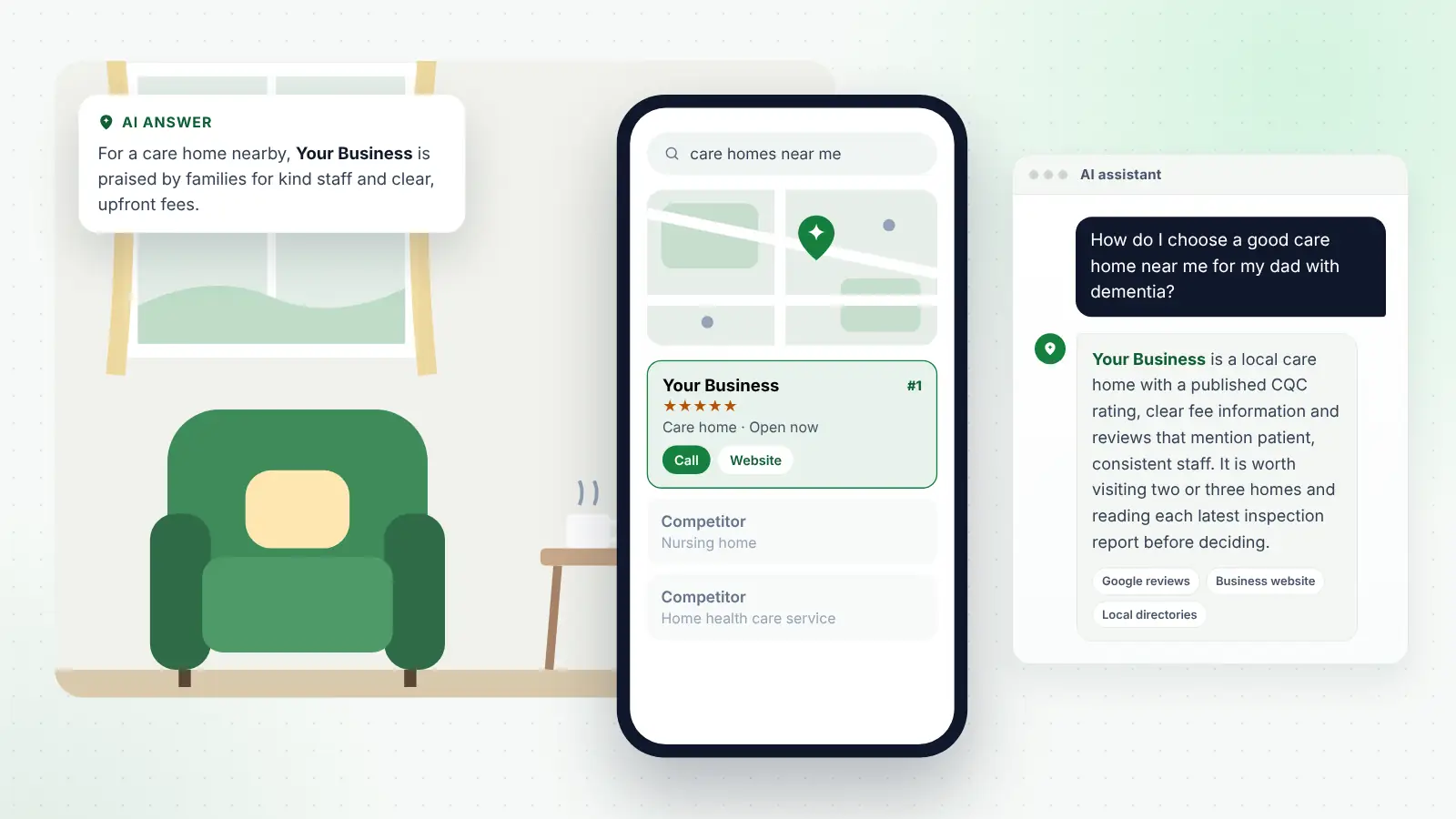
Most care searches are local and specific. Families type “care homes near me”, “nursing homes in [town]”, “dementia care home [area]”, “respite care near me”, “home care [town]” or “live-in care [county]”. Many of those searches happen on a phone, often late in the evening, and the map results at the top of the page are where the first shortlist is made.
For a care provider, local search is not about volume. It is about making sure the right families see accurate, reassuring information at the moment they start looking.
A Google profile that shows your inspection rating
Choose the primary category that fits best, such as “Nursing home”, “Retirement home” or “Home health care service” (the exact category names available can vary, so pick the closest match), and add secondary categories only if they genuinely apply. Care homes should show their address and visiting information. Home care agencies can set a service area covering the towns and villages they serve and hide the office address if families should not visit without an appointment. Add your phone number, office hours, a description of each service, a link to your fees page and real photos of your home or team. Mention your current inspection rating in your description and keep it updated.
Family reviews and identical details on care directories
Google reviews feed directly into how families judge you on the map. Combine the review approach above with consistent business details. Your name, address, phone number and website should be identical on Google, Apple Maps, Bing, CQC or your regulator’s listing, carehome.co.uk or homecare.co.uk, local authority directories and community sites. Mismatched details confuse families and search engines alike.
Service and area pages
Your website should have a clear page for each type of care you provide, such as residential, nursing, dementia, respite or live-in care, with what it involves, who it suits and how to arrange it. Home care agencies should add a page for each main town or area they cover. Include your fees page, your rating, team profiles and a calm guide to how care starts. These pages answer the exact questions families are searching for.
Local links and mentions
Mentions from local community groups, dementia support organisations, carers’ charities, faith groups, local news and local authority directories show search engines that you are an established and trusted local service. Many come naturally from the partnership work above.
Results from local SEO usually build over three to six months, and nothing guarantees a particular position. If you would prefer to spend your time on care, specialist local SEO for care homes and home care providers can look after your profile, listings, content and links for you.
AI search: what assistants tell families about care
More families now ask AI assistants for help before they ring anyone. Someone might ask ChatGPT “How do I choose a good care home near me for my dad with dementia?”, ask Gemini “What is the difference between residential and nursing care?”, ask Copilot “How much does home care cost in [town]?” or ask Perplexity “Which home care agencies cover [village]?”. Google often answers questions like these with an AI Overview too, sometimes naming local providers.
These tools try to give careful answers to sensitive questions, so they rely on information that is consistent and trustworthy. For a care provider, the things that help most are the same things that help families choose:
- Your inspection rating, displayed accurately on your website and consistent with your regulator’s listing.
- Clear fee information, so an assistant can give a realistic idea of cost or point families to your fees page.
- Plain descriptions of each type of care, so you can be matched to a question about dementia care, nursing care or live-in care.
- The areas you cover, stated clearly, for home care in particular.
- Genuine reviews on Google and specialist care sites that describe kindness, communication and consistency.
- FAQs that answer real questions, such as how quickly care can start, whether couples can stay together, how visiting works or what happens if needs increase.
- Mentions on reputable sites, such as local authority directories, local news and charity or community pages.
This work goes by the name answer engine optimisation, or AEO. For a care service, the principle is simple: be clear, be consistent and be honest. A provider whose rating, fees, services and people are described plainly in several trustworthy places is much easier for an AI assistant to describe accurately than one with vague or promotional wording.
Tip
Ask an AI assistant the questions your families ask, using your town and type of care. If the answer is wrong or out of date, check that your website, Google profile and directory listings say the same thing.
Frequently asked questions
Do I have to show my CQC rating on my website?
Yes. In England, once CQC has rated your service, you must display your most recent rating on every website you maintain, as well as at your premises. CQC expects this within 21 calendar days of the report being published. The official CQC widget is the simplest way to keep it current.
Should a care home or agency put its fees on the website?
The CMA expects care homes to give clear fee information upfront, including on their website, so that families can compare. Publishing weekly fees or clear ranges, with what is included and how fees can change, is the safest approach. Home care agencies benefit from the same openness about hourly rates and minimum visit lengths.
When is the right time to ask relatives for a review?
Wait until care is settled, then offer a gentle, optional invitation with links to Google and your specialist listing. Ask all families, not only those you expect to be positive, never offer incentives, and never share personal or care information in public replies.
Can social workers or GPs recommend us?
They usually need to offer impartial choice, so they are unlikely to recommend one provider. What they can do is share information about services they know. Keeping them informed about your availability and being reliable when they call makes it more likely families will hear about you.
How long before more families find our care service through search?
Local SEO usually builds over three to six months, depending on how competitive your area is and where you start from. Accurate listings, a complete Google profile, clear service pages and steady genuine reviews tend to make the biggest difference.
Next steps
Families choose care services that are clear, honest and kind from the first search to the first visit. Look at your service the way a worried family would: check your rating is displayed correctly everywhere, make your fees and terms easy to understand, review how enquiries are handled at every hour, and introduce the real people who provide your care.
Then make sure the same accurate, calm information appears on Google, specialist care sites and anywhere else families look. That consistency helps families find you, helps AI assistants describe you correctly and, most importantly, helps the right families feel confident choosing you.