Smart home and AV installation sits where building work, electronics and IT meet. Homeowners want cinema rooms, music in every room, reliable Wi-Fi and lighting and heating that run themselves. Businesses want meeting rooms, music and displays that simply work.
Project values can be high, but reputations are made or lost on reliability. A beautifully finished system that drops out every week, or that nobody supports after handover, does lasting damage to a young company. The installers who do well combine careful design, tidy workmanship, good relationships with other trades and a clear plan for supporting systems for years.
This guide covers the main steps to starting a smart home and AV business in the UK, from services and credentials to electrical regulations, product security rules, brand relationships, maintenance contracts and getting found by local customers.
Key points
- Decide early whether you will focus on residential projects, commercial AV or both, because it shapes your training, brands, cash flow and marketing.
- CEDIA membership and certifications are the main industry credentials for residential integrators, alongside manufacturer training for each platform you install.
- Some mains electrical work in homes, such as new circuits, is notifiable under Part P in England, so register with a competent person scheme or work with a registered electrician.
- The UK product security regime for consumer connectable products has applied since 29 April 2024, and it is worth understanding where it affects what you sell.
- Early involvement with builders, architects and designers, accurate use of brand names and well-designed support plans turn one-off jobs into a lasting business.
In this guide
- Decide what kind of business you want to run
- CEDIA membership and certification
- Electrical work and Part P
- Product security rules for connected devices
- Brands, dealer accounts and trade mark care
- Working with builders, architects and interior designers
- Setting up, costs and pricing
- Maintenance contracts and recurring income
- Local SEO: reaching homeowners and builders near you
- AI search: being named when people ask about home cinema
- Frequently asked questions
- Next steps
Decide what kind of business you want to run
Few new companies do everything well at first. Being clear about your focus helps you choose the right brands, training and customers.
- Home cinema and media rooms. Dedicated cinemas, living-room setups, projectors and acoustic treatment. High value and often linked to renovations or self-builds.
- Multi-room audio and video. Ceiling and in-wall speakers, streaming and TV distribution. A common entry point that leads to wider smart home work.
- Networking and whole-home Wi-Fi. Structured cabling, access points and network racks. Increasingly the foundation everything else depends on.
- Lighting control and smart heating. Scene-based lighting, motorised blinds and heating control, often through one control platform.
- Commercial AV. Meeting rooms, video conferencing, signage and hospitality music. Often more repeatable, with service contracts.
Many installers start with residential work, often from an electrical, aerial or IT background, and add commercial projects once they can handle longer payment terms. If you already offer aerials, CCTV or IT support, decide whether smart home work sits within that business or under a separate brand.
The work demands low-voltage cabling, networking, audio and video calibration, control system programming, basic acoustics and a good eye for finish. Manufacturer training is essential for the platforms you install, and many brands require it before opening a dealer account. Time with an established integrator is one of the best ways to learn design, documentation and how to manage clients through a long project.
CEDIA membership and certification
CEDIA is the international trade association for the smart home industry and is active in the UK. It offers membership for integrator businesses and certifications for individuals. Its certification pages currently list four main certifications:
| Certification | Who it suits |
|---|---|
| Cabling and Infrastructure Technician (CIT) | Early-career technicians working under supervision |
| Integrated Systems Technician (IST) | Technicians who work independently |
| Residential Networking Specialist (RNS) | Experienced technicians with networking knowledge |
| Designer Specialist (ESC-D) | Experienced system designers |
Certifications last three years and are renewed through continuing education. CEDIA also runs UK training courses and lists members in an online directory for homeowners. Since January 2025 integrator membership has been offered in tiers with different benefits, such as use of the member logo and directory placement, so check what each tier includes.
Tip
Use the CEDIA logo and certification titles only as your membership tier and certifications allow, and keep your directory entry matching your business name, address and phone number exactly.
Electrical work and Part P
Much AV work uses low-voltage cabling, but many projects also involve mains work: a new circuit for a cinema room or equipment rack, rewired lighting for a control system or extra sockets in a media wall.
In England, electrical work in homes falls under Part P of the Building Regulations. The government’s Planning Portal guidance on electrics and building regulations lists notifiable work as:
- Installing a new consumer unit.
- Installing a new circuit, such as a lighting circuit or a dedicated supply.
- Altering or adding to existing circuits in a special location, which in England means the space around baths and showers.
In Wales, special locations also include kitchens and outdoors, and Scotland and Northern Ireland have their own building standards systems. Most repairs, replacements and additions outside special locations are not notifiable, but all work should still be done safely and to BS 7671.
Notifiable work can be self-certified if you are registered with a competent person scheme. Otherwise it must be notified to building control before work starts or, in England, certified by a registered third-party certifier. Many integrators register for domestic electrical work or partner with a trusted registered electrician.
Smart heating is a natural addition, but any work on a gas appliance itself must be done by a Gas Safe registered engineer. Many installers fit thermostats and controls themselves and partner with a heating engineer for anything involving the boiler.
Product security rules for connected devices
Smart home systems rely on connected products: hubs, cameras, speakers, streamers, thermostats and more. Since 29 April 2024, the UK product security regime under the Product Security and Telecommunications Infrastructure (PSTI) Act 2022 has applied to consumer connectable products. The government’s guidance on consumer connectable product security sets out three core requirements:
- No universal default or easily guessable passwords.
- Published information on how to report security issues.
- Published information on the minimum period of security updates.
The legal duties fall mainly on manufacturers, importers and distributors. The Act excludes from the definition of distributor someone who makes a product available by carrying out a contract for works that include installing it into a building, where identical products are also sold to UK consumers by other means. So an installer fitting products as part of a project is often treated differently from a business selling boxed devices. If you also sell products over the counter or online, import directly from outside the UK or sell devices under your own brand, you may take on duties, so take advice.
Either way, choose products whose manufacturers publish update periods, set unique credentials on every device and tell customers how long equipment is likely to be supported. Remote support also means holding logins and access to systems inside people’s homes, so keep credentials in a secure password manager, restrict staff access and agree in writing when you will connect remotely.
Brands, dealer accounts and trade mark care
Most integrators buy through a mix of distributors and direct dealer accounts. Premium brands often expect dealers to complete training, meet minimum purchase levels, have a demonstration space and provide proper after-sales support.
When you market those brands, be accurate:
- Only describe yourself as an authorised dealer, partner or certified installer where you genuinely hold that status.
- Use brand logos only as your dealer agreement allows.
- Keep manufacturers’ names out of your business name, domain and Google Business Profile name. It can suggest you are the brand, breach your dealer agreement and break Google’s naming guidelines.
- Saying which brands you install and support is generally fine, provided you do not imply an endorsement you do not have.
If your dealer status changes, update your website, listings and quotes promptly.
Working with builders, architects and interior designers
The best projects are often shaped before the customer thinks about AV. Cabling for speakers, screens, access points and lighting control needs to be in at first fix, and adding it after plastering is slower and more expensive.
- Builders and developers need a subcontractor who turns up at first and second fix, works to the programme and leaves the site tidy.
- Architects value clear design documents, cable schedules and rack locations that fit their drawings.
- Interior designers care about how equipment looks: concealed speakers, hidden screens and neat keypads.
- Electricians and joinery firms often need help with media walls and built-in cabinets.
A short pre-wiring guide, a simple design sign-off process and prompt communication show that you understand how building projects run. Credit partners when you share finished projects, and ask them for testimonials you can use with permission.
Tip
Create a one-page first-fix checklist for builders and electricians covering back boxes, conduit, cable types and rack ventilation. It prevents problems on site and keeps your name in front of the trades who recommend you.
Setting up, costs and pricing
Decide whether to trade as a sole trader or limited company, register with HMRC and keep good records. You will need public liability insurance, employers’ liability if you take on staff, cover for tools and stock, and van insurance, and professional indemnity is worth considering if you design systems. Use written terms covering deposits, staged payments, ownership of equipment until paid and delays caused by other trades.
| Item | Rough guide | Notes |
|---|---|---|
| Van and racking | Varies widely; used vans keep costs down | Branded vans help local recognition |
| Tools and test equipment | From a few hundred to a few thousand pounds | Cable testers, network tools, calibration kit |
| Demonstration space | From a single room to a full showroom | Many brands value a working demo |
| Training and certification | Varies by course and platform | Manufacturer courses and CEDIA |
| Stock and dealer minimums | Varies by brand | Check opening orders and credit terms |
| Software | Typically monthly subscriptions | Design, quoting and remote monitoring |
Figures vary by area, supplier and scale. Cash flow is a real challenge on large projects, so staged payments linked to first fix, equipment delivery and commissioning are common.
Customers often compare your quote with online box prices, so price on the value of design, installation, programming and support rather than hardware margin alone. Separate these on your quotes, and offer good, better and best options so customers can choose without feeling pushed.
Maintenance contracts and recurring income
Systems need ongoing care: firmware updates, app changes, network faults and customers who forget how something works. Without a plan, this becomes unpaid time. With one, it becomes steady recurring income. A good support plan usually includes:
- Remote monitoring of key equipment and the network, with the customer’s agreement.
- Planned software and firmware updates, tested before they go live.
- Clear response times for remote and on-site support.
- An annual health check, including backups of programming.
- Discounted rates for additional work and upgrades.
Commercial clients often value guaranteed response times most. Introduce plans at the quotation stage and explain plainly what is included.
Local SEO: reaching homeowners and builders near you
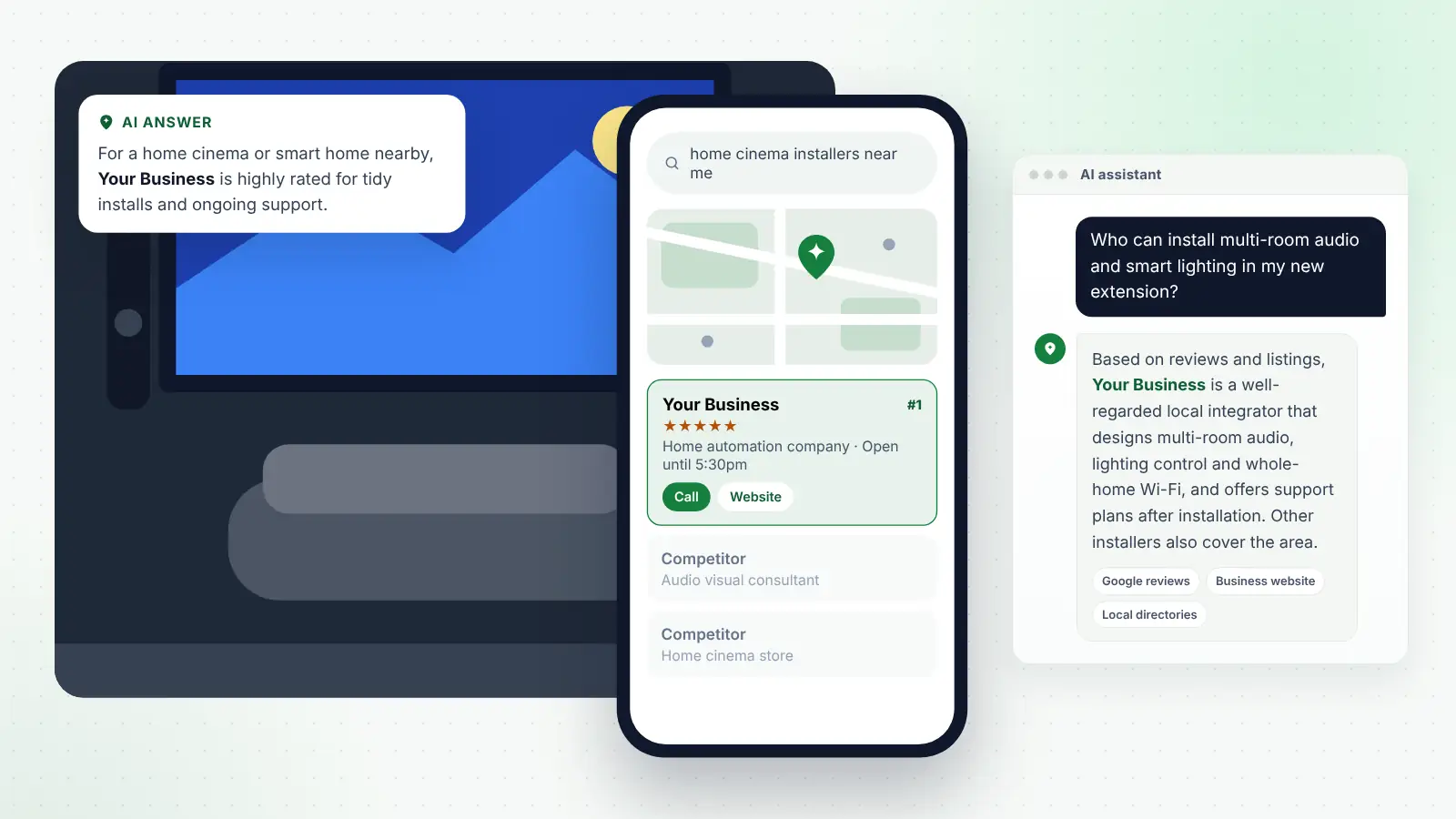
Most people commissioning a cinema, multi-room audio or smart home system do not already know an installer. They search when planning a renovation, extension or new build, often months before work starts. Searches such as “home cinema installers near me”, “multi-room audio installation [town]”, “whole home Wi-Fi installer” and “smart lighting installer” are local, and the businesses on the Google map get most of the calls. Commercial buyers search for “meeting room AV installers” or “background music system for restaurant”.
Google Business Profile
- Choose the most accurate primary category, such as home automation company, and add relevant secondary categories.
- Show showroom hours and whether visits are by appointment, or set up as a service-area business covering the towns you genuinely serve.
- Add each service separately: cinema, multi-room audio, networking, lighting control, heating, commercial AV and support plans.
- Upload real photos of finished rooms, neat racks and concealed speakers, avoiding anything that reveals a customer’s address.
- Mention CEDIA membership, certifications and the platforms you support, accurately.
Reviews, citations and your website
Ask every customer for a review at handover with a direct link. Reviews that mention tidy work, clear explanations and responsive support are especially persuasive, and you should reply to every one politely.
Keep your business name, address and phone number identical across your website, Google profile, Bing Places, Apple Business, UK directories, your CEDIA listing and brand dealer locators, which are trusted sources that are often overlooked.
Your website should have a page for each main service explaining what is involved, typical timescales, what affects cost and when in a build you need to be involved. Project case studies with photos are far more persuasive than a row of brand logos. Area pages help if each contains genuinely local information.
Local links
Mentions from builders, architects and designers you work with, local business groups, home improvement publications and local news help show search engines you are an established local business. If you would rather focus on projects while specialists handle your visibility, local SEO for smart home and AV installers is one option. Whichever route you take, expect the gains in map rankings and AI answers to take three to six months to build.
AI search: being named when people ask about home cinema
More people now ask ChatGPT, Gemini, Perplexity, Copilot and Google’s AI Overviews for advice and recommendations. A homeowner might ask “What should I pre-wire in my extension for a smart home?” or “Who installs multi-room audio near me?”. A business might ask “Which AV companies near me set up meeting rooms for video calls?”.
These tools try to give measured answers, so they rely on information they can confirm across the web:
- Consistent information everywhere. Matching details on your website, profile, directories, CEDIA listing and dealer locators.
- Reviews. Genuine reviews describing the systems you installed and the support you gave.
- Clear service descriptions. The systems you design, brands you support, areas you cover and customers you serve.
- Helpful FAQs. Answers about pre-wiring, costs, Wi-Fi coverage, device security and support plans.
- Mentions on reputable sites. Trade bodies, partner websites, home publications and local news.
No one can guarantee an AI recommendation, but the work that helps you appear is the same work that builds trust with customers, so it is never wasted.
Frequently asked questions
Do I need to be a CEDIA member to start a smart home business?
No. Membership is voluntary. However, CEDIA membership and certifications are widely recognised, give your team a structured training path and reassure homeowners, architects and designers.
Do I need to be a registered electrician?
Not for low-voltage cabling. Notifiable mains work in homes, such as a new circuit, must comply with Part P in England and be self-certified through a competent person scheme or checked by building control or a registered third-party certifier. Many installers register or partner with a registered electrician.
Does the PSTI regime apply to me as an installer?
It depends on how you supply products. Installing products into a building under a works contract is excluded from the definition of distributor where identical products are also sold to consumers by other means. If you also sell devices directly, import them or sell under your own brand, you may have duties, so take advice.
Can I advertise the brands I install?
Yes, if you are accurate. Say which brands you install and support, claim authorised dealer status only where you hold it, use logos as your agreements allow and keep brand names out of your business name.
How long does it take to build a steady business?
It varies by area, experience and how quickly you build trade relationships and support contracts. Many installers find work builds steadily over the first couple of years, and local SEO usually takes three to six months to show stronger results.
Next steps
Starting a smart home and AV business takes training, dealer accounts, a clear approach to electrical work and device security, and good relationships with the trades who bring you projects. Build support plans into every quote and you create income that lasts beyond each installation.
Alongside that, make sure customers can find you. A complete Google profile, consistent details, genuine reviews and a website that shows real projects will help you appear in local search and in the AI tools people increasingly use to choose an installer.