Most denture clinics are built on skill and word of mouth. A clinical dental technician (CDT) who makes dentures that fit well and feel natural will usually have a loyal following, a few dentists who send patients their way and a steady stream of repair calls. What many clinics lack is a reliable flow of new complete denture patients, because a large share of the people who could come to them directly do not know that they can.
That gap is the main opportunity. Plenty of people with no natural teeth still assume they need to find a dentist, join a waiting list or pay dental practice prices for a new set. Others only discover a denture clinic when something breaks. Growing a clinic is largely about closing that knowledge gap, building good relationships with dentists for the work you cannot do alone, and turning one-off repairs into long-term patients.
This guide is for established clinics and CDTs in the UK. It covers your scope, the regulatory basics, working with dentists, fees and finance, and how people now find denture services through Google and AI assistants. It is general information rather than regulatory advice, so check the detail with the General Dental Council and your indemnity provider.
Key points
- CDTs can make and fit complete dentures directly for patients with no natural teeth, but partial dentures and implant-retained work need a dentist’s involvement first.
- Many potential patients do not know they can see a CDT directly, so clear, accurate explanations on your website and Google profile are your most valuable marketing.
- Strong, two-way relationships with local dentists bring referrals and make prescription work run smoothly.
- Same-day repairs are often a patient’s first contact with you, so treat them as the start of a relationship rather than a one-off job.
- Advertising must follow GDC guidance, which means showing your registration details, using your title correctly and never calling yourself a “denture specialist”.
- Local search and AI assistants both depend on consistent details, genuine reviews and clear service descriptions built up over three to six months.
In this guide
- Be clear about what you can offer directly
- Get the regulatory basics right
- Understand the NHS and private context
- Build a balanced service mix
- Work closely with dentists
- Set clear fees and handle finance properly
- Design the experience around your patients
- Local SEO: be found when patients search nearby
- AI search: answer the questions patients now ask
- Advertise within GDC guidance
- Turn repairs and fittings into long-term relationships
- Frequently asked questions
- Next steps
Be clear about what you can offer directly
Everything in your marketing depends on describing your scope accurately. The GDC sets out what each registered dental professional title covers in its Scope of Practice guidance, which was revised with effect from 1 November 2025. The GDC said the boundaries of each title were unchanged, but the revised guidance places more emphasis on professionals judging for themselves whether they are trained, competent and indemnified for each task.
For a CDT, the broad position is well established. You can provide complete dentures directly to patients who have no natural teeth. Where a patient has natural teeth or implants, they need to see a dentist before you begin, and partial dentures are provided on a dentist’s prescription or treatment plan. You should also refer an edentulous patient to a dentist if there are oral health concerns or they need a treatment plan.
| Service | Can patients come to you directly? | Notes |
|---|---|---|
| New complete dentures | Yes, for patients with no natural teeth | Refer to a dentist if you have oral health concerns |
| Partial dentures | Only with a dentist’s prescription or treatment plan | Patient needs a dentist’s assessment first |
| Implant-retained dentures | Working with the patient’s dentist | The dentist plans and places the implants |
| Denture repairs | Generally yes | Check your scope for any impressions involved |
| Relines and adjustments | Depends on the case | Check current GDC guidance and your indemnity |
| Mouthguards and other appliances | Usually on a dentist’s prescription | Check scope for each device |
Some finer detail, such as relines and impressions for repairs, has long been debated within the profession. Read the current GDC guidance yourself and confirm with your indemnity provider rather than relying on what colleagues assume.
Tip
Add a short “Do I need to see a dentist first?” section to your website and Google profile. It answers the question patients are most unsure about and saves your team from repeating it on the phone.
Get the regulatory basics right
- GDC registration and indemnity. You must be registered with the GDC to use the title, and your indemnity should reflect the work you actually do, including implant-retained cases or home visits.
- CQC in England. Many denture clinics in England are registered with the Care Quality Commission as dental services, typically for treatment of disease, disorder or injury. Whether and how you need to register depends on the services you provide, so check the CQC’s scope of registration guidance directly. Scotland, Wales and Northern Ireland have their own arrangements.
- Custom-made devices. Dentures are custom-made medical devices, and the manufacturing side is subject to rules overseen by the MHRA, which are separate from GDC requirements.
- Complaints. Have a clear complaints procedure and explain on your website where patients can go if they are not satisfied. For private treatment, the GDC’s guidance points patients to the Dental Complaints Service.
If you are a member of a professional association, such as CDTA UK or the Dental Technologists Association, it is worth mentioning. These bodies support CDTs and, in the case of CDTA UK, have campaigned for changes to the scope of practice.
Understand the NHS and private context
NHS dentures in England are provided through NHS dental practices as part of the highest charge band, and in many areas patients struggle to find an NHS dentist taking on new adults. That shapes the patients who reach you. Some come because they cannot get an NHS appointment. Others have had NHS dentures and want something that looks more natural or fits better. Some simply want the person who makes the denture to be the person who fits it.
Most CDT-led clinics are private, so explain the value of what you offer without disparaging NHS care: time spent on impressions and try-ins, the choice of teeth and materials, direct contact with the person who makes the denture, quick repairs and clear aftercare. Avoid claims such as “better than NHS dentures”, which you cannot substantiate for every patient.
Build a balanced service mix
Seeing your services side by side helps you decide where to focus your marketing.
| Service | Typical patient | How they search | What to emphasise |
|---|---|---|---|
| Same-day repair | Someone with a cracked or broken denture | Urgently, on a phone, often on Google Maps | Turnaround times, opening hours, walk-in or call-ahead |
| Reline or adjustment | Long-term denture wearer with a loose fit | “Loose dentures” or “denture reline near me” | Comfort, how long it takes, whether they need to leave the denture |
| New complete dentures | Someone whose set is worn or who has recently lost their remaining teeth | Research over days or weeks | The process, number of appointments, fees, direct access |
| Implant-retained dentures | Patient frustrated with movement or a poor lower fit | Long research, often with a dentist involved | How you work with their dentist, timescales, realistic expectations |
| Domiciliary visits | Housebound patients and care home residents | Often a family member or carer searching | Areas covered, what can be done at home, how to arrange a visit |
Repairs bring volume and visibility. New sets and implant work bring higher value. A clinic that markets only repairs can be busy without growing, so make sure your website and profile give new denture services equal prominence.
Work closely with dentists
Dentists are your partners rather than your competitors. Many general practices do not have the time or appetite for complex complete denture work, and partial dentures and implant-retained cases cannot happen without a dentist’s involvement.
To build referral relationships that last:
- Make referring easy. Offer a simple referral form or email address, and agree how prescriptions and treatment plans reach you.
- Communicate clinically. Send a short update to the referring dentist when a case is complete, with the patient’s consent.
- Refer back properly. If you spot an oral health concern, refer the patient to a dentist promptly. That protects the patient and shows dentists you can be trusted.
- Offer implant collaboration. Dentists who place implants often need someone skilled in overdenture work. Explain how you share the case and who the patient contacts at each stage.
- Avoid inducements. Referral relationships should be based on good patient care and reliable communication, not payments.
If most referrals come from one practice, a change of ownership there could affect you quickly, so keep building new relationships.
Set clear fees and handle finance properly
Denture patients compare costs carefully, especially if they are weighing private fees against NHS charges or paying for a parent. Clear guide prices for repairs, relines and new complete dentures help them decide before they call. Explain what each fee includes, such as consultations, try-in appointments, fitting and aftercare, and make clear that the final cost depends on an assessment. The GDC’s guidance on advertising also expects you to state whether your clinic is NHS, mixed or wholly private.
If you offer patient finance for higher-value work, introducing patients to a lender is generally a regulated credit activity. You will usually need the appropriate FCA permission, or to work under an arrangement set up by an FCA-authorised finance provider. Any promotion of finance must be fair, clear and not misleading, so check wording with your finance provider before it goes on your website or social media.
Tip
Publish a simple fee guide with “from” prices and a clear list of what is included. Patients who understand the cost before they arrive are less likely to cancel and more likely to proceed.
Design the experience around your patients
Many denture patients are older, some have mobility or hearing difficulties, and relatives are often involved. State step-free access and parking clearly online, answer the phone with a person, give written information about the process, and set realistic expectations about how long new dentures take to settle. Make it easy for patients to come back if something does not feel right. These are the details that appear in reviews, and they reassure the next nervous patient.
Local SEO: be found when patients search nearby
Denture searches are local and often urgent. A patient with a broken denture before a family event wants a clinic they can reach today, and a relative searching for a parent wants somewhere close and well reviewed. If your clinic does not appear on the map for those searches, the call goes elsewhere, often to a dental practice that may not offer same-day repairs at all.
Focus on the foundations:
- Google Business Profile. Choose the most accurate primary category, such as denture care centre, and add relevant secondary categories. List every service, your opening hours, accessibility details, parking and repair turnaround. Add photos of your clinic and team, not stock images.
- Reviews. Ask satisfied patients for a review after fitting or a successful repair, using a simple card or text message. Never offer incentives or write reviews on patients’ behalf, and respond politely without sharing clinical details.
- Consistent details. Make sure your clinic name, address and phone number are identical across your website, Google, Apple Maps, Bing, healthcare directories and local listings.
- Service pages. Create a separate page for each main service: new complete dentures, repairs, relines, implant-retained dentures and domiciliary visits. Explain the process, timescales, guide fees and when a dentist is needed.
- Area pages. If you draw patients from several towns, a page for each area you genuinely serve, with useful local detail, helps you appear beyond your immediate postcode.
- Local links. Mentions from community organisations, care providers, later-life groups and local news are more valuable than generic directory listings.
Build pages around real searches such as “denture repair near me”, “same day denture repair”, “new dentures near me” and “implant dentures [town]”.
If you would rather have specialists handle this, our local SEO for denture clinics and clinical dental technicians covers your profile, listings, content and links. Results usually build over three to six months, and no one can guarantee rankings.
AI search: answer the questions patients now ask
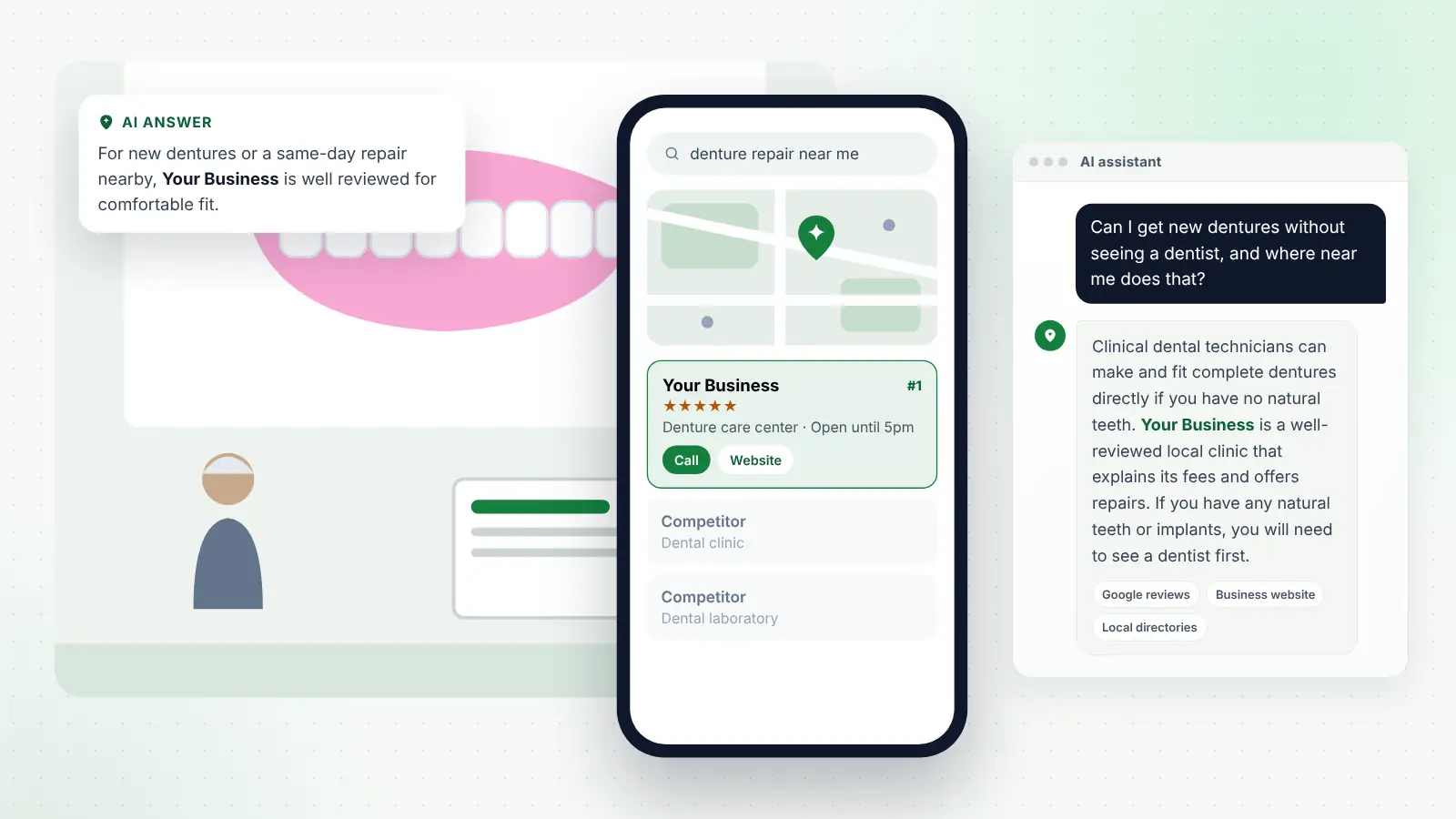
More people now ask ChatGPT, Gemini, Perplexity, Copilot and Google’s AI Overviews for help before they search a map. Their questions are conversational and often reveal the knowledge gap you need to close: “Can I get dentures without a dentist?”, “Who can fix my dentures today near me?”, “How much do private dentures cost?” or “Are implant dentures worth it for a loose lower denture?”.
AI tools build answers from information they can find and cross-check. They rely on consistent details across your website, Google profile and directories; clear service descriptions that say when a dentist is needed; reviews describing comfort, fit and repair speed; FAQs written the way patients ask; and mentions on reputable local and professional sites.
A clear “Can I see a CDT directly?” page is especially valuable, because AI tools are asked that question often. Keep it accurate: overstating your scope could mislead patients and breach GDC guidance.
Advertise within GDC guidance
The GDC’s advertising guidance applies to CDTs as it does to dentists. In summary:
- Show your qualification, the country it was obtained in and your GDC registration number wherever you are named as providing care.
- Include the clinic’s address, contact details, a link to the GDC, your complaints procedure and the date the website was last updated.
- Do not use misleading titles. The GDC names “denture specialist” as one dental care professionals must not use, though “experienced in” or “special interest in” is acceptable where true.
- Do not compare your skills with other professionals, and make clear treatment depends on an assessment.
General UK advertising rules also apply, and consumer law prohibits fake or misleading reviews.
Tip
Audit your website, Google profile and social media pages once a year against the GDC checklist. Old pages and forgotten directory listings are where outdated titles and claims usually survive.
Turn repairs and fittings into long-term relationships
Your first meeting with many patients is an emergency repair, so make it count. Explain honestly whether the denture is nearing the end of its life, offer a check-up appointment, and ask permission to keep in touch. Many patients who trust you with an emergency repair return for a new set and recommend you to friends.
After fitting new dentures, a follow-up appointment for adjustments helps patients settle and gives you a natural moment to ask for a review. A periodic check-up reminder, with consent, keeps you in mind.
Frequently asked questions
Can a clinical dental technician see patients without a dentist?
Yes, for complete dentures for patients with no natural teeth. Patients who have natural teeth or implants need to see a dentist first, and partial dentures are provided on a dentist’s prescription or treatment plan. A CDT should refer a patient to a dentist if there are oral health concerns.
Does a denture clinic need to register with the CQC?
Many denture clinics in England are registered with the CQC as dental services. Whether you need to register depends on the services you provide, so check the CQC’s scope of registration guidance directly and take advice if you are unsure. Different regulators apply in Scotland, Wales and Northern Ireland.
How do I get more referrals from dentists?
Make referring simple, communicate clearly about each case and refer patients back promptly when they need a dentist. Dentists value reliable, clinically sound partners who make their own lives easier.
How long does it take for local SEO to work for a denture clinic?
Profile and listing improvements can help within weeks, but stronger map rankings and AI visibility usually build over three to six months. Consistency matters more than short bursts of activity.
Next steps
Start with what matters most to patients: a clear explanation of when they can come to you directly, a simple fee guide, and visible registration details and complaints procedure. Then approach two or three new dental practices, ask for a review after every fitting, and give every service its own page.
None of this needs to happen at once. A clinic that steadily improves its information, relationships and reviews over the next six months will be in a far stronger position to attract the patients who need it.