Hearing care is a service people often put off for years. Someone notices they are turning the television up, struggling in restaurants or asking family to repeat themselves, and it can take a long time before they book a test. When they finally do, or when a blocked ear or a sudden ringing sends them looking for help that week, they want someone local, patient and trustworthy. That is exactly where a good independent clinic can stand out.
Many hearing aid dispensers and audiologists set up on their own after years with a national chain or the NHS, wanting longer appointments, freedom to recommend from a wider range of manufacturers and a closer relationship with patients. Others start with a home-visit service or a room inside a pharmacy, GP surgery or opticians before taking on their own premises. Whichever route you choose, you become a business owner as well as a clinician, with registration, insurance, equipment, pricing and marketing to get right.
This guide covers the practical steps for setting up an independent hearing clinic in the UK, with a focus on England where some rules differ between the nations. It explains the protected title and function, professional bodies, ear wax removal, NHS contracts, pricing, responsible advertising and how patients now find hearing clinics through Google and AI assistants.
Key points
- “Hearing aid dispenser” is a protected title, and testing hearing or prescribing a hearing aid for retail sale or hire is a protected function limited to HCPC registrants.
- “Audiologist” is not a protected title, but audiologists can join the voluntary accredited register run by the Academy for Healthcare Science, which took over the RCCP register in 2021.
- Ear wax removal may need CQC registration in England depending on who carries it out and why, so check before you advertise microsuction.
- NHS adult hearing services are commissioned locally, and accreditation, quality standards and payment terms vary from one area to another.
- Most patients search for a need, such as “microsuction near me” or “private hearing test”, so build your visibility around those services and the areas you cover.
In this guide
- Understand the protected title and function
- Ear wax removal: training, insurance and CQC
- NHS hearing services and private work
- High street room, shared space or home visits?
- Pricing hearing tests, wax removal and aids
- Advertise responsibly
- Local SEO: being found for hearing tests and microsuction
- When patients ask AI where to get their hearing checked
- GP, care home and family referrals
- Frequently asked questions
- Final thoughts
Understand the protected title and function
Hearing aid dispensing is regulated by the Health and Care Professions Council (HCPC) across the whole of the UK. It is unusual among HCPC professions because it is regulated in two ways. “Hearing aid dispenser” is a protected title, so only registrants can use it, and there is also a protected function. The HCPC explains that only registered hearing aid dispensers can assess or test hearing, or prescribe a hearing aid, where the aid is supplied by retail sale or hire. Doing so without registration is a criminal offence.
In practice, that means anyone carrying out private hearing assessments with a view to selling hearing aids in your clinic must be HCPC registered, unless a specific exemption applies. If you employ or contract other clinicians, check their registration before they start and at each renewal. HCPC registrants must meet the standards of proficiency and the standards of conduct, performance and ethics, keep up continuing professional development, hold appropriate indemnity and renew their registration every two years.
Audiologists and voluntary registration
“Audiologist” is not a protected title in the UK, which can confuse patients. Many audiologists are degree-qualified and work in NHS departments, and some are also registered as hearing aid dispensers so they can dispense privately. Audiologists can join the voluntary accredited register held by the Academy for Healthcare Science (AHCS). The Registration Council for Clinical Physiologists (RCCP), which many audiologists will know, merged with the Academy in 2021, so the register formerly held by the RCCP now sits with the AHCS.
If you are building a team, be clear about who holds which registration and what each person can do. Patients and family members often cannot tell the difference between a hearing aid dispenser, an audiologist and someone who only offers ear wax removal, so a short plain-language explanation on your website helps.
Professional bodies
Membership of a professional body is voluntary, but it brings guidance, training and recognition. The British Society of Hearing Aid Audiologists (BSHAA) is the main professional body for hearing aid audiologists in the independent sector. The British Academy of Audiology (BAA) represents audiologists more broadly, including those working in the NHS. Many clinicians belong to one or both. Patients may not recognise every name, but GP practices, care homes and other referrers often do.
Ear wax removal: training, insurance and CQC
Ear wax removal is often the busiest service in an independent clinic, and microsuction appointments are a common first contact with new patients. With many GP surgeries no longer routinely removing ear wax, demand from people looking to pay privately has grown in many areas.
There is no single national licence for ear wax removal, but you should only offer the methods you have been properly trained in, whether that is microsuction, irrigation or manual removal with instruments. Look for training that includes supervised practice, recognising when to refer, infection control and handling complications. Keep records of your training and competence, and refresh it as guidance changes.
Your professional indemnity and public liability insurance should explicitly cover each ear wax removal method you use, and any home or care home visits. Check this with your insurer in writing rather than assuming it is included.
Check whether you need CQC registration
In England, the Care Quality Commission (CQC) has published guidance on whether earwax removal providers need to register. In summary, registration for the regulated activity “treatment of disease, disorder or injury” is needed where a listed health care professional carries out the removal and agrees with the person that there is a problem needing intervention. Providing a CQC-regulated activity while unregistered is a criminal offence, so this is worth settling before you open. The way your service is staffed and described matters, so read the guidance carefully and contact the CQC if you are unsure. Scotland, Wales and Northern Ireland have their own regulators and rules.
Tip
Decide on your CQC position before you print leaflets or build your website. The way you describe your ear wax service, and who delivers it, can affect whether registration applies.
NHS hearing services and private work
NHS adult hearing services for age-related hearing loss are commissioned locally by integrated care boards in England. In many areas, independent providers have been able to deliver NHS hearing assessments, fittings and aftercare alongside hospital departments. This was commonly arranged through any qualified provider (AQP) schemes. Since January 2024, NHS healthcare services in England have been arranged under the Provider Selection Regime, and some areas use arrangements where several qualifying providers can be approved and paid according to the activity they deliver.
Requirements vary by area, but commissioners commonly look for clinical governance, qualified staff, appropriate premises and equipment, and quality accreditation such as IQIPS or a commitment to achieve it. Contracts usually guarantee no minimum volume. Watch for opportunities on Find a Tender, where commissioners publish Provider Selection Regime notices, and on your local integrated care board’s website, and read the service specification closely before you apply.
NHS work can bring a steady stream of patients and introduce people to your clinic, but it usually pays less per patient than private fittings and comes with reporting requirements. Many independents run a mix: NHS patients for volume and community presence, private patients for premium hearing aids, and paid services such as ear wax removal and tinnitus support. Be careful never to pressure NHS patients towards private upgrades; explain the options fairly and let them decide.
High street room, shared space or home visits?
There are several ways to set up, and many clinics combine more than one:
- Standalone high street clinic. Strong visibility and a professional setting, but higher rent and fit-out costs.
- Room in a pharmacy, GP surgery or opticians. Lower overheads and built-in footfall, with referrals from the host business.
- Home visits. Valuable for older and less mobile patients, though testing conditions and equipment are more limited.
- Care home and community sessions. Regular outreach that builds referrals and local reputation.
For testing, you need a quiet room that meets the relevant ambient noise standards for audiometry, or a sound booth. Think about wheelchair access, parking, a hearing loop at reception and somewhere private for discussions about hearing aids and costs.
Rough start-up costs
Costs vary widely by area, premises and how much equipment you buy new. The figures below are rough guides only.
| Item | Typical cost | Notes |
|---|---|---|
| Audiometer and tympanometer | £3,000–£10,000 | Calibrate annually |
| Real ear measurement and fitting software | £3,000–£8,000 | Supports verified fittings |
| Microsuction unit, microscope or loupes | £2,000–£8,000 | Training needed before use |
| Sound booth or room treatment | £2,000–£15,000 | Depends on room and noise levels |
| Fit-out, furniture and signage | £3,000–£20,000 | Lower if sharing premises |
| Practice management software | £50–£200 per month | Booking, records and recalls |
| Insurance and registrations | £500–£2,000 per year | Indemnity, public liability, HCPC |
Many manufacturers and distributors offer equipment packages, credit terms or support for new independents. Read the terms carefully, because some arrangements come with purchase commitments that can limit your independence.
Pricing hearing tests, wax removal and aids
Pricing is where independent clinics can build trust or lose it. Patients often arrive having seen low headline prices online and very different quotes from chains, and they want to understand what they are paying for.
- Ear wax removal. Set a clear price for one or both ears, and say whether a follow-up is included if wax does not clear first time.
- Hearing tests. Decide whether you charge, offer a free test or include the test with a hearing aid fitting, and say so plainly.
- Hearing aids. Publish guide prices by technology level, and explain what the price includes: assessment, fitting, real ear measurement, follow-up appointments, servicing, warranty and how long aftercare lasts.
- Aftercare plans. Some clinics offer a separate monthly or annual plan for wearers who bought elsewhere or whose aftercare has ended.
- Tinnitus and specialist services. Price tinnitus assessments, custom ear protection and musicians’ moulds individually.
A trial period, or a clear returns policy for hearing aids, reassures patients who worry about spending a significant amount on something they may not get on with.
Advertise responsibly
Hearing aids are medical devices, and advertising in the UK is covered by the CAP Code, enforced by the Advertising Standards Authority (ASA). The ASA’s advice on hearing aids and hearing amplifiers is worth reading in full before you write any marketing. Key points include:
- Back up every claim. Claims about how well a hearing aid works must be accurate, not exaggerated and supported by documentary evidence. In practice, that means avoiding any suggestion that hearing aids restore normal hearing or that a treatment will cure tinnitus.
- Be careful with “independent”. Do not describe your advice as independent or impartial if you have commercial ties to particular manufacturers or retailers.
- Do not blur aids and amplifiers. Keep a clear distinction between prescribed hearing aids and over-the-counter amplifiers.
- Treat testimonials as claims. What a patient says in a review or testimonial still needs to be accurate if you use it in advertising.
Free hearing test offers
“Free hearing test” is a common offer, and it can work well, but the CAP Code is strict about the word “free”. If you use it, the test must be genuinely free, with no obligation to buy and no hidden charges, and any conditions should be stated clearly. Do not use a free test as a route to high-pressure selling. Patients and family members talk, and reviews quickly reflect how people felt in the appointment.
Tip
Write a short “What happens at your hearing test” page. Explaining how long it takes, what is checked and that there is no obligation to buy reassures nervous patients and their families.
Local SEO: being found for hearing tests and microsuction
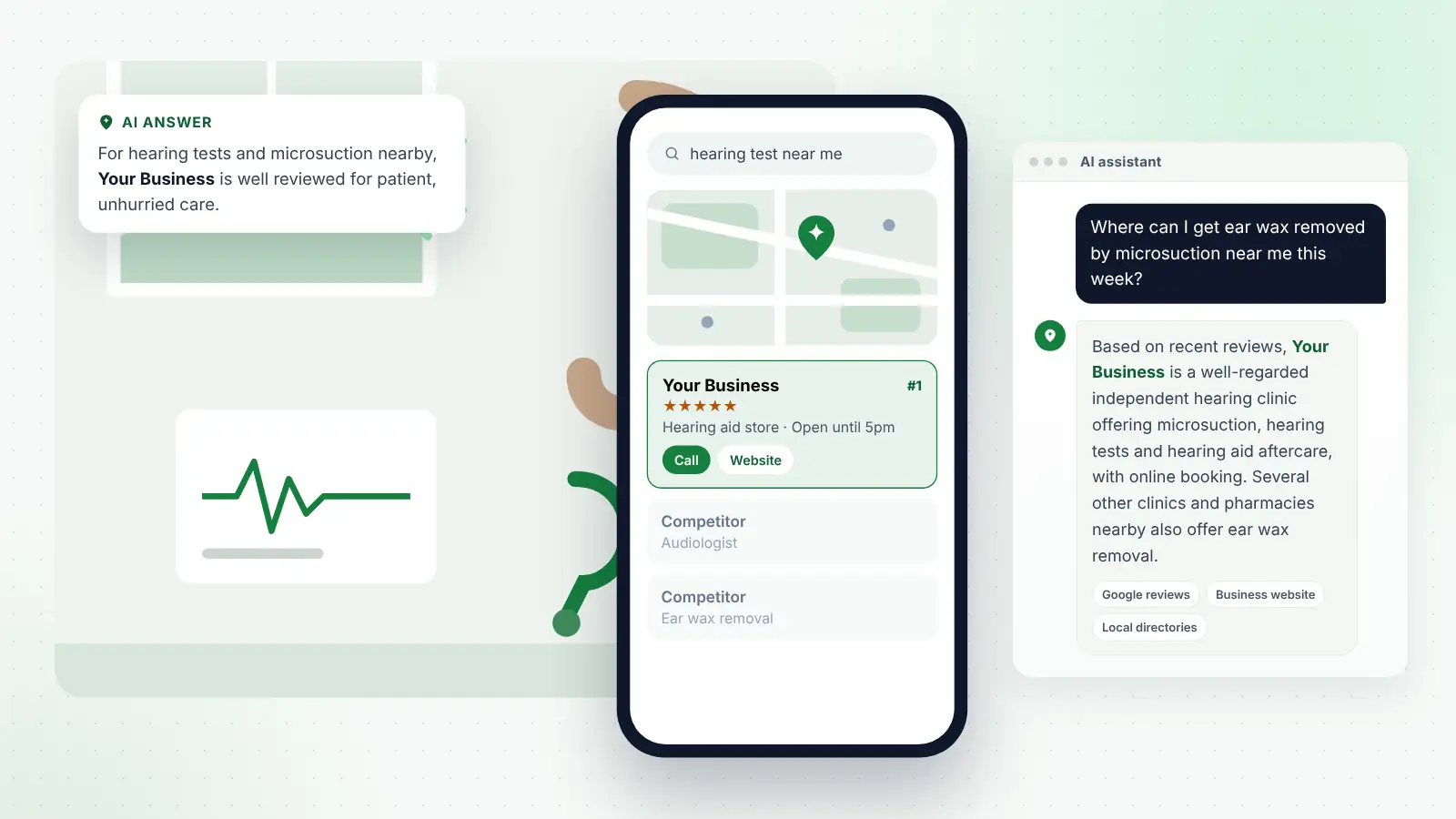
Hearing care is a local service. Patients rarely travel far for ear wax removal or regular aftercare, and family members searching on behalf of a parent want somewhere easy to reach. People search for their need and their area: “hearing test near me”, “microsuction [town]”, “ear wax removal same day”, “hearing aids near me”, “hearing aid repair [town]”, “tinnitus clinic near me”, “home hearing test for elderly parent” and “custom ear plugs for musicians”.
The map results at the top of Google, with reviews, opening hours and booking links, are often where those decisions are made. A complete and accurate presence there is one of the most reliable ways to bring new patients through the door.
Fill in every part of your clinic’s Google profile
Choose your primary category carefully, such as “Hearing aid store” or “Audiologist”, and add other categories only where they genuinely apply. List each service separately with a clear description: hearing tests, microsuction ear wax removal, hearing aid fitting, hearing aid repairs and servicing, tinnitus assessment, custom ear protection and home visits. Add opening hours, accessibility details including a hearing loop, parking, an online booking link and real photos of your clinic, testing room and team.
If you offer home visits, show the areas you cover. If you run sessions inside another business, make sure the address and hours are clear so patients do not turn up on the wrong day.
Asking hearing patients for honest reviews
Reviews influence both rankings and choice, and families often read them carefully before booking for a parent. Ask at a natural moment, such as after successful ear wax removal or at a follow-up when a new hearing aid wearer is settling in well. Give patients a simple link or printed card, and offer to help older patients who are less confident online. Never offer incentives, and when replying, do not confirm the person is a patient or mention their hearing. A brief thank-you is enough.
One clinic name, address and number everywhere
Your clinic name, address, phone number and website should be identical across Google, Apple Maps, Bing, professional directories, NHS listings where you hold a contract, manufacturer clinic finders and local directories. Include an email address or text option alongside your phone number, because some people with hearing loss find phone calls difficult.
Build service and area pages
Your website needs a page for each main service, written in plain language: what happens at the appointment, how long it takes, prices, aftercare and when someone should see their GP or seek urgent help, such as sudden hearing loss. Add a page about your team showing HCPC registration and qualifications, and pages for the main towns you serve, especially if you do home visits.
Links from surgeries, community groups and health sites
Links and mentions from GP practice and pharmacy partner pages, care homes, community and charity groups, local news, music venues and professional directories help search engines see that your clinic is established and trusted.
Expect a gradual climb: wax removal bookings may lift sooner, but a clear improvement in map position typically takes three to six months, depending on how many hearing chains trade nearby. If you would rather spend your time with patients, specialist local SEO for hearing clinics and audiologists can look after your profile, listings, service pages and links for you.
When patients ask AI where to get their hearing checked
A blocked ear or a persistent ringing is increasingly something people describe to an AI assistant before booking anything. Someone might ask ChatGPT “Where can I get ear wax removed by microsuction near me this week?”, ask Gemini for “an independent hearing clinic in [town] that does home visits for my dad”, or ask Perplexity or Copilot “Is there a tinnitus specialist near me?”. Google’s AI Overviews also appear for many health and local searches, often summarising options before the map results.
For health questions, AI tools try to give safe and reliable answers, so they lean on trustworthy, consistent information. For a hearing clinic that usually means:
- Consistent clinic details across Google, your website, professional directories and local listings.
- Reviews that mention the service people came for and how they were treated.
- Clear service descriptions, so the tool can match you to “microsuction”, “hearing aid repair” or “home visits in [village]”.
- FAQs that answer real questions, such as whether microsuction hurts, how long a hearing test takes, whether a test is free and how hearing aid aftercare works.
- Evidence of registration, such as your HCPC status and professional body membership.
- Mentions on reputable sites, such as professional directories, local news, charities and partner practices.
That work goes by the name answer engine optimisation (AEO). For a hearing clinic, clarity matters more than clever wording. A clinic that states who it is, what it offers, where it sees patients, what it charges and what aftercare is included is far easier for an AI assistant to recommend than one with vague descriptions.
GP, care home and family referrals
Search brings new patients, but relationships keep a hearing clinic busy. GP surgeries, pharmacies and opticians that do not offer hearing care can be valuable referral partners. Care homes need regular hearing checks and ear wax removal for residents. Local hearing loss charities, lip-reading classes, community groups and music venues are good places to build your name.
Hearing aid wearers are long-term patients. Schedule follow-up appointments after fitting, offer an annual hearing review, and remind wearers when servicing or a review is due. A patient who feels well looked after for several years is likely to stay with you when it is time to replace their aids, and to recommend you to friends. Track a few numbers each month: new patients by source, ear wax appointments that lead to hearing tests, fittings, returns, reviews received and aftercare appointments missed.
Frequently asked questions
Do I need to be HCPC registered to open a hearing clinic?
To use the title hearing aid dispenser, or to test hearing and prescribe hearing aids for retail sale or hire, you must be HCPC registered. You can own the business without being registered yourself, but anyone carrying out those protected functions must be.
Can I offer ear wax removal without being a hearing aid dispenser?
Ear wax removal is not limited to one profession, but you should be properly trained, insured for each method you use and clear on whether CQC registration applies to your service in England. Check the CQC’s guidance and your insurer’s terms before you start.
Is it worth taking on NHS hearing work?
It can be, particularly for building patient numbers and community presence, but it usually pays less per patient than private work and involves quality and reporting requirements. Read the local service specification carefully and model whether the volume will cover your costs.
Can I advertise a free hearing test?
Yes, as long as it is genuinely free, with no obligation to buy and any conditions stated clearly. Follow the CAP Code’s rules on free offers and avoid presenting the test as a sales appointment.
How long before a new hearing clinic has a steady list of patients?
Most new clinics build gradually over the first year. Ear wax removal and partnerships with local practices often bring early patients, while hearing aid fittings and reviews grow steadily as your reputation and online visibility build over several months.
Final thoughts
Starting an independent hearing clinic lets you offer the unhurried, personal care many patients want, but it also asks you to run a careful business. Keep your HCPC registration and insurance in order, settle your CQC position on ear wax removal, decide whether NHS work fits your plans, invest in properly calibrated equipment and price your services clearly.
Then make sure the people searching for microsuction, a first hearing test, tinnitus support or help for a parent can find you. A complete Google profile, steady reviews, clear service and area pages and consistent information across the web will help both search engines and AI assistants point patients to your clinic.