Many architects reach a point where they want to run their own studio. You might want to choose the projects you take on, work more closely with clients, design in a way that reflects your own values, or simply build something that carries your name. For residential architects in particular, there is steady demand from homeowners who want to extend, convert, renovate or build.
Starting a practice involves more than finding your first client. You are entering a regulated profession, so you need to think about how you describe yourself, what insurance you hold, how you set out your terms, and how you meet your duties under the building regulations. Then you need a reliable flow of enquiries, and for most small practices that now comes from a mix of referrals, reputation and being easy to find online.
This guide covers the main steps for small architecture practices in the UK, with a focus on residential work such as house extensions, loft conversions, renovations and new builds. It is general information only. Regulation in this area has changed significantly in recent years, so always check the latest guidance from the Architects Registration Board (ARB) and take professional advice on your own situation.
Key points
- “Architect” is a protected title under the Architects Act 1997, so only people on the ARB register can use it in business, and a company name containing the word needs ARB involvement.
- The current Architects Code, in force since 1 September 2025, requires you to promote your services accurately, give clients clear written terms and hold suitable professional indemnity insurance.
- Since October 2023, projects in England with more than one contractor need a principal designer for building regulations, and on domestic work that duty can fall on you by default.
- Clear fee structures, a strong portfolio and good relationships with builders and engineers help a new practice win its first projects.
- Homeowners increasingly find architects through Google Maps, reviews and AI assistants, so an accurate online presence matters from day one.
In this guide
- Is running your own practice right for you?
- The protected title and who can call themselves an architect
- The Architects Code and your professional obligations
- PII cover for architects
- Building safety and principal designer duties
- Setting up the business
- Pricing your services
- Winning commissions through referrals and a local name
- Local SEO: how homeowners find an architect nearby
- AI search: how homeowners now shortlist architects
- Frequently asked questions
- Final thoughts
Is running your own practice right for you?
Running a practice means you are responsible for every part of the business, not just the design work. That includes winning projects, writing fee proposals, managing cash flow, keeping your insurance in place, supervising any staff and handling the occasional unhappy client.
Before you commit, think honestly about:
- The work you want. Residential extensions and lofts bring a steady volume of smaller projects. New builds and self-build projects are larger but less frequent. Commercial and public work usually needs a track record and more resources.
- Where your first projects will come from. Previous clients, contacts at your last practice (within any restrictions in your contract), builders and friends of friends often provide the early work.
- Your financial runway. Fees are often paid in stages, and planning delays can hold up the next stage. Make sure you can cover several months of costs while the pipeline builds.
- Your appetite for business. Some architects enjoy marketing, proposals and client meetings. Others find it takes them away from design.
- Working alone or with others. A partnership or small team spreads the workload and the risk, but adds decisions about ownership and management.
The protected title and who can call themselves an architect
Under section 20 of the Architects Act 1997, it is a criminal offence for anyone to use the title “architect” in business or practice unless they are on the Architects Register held by ARB. The register is public, and clients and other professionals can check it online. ARB’s title protection policy explains how it investigates misuse.
This matters for how you set up and market your practice:
- Your own title. You can only describe yourself as an architect once you are registered. ARB’s guidance suggests that people who are still training avoid terms such as “trainee architect” when seeking work, and use descriptions such as “architectural assistant” instead.
- Your staff. If your team includes architectural technologists, architectural designers or assistants who are not registered, do not describe them as architects on your website, social media or proposals, even informally.
- Your business name. A limited company or LLP can only use “architect” in its name if a registered architect is in control and management of the architectural work. You need to ask ARB for permission, and Companies House will look for evidence of this when you register the name.
It is worth understanding the wider market too. Chartered architectural technologists, members of the Chartered Institute of Architectural Technologists (CIAT), and architectural designers also design extensions and new homes, and many do excellent work. They cannot call themselves architects, but they compete for many of the same clients. Your registration is a genuine point of difference, so explain clearly what it means for clients rather than simply relying on the title.
Tip
Check every page of your website, your Google profile and your social media bios before you launch. Only registered architects should be described as architects, and the wording should match how ARB’s register lists them.
The Architects Code and your professional obligations
ARB’s Architects Code of Conduct and Practice sets the standards registered architects must meet. A new version came into effect on 1 September 2025, replacing the 2017 Code. It is built around six standards: honesty and integrity, public interest, competence, professional practice, communication and collaboration, and respect.
Several parts of the Code shape how you run a small practice:
- Promoting your services. Architects must promote their services responsibly and accurately. That covers your website, portfolio, reviews and social media. Do not imply you designed a project you only contributed to, or suggest that planning permission is guaranteed.
- Written terms of engagement. You must give clients clear written terms before work starts. For homeowners this usually means a fee proposal and appointment that set out the scope, stages, fees, what is excluded and how changes will be handled.
- Insurance. You must make sure your liabilities are covered by suitable professional indemnity insurance.
- Complaints. You must deal with complaints and disputes promptly and courteously, so have a simple written complaints procedure ready.
- Competence. You must keep your knowledge and skills up to date. ARB now runs a CPD scheme with mandatory topics, which currently include fire and life safety and environmental sustainability, and you record your activity on an approved platform.
Many architects also join the Royal Institute of British Architects (RIBA). Individual membership gives you access to resources, standard forms of appointment and the RIBA Plan of Work. A practice can also apply to become a RIBA Chartered Practice, which involves meeting criteria such as having a chartered member as a director or partner, holding appropriate insurance and having quality management, health and safety and CPD arrangements in place. It is optional, but some clients recognise it as a mark of a well-run practice.
PII cover for architects
Professional indemnity insurance (PII) protects you if a client claims your advice or design was negligent and caused them a loss. For an architect, a single error in a structural detail, a boundary or a planning drawing can lead to a costly claim, so suitable cover is essential as well as a regulatory requirement.
When arranging PII:
- Use a specialist broker who understands architects and can explain the options.
- Match the level of cover to your work. A practice designing extensions needs different cover from one working on multi-storey residential buildings.
- Read the exclusions. Fire safety, cladding and some other risks may be restricted or covered on a different basis, so understand exactly what is and is not covered.
- Plan for run-off cover. Claims can arise years after a project finishes, so you need to think about cover after you stop practising or close a company.
- Keep it in place. PII is usually written on a claims-made basis, meaning the policy in force when a claim is made is the one that responds, so a lapse can leave you exposed for past work.
Premiums for new practices vary widely depending on the type of work, your experience and your claims history. Get quotes early so you can include the cost in your business plan.
Building safety and principal designer duties
The Building Safety Act 2022 led to major changes to the building regulations in England. Since 1 October 2023, a dutyholder regime applies to building work. Clients, designers and contractors all have specific duties, and they must have the skills, knowledge and behaviour needed for the work they take on.
On projects involving more than one contractor, the client must appoint a principal designer and a principal contractor for building regulations purposes. The principal designer plans, manages and monitors the design work so that it complies with the building regulations, and coordinates with other designers.
This is especially important for residential architects. If a domestic client does not make these appointments, the designer in control of the design phase is treated as the principal designer. In practice, that can mean you take on the duty for an extension or loft conversion without a formal appointment. Make sure you:
- State clearly in your appointment whether you are acting as principal designer for building regulations and, separately, under the Construction (Design and Management) Regulations 2015.
- Only accept the role where you have the competence and resources to carry it out.
- Check with your insurer that the role is covered.
- Keep clear records of design decisions and the information you share with the contractor.
Higher-risk buildings, broadly taller residential buildings, follow a stricter regime with the Building Safety Regulator acting as the building control authority. Most small residential practices will not work on these, but you need to recognise when a project falls into that category. Wales, Scotland and Northern Ireland have their own building regulations, so check the rules that apply where you work.
Setting up the business
Choosing a structure
Most new practices start as a sole trader, a limited company or a partnership. A limited company can offer some protection from personal liability and may be more tax efficient as profits grow, but brings more administration. Speak to an accountant about which suits you, and remember the ARB rules on business names that include “architect”.
Premises and equipment
You do not need a high street studio to start. Many architects begin from home or a shared workspace and meet clients at their property, which is where most residential conversations happen anyway. Budget for:
| Item | Typical cost | Notes |
|---|---|---|
| CAD or BIM software | Varies widely | Subscription costs depend on the package and number of licences |
| Computer and large monitor | £1,500–£4,000 | Needs to handle 3D models and rendering |
| Measured survey equipment | £200–£2,000 | Laser measure as a minimum; many outsource full surveys |
| Professional indemnity insurance | Varies widely | Get broker quotes early |
| ARB annual retention fee | Set by ARB | Check ARB’s website for the current fee |
| Website and photography | £1,000–£5,000 | Good project photography is worth the investment |
| Accounting and practice software | £20–£100 a month | Time recording helps you check fees against effort |
Treat these as ballpark figures; software licences, PII premiums and photography fees differ widely by region and provider.
Systems and paperwork
Before you take on clients, put in place a standard fee proposal, terms of appointment, a complaints procedure, a data protection policy and a simple way of tracking time spent on each project. The RIBA domestic forms of appointment are a common starting point for homeowner work.
Pricing your services
Homeowners often have no idea what an architect costs, and many expect to pay only for “drawings”. Explaining your fees clearly helps you win the right clients and avoid misunderstandings.
Common approaches include:
- Fixed fees per stage, often aligned to the RIBA Plan of Work, such as concept design, planning application, technical design and tender.
- A percentage of the construction cost, more common for larger projects and full services.
- Hourly rates, useful for advice, feasibility studies or work with an uncertain scope.
Many practices offer an initial paid consultation or feasibility study. This lets you understand the site and the brief before quoting for a full service, and it filters out enquiries that are not serious.
Be clear about what is not included. Structural engineering, measured surveys, party wall matters, planning fees and building control charges are usually separate, and clients appreciate knowing about them early.
Tip
Publish a short page explaining how you charge and what each stage includes. You do not need exact prices, but typical ranges for common projects help homeowners decide whether to get in touch.
Winning commissions through referrals and a local name
In the first year, relationships often bring the most work. Builders, structural engineers, planning consultants, estate agents, interior designers and kitchen companies are all asked to recommend architects.
Practical ways to build those relationships:
- Meet local builders and engineers and agree how you could work well together.
- Ask your clients if you can photograph their finished project and use it as a case study.
- Offer open days at completed projects, with the owner’s permission.
- Enter local design awards and share completed projects with local press.
- Write short guides on topics such as permitted development, lawful development certificates or what to expect from a planning application.
Keep the Code’s requirements in mind. Be transparent about any inducements and make sure any recommendation arrangements do not compromise your independence.
Local SEO: how homeowners find an architect nearby
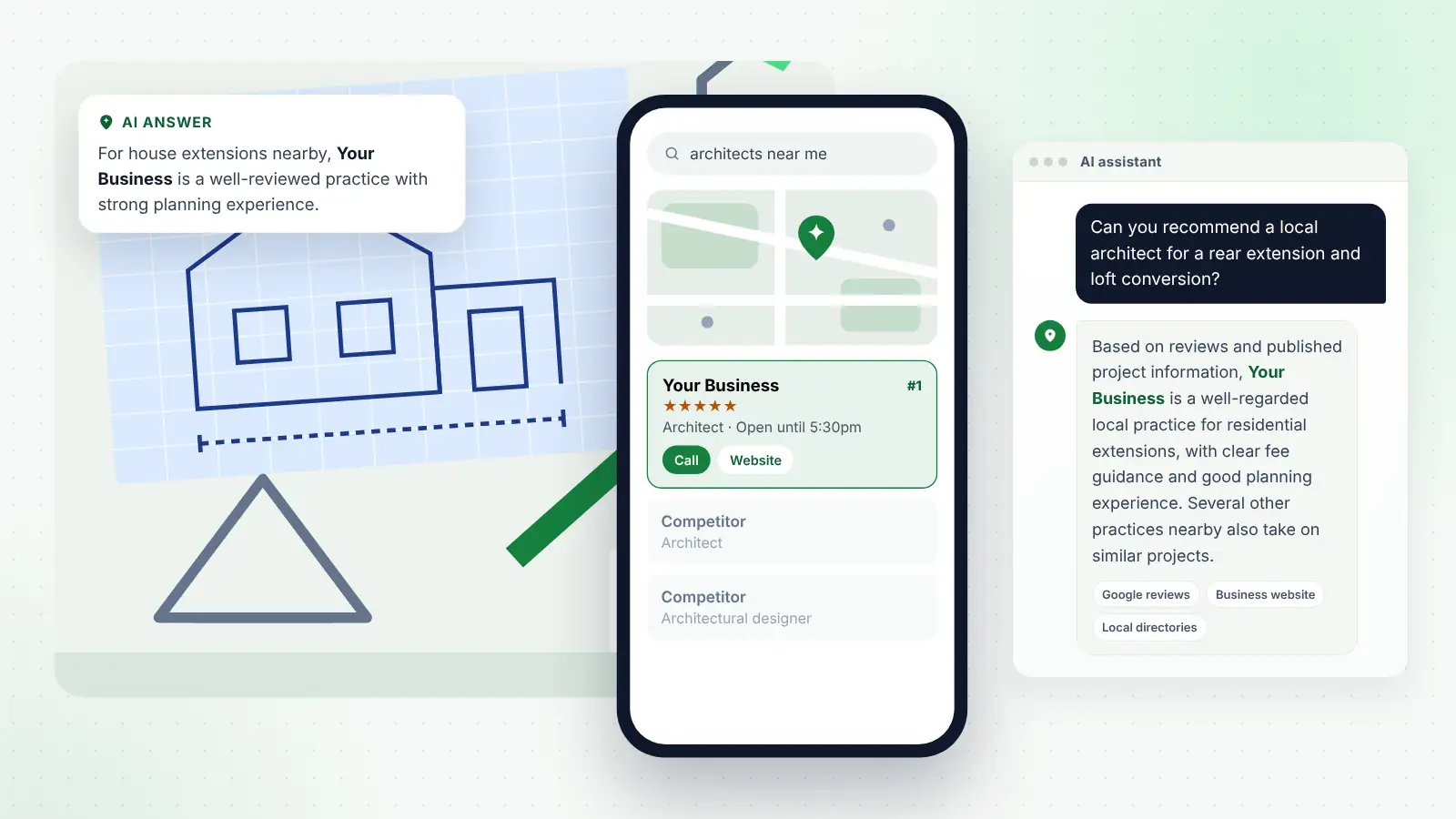
Most homeowners only hire an architect once or twice in their lives, so few have one in mind. When the time comes, they search. Typical searches include “architects near me”, “architect for house extension in [town]”, “loft conversion architect”, “planning drawings for an extension”, “self build architect near me” and “listed building architect”.
Local SEO helps your practice appear in the map results and local listings for those searches. For an architecture practice, the essentials are:
- Google Business Profile. Choose “Architect” as your primary category, add services such as extensions, loft conversions and planning applications, set your service area, and add photos of completed projects. If you work from home, hide your address and show the areas you cover instead.
- Reviews. Ask clients for a review once a project reaches a natural milestone, such as planning approval or completion. Reviews that mention design ideas, planning support and communication are particularly persuasive. Never write, buy or incentivise reviews, as fake and concealed incentivised reviews are prohibited under consumer law.
- Consistent details. Keep your practice name, address and phone number identical across your website, Google, Apple Maps, Bing, architecture directories and local business listings.
- Project and service pages. Create a page for each project type you want more of, and case studies that explain the brief, the design approach and the planning outcome. Pages about the areas you cover, mentioning local housing types and conservation areas where relevant, help you appear in nearby towns.
- Local links and mentions. Coverage of your projects in local press, listings on reputable local business sites, talks to community groups and features on design websites all build authority.
Many small practices manage this themselves, while others hand it to a team that does it every day, such as a specialist in local SEO for architects and architecture practices. Either way, expect results to build over three to six months, and keep your portfolio and service information up to date.
AI search: how homeowners now shortlist architects
A growing number of homeowners now ask AI assistants for help before they contact anyone. ChatGPT, Gemini, Perplexity, Microsoft Copilot and Google’s AI Overviews are being asked questions such as:
- “Can you recommend a local architect for a rear extension and loft conversion?”
- “Do I need an architect or an architectural technologist for a house extension?”
- “Which architects near [town] have experience with listed buildings?”
- “How much does an architect charge for planning drawings for an extension?”
An assistant recommending an architect pieces its answer together from what it can read and verify about each practice online. Answer engine optimisation (AEO) is about making that information clear, accurate and consistent. For an architecture practice, that means:
- Consistent practice information across your website, Google profile, directories and the ARB register.
- Clear service descriptions that say plainly what you design, for whom and in which areas.
- Case studies with real detail, such as the type of property, the planning route and what the client wanted to achieve.
- FAQs in clients’ own words, such as “Do I need planning permission for a loft conversion?” or “How long does a planning application take?”
- Reviews that describe the experience, not just a star rating.
- Mentions on reputable sites, including local news, professional bodies and established design publications.
Accuracy matters. AI tools may repeat what they find, so make sure planning information is current and phrased carefully. Encourage clients to check rules with their local planning authority rather than presenting general guidance as certain for every property.
Tip
Answer the question many homeowners ask first: what difference does using a registered architect make? A clear, fair explanation helps both clients and AI assistants understand your value.
Frequently asked questions
Can I call my practice an architecture practice if I am not registered?
You must not use the title “architect” in business unless you are on the ARB register, and a company name containing “architect” needs a registered architect in control of the architectural work. If you are not yet registered, use descriptions such as architectural design or architectural services, and check ARB’s guidance on title protection before you choose a name.
Do I need professional indemnity insurance as a sole practitioner?
Yes. The Architects Code requires architects to make sure their liabilities are covered by suitable professional indemnity insurance, and the risk of a claim does not depend on the size of your practice. A specialist broker can help you find cover that suits the work you do.
Will I be the principal designer on a house extension?
Possibly. In England, projects with more than one contractor need a principal designer for building regulations. If a domestic client does not appoint one, the designer in control of the design phase takes on the role. Agree the position in writing at the start and make sure you have the competence and insurance to carry it out.
Do I need to be a RIBA member to start a practice?
No. Registration with ARB is what allows you to use the title architect. RIBA membership and Chartered Practice status are optional, but they provide useful resources and are a recognised sign of professional standards.
How can a small practice compete with cheap plan drawing services?
Show what you offer beyond drawings: design thinking, knowledge of your local planning authority, help with building regulations and support through construction. Case studies, clear explanations of your process and reviews from past clients make that value visible.
Final thoughts
Starting an architecture practice takes careful preparation, but each step is manageable. Check that your title, staff descriptions and business name follow ARB’s rules, arrange suitable professional indemnity insurance, prepare clear written terms, and understand your duties under the building regulations before you take on your first project.
Then make it easy for homeowners to find and trust you. A strong portfolio, clear fee guidance, a complete Google profile, consistent listings and genuine reviews help you appear when people search locally or ask an AI assistant for a recommendation. Get those foundations right and keep them up to date, and your practice has a solid base to grow from.