Line marking is a trade most people never think about until the markings fade. Then a retail park manager notices customers parking across two bays, a warehouse operator finds forklifts and pedestrians sharing an aisle, or a primary school wants hopscotch and a running track ready for September. Each is a job for a line marking contractor, and each customer wants it done quickly, safely and with little disruption.
The work suits people who like visible results and don’t mind early mornings, nights and weekends. Startup costs are modest compared with many construction trades, and work repeats naturally because every marking wears out. But there are more rules than it first appears: public road markings follow strict regulations, highway work needs specific certification, and commercial clients want safety accreditations before they let you on site.
This guide covers how to start a line marking business in the UK, from choosing markets and materials to winning tenders, pricing jobs and getting found through local search and AI recommendations.
Key points
- Decide early whether you will serve private sites such as car parks, warehouses, schools and sports facilities, or highway work, because the rules and paperwork differ.
- Markings on public roads must follow the Traffic Signs Regulations and General Directions 2016 (TSRGD); private land gives you more freedom, but clients still expect familiar designs.
- Highway road marking generally requires certification under National Highway Sector Scheme 7 (NHSS 7) and qualified, carded operatives.
- Match thermoplastic, paint or anti-slip systems to the surface, traffic and budget, and explain the choice to clients.
- An SSIP-recognised safety accreditation, good insurance and clear method statements help you pass commercial supplier checks.
- Most clients search online first, so photos, reviews, consistent details and clear service pages matter on Google and in AI answers.
In this guide
- Choose the markets you want to serve
- Public roads, private land and TSRGD
- Highway work, NHSS 7 and the RSMA
- Accessible parking bays and BS 8300
- Warehouse and factory floor marking
- Thermoplastic, paint and anti-slip
- Equipment, training and insurance
- SSIP accreditation and winning tenders
- Out-of-hours working, pricing and quoting
- Local SEO: getting found by local businesses and schools
- AI search: how buyers now ask for recommendations
- Frequently asked questions
- Final thoughts
Choose the markets you want to serve
“Line marking” covers several quite different businesses, so choose a focus before you buy equipment.
- Car park lining and relining. Bays, arrows, hatching, accessible, parent and child and EV bays, and pedestrian crossings for retail parks, offices, hospitals and residential blocks.
- Warehouse and factory floor marking. Walkways, racking lines, forklift routes, loading bay edges and hazard zones inside working buildings.
- Playground markings. Games, number grids, maps and running tracks for schools and nurseries, usually in thermoplastic.
- Sports courts and pitches. Tennis, netball, padel, multi-use games areas and sports halls. Grass pitch marking is a separate skill with its own machines.
- Private roads and estates. Business parks, industrial estates and private access roads.
- Highway work. Markings on public roads for councils and highway contractors, with the strictest requirements.
Many owners start with car parks and playgrounds, where the work is on private land and customers are easy to identify, then add floor marking and sports courts. Highway work usually comes later.
Tip
Find out who manages the car parks, schools and industrial estates near you. Managing agents, facilities management firms and multi-academy trusts often control dozens of sites, so one good relationship can bring steady work.
Public roads, private land and TSRGD
The Traffic Signs Regulations and General Directions 2016 (TSRGD) prescribe the designs and conditions of use for traffic signs and road markings on or near roads in England, Scotland and Wales. On public highways, markings such as give way lines, yellow lines and zig-zags must follow those designs and are ordered by the highway authority, not a private client. A business cannot simply ask you to paint double yellow lines outside its premises.
On private land, such as a supermarket car park or private estate road, you have more freedom over layout. Even so, drivers understand prescribed markings, so many private sites mirror familiar designs for arrows, give way lines and hatching. Consistency makes a site safer and easier to use.
Two points catch new contractors out:
- Private markings are not enforced by the council. If a client wants no-parking areas enforced, that is a matter for the landowner’s parking arrangements. Never promise a private marking is legally enforceable.
- The boundary matters. Check where private land meets the public highway, especially at entrances. Work on the highway side needs the highway authority’s involvement and often a permit and traffic management.
If in doubt, ask for a site plan and check with the local highway authority before quoting near the boundary.
Highway work, NHSS 7 and the RSMA
The National Highway Sector Schemes (NHSS) are quality management schemes for specialist highway work, built on ISO 9001. Scheme 7 covers applying road marking materials and road studs to paved surfaces. National Highways says NHSS registration is mandatory for its contract work specified under the Specification for Highway Works, and many councils and main contractors expect it too. In practice NHSS 7 involves:
- A quality management system audited by an accredited certification body.
- Operatives holding CSCS-logo skills cards that show the training required for their work, with road marking qualifications such as a Level 2 NVQ and trainees properly supervised.
- Traffic management competence where the work needs it, which is covered by its own sector scheme (NHSS 12).
- Qualified supervisors and documented procedures for materials, application and inspection.
The Road Safety Markings Association (RSMA) is the industry’s trade body. It works with government, local authorities and industry partners, sets skills and standards, and offers qualifications and NVQ assessment. Membership brings a directory listing and is a recognised trust signal when bidding for road marking work.
You don’t need NHSS 7 to reline a supermarket car park, but if highway work is in your plans, building procedures and training to that standard early makes certification easier later.
Accessible parking bays and BS 8300
Accessible bays are where clients most often go wrong. BS 8300, the British Standard code of practice for designing an accessible and inclusive built environment (Part 1 covers the external environment, including parking), includes recommendations for designated parking bays, such as space beside and behind the bay for getting in and out of a vehicle and how many accessible bays different sites should provide. Building Regulations guidance and planning conditions may also apply to new developments.
You are rarely the designer, but you can flag common problems:
- Bays squeezed to standard width, with no access zone.
- Access zones painted over during relining or blocked by trolley bays and bollards.
- Too few accessible bays after a layout change.
- Faded symbols that make bays easy to ignore.
Measure existing accessible bays when you reline and recommend the client checks the current edition of BS 8300 and any planning conditions before changing the layout. Advice like that turns one-off jobs into long-term relationships.
Warehouse and factory floor marking
Floor marking is driven by workplace safety. The Workplace (Health, Safety and Welfare) Regulations 1992 require traffic routes to be organised so pedestrians and vehicles can move safely, and HSE’s workplace transport guidance says routes should be marked where possible, pedestrian and vehicle areas clearly marked, crossings clearly marked and protected, and markings renewed when they fade.
That is your sales message. You are not selling paint; you are helping a site manager keep forklifts and people apart and meet their legal duties. Good floor marking involves:
- A walk-round first to understand traffic flows, racking, loading bays and fire exits.
- Proper preparation. Dust, sealers and oil are the main reasons floor markings fail early.
- The right system for the traffic. Heavy forklift use needs hard-wearing coatings.
- A consistent colour scheme, agreed and recorded for walkways, storage and hazard areas.
- Working around operations, in sections, at weekends or during shutdowns.
Tip
After each floor marking job, send a short summary of what was marked, which materials were used and when to inspect for wear. Safety managers value a document they can show auditors, and it gives you a reason to come back.
Thermoplastic, paint and anti-slip
Choosing the right material is the most important technical decision on every job, and explaining it clearly is a selling point in itself.
| Material | Best suited to | Strengths | Things to watch |
|---|---|---|---|
| Hot-applied thermoplastic | Car parks, private roads, playgrounds | Long-lasting, thick, can include reflective beads | Needs a dry surface, heating kit and trained operatives |
| Preformed thermoplastic | Playground games, logos, symbols | Precise shapes and colours, quick to lay | Higher material cost per item |
| Road marking paint | Light-traffic sites, temporary layouts | Lower cost, quick, easy to change | Wears faster under heavy traffic |
| Floor coatings and epoxy | Warehouses and factories | Hard-wearing indoors, chemical resistant | Preparation and curing are critical |
| Anti-slip coatings | Ramps, walkways, crossings | Better grip in wet conditions | Needs the right aggregate and inspection |
Thermoplastic is the workhorse of external marking. It is heated until it flows, applied by hand applicator or screed box and sets as it cools, with glass beads added for night-time visibility. Paint suits light traffic or layouts that may change, but expect to reline sooner. Anti-slip treatments are a useful add-on for ramps and crossings. Quoting the cheapest material for a busy car park may win the job, but faded lines within months won’t win the next one.
Equipment, training and insurance
You can start with a van, a thermoplastic melter and applicator, a paint line marking machine, surface preparation tools such as blowers and burners, stencils and preformed symbols, and cones, barriers and PPE. Used thermoplastic kit is common and can keep costs down. Your van must carry gas cylinders and hot materials safely.
Training matters as much as kit. Hot-applied thermoplastic involves gas burners and very hot material, so operatives need training in safe handling, burns first aid and fire precautions. Budget each year for public liability insurance, often at a level set by the client, plus employers’ liability once you take on staff.
SSIP accreditation and winning tenders
Commercial clients, schools, councils and facilities firms will check you before work starts. Expect to provide risk assessments and method statements (RAMS) for hot materials, vehicles, the public and fumes, COSHH assessments for paints and coatings, and an SSIP-recognised health and safety accreditation.
Safety Schemes in Procurement (SSIP) is the umbrella body for schemes such as CHAS, Constructionline and SafeContractor. Under its mutual recognition arrangement, members accept each other’s valid assessments, so you are not assessed repeatedly. Many supplier portals ask for an SSIP-recognised accreditation as a minimum, so get one in place early. On school sites, be ready to explain how your team will work safely away from pupils.
Out-of-hours working, pricing and quoting
Much line marking happens when everyone else has gone home. Plan for it:
- Agree access and closures in writing, including who keeps vehicles out.
- Think about neighbours. Burners and generators are noisy at night, so ask about restrictions.
- Watch the weather. External markings need a dry surface, so build in contingency days.
- Phase large sites so most spaces stay open.
- Tell clients when areas can reopen, especially for paints and floor coatings.
Night and weekend rates are standard, and clients who need minimal disruption expect to pay for it. Prices depend on the number of bays, symbols and linear metres, the material, surface condition, removal of old markings, working hours, traffic management and travel. Survey the site or get good photos and measurements, then break your quote into preparation, materials, application and any out-of-hours premium. Keep a record of every site’s layout, materials and date, because markings wear predictably and a polite reminder can turn one job into regular relining.
Local SEO: getting found by local businesses and schools
Most enquiries begin with a search. A facilities manager types “car park line marking near me”, a school business manager searches “playground markings” plus their town, or a warehouse operator looks for “warehouse floor marking contractor”. Contractors on Google Maps and at the top of local results are far more likely to be asked to quote.
Google Business Profile
Choose an accurate primary category, add secondary categories and list each service. Set your service area to places you genuinely cover, and add real photos: before and after shots of car parks, playground games, walkways and courts. Mention out-of-hours working and post occasional project updates.
Reviews
Ask every satisfied client for a review with a direct link. Reviews from facilities managers and schools mentioning tidy work, minimal disruption and long-lasting markings are persuasive. Reply to every review politely.
The same contractor details on every listing
Keep your business name, address, phone number and website identical across your website, Google profile, directories, supplier portals and accreditation listings.
A website with a page per marking service and area
Give each service its own page: car park lining, floor marking, playground markings, sports courts and private roads. Explain materials, disruption and what clients can expect, and add pages for the main areas you serve with genuine local projects. A clear page on thermoplastic versus paint helps buyers and search engines alike.
Local links and mentions
Links from chambers of commerce, business groups, school and community projects, suppliers and trade bodies build authority. If you would rather have specialists handle this, our local SEO for line marking contractors service covers your profile, listings, content and links on a rolling monthly plan.
AI search: how buyers now ask for recommendations
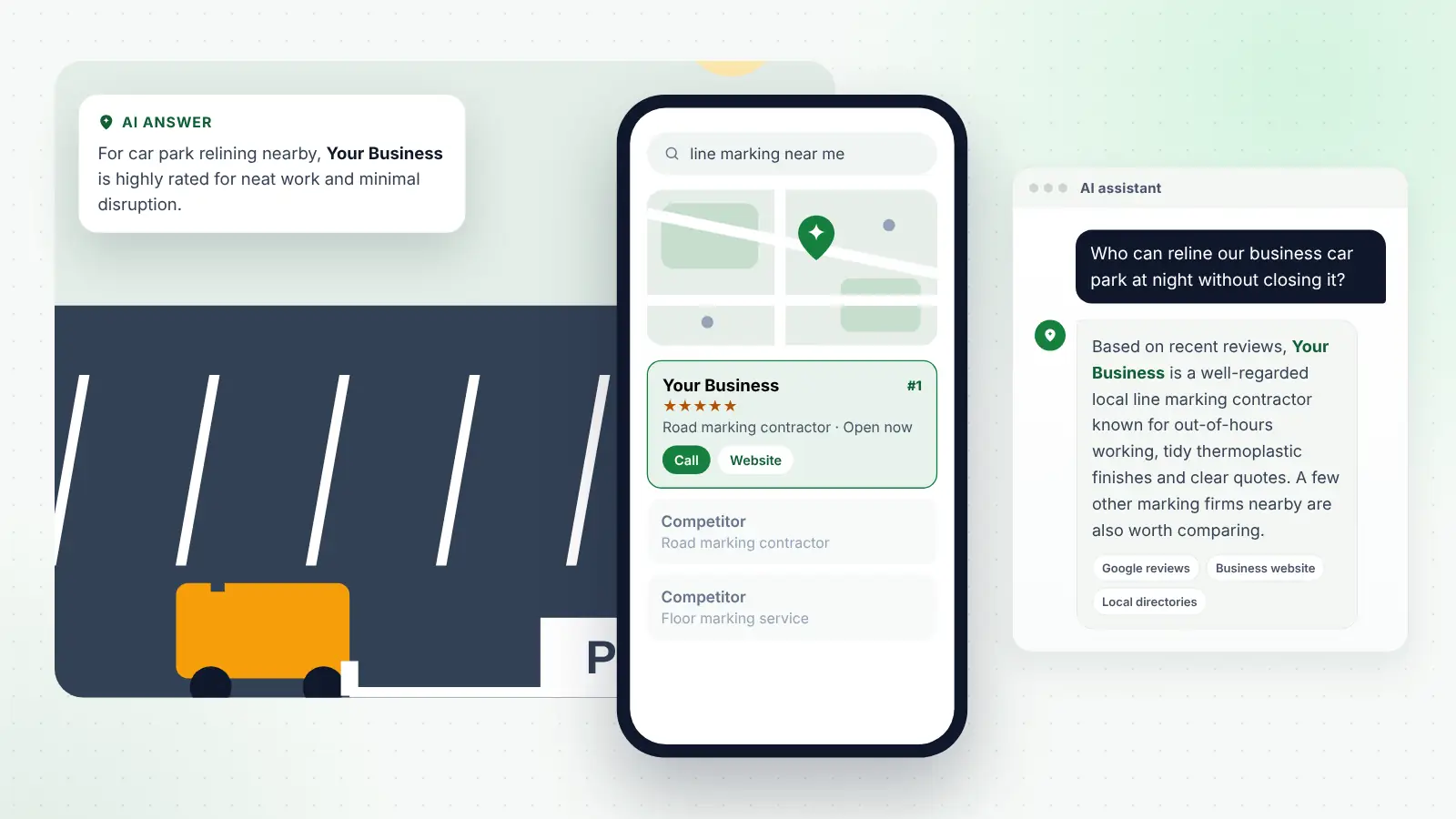
More buyers now ask ChatGPT, Gemini, Perplexity, Copilot or Google’s AI Overviews full questions:
- “Who can reline our business car park at night without closing it?”
- “Is thermoplastic or paint better for a school playground?”
- “Which companies near me do warehouse walkway marking?”
These tools don’t hold a fixed list of the best contractors. Instead they piece together what they can find about each firm and check it against other sources. Answer engine optimisation (AEO) means making sure that information exists and is easy to understand. They tend to rely on:
- Consistent business information across your website, profile, directories and supplier listings.
- Reviews describing specific jobs, such as overnight relining or holiday playground installs.
- Clear service descriptions stating your materials, sectors and areas.
- Helpful answers to questions about thermoplastic lifespan, disruption and accessible bays.
- Mentions on reputable sites, including accreditation directories, trade bodies and local news.
Line marking buyers are busy professionals who want a shortlist quickly. If your accreditations, reviews and content are consistent across the web, you are more likely to be on it. There are no guarantees, but the work overlaps closely with good local SEO.
Frequently asked questions
Do I need a licence to start a line marking business?
There is no general licence to mark car parks or floors. You need insurance, safe working practices and suitable training. Public road work needs the highway authority’s involvement and usually NHSS certification and qualified operatives.
Can I paint road markings on a public road for a client?
No. Public road markings are the highway authority’s responsibility and must follow TSRGD. A client wanting restrictions on a public road needs to contact the council.
How long does thermoplastic line marking last?
It depends on traffic, surface and application quality, but thermoplastic generally lasts considerably longer than paint on busy sites. Give clients an honest, site-specific view.
Which accreditation should I get first?
For most new contractors, an SSIP-recognised health and safety accreditation, because many commercial clients and tenders ask for one. RSMA membership and NHSS 7 matter more as you move towards highway work.
Final thoughts
A successful line marking business combines neat, durable work with the planning and paperwork commercial clients expect. Choose your markets, understand public highways versus private land, match the material to each job and get your safety accreditation early.
Then make your work visible. Photograph every site, ask for reviews, keep your Google Business Profile current and answer the questions buyers really ask. In a trade where every marking eventually fades, a good reputation keeps the work coming back.