Every year, a large number of households and businesses in the UK move, and almost all of them need help. Some just need a van and two people for an afternoon. Others need a full packing service, a large vehicle, storage for a few weeks and a team who can get a piano down a narrow staircase. That range is what makes removals such an accessible business to start: you can begin small with a single van and grow into crews, lorries and a storage facility over time.
It is also a trade built almost entirely on trust. Customers are handing over everything they own on one of the most stressful days of their year. They worry about damage, about the crew turning up late or not at all, and about hidden extras on the bill. The removal companies that do well take those worries seriously and show, before the customer books, that they are organised, insured and reliable.
This guide covers what you need to know to start a removal company in the UK, from choosing vehicles and understanding operator and driving licence rules to insurance, storage, pricing and getting found by people who are planning a move right now.
Key points
- Vehicle size shapes everything: vans up to 3.5 tonnes avoid operator licensing for UK work, while larger vehicles need a goods vehicle operator licence and the right driving licence category.
- A standard car licence covers vehicles up to 3,500kg, while vehicles from 3,500kg to 7,500kg need category C1 entitlement.
- Goods in transit and public liability insurance are essential, and customers will ask what you cover and how claims work.
- Membership of the British Association of Removers (BAR) is a recognised trust mark, with an approved code of practice and annual audits.
- Most moves are planned weeks ahead, so reviews, a strong Google Business Profile and clear online information decide who makes the shortlist.
In this guide
- Decide what kind of removal business you are starting
- Vehicles, operator licences and driving licences
- Insurance
- Trade association membership and standards
- Storage
- Equipment and startup costs
- Pricing, surveys and quotes
- Winning your first moves
- Local SEO for removal companies
- AEO and AI search for removal companies
- Frequently asked questions
- Final thoughts
Decide what kind of removal business you are starting
Removals covers a wide spread of services. Decide where you will start, because it affects your vehicles, licences, insurance and pricing.
- Man and van. Small moves, students, single items, flat moves and deliveries. Low startup cost, frequent short-notice bookings, very competitive pricing.
- Domestic house removals. Full house moves with a crew, often including packing. Higher value per job, more planning and more responsibility.
- Packing and specialist handling. Packing services, fragile items, antiques, pianos and furniture dismantling and reassembly.
- Storage. Short or long-term storage of customers’ belongings, often between house moves.
- Commercial and office moves. Planned relocations for businesses, often out of hours, with IT equipment and tight timescales.
- Long-distance and international moves. Higher value but more complex, including additional licensing for some work abroad.
Many successful firms start with man-and-van and small domestic moves, build reviews and cash flow, then add a larger vehicle, packing services and storage as demand grows. What tends to go wrong is taking on full house moves before you have the vehicle size, crew and insurance to handle them properly.
Vehicles, operator licences and driving licences
This is the section new removal businesses most often get wrong, and it is worth understanding before you buy or lease anything.
Vans up to 3.5 tonnes
Most new removal firms start with a large panel van or Luton van with a maximum authorised mass (MAM) of up to 3,500kg. For work within the UK, you do not need a goods vehicle operator licence for these vehicles. However, if you carry goods for hire or reward into the EU, Norway, Iceland, Liechtenstein or Switzerland using vans over 2,500kg and up to 3,500kg, businesses based in Great Britain need a standard international operator licence. The GOV.UK guidance on transporting goods using vans explains this in detail.
Be realistic about payload. A Luton van’s maximum weight includes the vehicle itself, the crew and fuel, so the weight of furniture and boxes you can legally carry is often less than people assume. Overloading is a common and avoidable problem.
Vehicles over 3.5 tonnes
Once you move to a vehicle over 3,500kg gross plated weight to carry customers’ goods for hire or reward, you need a goods vehicle operator licence. In Great Britain this is issued by the traffic commissioner, and in Northern Ireland by the Department for Infrastructure.
For hire or reward work, a standard licence is required: standard national for UK work, or standard international if you also work abroad. To get one, you generally need to show:
- Good repute – for the business and its transport manager.
- Financial standing – enough money to run and maintain your vehicles.
- Professional competence – usually a nominated transport manager holding a transport manager Certificate of Professional Competence (CPC).
- A suitable operating centre – somewhere to keep the vehicles when not in use.
- Systems to keep vehicles roadworthy and drivers compliant – including maintenance inspections and drivers’ hours records.
Heavier vehicles also bring drivers’ hours and tachograph rules, annual testing and more demanding maintenance schedules. Many growing firms stay with 3.5 tonne vans for longer than they first planned for exactly this reason, then make the step up once the business is ready.
Driving licence categories
A standard category B car licence lets you drive vehicles up to 3,500kg MAM. For vehicles from 3,500kg up to 7,500kg, you need category C1, and for heavier lorries, category C. Drivers who passed their car test before 1 January 1997 usually have C1 entitlement already, but always check the licence itself rather than assuming. Drivers who drive larger vehicles professionally also need a Driver Certificate of Professional Competence (Driver CPC).
| Vehicle | Typical licence | Operator licence for UK hire or reward work |
|---|---|---|
| Van up to 3,500kg | Category B | Not required |
| Van over 2,500kg for EU hire or reward work | Category B | Standard international (light goods) licence |
| Lorry 3,500kg–7,500kg | Category C1 | Standard operator licence |
| Lorry over 7,500kg | Category C | Standard operator licence |
Tip
Before you buy a vehicle, check the plated weight, the realistic payload and the licence categories your drivers actually hold. A bargain lorry is no bargain if none of your crew can legally drive it.
Insurance
Removal work carries obvious risks: damage to belongings, damage to properties, injuries from lifting and incidents on the road. Insurance is essential, and customers will ask what you cover.
- Goods in transit insurance. Covers customers’ belongings while they are loaded, carried and unloaded. Check the limits per load and per item, the exclusions, and whether packing by the customer affects cover.
- Public liability insurance. Covers damage to property and injury to the public, such as scraped walls, damaged floors or someone tripping over equipment.
- Employers’ liability insurance. A legal requirement if you employ anyone, including casual crew.
- Commercial vehicle insurance. Must cover business use for carrying goods for hire or reward.
- Storage cover. If you store customers’ goods, check that your policy covers goods in storage, and explain clearly to customers what is and is not covered.
Write your liability terms in plain English and put them in your quote. Customers who understand what is covered, and how to make a claim, complain far less when something does go wrong.
Trade association membership and standards
The British Association of Removers (BAR) is the main trade body for removal companies in the UK. Its code of practice has Approved Code status under the Chartered Trading Standards Institute scheme. Prospective members are checked against BAR’s membership criteria, existing members are audited every year at each operating centre, and members must protect customers against loss or damage to their goods to minimum standards. If a complaint is not resolved, members must offer alternative dispute resolution. You can read more on the Chartered Trading Standards Institute’s approved code page for BAR.
For a new firm, joining may not be immediate, but reading BAR’s criteria and code is a useful benchmark. It shows what customers and the industry expect in terms of written quotes, insurance, complaint handling and conduct, and setting your business up that way from the start makes later membership far easier.
Storage
Storage is a valuable add-on and a common reason customers choose one remover over another. People often need somewhere to keep their belongings between the sale of one property and the purchase of the next.
You have several options:
- Partner with a self-storage provider. The simplest start. You move goods in and out; they provide the space.
- Containerised storage. Wooden or steel containers in a secure warehouse, loaded at the customer’s home and stored sealed. Common in the removals industry.
- Your own warehouse. Higher investment and responsibility, but strong margins over time.
If you store goods yourself, think carefully about security, fire protection, damp, pest control, access records and insurance. Check with your local council about planning permission and the permitted use of any building before you start storing customers’ belongings there.
Equipment and startup costs
Startup costs depend heavily on whether you begin with a single van or a larger vehicle. These ranges are rough guides only and vary by area, supplier and condition.
| Item | Typical cost | Notes |
|---|---|---|
| Luton van (used) | £8,000–£25,000 | Check plated weight and payload carefully |
| Tail lift (if needed) | Often included or £2,000+ | Saves time and backs on heavier moves |
| Furniture blankets and covers | £300–£1,000 | Buy plenty; they protect your reputation |
| Trolleys, straps and dollies | £300–£800 | Piano and appliance trolleys if you specialise |
| Packing materials stock | £200–£800 | Boxes, tape, paper and wardrobe cartons |
| Insurance (first year) | Varies | Goods in transit, public and employers’ liability |
| Website, signage and branding | £500–£3,000 | A clean, well-signed van builds confidence |
| Booking and survey software | £20–£80 per month | Useful for video surveys and scheduling |
Keep a cash buffer for fuel, repairs and quieter weeks. A van off the road for a week in peak season can cost far more than the repair.
Pricing, surveys and quotes
Survey before you quote
The most reliable way to price a move is a survey, either in person or by video call. You need to know the volume of goods, access at both properties, parking, stairs and lifts, items needing special handling, and whether packing is needed. Phone estimates based on “it’s a three-bed house” are a common source of disputes and lost money.
Build a clear quote
A good removal quote usually includes:
- The volume or inventory of items being moved.
- Crew size, vehicle and expected time.
- Packing, materials, dismantling and reassembly.
- Insurance cover and liability limits.
- Access issues, parking arrangements and any permits.
- Price, deposit, payment terms and cancellation policy.
Manage peaks and quiet days
Fridays, month-ends and the summer holidays are busy because they line up with completion dates and school holidays. Midweek and mid-month dates are quieter. Offering modest discounts for flexible dates helps fill the diary, and customers moving into rented property or storage are often more flexible than buyers waiting on completion.
Tip
Respond to every quote request quickly with a clear, written quote. In removals, the first organised, professional response often wins the booking, even against slightly cheaper competitors.
Winning your first moves
- Estate agents, letting agents and conveyancers. They know about moves weeks in advance and are regularly asked to recommend a remover.
- Local landlords and property managers. Tenancy changes create regular small moves.
- Care homes and downsizing services. Older customers moving to smaller homes often need extra care and packing help.
- Businesses. Small offices and shops moving premises.
- Past customers. Ask for reviews and referrals after every move, while the relief and goodwill are fresh.
Local SEO for removal companies
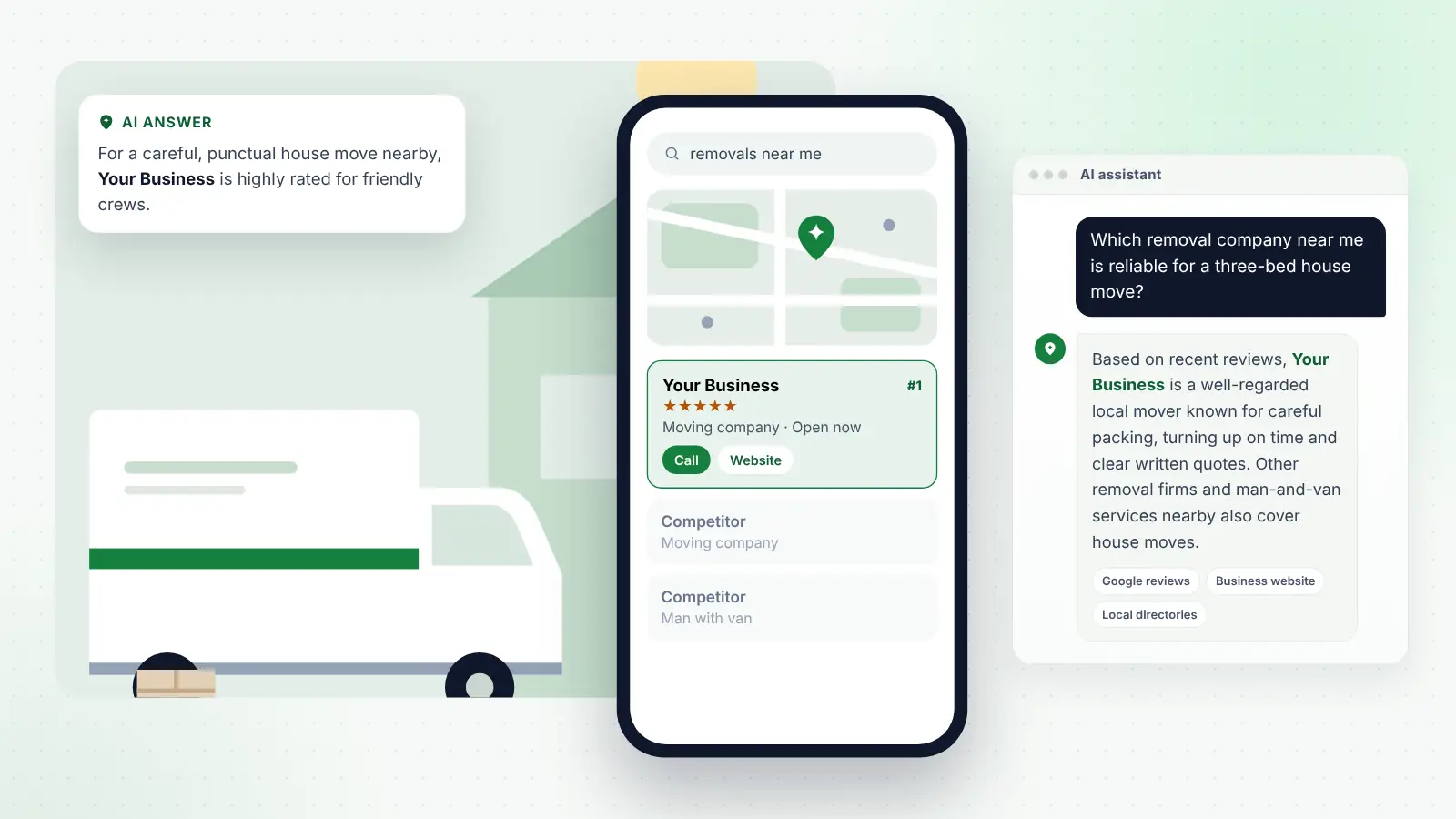
Most people only move a handful of times, so they rarely have a remover already in mind. They search on Google, compare reviews and request quotes from a short list. Typical searches include “removals near me”, “removal companies in [town]”, “man and van near me”, “house removals cost”, “packing service removals” and “storage near me”. The businesses in the map results and the first few organic results are far more likely to make the shortlist.
The essentials:
- Complete your Google Business Profile. Use an accurate category such as moving company, list every service, set your service area and add real photos of your vehicles, crew and packing work.
- Collect detailed reviews. Ask customers to mention the type of move and location. Reviews about care, punctuality and friendliness are particularly persuasive.
- Keep your details consistent. Your business name, phone number, website and service area should match across Google, directories, comparison platforms and trade association listings.
- Build service and area pages. Separate pages for house removals, man and van, packing, storage and office moves, plus pages for the main towns you serve, help you appear for specific searches.
- Publish useful guides. Packing checklists, moving day timelines and guide prices for typical moves help customers and build trust.
- Earn local links. Partnerships with estate agents, local business directories, community sponsorships and trade bodies all help.
You can do much of this yourself, especially in quieter months. If you would rather focus on running moves, our page on local SEO for removal companies explains how that can be handled for you. Either way, results usually build over three to six months, so starting in spring puts you in a good position for the busy summer season.
AEO and AI search for removal companies
People planning a move increasingly ask AI assistants for help. They ask ChatGPT, Gemini, Perplexity or Microsoft Copilot, or read Google AI Overviews, with questions like:
- “Which removal company near me is reliable for a three-bed house move?”
- “How much does a local house move cost in [town]?”
- “Do removal companies insure my belongings?”
- “How far in advance should I book removals?”
Answer engine optimisation (AEO) means making sure these tools can find accurate, consistent information about your business and trust it enough to mention you. For removals, the signals that tend to matter are:
- Consistent business details across your website, Google profile, directories and trade body listings.
- Reviews describing real moves and qualities such as care, punctuality and communication.
- Clear service descriptions covering what you offer, where and for whom.
- Plain-English answers to common questions about costs, insurance, packing, storage and what happens on moving day.
- Mentions on reputable sites, such as local news, estate agent partners and trade association directories.
This matters for removals because customers research carefully and often ask several questions before contacting anyone. A website that explains your insurance clearly, sets out how quotes work and answers common worries gives both customers and AI tools solid material to work with. It does not guarantee a mention, but it gives you a far better chance than a single page with a phone number.
Frequently asked questions
Do I need an operator licence for a Luton van?
For a van up to 3,500kg used only within the UK, you do not need a goods vehicle operator licence. If you carry goods for hire or reward into the EU or certain other European countries using vans over 2,500kg, businesses based in Great Britain need a standard international licence. Vehicles over 3,500kg need an operator licence for hire or reward work.
Can I drive a 7.5 tonne lorry on my car licence?
Only if you have C1 entitlement. A standard car licence covers vehicles up to 3,500kg. Drivers who passed their test before 1 January 1997 usually have C1, but check the licence to be sure. Professional drivers of larger vehicles also need Driver CPC.
Is goods in transit insurance a legal requirement?
It is not a general legal requirement, but it is essential in practice. Customers expect their belongings to be protected, trade bodies such as BAR require members to protect customers’ goods, and an uninsured damage claim could be costly. Explain your cover clearly in every quote.
Should I join the British Association of Removers?
BAR membership is a recognised trust mark, backed by an approved code of practice and annual audits. It can help you win higher-value moves. Even before you apply, reading its criteria is a good way to set up your business properly.
How do I fill quieter weekdays?
Offer modest discounts for midweek and mid-month dates, promote them to flexible customers such as tenants and those moving into storage, and build relationships with businesses that can move outside peak times.
Final thoughts
Starting a removal company is about matching your ambitions to your vehicles, licences and insurance, then delivering moves that customers remember for the right reasons. Understand where operator licensing starts, check every driver’s licence categories, protect customers’ belongings properly and put clear, written quotes in front of every customer.
Then make your reliability visible. Collect reviews after every move, keep your Google Business Profile up to date, explain your services and insurance in plain English, and build relationships with the agents who hear about moves first. That combination turns a single van into a business people recommend.