Landscaping and garden maintenance are among the most approachable trades to start in the UK. You do not need premises, the core tools are affordable, and almost every street has gardens that need cutting back, tidying, turfing or redesigning. That low barrier to entry is also the challenge: there are plenty of people with a mower and a van, and customers often struggle to tell a careful professional from someone who will disappear halfway through a job.
The businesses that do well tend to make a few decisions early. They choose a clear focus, they get the legal basics right from the first week, they price for the whole year rather than just the busy months, and they make it easy for homeowners to see their work before they pick up the phone.
This guide walks through each of those steps, from registrations and certificates to equipment, pricing, seasonality and getting found on Google and in AI assistants. It is written for anyone starting from scratch, whether you are leaving employment with a larger contractor or turning a part-time gardening round into a proper business.
Key points
- Decide early whether you are mainly a maintenance gardener, a hard landscaper, a designer or a mix, because it changes your equipment, pricing and marketing.
- If you take garden waste or rubble away from customers’ properties, you need to register as a waste carrier with the relevant environmental regulator.
- Using professional weedkillers or other pesticides for paying customers requires a recognised certificate, such as the PA1 and PA6 awards or their Lantra equivalents.
- Seasonality is the biggest financial risk, so plan winter work and cash reserves before your first spring.
- Photos of finished gardens, detailed reviews and a well-kept Google Business Profile do more to win work than almost any other marketing.
In this guide
- Choose the kind of garden business you want to run
- Get the landscaping business legally set up
- Registering to carry green waste and rubble
- Pesticide certificates and safe use of chemicals
- Equipment, vehicle and startup costs
- Qualifications, skills and trade bodies
- Pricing your work and planning for seasonality
- Winning your first customers
- Local SEO for landscape gardeners
- AEO and AI search: how customers ask for garden help now
- Growing beyond a one-person business
- Frequently asked questions
- Final thoughts
Choose the kind of garden business you want to run
“Landscaping” covers several quite different businesses. Before you buy equipment or print anything, decide where your main focus will be.
- Garden maintenance. Regular mowing, hedge cutting, weeding, pruning and seasonal tidy-ups. Lower value per visit but steady, repeatable income and loyal customers.
- Soft landscaping. Turfing, planting schemes, borders, lawn renovation and small redesigns. Moderate equipment needs and good margins on materials and labour.
- Hard landscaping. Patios, paving, driveways, walls, steps, fencing and decking. Higher value jobs, but heavier equipment, more skill, more risk and more customer scrutiny.
- Garden design. Drawing up plans and planting schemes, sometimes with a build service attached. Relies heavily on a strong portfolio.
Many successful firms combine two of these, typically maintenance plus soft or hard landscaping. Maintenance contracts provide cash flow in the quieter months, while project work earns the bigger margins. What tends to go wrong is trying to offer everything at once with one person and a small van. You end up turning down profitable patio work because you are booked solid with lawn cuts, or letting maintenance customers down because a paving job overran.
Get the landscaping business legally set up
Choose your structure
Most new landscapers start as sole traders because it is simple: you register for Self Assessment with HMRC and keep records of income and expenses. A limited company can make sense once profits grow or if you want to separate personal and business finances more formally, but it brings more admin and accounting costs. It is worth a short conversation with an accountant before deciding, particularly about VAT, which becomes compulsory once your turnover passes the registration threshold.
Get insurance in place before your first job
Public liability insurance is the minimum most customers expect, and many commercial clients and letting agents will ask to see your certificate. If you employ anyone, even part time, employers’ liability insurance is a legal requirement. Also consider cover for your tools and equipment, van insurance that covers business use, and contract works cover for larger hard landscaping projects.
Keep paperwork simple but consistent
From day one, use written quotes that set out what is included, materials, waste removal, timescales and payment terms. A short set of terms and conditions saves a surprising number of arguments, particularly around deposits, changes to the job and what happens if the weather delays work.
Registering to carry green waste and rubble
This is the requirement that catches out more new landscapers than any other. If your business transports waste, including grass cuttings, hedge trimmings, soil, turf, rubble or old paving taken away from customers’ gardens, you must register as a waste carrier.
You register with the regulator for the country where you are based:
| Country | Who you register with |
|---|---|
| England | Environment Agency |
| Wales | Natural Resources Wales |
| Scotland | Scottish Environment Protection Agency (SEPA) |
| Northern Ireland | Department of Agriculture, Environment and Rural Affairs (DAERA) |
In England there are upper and lower tiers, and the Environment Agency tells you which applies when you register through the GOV.UK waste carrier registration service. As a general guide, carrying green waste you have cut or removed yourself is usually lower tier, which is free and does not need renewing. Carrying construction or demolition waste, such as rubble, old paving or fencing, or waste produced by someone else, usually means an upper-tier registration, which carries a fee and needs renewing every three years. Operating without registration can lead to a fine, so treat this as a launch task, not something to sort out later. The system in England is also changing: new regulations made in 2026 will replace registration with a permit-based regime, phased in from July 2027, so check the current position when you register or renew.
Registration is only half of it. You also need to dispose of the waste properly, at a licensed site or through an authorised route, and keep waste transfer records. Customers are increasingly aware that they can be held responsible if their waste is fly-tipped, so being able to say “we are a registered waste carrier and here is our number” is a genuine selling point.
Tip
Put your waste carrier registration number on your quotes and website. It costs nothing, reassures careful customers and quietly separates you from operators who cannot show one.
Pesticide certificates and safe use of chemicals
If you plan to use weedkillers, moss killers or other pesticides as part of paid work, you need to understand the rules. Under the regulations that govern professional pesticide use, anyone using a professional product must hold a recognised certificate, or work under the direct supervision of someone who does while training. The old “grandfather rights” exemption ended in November 2015 and never covered commercial services anyway, so there is no route around this for a contractor.
The most common certificates for gardeners are:
- PA1 – the foundation unit covering safe handling and principles of pesticide use.
- PA6 – the unit for handheld applicators, such as knapsack sprayers, taken alongside PA1.
These are awarded through City & Guilds (NPTC) or as equivalent Level 2 awards through Lantra. Courses are widely available at agricultural colleges and private training providers, often over a few days.
Even if you only use products sold for amateur use, the Health and Safety Executive’s pesticides guidance makes clear that anyone using pesticides as part of their work should be trained and able to assess the risks. You also need the landowner’s permission, should follow the label exactly and need to think about pets, children, ponds and neighbouring gardens. Many customers now actively ask for chemical-free or reduced-chemical approaches, so being able to explain your choices clearly is part of the service.
Equipment, vehicle and startup costs
You do not need everything on day one. Buy what your chosen services require, hire specialist kit such as mini diggers, plate compactors and turf cutters until demand justifies owning them, and upgrade as the work grows. The ranges below are rough guides only; prices vary by area, supplier and whether you buy new or used.
| Item | Typical cost | Notes |
|---|---|---|
| Used van or pickup | £6,000–£18,000 | A tipper is useful for waste and materials |
| Trailer | £800–£3,000 | Handy for mowers and bulk bags |
| Mowers and strimmers | £800–£4,000 | Commercial-grade kit lasts longer |
| Hedge trimmers and blowers | £400–£1,500 | Battery kit reduces noise complaints |
| Hand tools and wheelbarrows | £300–£800 | Buy quality; they take a beating |
| Pesticide training (PA1/PA6) | Varies | Check local college and provider prices |
| Insurance (first year) | Varies | Depends on cover, turnover and staff |
| Website, signage and branding | £500–£3,000 | Clear van signage generates enquiries |
A common mistake is spending heavily on a new van and equipment, then having very little left to carry the business through its first winter. A modest, reliable used vehicle and a healthy cash buffer are usually the better combination.
Qualifications, skills and trade bodies
There is no single licence required to call yourself a landscaper, but qualifications help with both quality and trust. Horticulture qualifications from the RHS or colleges strengthen planting knowledge, while hard landscapers benefit from practical paving and construction training. If you plan to use chainsaws for any tree work, you need proper chainsaw training, and anything beyond small pruning is usually best left to qualified tree surgeons or subcontracted.
The British Association of Landscape Industries (BALI) is the main trade association for the sector. Membership is only granted to businesses that meet its membership terms, continued membership depends on maintaining standards, and it offers a dispute service and guidance on contracts. It tends to carry more weight on larger residential and commercial projects, and the membership criteria are useful to read even before you apply, because they show what an established landscaping business is expected to have in place. You can find details on the BALI website.
Pricing your work and planning for seasonality
Pricing approaches
Most landscapers use one of three approaches, often in combination:
- Day rate. Simple for maintenance and smaller jobs. Make sure your rate covers travel, fuel, equipment wear, waste disposal, insurance and the days you cannot work.
- Fixed price per job. Better for projects like patios and turfing. Measure carefully, cost materials accurately, add waste disposal and contingency, and state clearly what is excluded.
- Regular maintenance contracts. A monthly or per-visit fee for an agreed schedule. Predictable for you and easy for customers to budget.
A frequent error is pricing hard landscaping like maintenance work. Patios and walls carry more risk: ground conditions, drainage, access and materials can all change the job. Quotes should reflect that.
Seasonality
Garden work is seasonal in two directions. Demand surges from early spring into summer, then falls away. Winter weather also limits what you can physically do. Plan for it before your first year rather than discovering it in December.
- Build a base of maintenance customers who want visits all year, including autumn leaf clearance and winter tidy-ups.
- Promote less weather-dependent work for the quieter months: fencing, hedge reductions, pruning, design consultations and planning next year’s projects.
- Encourage spring project bookings in late winter, when many homeowners start thinking about their gardens.
- Hold enough cash in reserve to cover at least a few lean months of fixed costs.
Tip
In January and February, contact last year’s project customers about spring maintenance or a follow-up job. They already trust you, and it fills the diary before the rush starts.
Winning your first customers
Early work usually comes from people you know, neighbours of your first customers, and local searches. A few habits make a big difference:
- Photograph every job. Before, during and after, ideally from the angle the owner sees most, such as the back door or kitchen window.
- Ask for reviews at the right moment. When the customer is standing in their finished garden and clearly pleased.
- Use your van and site. Clear signage and, with permission, a small board outside a project.
- Talk to neighbours. A short note through nearby doors when you finish a job often leads to more work on the same street.
- Build referral partners. Estate agents, letting agents, property managers and other trades such as builders and fencers regularly need garden work done.
Local SEO for landscape gardeners
Most homeowners looking for a landscaper start with Google, and many look straight at the map results. Searches such as “landscapers near me”, “patio installers in [town]”, “garden maintenance near me”, “turf laying service” and “garden clearance [area]” are local by nature. The businesses shown in the map pack and the first few results usually get the calls, so local search visibility matters as much as your quality of work.
The good news is that the fundamentals are within reach of any small business:
- Set up and complete your Google Business Profile. Choose the most accurate primary category, add every service you offer, set your service area (you can hide your home address), and write a clear description of what you do and where.
- Add photos regularly. Garden work is visual. A steady flow of real project photos makes your profile more persuasive and shows Google the business is active.
- Collect detailed reviews. Reviews that mention the job and the area, such as “new patio and turf in Harpenden”, help customers and give search engines useful detail. Reply to every review politely, including the occasional negative one.
- Keep your details consistent. Your business name, phone number, website and service area should match across your website, Google, Facebook, Yell, Checkatrade or similar platforms, and any trade body listing.
- Build a website with service and area pages. A separate page for each main service, such as patios, turfing, garden design and maintenance, plus pages for the main towns you cover with real local projects, performs far better than a single page listing everything.
- Earn local links. Mentions from local community sites, suppliers, sponsored local events and trade bodies all help establish that you are a genuine local business.
Most of this you can do yourself in the evenings, especially in winter. If you would rather spend that time quoting and working, you can hand it to specialists; our page on local SEO for landscape gardeners and garden firms explains how that works for businesses like yours. Either way, expect results to build over three to six months rather than overnight, which is another reason to start well before the spring rush.
AEO and AI search: how customers ask for garden help now
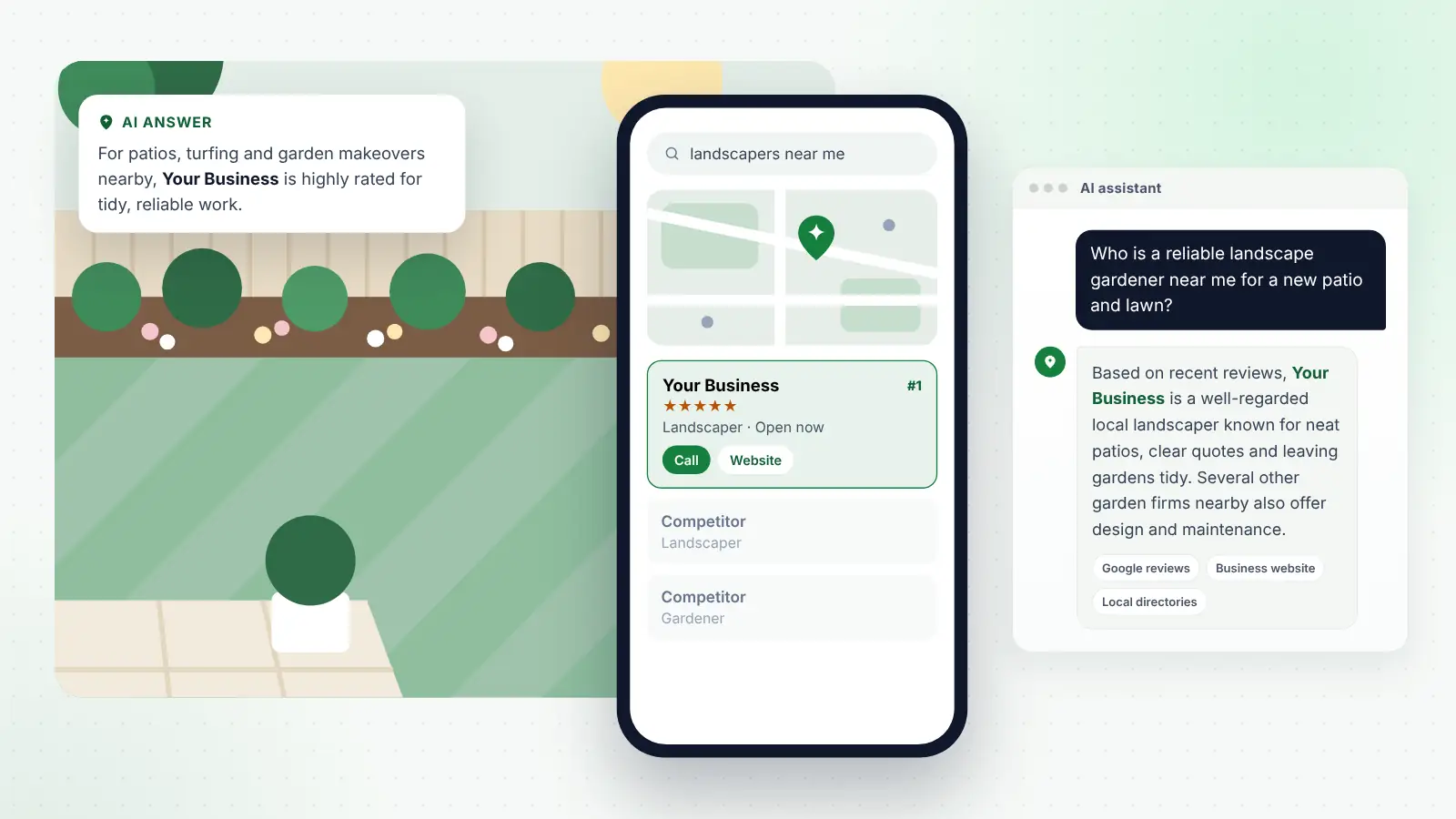
A growing number of homeowners now ask AI assistants for help rather than typing short searches. They might ask ChatGPT, Gemini, Perplexity, Microsoft Copilot or read a Google AI Overview with questions like:
- “Who is a good landscape gardener near me for a patio and new lawn?”
- “How much does a new patio cost in [town], and who should I ask to quote?”
- “Which local gardeners offer monthly maintenance and take the waste away?”
- “Is it better to lay turf in spring or autumn?”
These tools do not have a single list of the best landscapers. They draw on information they can find and cross-check across the web. Answer engine optimisation (AEO) simply means making sure that information exists, is accurate and is easy to understand. In practice, the signals they tend to rely on are:
- Consistent business information on your website, Google profile and directories, so the tool can be confident you exist and where you work.
- Reviews that describe specific jobs and qualities, such as reliability, tidiness and clear pricing.
- Clear service descriptions that say plainly what you do, where, and for whom.
- Helpful answers to common questions, such as patio costs, best times to turf, how long projects take and what aftercare is needed, written on your website in plain English.
- Mentions on reputable sites, including local news, community organisations, supplier case studies and trade association directories.
For a landscaping business this matters because garden projects are researched over days or weeks. Someone planning a patio might ask an AI assistant several questions before contacting anyone. If your website answers those questions well and your reputation is consistent across the web, you are far more likely to be the name that appears in the answer. As with local SEO, there are no guarantees and it takes time, but the work overlaps heavily, so improving one usually helps the other.
Growing beyond a one-person business
Once the diary is full, growth usually means one of three things: raising prices, specialising in higher-value work, or taking on help. Before hiring, make sure your pricing leaves room for wages, employer costs and the extra insurance. Many landscapers start with a reliable labourer on busy project days, then move to a permanent team member once maintenance contracts provide a steady base.
Systems matter more as you grow. A simple job management or scheduling app, standard quote templates and a consistent way of collecting photos and reviews keep the business organised. Turning finished projects into maintenance contracts is one of the most effective growth habits: it protects the quality of your work, steadies your income and keeps you front of mind for the customer’s next project.
Frequently asked questions
Do I need a licence to start a gardening business?
There is no general licence to work as a gardener or landscaper. However, you do need to register as a waste carrier if you take garden waste or other waste away from customers’ properties, and you need a recognised certificate to use professional pesticides. Check with your local council if you plan to work from a yard or store materials at home.
Can I take garden waste to my local tip?
Household recycling centres are generally intended for residents’ own household waste, and many do not accept trade waste or charge for it. Check your council’s rules, and look at licensed commercial waste sites or green waste facilities in your area. Keep records of where your waste goes.
Do I need PA1 and PA6 if I only use weedkiller occasionally?
If you use professional pesticide products as part of your work, yes, you need a recognised certificate, and the PA1 and PA6 units (or Lantra equivalents) are the usual route for handheld sprayers. Even with amateur products, you should be trained and able to assess the risks when working for customers.
How do I survive the winter months?
Combine year-round maintenance contracts with work that is less dependent on weather, such as fencing, hedge work and design consultations. Promote spring projects from late winter, and keep a cash reserve from the busy months to cover fixed costs.
Is BALI membership worth it for a new landscaper?
It depends on the work you want. For small maintenance rounds, insurance, waste registration and good reviews matter more. For larger residential and commercial projects, BALI membership can help, and reading its requirements is a useful benchmark for running your business properly even before you apply.
Final thoughts
Starting a landscaping business is mostly about getting a handful of things right consistently: the legal basics, honest pricing that covers the whole year, careful work, and making that work visible. Register as a waste carrier, get the right certificates for any chemicals you use, insure yourself properly and plan for winter before you need to.
Then make it easy for customers to find you and trust you. Photograph every job, ask for reviews, keep your Google Business Profile active and answer the questions homeowners actually ask. Those habits build a reputation that keeps working for you long after your first season.