Plenty of good brokerages start the same way: an experienced account handler or commercial executive realises that their clients follow them, not the logo above the door. They know the trades, they know which insurers will look at a difficult risk, and they know that the moment of truth is the claim, not the quote. Setting up on your own turns that knowledge into a business you own.
It is also a regulated business from day one. You cannot arrange insurance in the UK without being authorised by the Financial Conduct Authority or acting as an appointed representative of a firm that is. You need professional indemnity cover, insurer agreements, a compliant way of handling client money, a complaints process and a clear view of how your products deliver fair value. None of that is unmanageable, but it shapes everything from your launch timetable to how you write your website.
This guide is for people starting an independent brokerage focused on commercial cover for local businesses and trades, fleet, landlord, high-net-worth home or specialist schemes. It covers the regulatory routes, the rules that affect day-to-day trading, getting access to insurers, startup costs, how you are paid, winning your first clients, and the local SEO and AI search work that brings business owners to you directly. It is general information as at October 2026, not regulatory or legal advice, so check specifics with the FCA, your principal firm or a compliance consultant.
Key points
- You must be FCA authorised or become an appointed representative of an authorised principal before you arrange any insurance.
- The appointed representative route is usually faster and cheaper to start, but your principal sets the rules and takes a share of income.
- The Consumer Duty and fair value rules apply to consumers and smaller businesses, so add-ons, fees and premium finance need a clear justification.
- Specialising in a few trades or property types makes it easier to win insurer agencies, referrals and visibility in search.
- Everything you publish, from web pages to social posts, should be clear, fair and not misleading, and approved before use.
- Local SEO and AI search help business owners find you directly, and results usually build over three to six months.
In this guide
- Decide what kind of brokerage you want to be
- Choose your route: FCA authorisation or appointed representative
- Understand the rules that shape daily trading
- Professional indemnity, capital and your own cover
- Qualifications, competence and professional bodies
- Get access to insurers and markets
- Startup costs
- How you are paid
- Win your first clients
- Local SEO for insurance brokers
- How AI assistants recommend brokers
- Common mistakes new brokers make
- Frequently asked questions
- Next steps
Decide what kind of brokerage you want to be
Before you think about permissions or software, decide who your clients are. A brokerage that tries to quote everything for everyone ends up competing with comparison sites on price. One that is known for something specific is easier to recommend, easier to market and more attractive to insurers.
Common starting points for independent brokers include:
- Local businesses and trades. Public and employers’ liability, tools, contract works, shops, offices and combined policies for builders, electricians, salons, cafés and professional firms.
- Fleet and commercial vehicles. Van fleets, couriers, plant and haulage, where claims handling and risk management advice matter a great deal.
- Landlords and property owners. Single lets, portfolios, HMOs, blocks of flats and commercial property.
- High-net-worth home. Valuable homes, listed buildings, art, jewellery and collections, often with a more personal, advisory style of service.
- Specialist schemes. Tailored packages for one type of business, such as tree surgeons, dog groomers or holiday lets, usually built with an insurer over time.
Your choice affects which insurers you approach, which qualifications matter most, how much client money you handle and which rules apply. Personal lines work for consumers carries more of the retail rules than broking for larger commercial clients, for example.
Tip
Write down the five types of client you most want and the three you will politely refer elsewhere. Saying no to poor-fit risks protects your loss ratios, your insurer relationships and your time.
Choose your route: FCA authorisation or appointed representative
There are two main ways to trade lawfully. You can apply to the FCA for your own permissions as a directly authorised firm, or you can become an appointed representative (AR) of a principal firm that accepts regulatory responsibility for what you do.
| Directly authorised | Appointed representative | |
|---|---|---|
| Who is responsible to the FCA | Your firm | Your principal firm |
| Time to start trading | Months, as the FCA assesses your application | Often quicker, once the principal has completed due diligence |
| Upfront cost | Application fee, compliance support, systems, capital | Usually lower; joining and monthly fees vary |
| Independence | Full control of insurers, branding and processes | Must follow the principal’s rules and approvals |
| Income | You keep commission and fees | Principal usually takes a share or charges fees |
| Insurer access | You negotiate your own agencies | Often access to the principal’s agencies and schemes |
Many brokers start as an AR, build a book and then apply for direct authorisation later. Others go straight to direct authorisation because they already have insurer relationships and want full control. The FCA has strengthened its expectations of principals in recent years, so a good principal will look closely at your experience, business plan and controls before taking you on, and will monitor you once you are trading.
If you apply directly, the FCA will want a credible business plan, financial projections, evidence that you meet the threshold conditions, details of the people running the firm and how you will manage risk and compliance. Allow for the assessment period in your plans and avoid committing to premises or staff on the assumption of a fast decision. You can check any firm’s status on the FCA Register, which is also what clients and insurers will use to check yours.
Understand the rules that shape daily trading
Insurance distribution in the UK is mainly governed by the FCA’s Insurance: Conduct of Business sourcebook (ICOBS), the product governance rules, the Consumer Duty and the complaints rules. You do not need to memorise them, but you do need systems that keep you on the right side of them.
The Consumer Duty and fair value
The Consumer Duty requires firms to act to deliver good outcomes for retail customers, including fair value, clear communication, products that meet their needs and good support. For general insurance, “retail” is wider than private individuals. Following the FCA’s insurance simplification rules (PS25/21), in force since 9 December 2025, the Duty and the main product governance rules apply to consumers and smaller businesses, while specialist risks and contracts for larger commercial customers fall outside them. The dividing line broadly follows the Financial Ombudsman Service thresholds for micro-enterprises and small businesses, so most of a local brokerage’s commercial clients will still be in scope. The FCA’s policy statement on simplifying the insurance rules explains the changes.
Fair value matters most for the things you add on top of the core policy. Legal expenses cover, key or tools add-ons, breakdown, excess protection, premium finance and your own broker fees all need to be justified by the value they give the customer, not the income they give you. Practical steps include:
- Keeping a record of what each add-on costs the client, what it pays out and how often it is claimed on.
- Knowing the full cost of premium finance, including any commission you receive, and explaining it plainly.
- Setting broker fees by reference to the work involved, and disclosing them before the policy is arranged.
- Reviewing products with insurers and acting on information that suggests poor value.
Renewals and pricing
For consumer home and motor insurance, FCA pricing rules mean a renewing customer should not be charged more than an equivalent new customer through the same sales channel. If you broke high-net-worth home or private motor, make sure your renewal process and any fees you add respect this. For commercial clients, good practice is the same in spirit: explain why a premium has changed and what you have done in the market on their behalf.
Financial promotions and communications
FCA rules require communications about insurance to be clear, fair and not misleading. That includes your website, Google Business Profile posts, social media, emails, leaflets and sponsored content. Avoid words such as “cheapest” or “guaranteed” unless you can prove them, never imply cover you cannot provide, and show your firm’s status correctly. If you are an AR, your principal will usually need to approve promotions before they go live.
Complaints and the Financial Ombudsman Service
You must have a written complaints procedure and handle complaints fairly and promptly. Generally you have eight weeks to send a final response, after which an eligible complainant can take the matter to the Financial Ombudsman Service. Eligible complainants include consumers, micro-enterprises, small businesses, smaller charities and trustees of smaller trusts, so many of your commercial clients will be able to use the service. Log every complaint, look for patterns, and treat repeat issues as a signal to change your process.
Client money
Premiums and claims money passing through your hands may be client money under the FCA’s rules, unless you hold it under risk transfer arrangements agreed with insurers. Decide early how you will handle it, set up the right bank accounts and reconciliations, and get specialist help if you are unsure. Mistakes here are among the most serious a broker can make.
Professional indemnity, capital and your own cover
FCA rules require insurance intermediaries to hold professional indemnity insurance that meets minimum limits, and to maintain minimum capital resources. If you are an AR, your principal’s arrangements usually cover you, but check exactly how and whether you need anything extra. If you are directly authorised, you arrange your own PI cover and must keep it in force.
PI underwriters will look at your experience, the classes you broke, your largest clients and your claims handling procedures. Specialist or high-value work, such as large fleets or high-net-worth homes, can affect the terms you are offered. Alongside PI, think about cyber cover for the client data you hold, office and contents cover, employers’ liability once you take on staff, and directors’ and officers’ cover.
Qualifications, competence and professional bodies
There is no single exam you must pass to arrange general insurance, but the FCA expects your firm to make sure staff are competent and stay competent. In practice, qualifications from the Chartered Insurance Institute (CII) are the recognised standard. The Cert CII is a common foundation, the Dip CII is widely held by commercial account executives, and the Advanced Diploma leads to chartered status. Firms that meet the CII’s criteria can apply to use the Chartered Insurance Broker title.
Membership of the British Insurance Brokers’ Association (BIBA) is open to FCA-authorised firms carrying on UK general insurance business, and appointed representatives can also be included. BIBA membership offers technical and compliance support, access to schemes and facilities, and a listing on its Find Insurance service for public enquiries. These credentials are worth displaying on your website and Google profile, because they help clients and AI tools understand that you are an established, professional firm.
Get access to insurers and markets
A broker is only as useful as the markets it can reach. Insurers are selective about new agencies, especially for start-ups with no book of business, so plan your access in stages:
- Start with what you can reach. Wholesale brokers, managing general agents and broker networks often give new firms access to insurers they could not approach directly.
- Approach insurers with a plan. Explain your experience, target trades, expected premium volume and how you will handle claims and compliance.
- Use broking software. A broker management system with insurer trading for common commercial and property lines saves time and keeps a clear audit trail.
- Build specialisms into schemes. Once you have a book in one area, insurers may be willing to discuss a tailored scheme or delegated authority, which brings more control over wording and pricing.
Startup costs
Costs depend heavily on your route, whether you take an office and how quickly you hire. Treat this table as a checklist rather than a quote.
| Item | What to expect | Notes |
|---|---|---|
| FCA application or AR joining fees | Varies by route and principal | Direct authorisation also needs capital |
| Compliance support | Monthly retainer or principal’s fees | Essential in the first year |
| Professional indemnity insurance | Varies by experience and classes | Covered by principal for many ARs |
| Broker management software | Licence per user, often monthly | Check insurer trading for your lines |
| CII membership and exams | Per person, per exam | Budget for continuing development |
| Office, phones and IT | From home office to high street premises | Business owners often like to visit |
| Website, branding and listings | One-off build plus ongoing content | Keep promotions approved |
| Working capital | Several months of running costs | Commission arrives after premiums are paid |
How you are paid
Most brokers earn commission from insurers, and many also charge a broker fee. Some commercial clients pay a negotiated fee instead of, or alongside, commission. Whatever your model, be ready to explain it. Clients are entitled to ask what you earn, and the FCA expects fees to be disclosed before the policy is arranged. Under the Consumer Duty, fees and add-ons for retail customers, including smaller businesses, should reflect the value of the work you do.
Remember that cash flow lags behind activity. Commission is often paid only once premiums are collected, and instalment business spreads income over the year. Model a realistic first twelve months before you resign from your current role, and check any restrictive covenants in your employment contract before approaching former clients.
Win your first clients
New brokers rarely grow through advertising alone. A few reliable sources of business usually matter more:
- Accountants and solicitors. They see clients start businesses, buy premises and take on staff. Offer a simple referral process and helpful guides they can share.
- Commercial property agents and mortgage brokers. Landlords and commercial property buyers need cover at a fixed moment, often with a deadline.
- Trade associations and local business groups. Speaking to members about liability, contract works or fleet risk management builds trust in a specific trade.
- Existing contacts. People you have looked after before may follow you, subject to any restrictions in your previous contracts.
- Renewal reviews. Offer to review a business’s existing cover before renewal and explain any gaps, without pressure.
Document any introducer arrangements, disclose payments as your rules require, and never pay for referrals in ways that create a conflict with the client’s interests.
Tip
Keep a renewal diary with a review meeting 45 to 60 days before each renewal. Clients who hear from you early, with a clear explanation of the market, are much more likely to stay and to recommend you.
Local SEO for insurance brokers
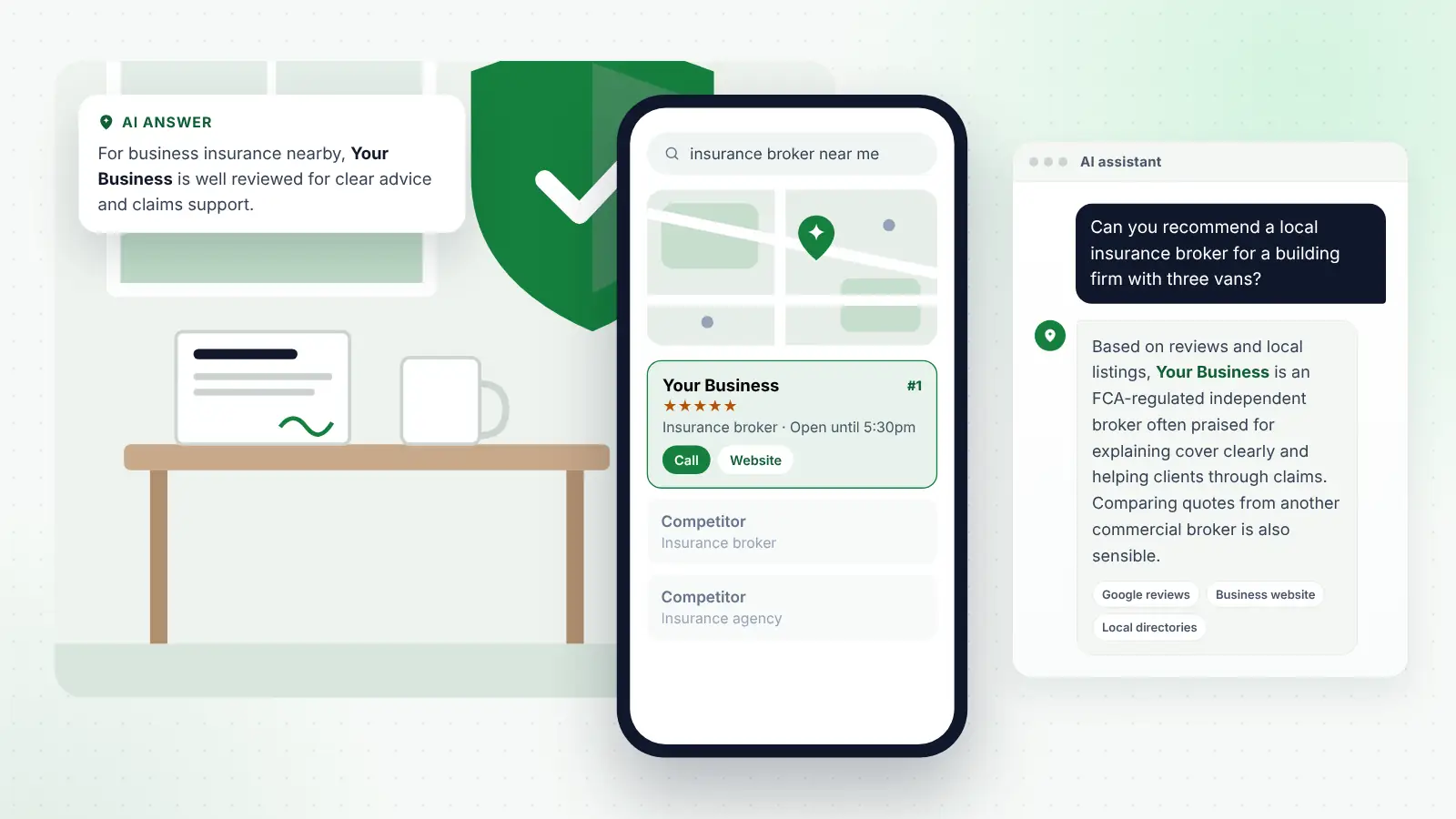
Business owners still search locally when they need cover. A builder taking on their first employee, a landlord buying a second property or a café owner whose renewal has doubled will often type “insurance broker near me”, “business insurance broker [town]” or “landlord insurance broker” into Google, then compare the firms on the map by reviews, opening hours and how specific they seem.
The firms that appear in that map pack usually have a few things in common:
- A complete Google Business Profile. Choose “Insurance broker” as your primary category, add your office hours, phone number and website, and list your lines of cover and specialisms as services. Add genuine photos of your team and office, and keep your details current.
- A steady flow of genuine reviews. Ask clients after a claim is settled well or a renewal is handled smoothly. Reviews that mention a trade, a claim or a specific service help both people and search engines understand what you do. Never offer incentives for reviews or post reviews yourself.
- Consistent details everywhere. Your firm name, address and phone number should match across your website, Google, Bing, Apple Maps, BIBA’s Find Insurance listing, trade directories and local business sites.
- A website with clear service and area pages. Create separate pages for each line you want to grow, such as public liability for trades, van fleet insurance or HMO insurance, and explain who it suits, what it typically covers, common exclusions and what information you need to quote. If you serve several towns, describe the areas you cover honestly rather than creating thin copies of the same page.
- Local and industry links. Mentions from local business groups, trade associations, chambers of commerce, sponsorships and introducer websites help show search engines you are a real, trusted local firm.
Remember that every one of these pages and posts may be a financial promotion, so build approval into your publishing routine. If you would rather focus on clients and insurers, specialist help with local SEO for insurance brokers and brokerages can take care of profiles, listings and compliance-aware content for your sign-off.
How AI assistants recommend brokers
A growing number of business owners now ask an AI assistant before they ever search Google. They might ask ChatGPT, Gemini, Perplexity or Copilot “who is a good local insurance broker for a scaffolding company?”, “do I need employers’ liability insurance for one part-time worker?” or “what does fleet insurance cover for five vans?”. Google’s AI Overviews also answer many of these questions at the top of the results page and often name local firms.
An assistant naming a broker relies on facts it can read and check about the firm online. To make sure it describes your brokerage correctly:
- Describe your specialisms plainly. State which trades, property types and vehicle fleets you work with, in the same words customers use.
- Answer real questions on your website. FAQs on what a policy covers, what affects a premium, how claims work and what to do before renewal are exactly the material AI tools draw on. Keep them accurate and approved.
- Keep your details consistent. Conflicting addresses, names or phone numbers make it harder for AI tools to be confident about recommending you.
- Earn reviews and mentions. Detailed reviews, trade association listings, BIBA membership and coverage on reputable local sites all help AI assistants see you as an established option.
- Be clear about regulation. Showing your FCA status and reference number helps both people and AI tools understand that you are a legitimate firm.
Local SEO and AI visibility support each other. The work that helps you appear in the map pack, such as consistent details, genuine reviews and clear service pages, is largely the same work that helps AI assistants describe and recommend you accurately. Expect both to build steadily over three to six months rather than overnight.
Common mistakes new brokers make
- Quoting every risk that comes in. Poor-fit business damages insurer relationships and uses time you need for good clients.
- Treating compliance as paperwork. Fair value assessments, complaints logs and promotion approvals should change how you work, not sit in a folder.
- Underestimating cash flow. Commission timing and instalment business can leave a new firm short for months.
- Selling add-ons by default. Including legal expenses or other extras without considering whether they suit the client undermines fair value and trust.
- Leaving the website until later. A clear, approved website and Google profile help introducers and clients check you out before they call.
Frequently asked questions
Do I need FCA authorisation to start an insurance brokerage?
You need to be either authorised by the FCA with the right permissions or an appointed representative of a principal firm that is. Arranging insurance without one of these is a criminal offence. Many new brokers start as an appointed representative and apply for direct authorisation once their book is established.
Do I need CII qualifications to be a broker?
There is no single mandatory exam for general insurance, but your firm must ensure staff are competent. CII qualifications such as the Cert CII and Dip CII are widely recognised by insurers, PI underwriters and clients, and are a strong way to show your expertise.
Does the Consumer Duty apply to commercial insurance?
It applies to consumers and, for general insurance, to smaller businesses that meet the micro-enterprise or small business thresholds. Since December 2025, contracts for larger commercial customers and specialist risks fall outside the Duty and the main product governance rules. Most local business clients are likely to remain in scope, so check each client’s size.
Should I join BIBA?
BIBA membership is open to FCA-authorised general insurance firms, including brokers working as appointed representatives, and offers compliance support, access to schemes and a listing on its Find Insurance service. Many brokers find the support and recognition worthwhile, and the membership is a useful trust signal on your website.
How long does it take for a new brokerage to appear in local search?
A tidied profile and corrected listings can bring a few more calls within weeks, while a firm grip on the map and regular mentions in AI answers tend to take three to six months, and longer where aggregators and established brokers are well entrenched. Consistent details, genuine reviews and clear service pages make the biggest difference.
Next steps
Start by choosing your clients and your regulatory route, because those two decisions shape everything else: your insurers, your costs, your compliance and your marketing. Speak to potential principal firms or a compliance consultant, sketch a realistic twelve-month cash flow and build a shortlist of insurers and wholesale markets for your target trades.
Then make sure business owners can find you. A complete Google profile, consistent listings, clear and approved service pages and a habit of asking for reviews will help both local search and AI assistants recognise your brokerage as a trusted option for the risks you know best.