Pest control is one of those services most people never think about until they suddenly need it. A wasp nest by the back door, scratching in the loft or droppings in a restaurant kitchen turns into an urgent problem, and the customer wants someone trained, discreet and available as soon as possible. That urgency, combined with a steady base of commercial contracts, makes pest control a resilient business for people who are prepared to learn the trade properly.
It is also a more regulated trade than many newcomers expect. The products you use, the traps you set and the animals you deal with are all covered by rules designed to protect people, pets and wildlife. Some of those rules have changed significantly in recent years, particularly around rodenticides and glue traps, and customers and commercial clients increasingly expect technicians to know them well.
This guide walks through what it takes to start a pest control business in the UK: training and qualifications, the key legal requirements, equipment and costs, pricing, building commercial work and making sure local customers can find you when they need help.
Key points
- The RSPH Level 2 Award in Pest Management is the industry’s recognised entry-level qualification, and membership of BPCA or NPTA adds credibility.
- To buy and use professional rodenticides you need proof of competence under the UK rodenticide stewardship regime, which has tightened from 2026.
- In England, glue traps for rodents can now only be used by licensed professionals in exceptional circumstances, while Wales and Scotland have banned them.
- Wildlife and animal welfare law applies to the way you deal with pests, so humane, lawful methods and good record-keeping matter.
- Domestic call-outs bring urgent work, but commercial contracts provide the steady year-round income most successful firms rely on.
In this guide
- Understand the market
- RSPH courses and the training you need
- Rodenticides and the stewardship regime
- Glue traps: the law has changed
- Wildlife and animal welfare law
- Wasps, bees and seasonal work
- Bait boxes, sprayers, a van and early costs
- Pricing domestic jobs and commercial contracts
- Landing your first nests, infestations and contracts
- Local SEO for pest control businesses
- AEO and AI search for pest control
- Frequently asked questions
- Final thoughts
Understand the market
Pest control work falls into two broad categories, and most businesses do both.
Domestic work covers homes and gardens: wasp nests in summer, mice and rats in autumn and winter, bed bugs, fleas, moths, cockroaches, squirrels in lofts and occasional bird problems. Jobs are usually one-off or a short course of visits, and customers find you quickly when they need you.
Commercial work covers restaurants, cafés, takeaways, food manufacturers, shops, offices, warehouses, care homes, schools, farms, landlords and housing providers. Clients usually want an ongoing contract with scheduled inspections, monitoring, reports and fast response to problems. Food businesses in particular need effective pest control to meet their food hygiene obligations, so a reliable contractor is valuable to them.
A typical pattern for a new business is to build reviews and cash flow from domestic work, then use that reputation to win commercial contracts that steady the year. Seasonality is real: wasp season is extremely busy, and rodent work rises as temperatures drop, so commercial agreements help fill the gaps.
RSPH courses and the training you need
The RSPH Level 2 Award in Pest Management
There is no single licence to become a pest controller, but the RSPH Level 2 Award in Pest Management is widely regarded as the standard entry qualification. It is offered through approved centres, including courses run by the British Pest Control Association (BPCA) and other training providers. Broader certificates and higher-level qualifications are also available for those who want to progress further.
You will also need training specific to what you do. Using rodenticides, fumigants and some insecticides professionally requires additional knowledge and, in some cases, specific certification. Working at height, confined spaces and bird proofing all have their own training needs.
Experience matters
Many successful independents start by working for an established pest control company. It gives you experience across a wide range of pests and premises, teaches you how commercial contracts and reporting work, and helps you learn the difference between a job that needs one visit and one that needs a full programme of treatment and proofing.
Trade associations
The two main trade bodies are the British Pest Control Association (BPCA) and the National Pest Technicians Association (NPTA). Both offer membership, training, technical support and continuing professional development. Membership is a recognised trust signal for homeowners and is often expected by commercial clients.
Tip
Join a recognised CPD scheme from the start and log every course, webinar and event. It keeps your skills current, supports your rodenticide proof of competence and gives commercial clients evidence of ongoing training.
Rodenticides and the stewardship regime
Rodenticides, particularly anticoagulants, pose a risk to wildlife such as birds of prey and other non-target animals. The UK Rodenticide Stewardship Regime, overseen by the Campaign for Responsible Rodenticide Use (CRRU UK), controls how professional products are sold and used.
The key points for a new business are:
- Proof of competence at the point of sale. Suppliers can only sell professional-use rodenticides to people who show recognised proof of competence.
- Accepted training. CRRU publishes a list of approved courses and certificates, which includes the RSPH/BPCA Level 2 Award and Certificate in Pest Management, alongside several other rodent-specific awards. You can see the current list on the CRRU training and certification page.
- Changes from 2026. From 1 January 2026, CRRU’s requirements mean pest professionals need either CRRU-approved certification that is less than five years old, or older approved certification backed by current membership of a CRRU-approved CPD scheme, such as BPCA Registered or BASIS PROMPT, meeting its annual criteria. Check your certificate dates regularly so you are never caught out.
- Follow the label. Product labels set conditions of use, including where and how products can be used, and those conditions are legally binding.
Responsible rodent control now means an integrated approach: surveying, identifying entry points, proofing, hygiene advice and using traps and toxic baits only where they are justified. Customers often value the proofing and advice more than the bait boxes.
Glue traps: the law has changed
Glue traps for rodents are now tightly restricted. In England, the Glue Traps (Offences) Act 2022 came into effect on 31 July 2024, and since then the use of glue traps for rodents is an offence unless you are a professional pest controller with a licence, used only in exceptional circumstances where other methods are ineffective or impractical and there is a serious risk to public health or safety. Licences are issued by Natural England, and applicants need a recognised qualification such as the RSPH Level 2 Award, an approved glue trap training course and, if they have not held a licence recently, a reference from a qualified pest controller.
The licensing conditions are strict. Restaurants, takeaways and private homes are generally not regarded as exceptional circumstances, traps must be checked very frequently, and there are fees for licences and reporting. Wales banned the use of glue traps for vertebrate animals in October 2023, and in Scotland a ban on using, supplying or possessing glue traps came into force in July 2026, so check the current rules if you work across borders.
For most new businesses, the practical message is simple: plan your rodent work around other methods, and treat glue traps as something you will rarely, if ever, use. BPCA publishes detailed guidance for members.
Wildlife and animal welfare law
Pest control involves animals, so welfare law applies. The Wild Mammals (Protection) Act 1996 makes certain cruel acts against wild mammals an offence. It includes exceptions for lawful pest control, such as lawfully used traps and the lawful use of approved poisons, but it does not protect careless or inhumane methods. Once an animal is caught in a live-capture trap, wider animal welfare duties apply too.
In practice, that means:
- Use only lawful, approved traps and products for the species you are dealing with, and follow the manufacturer’s instructions and label conditions.
- Check live-capture traps frequently and dispatch or release animals humanely and lawfully.
- Be aware that many species are protected. Bats, most wild birds, badgers and others have specific legal protection, and some bird control can only be carried out under general or specific licences.
- Keep clear records of what you did, where, what products you used and why.
If you are unsure about a species or method, stop and get advice from your trade association or the relevant nature agency before you act.
Wasps, bees and seasonal work
Wasp nests are often the first big source of domestic work, particularly in mid to late summer. They need confident, safe treatment, especially in lofts, wall cavities and near doors and play areas.
Bees are different, and handling them well protects your reputation. Industry guidance is that pest controllers should not treat bees unless there is a serious risk to people and no alternative. Honey bee swarms usually move on within a day or two, and a local beekeeper or swarm collector, such as one found through the British Beekeepers Association, can often collect them. Bumblebee nests are usually best left alone, since colonies die off naturally at the end of the season. Masonry or solitary bees typically point to worn mortar, and the long-term answer is repointing.
Customers often cannot tell wasps from bees, so good phone triage saves wasted visits. Ask for a photo and explain the options. Turning away a bee call with helpful advice often earns a loyal customer and a good review.
Tip
Write a short page on your website explaining the difference between wasps, honey bees and bumblebees, with photos. It reduces unnecessary call-outs, helps customers decide quickly and is exactly the kind of content AI assistants draw on.
Bait boxes, sprayers, a van and early costs
Pest control is not as equipment-heavy as some trades, but you do need a suitable vehicle, safe storage for products and reliable kit. These figures are rough guides only and vary by supplier and area.
| Item | Typical cost | Notes |
|---|---|---|
| Small van | £5,000–£15,000 | Plain or discreetly signed; many customers value discretion |
| Secure product storage | £200–£1,000 | Lockable, ventilated storage in the van and at base |
| Sprayers and dusting equipment | £300–£1,500 | Handheld sprayers, dusters and refills |
| Bait stations and traps | £300–£1,000 | Tamper-resistant boxes for rodents |
| Ladders, access kit and PPE | £400–£1,200 | Respirators, overalls, gloves and eye protection |
| Pest management courses | Varies | RSPH Level 2 and further specialist courses |
| Insurance (first year) | Varies | Public liability and professional cover |
| Job management software | £20–£80 per month | Useful for commercial reports and scheduling |
Insurance is essential. Public liability insurance is the minimum, and commercial clients will often ask for evidence of cover. If you employ anyone, employers’ liability insurance is a legal requirement. Consider professional indemnity if you give written advice, and cover for your vehicle and stock.
Pricing domestic jobs and commercial contracts
Domestic pricing
Most domestic work is priced as a fixed fee per treatment or per course of visits. Typical approaches:
- Single treatment price for wasp nests and similar jobs.
- Course of treatment for rodents, bed bugs, fleas or cockroaches, usually including follow-up visits.
- Proofing quotes for sealing entry points, fitting mesh or installing bird deterrents, priced on materials and time.
Be clear about what is included, how many visits you will make, any preparation the customer needs to do and whether there is a guarantee.
Commercial contracts
Commercial agreements are usually priced as an annual fee, billed monthly or quarterly, for a set number of routine inspections plus call-outs within agreed response times. The price should reflect the size and risk of the premises, the number of monitoring points, reporting requirements and travel. Good reporting is a large part of the value: many clients need documentation to show inspectors and auditors.
Landing your first nests, infestations and contracts
- Letting agents and property managers. Tenants often report pests to agents first, and agents need reliable contractors.
- Food businesses. Cafés, restaurants and small producers need effective pest control for food hygiene.
- Other trades. Builders, roofers, cleaners and gardeners regularly come across pest problems.
- Your own domestic customers. Many own businesses or know someone who does.
- Reviews and referrals. Ask every customer for a review while the relief is fresh.
Local SEO for pest control businesses
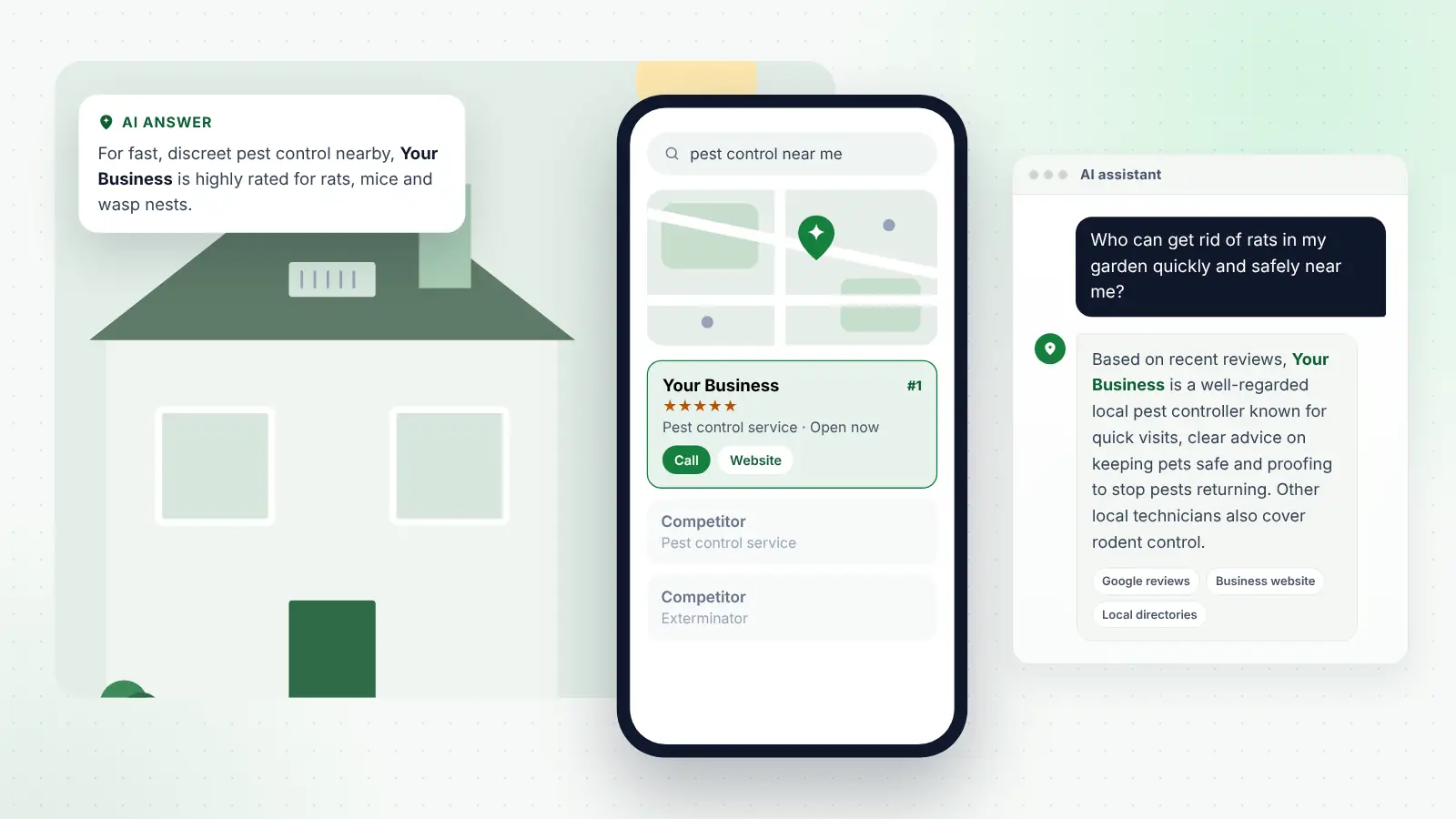
Pest control searches are urgent and local. Someone hears scratching in the ceiling or finds a wasp nest by the door and searches “pest control near me”, “rat exterminator [town]”, “wasp nest removal near me”, “mice in house what to do” or “bed bug treatment [area]”. They usually call one of the first few businesses they see, so map visibility matters a great deal, especially if national brands are taking the top positions in your area.
The essentials:
- Complete your Google Business Profile. Choose an accurate primary category, add each service and pest you deal with, set your service area and keep your hours accurate, including weekend or emergency availability.
- Show your credentials. Mention your RSPH qualification, trade association membership and insurance in your description, website and listings.
- Collect detailed reviews. Reviews that mention the pest, the speed of response and how discreet and helpful you were persuade worried customers.
- Keep your details consistent. Your business name, phone number, website and area should match across Google, directories, trade association listings and social media.
- Build service and area pages. Separate pages for rats, mice, wasps, bed bugs, birds and commercial pest control, plus pages for the main towns you cover, help you appear for specific searches.
- Earn local links. Local business groups, sponsorships, property and hospitality sites and trade association directories all help.
You can do this yourself, or bring in help if your time is better spent on call-outs. Our page on local SEO for pest control companies sets out how that works for technicians and growing firms. Expect results to build over three to six months, so work on it in spring, ahead of wasp season.
AEO and AI search for pest control
Customers increasingly ask AI assistants what to do before they call anyone. They might ask ChatGPT, Gemini, Perplexity or Microsoft Copilot, or see an answer in Google AI Overviews, with questions such as:
- “How do I know if I have rats or mice in my loft?”
- “Who can remove a wasp nest near me today?”
- “Is rat poison safe if I have a dog?”
- “Which pest control company near me does contracts for restaurants?”
Answer engine optimisation (AEO) is about feeding assistants reliable, matching facts about your pest business so they feel safe recommending it. For pest control, that usually comes down to:
- Consistent business information everywhere your business is listed.
- Reviews that describe the pest, the result and qualities like discretion and speed.
- Clear service descriptions stating exactly which pests you treat, for whom, and where.
- Helpful answers to common worries, such as signs of infestation, safety around children and pets, and what happens during a visit.
- Mentions on reputable sites, including trade association directories, local news and business networks.
This matters for pest control because many customers are anxious and want reassurance before they book. A business whose website calmly explains what to expect and how risks are managed is more useful to the customer and more likely to be referenced in AI answers. Nothing here can be guaranteed, yet most of the effort doubles up with solid local SEO for a pest firm.
Frequently asked questions
Do I need a licence to start a pest control business?
There is no general licence to trade as a pest controller, but you need appropriate training to use professional products, proof of competence to buy professional rodenticides, and a licence for any glue trap use in England. The RSPH Level 2 Award in Pest Management is the usual starting point.
Should I join BPCA or NPTA?
Both are respected and offer training, support and CPD. Membership is a strong trust signal for commercial clients in particular. Compare what each offers, including membership criteria and costs, and choose the one that suits your business.
What changed for rodenticide users in 2026?
From 1 January 2026, pest professionals buying professional rodenticides need either CRRU-approved certification less than five years old, or older approved certification plus membership of a CRRU-approved CPD scheme. Check the CRRU website for the current details and keep your certificates up to date.
Can I still use glue traps?
In England, only licensed professional pest controllers can use glue traps for rodents, and only in exceptional circumstances where other methods will not work and there is a serious public health risk. Wales and Scotland have banned them. For most jobs, other methods are expected.
Should I treat bee nests?
Generally, no. Industry guidance is to avoid treating bees unless there is a serious risk and no alternative. Refer honey bee swarms to a local beekeeper or swarm collector, and explain to customers that bumblebee nests usually die off naturally.
Final thoughts
A pest control business is built on knowledge, care and reliability. Get properly trained, keep your rodenticide competence current, understand the glue trap and wildlife rules, and treat every call as a chance to solve the underlying problem rather than just the symptom.
Then make sure people can find you when they need you. Keep your Google Business Profile accurate, collect detailed reviews, explain your services and safety measures clearly, and build relationships with the commercial clients who will keep your diary steady all year.