Working as a private chef lets you cook the food you care about for people who are genuinely looking forward to it: a tasting menu for eight friends celebrating a fortieth, dinners for a family in a holiday cottage, weekly meal prep for new parents or a supper club for strangers who become regulars.
It is also a business built on trust. Hosts are inviting you into their home, often for an occasion that matters, and want to know you are properly registered, take allergies seriously and will leave their kitchen spotless.
This guide covers registering as a food business, hygiene training and how ratings work when you cook in other people’s kitchens, allergens, insurance, pricing and deposits, cancellation terms, working with holiday let owners, platforms versus direct bookings, photography, and how local SEO and AI search help hosts find you. If you mainly want large weddings and corporate events, a catering business may suit you better.
Key points
- Register with your local council as a food business at least 28 days before you start trading, even if you cook mainly in clients’ kitchens.
- Your food hygiene rating relates to your registered business and base kitchen, not to each client’s kitchen, so your own procedures matter wherever you cook.
- You must give accurate information about the 14 allergens in every dish, so build allergen questions into your booking process.
- Clear prices per head, a deposit to secure the date and fair written cancellation terms protect you and your clients.
- Holiday let owners, lodge operators and small venues can become a steady source of bookings.
- Local SEO and AI search matter because most hosts hire a private chef rarely and choose whoever looks trustworthy online.
In this guide
- Is a private chef business right for you?
- Choosing your focus
- Registering as a food business
- Food hygiene training and your hygiene rating
- Allergens and dietary requirements
- Insurance
- Setting prices per head, deposits and cancellation terms
- Working with holiday let owners, lodges and venues
- Platforms versus direct bookings
- Photography that sells the experience
- Local SEO: being found by hosts nearby
- When hosts ask AI assistants for a chef
- Frequently asked questions
- Next steps
Is a private chef business right for you?
Private cooking suits chefs with strong all-round skills and an easy manner with people. You are the head chef, buyer, kitchen porter, front of house and business owner. You will cook in kitchens you have never seen, with unfamiliar ovens and limited worktop space, often while guests drift in to chat.
A typical booking runs from menu consultation and dietary questions through shopping, prep, transport, cooking and serving to washing up, with quotes, invoices and bookkeeping around it.
Demand is uneven. December, summer weekends and bank holidays can be packed, while late January to March is often quieter. Meal prep clients and cookery classes can help balance the year.
Choosing your focus
“Private chef” covers several different businesses, and a clear focus makes your menus, pricing and marketing simpler.
| Type of work | Typical booking | Things to consider |
|---|---|---|
| Dinner parties and celebrations | One evening, 4–20 guests | Weekend demand, high expectations |
| Holiday cottage and lodge catering | Several meals over a weekend or week | Travel, accommodation, group dietary needs |
| Meal prep and regular cooking | Weekly cooking for a household | Reliable income, labelling, reheating advice |
| Supper clubs | Ticketed dinners at home or a hired space | Ticketing, licensing, neighbours |
| Cookery demonstrations | Groups, hen parties, team events | Participant equipment, safety briefing |
Being known for something specific, such as seasonal British tasting menus or plant-based dinners, helps people remember and recommend you.
Registering as a food business
If you prepare, cook or serve food as a business, you must register with your local council at least 28 days before you start trading. Registration is free, the council cannot refuse it, and it applies even if you only cook a few evenings a month.
Because most of your cooking happens in other people’s homes, you register with the council for the place your business is based. For most solo chefs that is the home kitchen where you plan, store and prep. If you use a hired commercial kitchen, ask the council for that area how to register.
You may then be contacted about an inspection; put your food safety procedures in place straight away rather than waiting. Alongside registration, tell HMRC you are self-employed (or set up a limited company), check your home insurance and any mortgage or tenancy terms if you prep at home, and keep records of income, ingredients, mileage and equipment from day one.
Food hygiene training and your hygiene rating
Training and food safety management
Food businesses must make sure anyone handling food is supervised and instructed or trained in food hygiene appropriate to their work. No specific certificate is legally required, but a recognised course is the usual way to show that knowledge, and a Level 2 food hygiene certificate is a common baseline. Allergen awareness training is worth adding, as hosts increasingly ask about it.
You also need a food safety management system based on HACCP principles, covering how you buy, store, transport, cook, cool and reheat food. Transport deserves particular attention: plan how you keep chilled food cold between your base and the client’s home, and how you check probe temperatures in an unfamiliar kitchen.
How ratings apply when you cook in clients’ homes
The food hygiene rating scheme covers businesses that supply food to consumers, including caterers who work from private addresses. For businesses run from a home address, only limited address information is published, typically the first part of the postcode.
Your rating relates to your registered business: your base kitchen, storage, records and how you manage food safety. A client’s own kitchen is not inspected or rated as part of your business, which is exactly why your documented procedures matter when you cook there. Many private chefs carry their own probe thermometer, colour-coded boards, sanitiser and hand towels to every booking.
Display rules differ. In England, displaying your rating is voluntary but encouraged. In Wales and Northern Ireland, businesses must display their rating and tell customers what it is when asked. Scotland runs a separate scheme with a pass or improvement required result. The government’s guide to the food hygiene rating scheme explains how it works.
Tip
Mention a good hygiene rating on your website, in your Google Business Profile description and in your quotes. With no shopfront, it is one of the clearest independent trust signals a host can check.
Allergens and dietary requirements
You must be able to give accurate information about the 14 allergens in every dish you serve:
- Cereals containing gluten
- Crustaceans
- Eggs
- Fish
- Peanuts
- Soybeans
- Milk
- Tree nuts
- Celery
- Mustard
- Sesame
- Sulphur dioxide and sulphites
- Lupin
- Molluscs
The Food Standards Agency’s best practice guidance on allergen information for non-prepacked food encourages businesses to make allergen information available in writing and back it up with a conversation, an approach that suits private dining well.
A sound allergen process looks like this:
- Ask about allergies, intolerances and preferences for every guest when the booking is confirmed.
- Record the answers and confirm them back to the host in writing.
- Keep an allergen matrix for every dish, including stocks, sauces, garnishes and bought-in items.
- Re-check before you shop, as guests are often added late.
- Plan how you will avoid cross-contamination in a kitchen you don’t control, and ask on arrival whether anything has changed.
Be honest about your limits. If a guest has a severe allergy and you cannot be confident of controlling cross-contamination in a particular kitchen, say so and agree an alternative. Meal prep clients need written allergen information with the food, plus storage and reheating instructions.
Insurance
Check that any policy covers cooking in clients’ homes and holiday properties.
- Public liability: covers injury to guests or damage to property, such as a scorched worktop. Not legally required for sole traders, but holiday let owners and venues often ask to see it.
- Product liability: covers claims arising from the food you supply.
- Employers’ liability: a legal requirement, with limited exceptions, if you employ anyone, including a part-time assistant.
- Equipment cover: for knives, mixers, induction hobs and other kit you carry.
- Business use on your car insurance: for driving to bookings with equipment and ingredients.
Setting prices per head, deposits and cancellation terms
Pricing per head
Most private chefs price per head, often with a minimum spend or minimum number of guests. Rates vary widely by area, menu and experience, so research what established chefs nearby charge. Be clear about whether your price includes ingredients, how many courses, service and washing up, travel beyond a set distance, accommodation for multi-day bookings, extra staff and any crockery hire.
Count every hour, including the menu call, shopping, prep, travel and admin, or your true hourly rate can be far lower than it looks.
Deposits
A deposit secures the date and covers planning time and any ingredients bought in advance. Many chefs take a deposit on booking and the balance a set number of days before the event, with final adjustments for guest numbers invoiced afterwards. Put it in writing and keep it proportionate.
Cancellation terms
The usual 14-day cancellation right for consumer contracts made online or away from your premises does not generally apply to catering services booked for a specific date, but your terms must still be fair and clearly explained. Any amount you keep on cancellation should reflect genuine losses, such as planning time, ingredients bought and a date you cannot easily rebook. Cover falling guest numbers, late cancellations and what happens if you are ill. A solicitor’s review of your terms is money well spent.
Tip
Send a written booking confirmation with the menu, guest numbers, dietary requirements, arrival time, price, deposit and cancellation terms. It prevents most misunderstandings before they happen.
Working with holiday let owners, lodges and venues
Group holidays are one of the best sources of work: families and friends in large cottages and lodges often want a chef for an evening or more and rarely know who to ask.
Holiday let owners, letting agencies and lodge operators can recommend you before guests arrive. To make that easy:
- Send a short pack with sample menus, guide prices, areas covered, insurance and hygiene rating.
- Offer to cook for an owner so they can recommend you with confidence.
- Learn each property’s kitchen, parking and access.
- Provide a page owners can add to their welcome information.
- Leave every kitchen spotless and report any problems promptly.
Some owners ask for a referral fee. Decide your policy in advance and be transparent with guests if it affects your price.
Small venues and shops with event spaces can also host supper clubs and demonstrations. Selling alcohol usually needs a licence, such as a Temporary Event Notice in England and Wales, unless the venue holds one, so many supper clubs ask guests to bring their own.
Platforms versus direct bookings
Booking platforms that connect hosts with private chefs can help you win first reviews and fill early dates. They also usually take a commission or add a fee, shape price expectations and own the client relationship.
| Booking platforms | Direct bookings | |
|---|---|---|
| Finding clients | Platform brings enquiries | You need your own visibility |
| Cost | Commission or fees | Your marketing time and costs |
| Pricing | Often shaped by the platform | Set by you |
| Client relationship | Held by the platform | Yours, including repeat work |
| Terms | Platform rules apply | Your own deposit and cancellation terms |
Many chefs use platforms while they build a reputation, then shift towards direct bookings through their own website, Google profile, partnerships and word of mouth.
Photography that sells the experience
People book an evening, not just a plate of food, so your photos need to show both: plated dishes in natural light, a table laid for guests, you cooking calmly in a home kitchen, and settings such as garden dinners or supper club tables. Always ask before photographing a client’s home or guests, and never share anything that identifies their address. A modern phone in good natural light is enough to start.
Local SEO: being found by hosts nearby
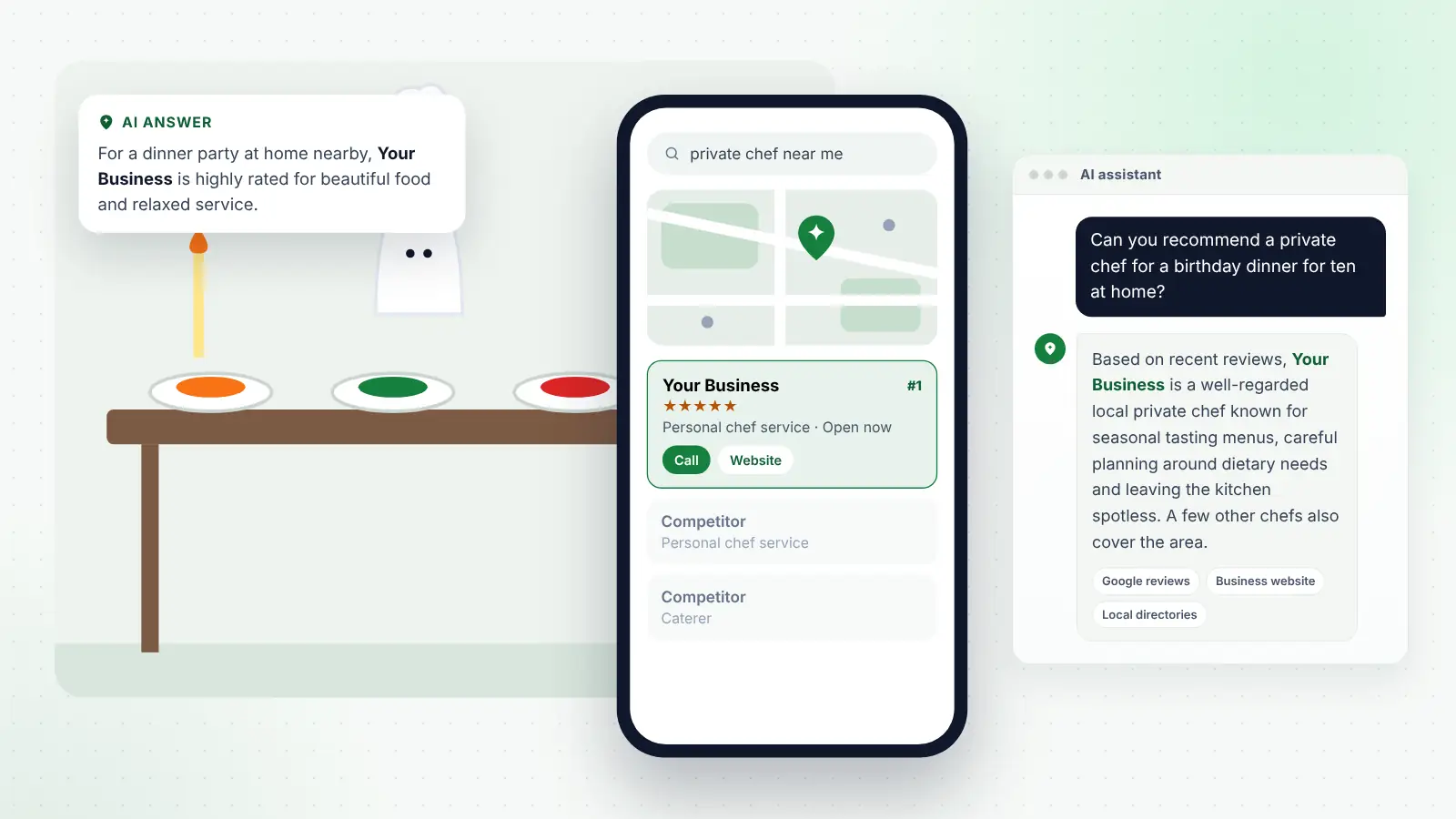
Most people hire a private chef only occasionally, so they rarely have someone in mind. They search for “private chef near me”, “private chef for a dinner party in Harrogate” or “chef for a holiday cottage in Cornwall”, then compare photos, menus and reviews.
A Google profile hosts can book from
Set up your profile as a service-area business and hide your home address. Choose the most accurate category, list the areas you cover, describe the occasions you cook for and add services such as dinner parties, holiday catering, meal prep and cookery classes. Add real photos regularly and use posts for seasonal menus and availability.
Reviews
Reviews matter especially when people are inviting you into their home. Ask every host a day or two after the event. Reviews that mention the occasion, the food and the tidy kitchen are especially useful. Reply to each one politely.
Consistent details
Keep your business name, phone number, website and service area identical across your website, Google profile, Bing Places, Apple Business Connect, social media and food, wedding and event directories.
A website that answers hosts’ questions
Include sample menus with guide prices per head, what is included, the areas you cover, how booking and deposits work, how you handle allergens and photos of real dinners. Separate pages for key services and your main areas help you appear for more specific searches.
Local links
Mentions from holiday let owners, venues, local producers you buy from and food festival pages help show you are a genuine local business. If you would rather spend your time cooking, specialist help with local SEO for private chefs and supper clubs can look after your profile, listings, content and links.
Tip
Create a short page for each area you cover most, with menus that suit it, local suppliers you use and reviews from hosts there.
When hosts ask AI assistants for a chef
More hosts now ask ChatGPT, Gemini, Perplexity, Copilot and Google’s AI Overviews to help plan an occasion: “can you recommend a private chef for a fortieth birthday dinner for twelve in the Peak District?”, “how much does a private chef cost?” or “who can cook for our group in a holiday cottage near St Ives?”.
These tools rely on information they can find and trust:
- Consistent information: the same name, area and description everywhere you appear.
- Reviews: a steady flow of detailed reviews on Google and other reputable sites.
- Clear service descriptions: what you cook, for which occasions, how many guests and where.
- Pricing guidance: guide prices per head and what is included.
- FAQs: answers to questions such as whether you bring equipment, handle allergies and wash up.
- Mentions on reputable sites: holiday let websites, local food guides and venue supplier pages.
AI recommendations cannot be switched on; they tend to follow a consistent, well-reviewed presence built over months.
Frequently asked questions
Do I need a licence to be a private chef?
There is no specific private chef licence in the UK, but you must register with your local council as a food business before you start. Selling alcohol, for example at a supper club, usually needs a licence, so check with your council.
Can I prepare food at home for bookings?
Yes. Your home kitchen becomes part of your registered food business, so it must meet food hygiene standards and may be inspected. Check your home insurance and any mortgage or tenancy terms too.
Do I need a food hygiene certificate?
No specific certificate is legally required, but you must be trained in food hygiene appropriate to your work. A Level 2 food hygiene course plus allergen training is the usual way to show this.
Should I use booking platforms or find clients myself?
Platforms can help you start and build reviews, but usually charge commission and keep the client relationship. Many chefs use them early, then build direct bookings over time.
Next steps
Start with the essentials: register with your council, complete hygiene and allergen training, write your food safety procedures, arrange insurance and draft clear booking terms. Then build a set of sample menus with guide prices and photograph every dinner you cook.
After that, focus on being easy to find and easy to trust: a complete Google Business Profile, a website that answers hosts’ questions, reviews after every booking and relationships with holiday let owners and venues nearby. Done consistently, each dinner you cook can lead to the next booking.


