Being a celebrant is one of the few jobs where you meet people at the biggest moments of their lives: a wedding, the arrival of a child, the loss of someone they love. The ceremonies themselves are often the easy part. The harder part is the business around them: being found by the right people, explaining the legal side honestly, earning the trust of funeral directors and venues, and filling the diary outside peak summer Saturdays.
Couples and families rarely book a celebrant more than once or twice, so few know where to start. They search on Google, ask an AI assistant, check venue supplier lists or follow a funeral director’s suggestion, and they judge you quickly on what they find.
This guide is for independent celebrants who lead weddings, vow renewals, naming ceremonies, funerals and memorials. It covers the legal position across the UK as it stands in October 2026, training and memberships, working with funeral directors and venues, fair booking terms, reviews, and how local search and AI recommendations now shape who gets the enquiry.
Key points
- In England and Wales, a wedding led by an independent celebrant is not legally binding on its own, so couples also complete a short legal registration.
- The Government consulted on reforming weddings law, including legally binding weddings led by humanist and independent officiants, between July and September 2026, but the law has not yet changed.
- Scotland and Northern Ireland allow some belief celebrants to conduct legal weddings, but the rules differ and unaffiliated independent celebrants generally cannot.
- Funeral work mostly comes through funeral directors, so reliability, calm communication and respect for families matter far more than marketing.
- Clear, fair deposit and cancellation terms protect you and reassure couples booking a specific date.
- A well-kept Google profile, honest pages for each ceremony type and thoughtful reviews help couples, families and AI assistants find and trust you.
In this guide
- Know the three kinds of work you can offer
- The legal position on celebrant weddings
- Training, memberships and insurance
- Working with funeral directors
- Working with wedding venues and suppliers
- Deposits, booking terms and cancellations
- Reviews and testimonials
- Local SEO for celebrants
- AI search: what assistants say about celebrants
- Frequently asked questions
- Next steps
Know the three kinds of work you can offer
Most independent celebrants offer some mix of three types of ceremony, and each behaves differently as a business.
Weddings and vow renewals are usually booked many months ahead, often a year or more. Couples choose you for your style and personality, and bookings cluster around late spring and summer weekends.
Naming ceremonies welcome a baby or child, and sometimes a step-parent or adopted child, into a family. They have no legal status, can be held almost anywhere and often fall on Sundays or outside the peak wedding season.
Funerals and memorials are booked at short notice, usually within days, and almost always through the family’s funeral director. There is no legal requirement for a funeral to be led by any particular person, so families can choose a celebrant for a non-religious or gently spiritual service. The work is steady across the year, asks a great deal of you emotionally and depends on being trusted by directors.
Many celebrants find a mix gives the steadiest income: funerals provide regular weekday work, weddings higher-value bookings, and namings fill gaps.
| Ceremony type | Typical booking lead time | Main source of bookings | Legal status |
|---|---|---|---|
| Wedding or vow renewal | Several months to over a year | Search, venues, recommendations | Not legally binding on its own in England and Wales |
| Naming ceremony | A few weeks to a few months | Search, friends, social media | No legal status anywhere in the UK |
| Funeral or memorial | Usually days | Funeral directors | No legal requirement for a particular officiant |
The legal position on celebrant weddings
This is the question couples ask most, and answering it clearly is one of the best ways to build trust. The rules differ across the UK and are under review in England and Wales.
England and Wales today
In England and Wales, a legally binding wedding currently has to take place at a register office, on approved premises with registrars present, or in a place of worship registered for marriages. A ceremony led by an independent or humanist celebrant is not legally binding on its own. Couples who want a celebrant-led ceremony usually also give notice and complete a short legal registration, often a simple statutory ceremony at the register office, before or after their celebrant ceremony.
Be open about this from the first conversation. Explain that the legal part is usually short and can be done on a different day, while the ceremony with you is the one their guests will remember, held almost anywhere and in words that mean something to them.
Reform: the 2026 consultation
The Law Commission published its report on weddings law, Celebrating Marriage: A New Weddings Law, in 2022, recommending a move to a system where the officiant, rather than the building, is regulated. In October 2025 the Government said it would reform weddings law when parliamentary time allows. In July 2026 it published a consultation, Tying the knot: reforming weddings law in England and Wales, which ran until 24 September 2026.
The consultation sets out the aim of allowing humanists and other non-religious belief organisations to conduct legally binding weddings, and also proposes allowing independent officiants to do so, with questions on how they should be regulated, such as entry requirements and a fit and proper test. As of late October 2026 the Government is analysing responses. No legislation has been passed and there is no confirmed timetable, so the current rules still apply to weddings being booked now.
Tip
Do not tell couples that your weddings will be legal “soon”. Explain the current position, mention that reform is being considered, and update your website when the Government publishes its response.
Scotland
Scotland already uses an officiant-based approach. Religious and belief bodies can have members authorised by National Records of Scotland to solemnise legal marriages, either by nomination to the register of celebrants or by temporary authorisation for specific weddings. Humanist weddings have been legal there for many years. The routes depend on being part of a qualifying religious or belief body, so an independent celebrant with no such affiliation generally cannot conduct a legal wedding there. NRS sets out its approach in its policy on marriage celebrant authorisation.
Northern Ireland
Following a 2018 Court of Appeal ruling, humanist celebrants in Northern Ireland have been able to conduct legally binding weddings through authorisation by the General Register Office for Northern Ireland. Independent celebrants generally cannot. If you work across borders, or are asked about a wedding in Northern Ireland, check the current position with GRONI before advising a couple.
Training, memberships and insurance
There is no statutory licence for independent celebrants in England and Wales, so people look for other signs that you know what you are doing.
Training is offered by a range of providers. Some, such as the Fellowship of Professional Celebrants, train celebrants across weddings, namings and funerals and offer ongoing membership. Humanists UK trains and accredits its own celebrants, who lead ceremonies in line with humanist values and are part of its network. Other academies and associations offer their own courses and codes of practice. When choosing, look at practical content such as script writing, delivery and working with funeral directors, and at the support offered afterwards.
Things worth having in place and showing clearly:
- Your training and any memberships, with a short explanation of what they mean.
- Public liability insurance, which venues and some funeral directors will ask about. Professional indemnity cover is also worth considering.
- Experience, such as how many ceremonies you have led.
- Data protection basics. You hold personal and sometimes sensitive information about families, so keep notes securely and check whether you need to pay the data protection fee to the ICO.
Working with funeral directors
For most celebrants, funeral work depends almost entirely on funeral directors. The director often suggests a celebrant to the family, and that recommendation is earned slowly.
What directors tend to value:
- Prompt replies. When a director calls, they need to know quickly whether you are free, often for a specific crematorium slot.
- Calm, kind contact with the family. Arrange the family visit or call promptly, listen more than you speak, and never rush people who are grieving.
- Reliability on the day. Arrive early, keep to the time allowed at the crematorium or burial ground, and work smoothly with the director’s team.
- A script the family has approved, sent in good time, with names, music and readings checked carefully.
- No surprises. Agree your fee and how it is paid, usually through the director as a disbursement, and stick to it.
Introduce yourself to local independent funeral directors in person with a short printed profile, then keep in touch lightly. A thank-you note after a service is appropriate; sales calls are not.
Tip
Treat every funeral as the one that earns your reputation. Families remember how they were cared for, and directors notice which celebrants families thank them for.
Working with wedding venues and suppliers
Many venues keep a recommended supplier list, and outdoor and barn venues in particular see couples who want a celebrant-led ceremony.
To be added to a venue’s list:
- Visit and learn the space. Know where ceremonies can be held, what happens if it rains and how the timings usually run.
- Send your insurance details and a short profile for the venue’s records.
- Be easy to work with on the day. Liaise with the coordinator, respect the schedule and help with the handover to the drinks reception.
Wedding planners, photographers and musicians who have seen you lead a good ceremony recommend you naturally. Wedding fairs can help, but judge them on the bookings they actually bring.
Deposits, booking terms and cancellations
You can only lead one wedding at a time, so a cancelled date you turned others away for is a real loss. Clear written terms protect you and reassure couples.
Good terms usually cover:
- The booking fee or deposit, what it secures and whether it is refundable.
- When the balance is due, often a set number of weeks before the ceremony.
- What happens if the couple cancels or changes the date, with a simple sliding scale if you use one.
- What happens if you cannot attend, such as illness, and how you would help find a replacement celebrant.
- Travel and extras, such as rehearsals, if charged separately.
Keep terms fair and in plain English. Under the Consumer Rights Act 2015, unfair terms in consumer contracts are not binding, and a large non-refundable sum that goes well beyond the work you have done and the booking you have lost may be challenged. If a contract is agreed at a distance, for example by email or online, consumers may have a 14-day cancellation period, so check how the consumer contract rules apply to your bookings. Take advice if unsure.
Showing a guide or “from” price for weddings and namings also helps couples enquire with confidence. Funerals work differently: they are booked days ahead and your fee is usually paid through the funeral director as a disbursement, so terms are simpler. Never ask a grieving family for a deposit or press them on payment.
Reviews and testimonials
For weddings and namings, ask a few weeks after the ceremony, once couples have their photographs and the day has settled. A short, friendly message with a direct link to your Google profile works well. Details such as how you captured their story help the next couple.
Funeral reviews need much more care. Never ask at the time of the funeral. Some celebrants include a gentle line in a final message a few weeks later, inviting feedback only if the family feels able to give it. Many families will not, and that is fine. Feedback from funeral directors, with permission, can be just as reassuring to future families.
When replying to any review, keep it short and warm. Never share personal details about a couple, a family or the person who died. Since April 2025, the Digital Markets, Competition and Consumers Act 2024 has made fake reviews and misleading review practices unlawful, so never write reviews yourself, buy them or offer incentives that distort them.
Local SEO for celebrants
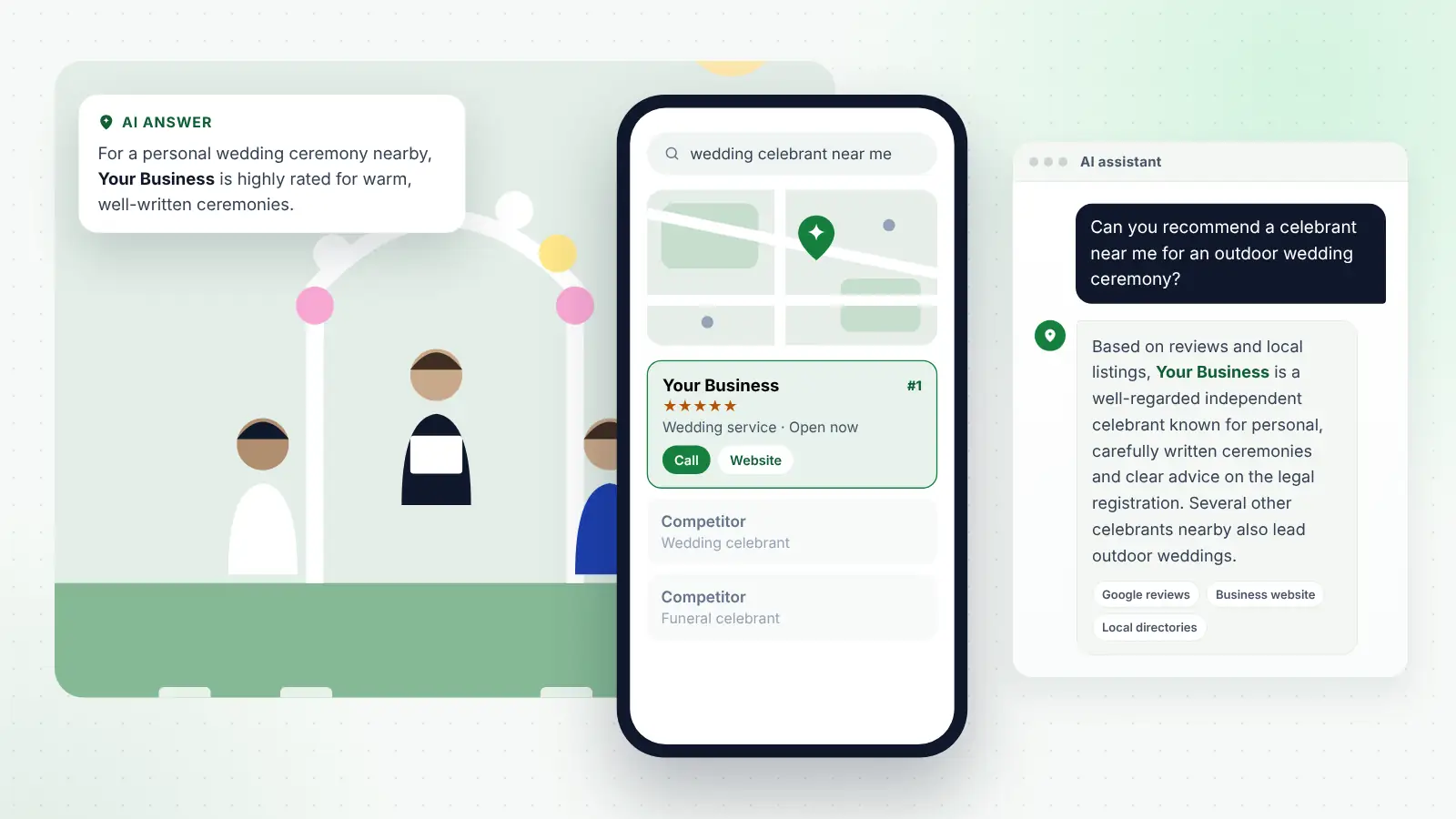
People usually search with a place in mind: “wedding celebrant near me”, “humanist celebrant Devon”, “naming ceremony celebrant Leeds” or “funeral celebrant near me”. Those near the top of the map get most of the calls.
Local search still matters even though you travel to clients, because Google weighs how relevant, prominent and complete your information is for the area being searched.
Google Business Profile
Set up a service-area profile listing the towns you cover, without showing a home address. Choose the most accurate primary category and add relevant secondary ones. Describe each ceremony type you offer, add good photographs of ceremonies (with permission), and answer messages promptly.
Reviews
Steady, genuine reviews are one of the strongest local signals. Follow the gentle approach above and reply to each one.
Consistent details
Keep your name, phone number, website and service area identical on Google, Bing, Apple Maps, wedding directories, your training body’s directory and social media.
A website with clear ceremony and area pages
Give each ceremony type its own page: weddings, vow renewals, naming ceremonies and funerals. On the wedding page, explain the legal position clearly. On the funeral page, describe how you work with families and directors in a calm, gentle way, with no hard-sell wording. Add pages for the main areas you cover, with real local detail.
Local and industry links
Links from venue supplier pages, wedding blogs, local magazines and training body directories all build trust. If you would rather spend your time writing ceremonies, specialist local SEO for celebrants can look after your profile, listings, pages and links for you. Expect results to build over three to six months.
AI search: what assistants say about celebrants
More people now ask ChatGPT, Gemini, Perplexity, Copilot or Google’s AI Overviews for help before they search in the usual way. Couples ask questions such as “is a celebrant wedding legally binding in England?”, “can you recommend a celebrant for an outdoor wedding near Bath?” or “how do we have a naming ceremony for our baby?” Families ask “what does a funeral celebrant do?” or “who leads a non-religious funeral near me?”
They tend to rely on:
- Consistent information about who you are, where you work and what ceremonies you offer.
- Reviews on Google and other well-known sites, and what those reviews actually say.
- Clear service descriptions, so the tool understands you lead naming ceremonies or memorials, not just weddings.
- Accurate FAQs on your website, such as how the legal registration works, how far ahead to book and what your fee includes.
- Mentions on reputable sites, such as venues, wedding blogs, local news and your training body’s directory.
Because many AI questions are about the legal side, a clear, up-to-date explanation on your website is particularly valuable. Update it promptly if the law changes.
Frequently asked questions
Can I become a celebrant without formal training?
There is no legal requirement for training to lead independent ceremonies in England and Wales, but many directors and venues expect to see it, and it helps enormously with writing and delivery.
Do couples need to do anything else for a celebrant wedding in England or Wales?
Yes. They need to give notice and complete a legal registration with the register office, usually a short statutory ceremony, because a celebrant-led ceremony is not legally binding on its own. This may change in future if the Government proceeds with reform, but no change has been made yet.
How do I get my first funeral bookings?
Introduce yourself to local independent funeral directors, explain your approach and make it easy to reach you. One or two well-led services often lead to more.
How can I fill quieter dates?
Promote weekday and winter weddings, elopements, vow renewals and naming ceremonies, each with its own page and photographs.
Next steps
A busy celebrant diary is built from a few things done consistently well: honest explanations of the legal side, ceremonies people remember, reliable relationships with funeral directors and venues, fair terms and a steady flow of thoughtful reviews. Review your website and Google profile as a couple or a grieving family would see them. If the legal position, your ceremonies and your areas are clear there, people and AI assistants will find it easier to recommend you.