Energy assessment is a practical, flexible business to start. Every home sold or let in England and Wales needs a valid Energy Performance Certificate, new homes need SAP calculations before and after they are built, commercial landlords need non-domestic EPCs, and a growing volume of retrofit work depends on proper whole-house assessments. You can start as a sole domestic assessor with a laptop, a laser measure and a car, then add services as your qualifications and confidence grow.
It is also a sector going through real change. EPCs are being reformed, landlords are working towards higher minimum standards, and the Home Energy Model is set to replace SAP. That creates opportunity for assessors who understand the changes.
This guide covers which assessments to offer, qualifications and accreditation, EPC reform as it stands in October 2026, landlord standards, retrofit, working with agents, pricing and getting found on Google and in AI search. It focuses on England and Wales; Scotland and Northern Ireland have their own arrangements.
Key points
- You need a recognised qualification and membership of a government-approved accreditation scheme before you can lodge any EPC.
- Domestic, non-domestic, on-construction (SAP) and retrofit assessment are separate competencies, each with its own qualification route.
- Reformed EPCs with four headline metrics are now planned for the second half of 2027, so RdSAP-based certificates remain the norm for now.
- Government has said private rented homes should reach the equivalent of EPC C by 1 October 2030, which is driving landlord demand for assessments and advice.
- A spread of work across agents, direct customers, builders and retrofit projects makes the business far more resilient than relying on agent panels alone.
- A complete Google Business Profile, clear prices and coverage, and reviews that mention speed and clear advice win most direct bookings.
In this guide
- Understand the types of energy assessment
- Get qualified
- Join an accreditation scheme
- What is changing: RdSAP 10, EPC reform and the Home Energy Model
- Landlord standards: the main driver of demand
- Retrofit assessment under PAS 2035
- Working with estate and letting agents
- Set up the business and price your services
- Local SEO: being found by sellers and landlords in your postcodes
- AI search: getting suggested when people ask who can do an EPC
- Frequently asked questions
- Final thoughts
Understand the types of energy assessment
Each type of work needs a different qualification, software and client base. Most new assessors start with domestic EPCs, which currently last ten years and are needed when a home is sold or let, then add others over time.
| Assessment | What it involves | Typical clients | Qualification route |
|---|---|---|---|
| Domestic EPC | Survey of an existing home using RdSAP | Sellers, landlords, agents | Domestic energy assessment (Level 3) |
| Commercial EPC | Assessment of non-domestic buildings using approved software | Commercial landlords, agents, owners | Non-domestic assessment (Level 3, 4 or 5 by building complexity) |
| SAP calculation | Design-stage and as-built energy calculations for new homes and conversions | Builders, developers, architects, self-builders | On-construction domestic energy assessment |
| Display Energy Certificate | Rating based on actual energy use of public buildings | Councils, schools, public bodies | Specific DEC accreditation |
| Retrofit assessment | Whole-dwelling assessment under PAS 2035 | Retrofit coordinators, installers, social landlords | Level 3 retrofit assessor qualification |
| Air tightness testing | Pressure testing of new and refurbished buildings | Builders, developers | Separate testing registration, often via a partner |
Commercial EPCs are graded by building complexity: Level 3 for simpler buildings, Level 4 for buildings with more complex heating, ventilation and air conditioning, and Level 5 for the most complex, typically using dynamic simulation. Fees are higher and the work is less tied to house sales.
Display Energy Certificates are needed for buildings over 250 square metres that are occupied by a public authority and frequently visited by the public. For buildings over 1,000 square metres the DEC lasts 12 months, which makes it useful repeat work; the government’s guide to Display Energy Certificates sets out the details. Air tightness testing needs its own equipment and registration, so many assessors partner with a specialist tester, and builders appreciate arranging SAP calculations and air tests through one contact.
Get qualified
You need a recognised qualification for each type of assessment you carry out, usually delivered as a mix of online learning, classroom days and practice assessments.
The usual routes are:
- Domestic energy assessor (DEA). A Level 3 qualification covering construction, heating systems and RdSAP data collection.
- Non-domestic energy assessor (NDEA). Level 3, 4 or 5 qualifications matched to the complexity of the buildings you want to assess. Many assessors start at Level 3 or 4 and progress.
- On-construction domestic energy assessor. SAP for new dwellings and conversions, suited to people with construction or design experience.
- DEC assessor. Specific training and accreditation for Display Energy Certificates.
- Retrofit assessor. A Level 3 certificate for retrofit assessors, usually taken by people who already hold or are taking the DEA qualification. The retrofit coordinator role requires a higher-level qualification, typically a Level 5 diploma.
Courses vary in quality and cost. Ask how much field practice is included, which software you will learn and whether the provider helps with accreditation afterwards.
Join an accreditation scheme
To lodge certificates on the national register you must also belong to a government-approved accreditation scheme. Well-known schemes include Elmhurst, Stroma and Quidos, among others, each covering different assessment types.
Schemes generally:
- confirm your qualifications and register you as an accredited assessor
- provide access to lodgement, and often to approved software
- audit a sample of your work and require you to correct errors
- set requirements for professional indemnity insurance, which some schemes offer as part of membership
- require continuing professional development, especially when methodologies change
- handle complaints and disciplinary processes
Compare lodgement fees, membership costs, software, technical support and how well each scheme is preparing assessors for the new EPC methodology. Your scheme membership is also a key trust signal, so show it clearly online.
What is changing: RdSAP 10, EPC reform and the Home Energy Model
Clients ask about this constantly. As of late October 2026, the position is as follows.
RdSAP 10 is the current domestic methodology
Domestic EPCs on existing homes are produced using RdSAP 10, introduced in 2025. It collects more detailed information than earlier versions, so careful data collection matters more than ever.
Reformed EPCs are planned for the second half of 2027
In January 2026 the government published a partial response to its consultation on reforming the energy performance of buildings regime. The headline decisions for domestic EPCs include four headline metrics in place of the single rating: energy cost, fabric performance, heating system and smart readiness. Reformed EPCs will be produced using the Home Energy Model, and an EPC will be needed at the point a property is marketed, rather than at sale or letting. EPCs will keep their ten-year validity. Further decisions, including some on DECs and EPC quality, were left for a final response.
New-style EPCs were originally aimed at October 2026. In March 2026 the government moved the launch to the second half of 2027. Until then, RdSAP-based certificates continue. The latest position is on the government’s consultation page, and your accreditation scheme will brief you on training and transition dates.
The Future Homes Standard and the Home Energy Model
For new homes in England, the Future Homes Standard was published in March 2026, with SAP 10.3 as the compliance method at launch and the new requirements phasing in after transitional arrangements. The Home Energy Model is expected to be approved later and run alongside SAP for a transition period before replacing it; no firm date has been set. On-construction assessors should expect significant retraining over the next few years.
Tip
Keep a short, dated “what’s changing” page on your website. Landlords and homeowners search for this constantly, and an accurate, plain-English summary positions you as the local expert. Update it whenever official dates move.
Landlord standards: the main driver of demand
Private rented homes
Under the current rules, privately rented homes in England and Wales must generally have an EPC rating of at least E, unless a valid exemption is registered. In January 2026 the government confirmed its intention that private rented homes reach the equivalent of EPC C by 1 October 2030, assessed using the new fabric performance metric alongside either the heating system or smart readiness metric. Homes with an EPC rated C or above obtained before 1 October 2029 are expected to be treated as compliant until that certificate expires or is replaced. A spending cap of £10,000 per property was confirmed (lower for some lower-value homes), with exemptions where landlords have spent the cap and still cannot reach the standard. New regulations are needed to bring this into force, so describe it to clients as confirmed government policy rather than current law.
Landlords therefore want more than a certificate: where the property stands, which improvements are likely to help most and whether to act now or wait. Clear, honest advice builds long-term relationships.
Commercial landlords and MEES
For non-domestic property, the minimum for letting is currently EPC E. In June 2026 the government published an interim response proposing that privately rented non-domestic buildings over 1,000 square metres reach EPC B from 2031, where cost-effective, and dropped the earlier proposal for an interim C target in 2027. Smaller buildings stay at E for now, and the seven-year payback test remains. A full response is expected and legislation is still needed. This keeps commercial landlords and their agents interested in assessments and improvement advice, especially for larger buildings.
Retrofit assessment under PAS 2035
PAS 2035 is the framework for whole-house domestic retrofit. Many government-funded energy efficiency schemes require work to follow it, and it is increasingly used for private retrofit projects too.
The framework sets out several roles, including retrofit assessor, retrofit coordinator, designer, installer and evaluator. The retrofit assessor carries out the whole-dwelling assessment: an RdSAP-based energy assessment, a condition survey, a record of ventilation and moisture risks, and an occupancy assessment covering how the household uses the home. The coordinator uses this to plan and oversee improvements.
For a domestic assessor this is a logical next step. It builds on existing skills, pays more per visit than a basic EPC and brings repeat work from coordinators, installers and social landlords. Funded demand rises and falls with schemes, so treat it as one strand of the business.
Working with estate and letting agents
Agents remain a major source of domestic EPC work, especially at first. They value assessors who respond quickly, turn certificates round fast and communicate well with vendors and tenants.
Some practical points:
- Agree terms in writing. Be clear about fees, who pays, turnaround times and how keys and access are handled.
- Understand referral arrangements. Some agents take a referral fee or add a margin. Agents are generally expected to tell their clients about these, and the arrangement needs to work for you as well as them.
- Add value. A short note for landlord clients on what their rating means and what could improve it makes you more useful than a cheaper rival.
Agent work brings volume but often lower fees, so balance it with direct bookings.
Set up the business and price your services
Most assessors start as sole traders registered for Self Assessment, and some form a limited company as they grow. You will need professional indemnity insurance as your scheme requires, public liability cover and business car insurance. A DBS check can reassure agents and households.
| Item | Typical cost | Notes |
|---|---|---|
| Qualification training | Varies by level and provider | Compare support, field practice and software |
| Accreditation scheme | Annual membership plus lodgement fees | Fees differ between schemes |
| Professional indemnity insurance | Varies | Sometimes included with scheme membership |
| Equipment | Modest | Laser measure, tablet or laptop, camera, torch, ladder, moisture meter |
| Website and booking system | Low to moderate | Online booking saves time on calls |
| Vehicle costs | Varies | Plan travel radius around fees |
Domestic EPC fees vary with property size, area and how the job arrives; commercial, SAP, DEC and retrofit work is usually quoted individually. Guide prices for domestic work help customers book quickly.
Local SEO: being found by sellers and landlords in your postcodes
Most people who need an EPC search for one locally and want an appointment within days. Typical searches include “EPC near me”, “energy performance certificate [town]”, “commercial EPC [city]”, “SAP calculation for extension”, “retrofit assessor near me” and “air test new build”. If you only appear on agent panels and national booking sites, you miss a large share of direct work.
Google Business Profile
Choose the most accurate primary category, set a service area rather than showing a home address, and list each service separately. Add real photos from site visits, keep hours accurate, include a booking link and mention your accreditation scheme in your description.
Reviews
Reviews are a major trust signal and a factor in local visibility. Ask every satisfied customer, ideally with a direct link sent when you lodge the certificate. Reviews that mention punctuality, a quick turnaround, clear explanations or helpful advice for landlords are especially useful because they describe exactly what new customers are looking for. Respond courteously to each review, even the occasional complaint about a missed slot or a disappointing rating.
Matching business details across property directories
Make sure your business name, phone number and service area match everywhere: your website, Google, Bing Places, Apple Business Connect, Yell, local directories and property-related directories. Mismatched phone numbers or coverage areas leave both landlords and search engines unsure which assessor is which.
Pages for each assessment type and area you cover
Give each main service its own page: domestic EPCs, landlord EPCs, commercial EPCs, SAP calculations, DECs and retrofit assessments. Explain what each involves, how long it takes, what the customer needs to provide and guide prices where possible. If you cover several towns, write genuinely useful area pages rather than copies with the place name swapped. If you would rather have specialists handle this while you stay on site, our local SEO for EPC and energy assessors service focuses on exactly these steps.
Local links
Mentions from local business groups, landlord associations, builders and architects you work with, and community energy groups help search engines trust you.
AI search: getting suggested when people ask who can do an EPC
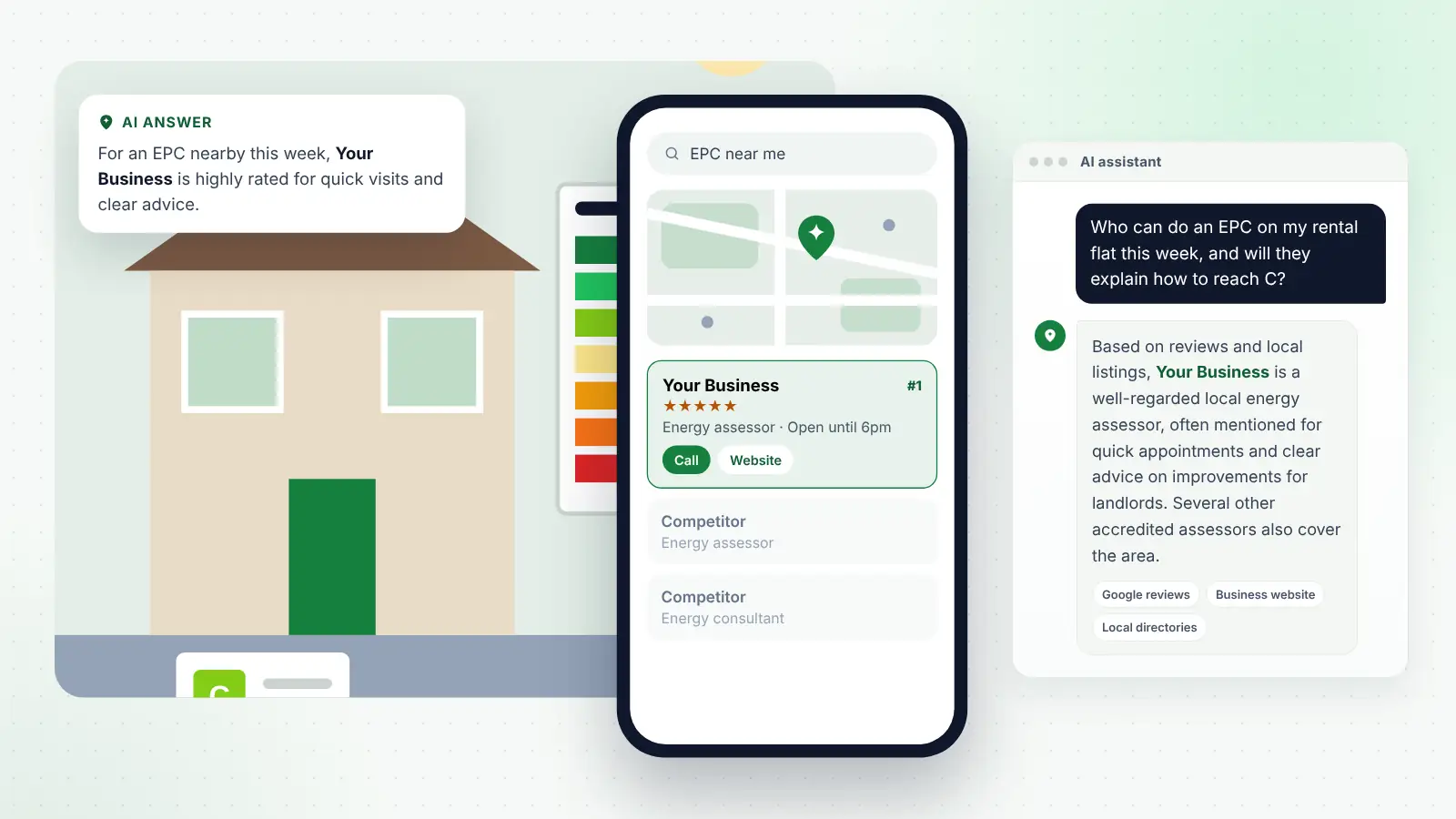
More people now ask AI assistants such as ChatGPT, Gemini, Perplexity, Copilot and Google’s AI Overviews for help before they book. Energy assessment suits this kind of question, because many customers don’t know exactly what they need. They ask things like “Do I need an EPC to rent out my flat?”, “What does EPC C by 2030 mean for my rental?”, or “Which energy assessor near me can help me apply for retrofit funding?”.
These tools tend to favour businesses that:
- describe each service clearly, with consistent details across the web
- have a healthy number of recent, detailed reviews
- answer common questions in plain English, with FAQs on service pages
- are mentioned on reputable local, property and industry websites
- show their accreditation and qualifications clearly
The work is much the same as good local SEO, with extra emphasis on clear answers. Keep explanations of EPC reform and landlord standards accurate and dated, because AI assistants can repeat outdated information if that is all they find.
Tip
Ask a few AI assistants the questions your customers would ask, every few months. Note which local assessors are mentioned and what information is shown, then fill the gaps on your own website and profiles.
Frequently asked questions
Do I need building experience to become a domestic energy assessor?
It helps but is not essential. Many people come from estate agency, building or property management, and good courses cover the fundamentals.
Can I lodge EPCs as soon as I qualify?
No. You also need to join a government-approved accreditation scheme, meet its insurance and other requirements and be registered before you can lodge certificates. Allow time for this between finishing your course and starting paid work.
Should I wait for the new EPC system before starting?
There is little reason to wait. RdSAP-based EPCs remain in use until reformed certificates launch, which is currently planned for the second half of 2027, and the underlying skills of surveying a home carefully will still be needed. Your scheme will provide training for the new methodology.
Is retrofit assessment worth adding?
For many domestic assessors, yes, as long as it sits alongside other services rather than becoming your only income.
Final thoughts
Energy assessment rewards care, accuracy and clear communication. Get properly qualified, choose a scheme that supports you through the coming changes, and spread your work across agents, direct customers, builders, commercial clients and retrofit projects so no single source can empty your diary. Pair that with a clear website, an accurate Google Business Profile and steady reviews. Local SEO and AI search results build over three to six months, so start early and keep your information current.