Many vets reach a point where they want more say over how their patients are cared for. Perhaps you want longer consultations, a say in which referral centres you use, or simply the chance to build a practice that reflects your own standards. With a large share of UK practices now owned by corporate groups, there is also real interest from pet owners in finding a genuinely independent vet.
Opening your own practice gives you that control, but it also makes you an employer, a business owner and the person responsible for medicines, controlled drugs, clinical waste and round-the-clock emergency arrangements. The regulatory picture has also shifted, with the Competition and Markets Authority (CMA) introducing new requirements on price transparency, prescriptions and complaints.
This guide works through the main decisions in a sensible order: the type of practice, the route in, registration, premises and equipment, medicines and controlled drugs, out-of-hours cover, the CMA changes, money, and how pet owners now find a vet through Google and AI assistants. It is general information rather than legal or financial advice, so treat it as a starting point for conversations with the RCVS, your accountant, solicitor and veterinary business advisers.
Key points
- Decide early what kind of practice you are building, because species, services and opening hours shape your premises, team and costs.
- Premises that supply or store veterinary medicines must be registered as veterinary practice premises, with the register run by the RCVS on behalf of the Veterinary Medicines Directorate.
- The RCVS Code requires vets in practice to take steps to provide 24-hour emergency first aid and pain relief, so out-of-hours arrangements need to be in place before you open.
- The CMA’s order following its veterinary market investigation brings in price lists, ownership information, written prescription and complaints requirements, phased in with later dates for smaller businesses.
- Most clients choose a vet close to home, so an accurate Google profile, genuine reviews and clear information about your fees and services are part of your launch plan.
In this guide
- Decide what kind of practice you want to run
- Start from scratch or buy an existing practice
- Registration and professional regulation
- Premises, equipment and team
- Medicines, controlled drugs and clinical waste
- Out-of-hours and emergency cover
- The CMA changes and what they mean for a new practice
- Money: costs, pricing and health plans
- Local SEO: how pet owners find a vet near them
- AI search: how pet owners now ask for recommendations
- Building loyalty once clients have registered
- Frequently asked questions
- Final thoughts
Decide what kind of practice you want to run
Before you look at premises or talk to lenders, be clear about the practice you want to build. The species you treat and the services you offer affect almost everything else, from the size of the building to the equipment list and the team you recruit.
Common models include:
- Small animal first opinion. Dogs, cats, rabbits and other pets, with consultations, vaccinations, neutering, dentistry and routine surgery. This is the most common route for new independents.
- Mixed practice. Small animals alongside farm animals and sometimes horses, usually in rural areas, with ambulatory work and a wider range of equipment and medicines.
- Equine or farm only. Largely ambulatory, with a smaller base but specialist kit and vehicles.
- Limited service or niche practice. For example a vaccination and neutering clinic, a cat-only practice, an exotics practice or a home-visit service. These can start smaller, but they still need emergency arrangements and appropriate premises registration.
Look carefully at your local market. Note how many practices are nearby, who owns them, what hours they keep, how they handle out-of-hours care and what their reviews say. Gaps often show up quickly: an area with no independent practice, no cat-friendly clinic, limited evening appointments or poor reviews for communication.
Start from scratch or buy an existing practice
There are two broad routes. You can open a new practice in premises you fit out yourself, or buy an established practice with its clients, team and equipment.
| Factor | Opening a new practice | Buying an existing practice |
|---|---|---|
| Clients on day one | None, you build from zero | An existing client base |
| Control over layout and fit-out | Full control | Limited to what you change later |
| Upfront cost | Fit-out and equipment, plus running costs while you grow | Purchase price, including goodwill |
| Early cash flow | Usually slow for the first months | Income from the start, if clients stay |
| Premises registration | New registration and an early inspection | New registration if premises or ownership details change |
| Main risk | Not attracting clients quickly enough | Inheriting problems with premises, staff or compliance |
A new practice suits vets who want a specific way of working and can fund a slower start. Buying suits those who want income from day one and are comfortable improving someone else’s systems over time. If you buy, look closely at several years of accounts, the lease, the condition of equipment, the controlled drugs records, staff contracts and any pet health plan liabilities. Employment law may mean staff transfer to you on their existing terms.
Tip
Ask any seller about the practice’s out-of-hours arrangements and when the current contract ends. Emergency cover is easy to overlook in a purchase and can be hard to replace at short notice.
Registration and professional regulation
Veterinary practice is regulated at the level of the individual professional and, for medicines, at the level of the premises.
Registering your vets and nurses
Anyone practising veterinary surgery in the UK must be registered with the Royal College of Veterinary Surgeons (RCVS). Registered veterinary nurses are also on an RCVS register and can carry out certain procedures under the direction of a vet. Check every vet and nurse on the RCVS register before they start, make sure they have appropriate professional indemnity cover, and keep records of their continuing professional development.
Registering your premises
If your practice supplies or stores veterinary medicines, which almost every practice does, you are legally required to register the premises. The register of veterinary practice premises is maintained by the RCVS on behalf of the Veterinary Medicines Directorate (VMD). The RCVS guidance on registering a practice explains the process: applications are made online, can only be accepted within four weeks of the opening date, and a fee is charged per premises.
New premises are inspected within six months of opening, and an inspection fee applies, to check compliance with the Veterinary Medicines Regulations, including the storage, recording and supply of medicines. If you later join the Practice Standards Scheme, that inspection is carried out as part of the scheme instead.
The Practice Standards Scheme
The RCVS Practice Standards Scheme (PSS) is a voluntary accreditation scheme with different levels depending on the services you offer. It is not required to open, but it gives clients and staff an independent signal of quality, and preparing for it is a useful framework for setting up policies properly from the start. Many new practices aim to apply once they are settled.
Your business structure and name
Decide whether to trade as a sole trader, partnership or limited company, and take advice on tax and liability. Your practice name must follow the RCVS guidance on advertising and practice names, and some names may need an RCVS letter of non-objection before you can incorporate at Companies House.
Premises, equipment and team
Look for premises with good access, parking and visibility, and enough space for a reception and waiting area (ideally with separate areas for dogs and cats), consulting rooms, a preparation area, theatre, kennels and cattery, an X-ray room, a dispensary, and staff facilities. Check planning use with your local council before you sign anything, and make sure the lease is long enough to justify the fit-out.
Typical equipment for a small animal practice includes consulting tables, anaesthetic machines and monitoring, an operating table and lighting, an autoclave, digital X-ray, ultrasound, in-house laboratory equipment, dental equipment and kennelling. Leasing and finance are common, but compare total costs over the term rather than monthly payments.
X-ray equipment brings its own duties under the Ionising Radiations Regulations, including notifying or registering with the Health and Safety Executive, appointing a radiation protection adviser and having local rules in place.
A small practice usually needs:
- One or more vets, often the owner plus an assistant as client numbers grow.
- Registered veterinary nurses, along with student or auxiliary nurses.
- Receptionists who handle calls, bookings and worried owners calmly.
- A practice manager, either a dedicated role or combined with another position at first.
Recruitment is a real challenge in many areas, so start conversations well before you open and think about what will make your practice an attractive place to work.
Medicines, controlled drugs and clinical waste
Supplying medicines is a large part of practice income and one of the most regulated parts of the job.
- Veterinary medicines. You must follow the Veterinary Medicines Regulations on prescribing, storage, labelling and record keeping, and keep appropriate records of medicines received and supplied. Prescription-only medicines for animals must be prescribed by a vet for animals under their care.
- Controlled drugs. Drugs such as opioids, ketamine and some sedatives are controlled under the Misuse of Drugs legislation. Higher-schedule drugs must be recorded in a controlled drugs register and kept in a secure, locked cabinet, with careful records of receipt, use and destruction. Inspections check controlled drug traceability, so set up robust systems from day one.
- Clinical and hazardous waste. Sharps, pharmaceutical waste, anatomical waste and contaminated materials must be segregated, stored safely and collected by a registered waste carrier, with the correct paperwork kept. Your local authority and waste contractor can advise on the requirements in your area.
- Cremation. Arrange a reputable pet crematorium partner and be clear with owners about the options and prices.
Out-of-hours and emergency cover
The RCVS Code of Professional Conduct requires vets in practice to take steps to provide 24-hour emergency first aid and pain relief to animals. That does not mean you must be on call every night yourself. The RCVS guidance on 24-hour emergency cover allows practices to share rotas with neighbouring practices or use a dedicated out-of-hours provider, as long as the arrangement is made in advance and confirmed in writing.
You must also tell clients exactly what your out-of-hours arrangements are: who provides the service, where it is, the phone number, the hours it covers and likely initial costs. Put this on your website, your Google profile, registration forms and vaccination cards, and update it promptly if anything changes. Clear emergency information also matters for search, because “emergency vet near me” is one of the most urgent searches pet owners make.
The CMA changes and what they mean for a new practice
The CMA published the final report of its market investigation into veterinary services in March 2026 and made the Veterinary Services Market Investigation Order in September 2026 to put its remedies into effect. The requirements apply to veterinary businesses of all sizes across the UK, but smaller businesses (those with fewer than 15 first opinion practices and out-of-hours centres) have been given later compliance dates for many of them, running from March to September 2027.
The main areas include:
- Price lists. Publishing standardised price information for common services on your website and in the practice.
- Ownership and practice information. Making clear who owns the practice and what services it offers.
- Prescriptions. Making owners aware that they can ask for a written prescription and buy medicines elsewhere, with limits on what can be charged for a prescription.
- Written estimates and itemised bills. Giving clearer information about costs before and after treatment.
- Complaints. Having a written in-house complaints process, keeping a log and taking part in mediation where needed.
- Cremation. Offering clear options and prices.
For a new practice this is an opportunity rather than a burden. You can build transparent pricing, estimates and complaints handling into your systems from the start instead of retrofitting them later. Check the CMA’s published order and guidance for the exact obligations and dates that apply to you, as these details matter.
Tip
Write your price list and complaints procedure before you open. Owners comparing practices online increasingly look for clear fees, and an independent practice that is open about pricing has a strong story to tell.
Money: costs, pricing and health plans
Opening a practice involves significant upfront investment. Work with an accountant who understands veterinary businesses to build a plan that covers:
- Set-up costs, including fit-out, equipment, practice management software, initial drug stock and professional fees.
- Running costs, such as rent, salaries, drugs and consumables, laboratory fees, insurance, utilities, waste collection and out-of-hours provision.
- A client growth forecast, with a cautious version as well as a hopeful one.
- Enough working capital to cover the months before the practice breaks even.
Costs vary widely by area, building and the services you offer, so get several quotes for fit-out and equipment rather than relying on rough figures.
On the income side, a pet health plan is one of the most useful tools you have. Owners pay monthly for vaccinations, parasite treatment and check-ups, often with a discount on other services. Plans spread the cost for owners and give you predictable recurring income. Make the terms clear, because the CMA changes include requirements on information about pet care plans.
Local SEO: how pet owners find a vet near them
Most pet owners register with a practice within a short drive of home, and nearly all of them start with a search. Typical examples include “vets near me”, “independent vet near me”, “emergency vet open now”, “puppy vaccinations near me”, “cat friendly vet in [town]” and “rabbit vet near me”. Practices that appear in the map results for those searches get the first look and often the first phone call.
Local SEO is the work of making your practice visible and trustworthy in those results. For a veterinary practice, the essentials are:
- Google Business Profile. Choose “Veterinarian” or the closest fitting primary category, add relevant secondary categories, and list your services, opening hours, accessibility details and a booking link. Add your out-of-hours arrangements and real photos of the practice, consulting rooms and team.
- Reviews. Ask clients for a review after a positive visit, using a simple link or card. Reply politely to every review without discussing an animal’s treatment in public, and handle complaints through your published procedure.
- Consistent details. Your practice name, address and phone number should match exactly across your website, Google, Apple Maps, Bing, the RCVS Find a Vet listing and pet directories. Mismatched details confuse both owners and search engines.
- A website with service pages. Create clear pages for vaccinations, neutering, dentistry, health plans, emergency care and any species or special interests you cover, explaining what is involved and linking to your price list.
- Local links and mentions. Relationships with rescue centres, breeders, groomers, local shows and community groups often lead to genuine mentions and links that help you stand out.
Set up and verify your Google profile as early as you can before opening, so it has time to build. If you would rather spend your time with patients, some practices bring in specialist SEO for vets and veterinary practices to look after profiles, listings and content. Whoever does the work, expect results to build steadily over three to six months rather than overnight.
AI search: how pet owners now ask for recommendations
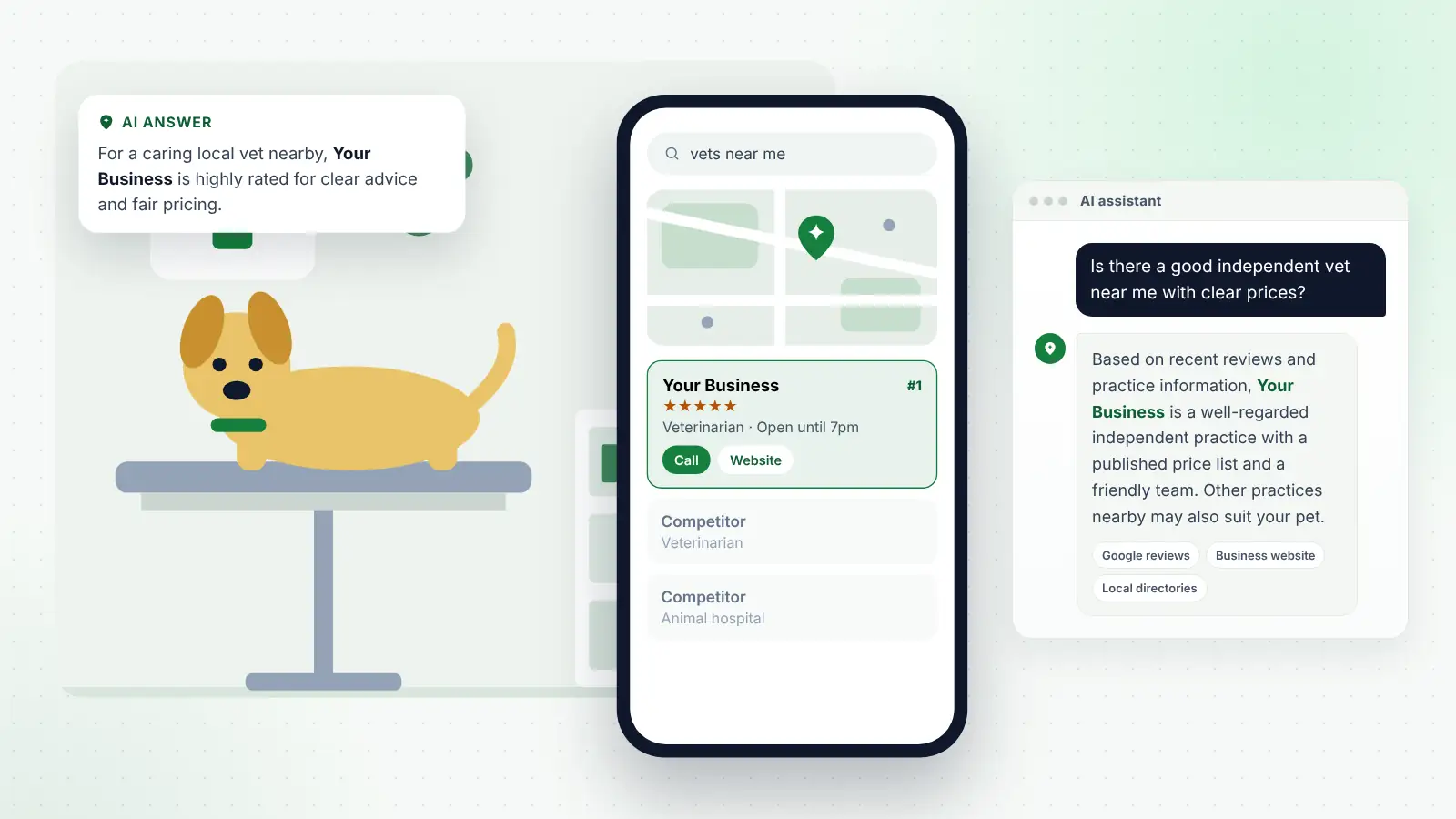
More owners are now asking AI assistants for help choosing a vet. They type full questions into ChatGPT, Gemini, Perplexity, Microsoft Copilot or Google’s AI Overviews and get a short answer naming a few practices.
The questions are often more detailed than a typical search:
- “Is there a good independent vet near me with clear prices?”
- “Which vet in [town] is good with nervous dogs?”
- “Where can I take my rabbit for a check-up near [area]?”
- “Which local vets offer a pet health plan for cats?”
- “What should I do if my dog is unwell at night near [town]?”
AI tools build their answers from information they can find and cross-check. Optimising for this, often called answer engine optimisation (AEO), means giving them clear, consistent material to work with:
- Consistent information across the web. Your name, address, services, opening hours and ownership should match on your website, Google profile and directories.
- Reviews that describe the experience. Reviews mentioning gentle handling, clear explanations or support at a difficult time help AI tools understand what you are known for.
- Clear service descriptions. Plain-English pages explaining each service, the species you treat and what owners can expect.
- Helpful FAQs. Answer the questions owners actually ask, such as how to register, what a health plan covers, how out-of-hours care works and how prescriptions are handled.
- Mentions on reputable sites. Local news coverage, community websites, rescue charity partnerships and veterinary directories add weight to what your own site says.
The CMA changes make this even more relevant. Published price lists and clear ownership information are exactly the kind of detail AI tools draw on when someone asks for an independent, transparent vet nearby.
Building loyalty once clients have registered
A practice grows when clients stay, return for boosters and recommend you to friends and neighbours.
- Send clear reminders for vaccinations, parasite treatments and check-ups, with easy online booking.
- Offer your health plan at the first puppy or kitten visit, when owners are most receptive.
- Train reception staff to handle cost questions confidently and kindly.
- Follow up after surgery or a hospital stay to check how the animal is doing.
- Handle euthanasia and bereavement with care, including clear cremation options.
- Review your price list and service pages regularly so they stay accurate.
A short pre-opening checklist helps keep everything on track:
| Area | What to confirm before opening |
|---|---|
| People | RCVS registration and indemnity checked for every vet and nurse |
| Premises | Lease signed, planning use confirmed, fit-out complete |
| Medicines | Premises registration applied for, controlled drugs register and cabinet in place |
| Safety | Radiation protection, waste contracts and health and safety arrangements set up |
| Out-of-hours | Written arrangement in place and published to clients |
| Transparency | Price list, ownership information and complaints procedure ready |
| Online presence | Google profile verified and complete, key directories listed |
Frequently asked questions
Do I have to be a vet to own a veterinary practice?
No. In the UK, practices can be owned by non-vets, which is why corporate groups own so many. However, veterinary surgery itself can only be carried out by registered vets, and the vets working in the practice remain professionally responsible under the RCVS Code.
Is the Practice Standards Scheme compulsory?
No, it is voluntary. Your premises must still be registered if you supply or store medicines, and will be inspected for compliance with the Veterinary Medicines Regulations. Joining the scheme means that inspection is carried out as part of your accreditation.
Can I open without providing my own out-of-hours service?
Yes, as long as you have arranged emergency cover in advance. Many independents use a dedicated out-of-hours provider or share a rota with nearby practices. The arrangement should be confirmed in writing, and clients must be told the full details.
Do the CMA requirements apply to small independent practices?
Yes. The order applies to veterinary businesses generally, though smaller businesses have been given more time for many of the requirements. Check the CMA’s order and guidance for the dates that apply to you.
How quickly will a new practice appear on Google Maps?
Once your Google profile is verified, it can start appearing for nearby searches, but strong visibility usually builds over three to six months. A complete profile, genuine reviews and consistent listings tend to help.
Final thoughts
Opening an independent veterinary practice is a big undertaking, but it becomes manageable when you take it step by step. Decide on your model, choose between building and buying, register your premises, set up robust systems for medicines and controlled drugs, and secure out-of-hours cover before you open. Build transparent pricing and complaints handling into the practice from the start, and you will be ready for the CMA requirements as they come in.
Then make sure local pet owners can find you. A complete Google profile, accurate listings, clear service and price information and a steady flow of genuine reviews will help you appear when people search or ask an AI assistant for a vet nearby. Put those foundations in place early and keep them up to date as the practice grows.