Most independent speech and language therapists did not go into private practice to become marketers. They went in to have more control over their caseload and to offer support families could not always get quickly elsewhere. But a good reputation spreads slowly, and a parent searching late at night for help with a child who is not yet talking needs to be able to find you, understand what you do and trust that you are properly qualified.
Growing a practice in this field is not about chasing enquiries at any cost. It is about being clear: about who you help, your registration and standards, your fees, and the settings you work in. When those things are in place, families, adults and schools can choose with confidence, and the right referrals tend to follow.
This guide covers the professional foundations, defining your caseload, EHCP and tribunal work, school contracts, online therapy, safeguarding and insurance, honest marketing, and how people now find therapists through Google and AI assistants. It is general information rather than regulatory or legal advice, so check the detail with the HCPC, the RCSLT and your insurer.
Key points
- “Speech and language therapist” and “speech therapist” are protected titles, and HCPC registration is the first thing many parents and professionals look for.
- Being specific about the ages, needs and settings you work with brings better-matched enquiries and makes it easier for others to refer to you.
- EHCP reports, tribunal work and school contracts can bring steady income, but each needs clear terms, careful scoping and realistic timescales.
- Professional indemnity cover is a condition of HCPC registration, and independent therapists also need their own safeguarding checks and policy.
- HCPC standards expect promotional activity to be accurate and not likely to mislead, so describe what you offer calmly and avoid promising outcomes.
- Local SEO and AI search help families find you, but they work best when your information is consistent everywhere it appears.
In this guide
- Get the professional foundations right
- Define who you help and where you work
- Build a clear, reassuring enquiry journey
- EHCP assessments and tribunal reports
- School contracts and partnerships
- Online therapy
- Safeguarding, insurance and data
- Market your practice honestly
- Local SEO for speech and language therapists
- AI search and how families ask for help
- Frequently asked questions
- Next steps
Get the professional foundations right
Before you think about visibility, make sure the things families and referrers check are clear and up to date.
HCPC registration and protected titles
Speech and language therapists are regulated by the Health and Care Professions Council. “Speech and language therapist” and “speech therapist” are protected titles, so only people on the HCPC register can use them. Parents searching online see a mix of registered therapists, early years practitioners, tutors and self-described communication coaches, and they often cannot tell the difference. Stating your registration plainly, with your number and a note that anyone can check the register, is one of the most reassuring things you can do.
RCSLT membership
The Royal College of Speech and Language Therapists is the profession’s professional body. Membership is not the same as registration, but it signals that you are connected to professional guidance and continuing development, and many families and schools recognise the name.
ASLTIP membership and directory
ASLTIP, the Association of Speech and Language Therapists in Independent Practice, supports therapists working privately and runs a public directory that parents and professionals use to find independent therapists. According to the RCSLT’s independent practice guidance, full membership requires HCPC registration, current RCSLT membership and at least two years’ post-qualification experience. Affiliate membership is available to newly qualified therapists and returners working under a full member’s supervision, but affiliates are not listed in the public directory.
Tip
Write your HCPC registration, RCSLT membership and ASLTIP membership in exactly the same way on your website, your Google profile and every directory. Consistency helps families, and it helps search engines and AI tools confirm who you are.
Define who you help and where you work
Independent therapists often begin by taking almost anything that comes in. The practices that grow steadily tend to become more specific, so the right people contact them and others are pointed elsewhere sooner. Write these down in plain language:
- Age groups: pre-school children, school-age children, teenagers or adults.
- Needs: speech sounds, language delay or disorder, stammering, social communication, voice, eating and drinking, or aphasia and other neurological conditions.
- Settings: your clinic room, clients’ homes, nurseries and schools, care homes, or online.
- Area covered: the towns you can realistically travel to, and how travel is charged.
- Availability: whether you have a waiting list, and roughly how long it is.
Honesty about availability matters. Many families come to independent therapists while facing a wait for NHS speech and language therapy, and waiting times vary a great deal across the country. Avoid presenting yourself as a replacement for the NHS or suggesting families should leave an NHS list. A calm line such as “some families choose to see us while waiting for, or alongside, NHS support” is accurate and respectful.
Build a clear, reassuring enquiry journey
Parents who contact a speech therapist are often anxious, and adults recovering from a stroke, and their families, may be dealing with a lot at once. A predictable journey makes the first step easier.
- A short enquiry form or call asking only what you need: age, main concern, location and preferred setting.
- A prompt reply, with a response time stated on your website that you keep to.
- A clear explanation of the assessment: how long it takes, where it happens and what the family receives afterwards.
- Written terms before you start, covering fees, cancellations, reports and how you store information.
- A plan the family understands, including how often you suggest sessions and how progress will be reviewed.
| Stage | What the client wants to know | What to provide |
|---|---|---|
| Finding you | Are you qualified and do you help with this | Registration, specialisms, areas covered |
| First contact | Can you see us and roughly when | Honest availability and response times |
| Assessment | What happens and what it costs | Clear description, fee and what is included |
| Therapy | How often, where and for how long | Session format, review points, home practice |
| Reports | What a report includes and when it arrives | Scope, timescale and fee in writing |
EHCP assessments and tribunal reports
In England, many independent therapists provide assessments and reports for children going through an education, health and care (EHC) needs assessment, or for families appealing to the First-tier Tribunal (Special Educational Needs and Disability). Wales, Scotland and Northern Ireland have their own systems, so describe the right process for where you work. The SEND system in England has also been the subject of government reform proposals, so check the current position before writing about it in detail.
This work can be valuable to families and a steady part of your income, but it needs clear boundaries:
- Scope it in writing: whether you will observe in school, speak to staff, and what the report will cover.
- Be specific: families and tribunals generally need recommendations that say who should deliver therapy, how often and for how long.
- Stay independent: your role is to give an honest professional opinion, even when it is not what the family hoped to hear.
- Respect timescales: tribunal deadlines can be tight, so only accept work you can complete properly.
- Price elements separately: assessment, report writing, meetings and hearings are easier to explain that way.
If you take instructions from solicitors, check that your indemnity insurance covers report writing and expert work, and consider training in the expert witness role.
Tip
A short, calm page explaining how your EHCP and tribunal reports work, including what is included, typical timescales and what you cannot promise, answers the questions families ask most and filters out work you cannot take on.
School contracts and partnerships
Contracts with independent schools, academies, nurseries and specialist settings can give your practice a predictable base. Schools usually want reliability, clear communication and practical support for staff as well as direct therapy.
Agree the number of days or hours, which children you will see and how they are prioritised, what staff training you will give, how progress is reported and how parents are involved. Check whether the setting needs evidence of insurance, safeguarding training or a DBS check, and whether it requires cover beyond what you hold.
Online therapy
Many independent therapists now offer some sessions online, for example for teenagers who stammer, adults with aphasia or families further away. Before offering it, think through:
- Which clients and needs suit online sessions, and which are better seen in person.
- How you obtain consent and explain privacy, recording and data storage.
- What a parent needs to do during sessions with younger children.
- Whether your insurance covers online work, including any clients outside the UK.
- How you would handle a safeguarding concern raised during an online session.
Be specific on your website about what is offered online, so a parent searching for “online speech therapy for stammering” knows quickly whether you can help.
Safeguarding, insurance and data
Safeguarding
Independent therapists work with children and vulnerable adults, often alone and sometimes in people’s homes. The RCSLT’s independent practice guidance says self-employed therapists need criminal record checks through their nation’s scheme: DBS in England and Wales, PVG in Scotland and AccessNI in Northern Ireland. It also encourages independent therapists to have their own safeguarding policy that fits local procedures. Keep your training current, know how to contact your local safeguarding partnership, and say on your website that you hold the appropriate checks.
Insurance
The HCPC requires all registrants to have appropriate professional indemnity cover as a condition of registration, and self-employed therapists are likely to need their own. RCSLT membership includes insurance, but check what it covers for your work. Home clinics, report writing, school contracts, online sessions and specialist areas such as dysphagia may need checking, and some contracting organisations ask for specific cover. Business use on your car insurance is easy to forget if you travel between clients. Finally, you hold sensitive health and education records, so store them securely and in line with UK data protection law.
Market your practice honestly
The HCPC’s standards of conduct, performance and ethics, in their revised form since September 2024, say you must be honest about your experience, qualifications and skills, and must take reasonable steps to make sure any promotional activity you are involved in is accurate and not likely to mislead. They also cover using social media responsibly and protecting service users’ privacy. You can read them on the HCPC website. UK advertising codes apply too.
In practice, that means:
- Describing what therapy involves and how progress is reviewed, rather than promising results or timescales.
- Avoiding words like “cure”, particularly about stammering, and claims to be “the best” or “the leading” therapist.
- Only describing specialist experience you genuinely have.
- Never using photos or stories that could identify a client without clear, informed consent.
- Being transparent about fees, including travel and reports.
Reviews matter to parents, but approach them with care. You can let clients know you would value a review if they are happy to leave one, but never pressure anyone, offer incentives or write reviews on anyone’s behalf. Keep replies brief and never confirm details about the person or their needs.
Local SEO for speech and language therapists
Most families looking for private therapy want someone nearby, or someone who can visit their home or the child’s school. Adults recovering from a stroke and their families often search locally too. Many search for the concern rather than the job title: “toddler not talking”, “speech therapist for stammer near me”, “private speech therapy for children” or “speech therapy after stroke near me”.
Local SEO is how you appear for those searches on Google Search and Google Maps.
Google Business Profile
A Google Business Profile is for businesses that meet clients in person during their stated hours. If you see clients in a clinic room, you can usually list that address. If you visit homes and schools, you can show a service area instead. Online-only work is not eligible on its own. Choose an accurate category, describe your services and age groups, add your hours, and use calm photos of your therapy space and resources rather than of clients.
Parent reviews and matching directory details
Reviews that mention a clear assessment, helpful advice for home practice or good communication with school reassure other parents. Ask gently, such as at the end of a block of therapy. Your practice name, address or service area, phone number and website should also match across your Google profile, the ASLTIP directory, local authority SEND local offer listings where you appear, and other directories.
Pages for each therapy service and the areas you visit
Separate pages for children’s speech and language therapy, stammering, EHCP and tribunal reports, adult and neurological rehabilitation and online therapy let you explain each properly and match how people search. If you cover several towns, a page for each area that genuinely describes how you work there can help.
Local links and mentions
Mentions from parenting groups, nurseries, schools, community organisations, stroke support groups and education or health websites show search engines you are an established local practice. They usually come from genuine relationships, such as giving a talk to parents or writing a helpful article for a local group.
If you would rather focus on your caseload, specialist SEO for speech and language therapists can take care of your profile, listings, content and local links while you check that everything stays accurate.
AI search and how families ask for help
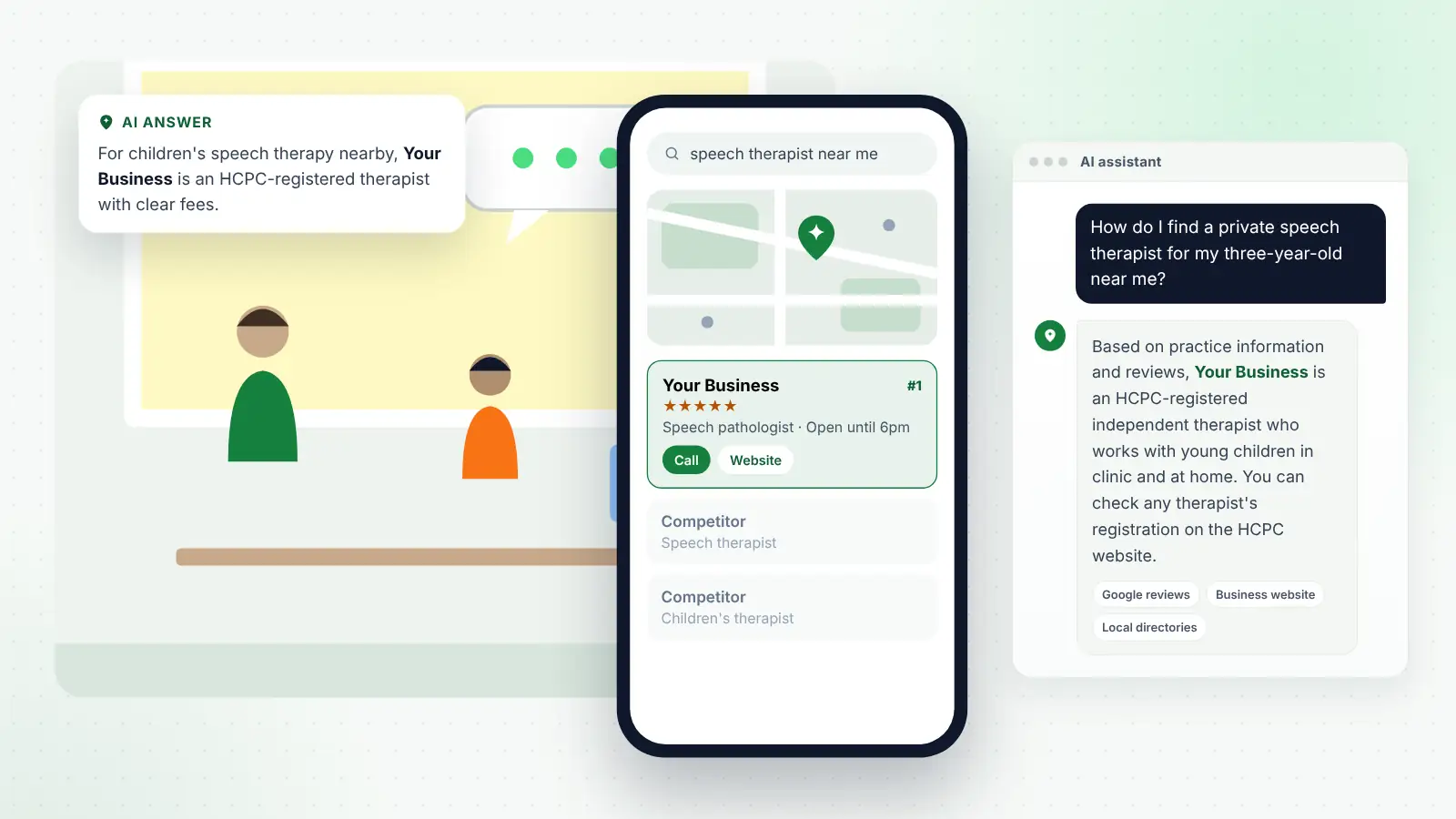
More parents and adults now ask AI assistants such as ChatGPT, Gemini, Perplexity and Copilot for help, and Google often shows an AI Overview above the results. People ask full questions: “how do I find a private speech therapist for my three-year-old near me”, “who can write a speech and language report for an EHCP appeal” or “can I get speech therapy at home after a stroke”.
These tools try to give a confident answer, so they draw on information they can cross-check. For a speech therapy practice, that tends to mean:
- Consistent information about your name, location, registration and services across your website, Google profile and directories.
- Clear service descriptions stating the ages, needs and settings you work with.
- Helpful FAQs answering what families actually ask, such as what happens at an assessment or how long a report takes.
- Reviews describing the experience in clients’ own words.
- Mentions on reputable sites, such as professional directories and local organisations.
AI tools often remind users to check a therapist’s registration, so make your HCPC details easy to find. Nothing guarantees an AI recommendation, but clear, accurate and consistent information gives you the best chance of being described correctly.
Frequently asked questions
Do I need to be an RCSLT member to practise independently?
HCPC registration is the legal requirement for using the protected titles. RCSLT membership is not, but it gives access to professional guidance and insurance, is widely recognised, and is required for full ASLTIP membership.
Can I list my practice on Google if I only visit homes and schools?
Yes, as long as you meet clients in person. You can set up a service-area profile and hide your home address. If all your work is online, you are not eligible, so focus on your website, directories and AI search.
How do I talk about NHS waiting lists without sounding negative?
Keep it factual and respectful. Explain that some families choose independent therapy while waiting for, or alongside, NHS support, and that you are happy to work with NHS colleagues where appropriate. Avoid figures you cannot source and avoid criticising local services.
Should I publish my fees?
Usually, yes. Clear prices for assessments, sessions, reports and travel help families plan. If report and tribunal fees vary, explain what affects the cost.
How long does local SEO take to make a difference?
A completed profile and accurate listings can bring extra enquiries from parents and adult clients within a few weeks. Stronger map rankings and AI visibility usually build over three to six months, depending on your area and how established you already are.
Next steps
Start with the foundations: check that your registration, memberships, insurance and safeguarding checks are current and clearly described. Then write down who you help, where you work and how your enquiry journey runs, and make sure your website, Google profile and directory entries tell the same story.
From there, small steady improvements add up. Clear service pages, honest information about fees and availability, gentle requests for reviews and real relationships with local schools and professionals will help the right families find you. Growth in an independent practice is rarely quick, but it can be steady and sustainable when it is built on trust.