If you have been fitting windows and doors for a few years, you will know the pattern. A homeowner books three quotes. One comes from a national brand whose representative arrives with a tablet, spends two hours in the living room, quotes a large figure, then knocks a third off if they sign tonight. One comes from another local firm. One comes from you. The homeowner is tired, a little suspicious of everyone and trying to work out who is telling the truth.
Many independent installers lose that comparison not because their product or price is worse, but because they never make the case clearly. They measure up, send a one-line price by email a week later and hope. Meanwhile the big brands have a polished process, even if parts of it are designed to rush people. The answer is not to copy their tactics. It is to build an equally deliberate sales process that is calm, transparent and easy to say yes to.
This guide is for established installers who want to convert more of the quotes they already give and attract more homeowners who prefer a no-pressure approach. It covers the home visit, written quotes, certification, guarantees and deposits, cancellation rights, energy ratings, using your past installations as proof, and how all of this feeds into Google and AI search.
Key points
- Homeowners who have experienced hard selling actively look for an installer who explains things and leaves them to decide, so make “no pressure” a visible part of how you work.
- A detailed written quote with a clear validity period does more selling than any same-day discount, because it lets people compare like with like.
- FENSA or Certass registration, the building regulations certificate, an insurance-backed guarantee and deposit protection are reasons to buy, so explain them plainly rather than listing logos.
- Treat the 14-day cancellation period for home-visit contracts as a reassurance you mention up front, not small print.
- Photos, reviews and addresses of real local installations persuade more than brochures, and the same proof helps you appear on Google Maps and in AI assistant answers.
In this guide
- Why pressure selling is a weakness you can use
- Run a home visit that earns trust
- Written quotes that do the selling for you
- Make certification and building regulations part of the conversation
- Guarantees, deposits and consumer protection
- Treat cancellation rights as a selling point
- Explain energy ratings and performance honestly
- Showcase your installations as proof
- Local SEO that suits a no-pressure glazing firm
- AI search: what assistants tell homeowners about your company
- Frequently asked questions
- Final thoughts
Why pressure selling is a weakness you can use
The double glazing industry still carries the memory of salespeople who would not leave, “price held for tonight only” offers and inflated list prices discounted on the spot. Many homeowners have either experienced it or heard about it from a parent. When they book quotes now, a large part of what they are assessing is whether they can trust the person in front of them.
That gives an independent installer a real advantage, provided the homeowner can see it. Consider how most customers behave in practice:
- They get two to four quotes and often take several weeks to decide, particularly for a whole-house job.
- They discuss it with a partner or family member who was not at the visit, so whatever you leave behind has to explain itself.
- They search for reviews of every company that quoted, and read the negative ones closely.
- They compare what is included, not just the headline figure, but only if the quotes make that possible.
Pressure tactics work against all of these behaviours. A same-day discount implies the original price was not real. A quote that is only explained verbally falls apart when it is passed to a partner. A pushy visit becomes a one-star review. If your process does the opposite, and the homeowner notices, you win jobs you are currently losing on presentation.
It is also worth remembering the legal side. UK consumer protection law prohibits misleading and aggressive commercial practices, and the Competition and Markets Authority now has stronger direct enforcement powers under the Digital Markets, Competition and Consumers Act 2024. Fake “was” prices and artificial deadlines are a risk, not just bad manners.
Run a home visit that earns trust
The survey visit is where most window and door jobs are won or lost. A good one is structured, unhurried and focused on the house and the people living in it. Here is a sequence that works for many installers.
- Confirm the appointment properly. Send a text or email the day before with your name, a photo if you are comfortable with that, the expected length of the visit and what you will do. It removes the anxiety of a stranger arriving.
- Start with questions, not products. Ask what prompted the enquiry: draughts, condensation, noise, security, a tired front door, a planned sale. The answer tells you what matters and what to explain.
- Look at the existing windows together. Point out what you see, such as failed seals, blown units, rotten timber, missing trickle vents or windows that would need to work as fire escapes. Customers value being shown rather than told.
- Measure and note everything. Survey each opening, check lintels, cills and reveals, and photograph anything that affects price or fitting.
- Show samples, briefly. Frame corners, a door sample and hardware are more useful than a brochure. Stick to the options that suit the house.
- Explain your process and paperwork. Who fits, how long it takes, what the building regulations certificate is, what the guarantee covers and how deposits are protected.
- Tell them when the quote will arrive, and leave. “You will have a written quote by Thursday, it is valid for 60 days, and there is no need to decide anything today.” Then go.
Keep the visit to a sensible length. Most homeowners are relieved when a surveyor finishes in under an hour and does not need to be shown the door.
Tip
End every visit with the same sentence, such as “We never ask for a decision on the day.” Customers repeat it to partners and in reviews, and it becomes part of how people describe you.
Written quotes that do the selling for you
A thin quote is one of the most common reasons established installers lose work they should win. If your quote says “supply and fit 8 windows and 1 door, £X”, the homeowner has nothing to weigh against a competitor’s thick folder, even if your job is better.
A strong written quote includes:
- The property address, the date of the visit and the name of the surveyor.
- A schedule of every opening, with style, opening configuration, colour inside and out, glazing specification, hardware and any special features such as obscure or safety glass.
- The frame system or door brand, and the energy rating or U-value of each product where you have it.
- Exactly what is included: removal and disposal of old frames, internal and external finishing, making good, trickle vents, cills, any extra work identified at the survey.
- Certification: confirmation that the job will be registered under your competent person scheme and the homeowner will receive a certificate.
- Guarantee: length, what it covers and the fact that it is insurance-backed.
- Payment schedule and how any deposit is protected.
- A clear validity period.
Validity periods instead of deadlines
A validity period is the honest alternative to a “tonight only” price. It tells the customer how long you will hold the price, usually because your fabricator’s prices and your diary can change, and it gives them time to compare quotes and talk it over. Thirty to ninety days is common, depending on how stable your supply prices are. If you need to change the price after it lapses, say so and explain why.
The table below sets out common pressure tactics and the honest alternatives that tend to convert better over time.
| Pressure tactic | Why customers distrust it | Honest alternative |
|---|---|---|
| Large “today only” discount | Suggests the first price was inflated | One fair price with a stated validity period |
| Price given verbally at the table | Hard to compare or share with a partner | Detailed written quote sent within a set number of days |
| Long visit with a “call to the manager” | Feels staged and wears people down | Visit under an hour, no decision asked for |
| Vague “lifetime” guarantee | Unclear what it covers or who honours it | Stated guarantee length, insurance-backed, with what is covered |
| Large deposit taken on signing | Fear of losing money if the firm folds | Modest, protected deposit with a clear payment schedule |
| Cancellation rights buried in small print | Feels like a trap | Cancellation period explained at the visit and in writing |
Follow up on quotes without pestering homeowners
Following up is not pressure selling, provided it is helpful. A short message a few days after sending the quote, asking whether anything needs clarifying, is welcome. A second message before the validity period ends is reasonable. After that, leave it. Many installers find that a calm, single follow-up turns a surprising number of “we are still thinking” customers into jobs.
Make certification and building regulations part of the conversation
Replacement windows and external doors in homes in England and Wales must meet building regulations. The practical route for most installers is registration with a competent person scheme such as FENSA or Certass, which lets you self-certify the work. The scheme notifies the local authority, and the homeowner receives a certificate. If the work is not done by a registered installer, the homeowner normally needs to involve building control, which adds cost and time. Scotland and Northern Ireland have their own building standards systems.
Most homeowners do not know any of this until a solicitor asks for the certificate when they sell. Explaining it at the survey does two things. It shows you understand the rules better than a cheaper unregistered fitter, and it gives the homeowner a concrete reason to choose a certified installer.
Keep the explanation short and practical:
- “Because we are registered with [scheme], we register your installation once it is finished and you will receive a certificate.”
- “Keep it with your house documents, because you will be asked for it when you sell.”
- “Our work is inspected by the scheme from time to time, so standards are checked independently.”
Make sure you register every job promptly, and that the certificate actually reaches the customer. A missing certificate discovered years later during a house sale is a frustrating problem for the homeowner and a poor reflection on you.
It is also worth explaining the requirements that affect their specific windows. Replacement work should not make ventilation or means of escape worse, and safety glazing is needed in certain locations. Listed buildings and conservation areas may need consent before anything is changed. When a customer understands why a bedroom window needs a particular opening or why you are including trickle vents, a cheaper quote that ignores those points stops looking like a bargain.
Guarantees, deposits and consumer protection
Homeowners worry about two things when choosing a smaller installer: what happens to their deposit if the firm stops trading, and whether the guarantee will be worth anything in ten years. National brands lean on their size to answer both. You answer them with insurance.
Insurance-backed guarantees
An insurance-backed guarantee means that if your business ceases trading, the guarantee on the work is still honoured for its remaining term. Many competent person schemes expect members to offer one. Explain in one sentence what it is, tell the customer who provides it and include the documents with their completion paperwork.
Deposit protection
Deposit protection insurance means the customer gets their deposit back if you are unable to complete the work. Keep deposits modest and in proportion to the costs you genuinely face at order, such as made-to-measure frames from your fabricator, and say how they are protected. A homeowner who has been asked for a large unprotected deposit by another firm will notice the difference.
Membership schemes and trade bodies
Several industry schemes package these protections together. The Double Glazing and Conservatory Ombudsman Scheme (DGCOS) is an industry-funded membership scheme that offers members’ customers deposit protection, insurance-backed guarantees and access to dispute resolution. It is not a statutory ombudsman, so describe it accurately. The Glass and Glazing Federation (GGF) is the main trade association, with its own code of practice and consumer protection arrangements. Some installers also use TrustMark or a local authority-backed trader scheme.
You do not need every badge. What matters is that you can explain, simply and truthfully, what protection the customer gets and who provides it. A short “how you are protected” page on your website and a one-page sheet left at the survey do this well.
Treat cancellation rights as a selling point
Most window and door contracts are agreed in the customer’s home, which normally makes them off-premises contracts under the Consumer Contracts Regulations. That gives the customer a 14-day cancellation period, and you must provide clear written cancellation information and a cancellation form. If you fail to provide that information, the cancellation period can be extended by up to 12 months, and failing to give the cancellation notice for an off-premises contract can be a criminal offence. Trading Standards and Citizens Advice both publish plain-English guidance on these rules if you want to check your paperwork against them.
Some installers treat cancellation rights as something to minimise. A better approach is to mention them openly: “Once you sign, you have 14 days to change your mind, and here is the form.” For a nervous homeowner that sentence removes much of the risk of saying yes. It also contrasts sharply with the high-pressure experience they may have had elsewhere.
Two practical points still need care. Starting work, or ordering made-to-measure frames, during the cancellation period has consequences for what the customer would owe if they cancel, and the rules on made-to-measure goods in supply-and-fit contracts are not always straightforward. If the customer wants you to start early, get their express request in writing and explain what they may have to pay if they cancel. Have your terms reviewed by a solicitor who understands the trade.
Explain energy ratings and performance honestly
Energy efficiency is one of the main reasons people replace windows, and one of the areas most prone to exaggeration. Claims such as “these windows will halve your heating bill” are hard to support and easy to challenge.
A more credible approach:
- Explain what the ratings mean. Window energy ratings and U-values describe how well a product keeps heat in. Show the customer the rating label or data sheet for the products you are quoting, and explain that new windows must meet the minimum thermal performance in the current building regulations.
- Be realistic about savings. The benefit depends on what is being replaced, the rest of the house and how it is heated. Replacing old single glazing makes a much bigger difference than replacing reasonably recent double glazing. Say that.
- Talk about comfort as well as cost. Fewer draughts, less condensation, warmer rooms near windows and reduced outside noise are benefits customers notice immediately.
- Be clear on trade-offs. Triple glazing, acoustic glass and higher-specification doors cost more. Explain when the extra cost makes sense, for example on a noisy main road, and when it probably does not.
Honest explanations here often win jobs from homeowners who are tired of inflated claims. They also protect you, because savings claims you cannot support are exactly the kind of statement consumer law treats as misleading.
Showcase your installations as proof
A national brand has advertising budgets. You have something more persuasive: hundreds of real installations on streets your customers walk down every day. Most installers under-use this.
Ways to make your past work visible:
- Photograph every job consistently. Take a before and after from the same angle, plus close-ups of finishing, sills, hardware and internal reveals. Ask permission to share, and avoid showing house numbers unless the customer is happy with it.
- Build a local gallery. Organise your website and Google Business Profile photos by town or area, so a homeowner in one village can see work nearby.
- Offer to show finished installs. With the owner’s agreement, some installers keep a short list of past customers who are happy for prospective customers to see their windows or doors from the street, or to take a call.
- Write short project notes. A few sentences on what was replaced, why and what the customer wanted. These make excellent website case studies and Google posts.
- Use site boards and neighbour notes. A tidy board during the job and a polite note to neighbouring houses afterwards, with the customer’s permission, generate enquiries from people already considering the same work.
- Ask for detailed reviews. Encourage customers to mention what was installed, the area and how the visit and fitting felt.
Tip
Create a simple “photos at handover” habit for every fitting team. Ten minutes of photos at each job builds a gallery that does more for your conversion rate than any brochure.
Local SEO that suits a no-pressure glazing firm
Homeowners who want an independent, no-pressure installer usually find one by searching locally. Typical searches include “window fitters near me”, “double glazing [town]”, “composite front doors [town]”, “bifold doors installed near me”, “FENSA registered installer [town]” and “misted double glazing repair”. The map results that appear at the top for these searches are where local installers can compete on equal terms with national names, because Google weighs relevance, distance and reputation rather than advertising budget.
For an installer whose strength is honesty and quality, local search is also where that reputation becomes visible. Reviews, photos and clear information do the job your salesperson would otherwise have to do in the living room.
Google Business Profile
Choose the most accurate primary category, such as window installation service, and add secondary categories only where they genuinely apply, for example door supplier or conservatory construction. Write a description that explains what you install, the areas you cover, your scheme registration and how your quotes work, including the fact that you do not ask for a decision on the day if that is your policy. Add services individually, upload photos of local installations regularly and use updates (posts) to explain your guarantee and certification.
Reviews that mention the relaxed survey and tidy fitting
Reviews are where a no-pressure approach pays off. Ask every customer once the job is complete and they are happy, with a direct link. Reviews that mention a relaxed survey, a clear written quote, tidy fitting and the area you worked in are far more persuasive than five stars alone, and they help you appear for searches in those places. Answer each review politely and without getting defensive, even the one-star ones. Never offer incentives for positive reviews or write reviews yourself.
Matching details across Google, scheme listings and directories
Your business name, address or service area and phone number should match exactly across your website, Google, Bing Places, Apple Business, your competent person scheme listing, trade body directories and fabricator installer finders. Inconsistent details make it harder for search engines, and AI tools, to be confident they have the right information.
A website that answers buying questions
Give each main product its own page: replacement windows, composite doors, bifold and sliding doors, repairs. Add area pages for the towns where you have genuine installations and reviews, with local project examples. Then add the pages that support your sales approach: how your home visits work, what your quotes include, how deposits and guarantees are protected, and an explanation of building regulations certificates. Guide prices or typical ranges, if you are comfortable sharing them, help homeowners self-qualify before they book.
Local and industry links
Links and mentions from your fabricator’s installer directory, trade body listings, local business groups, community sponsorships and local news all help show that you are an established local business.
Keeping all of this up to date alongside surveys and fitting is a lot of work, so some installers bring in specialist local SEO for window and door installers and glazing firms to handle the profile, reviews process, listings and content each month. Either way, expect improvements to build over three to six months rather than weeks.
AI search: what assistants tell homeowners about your company
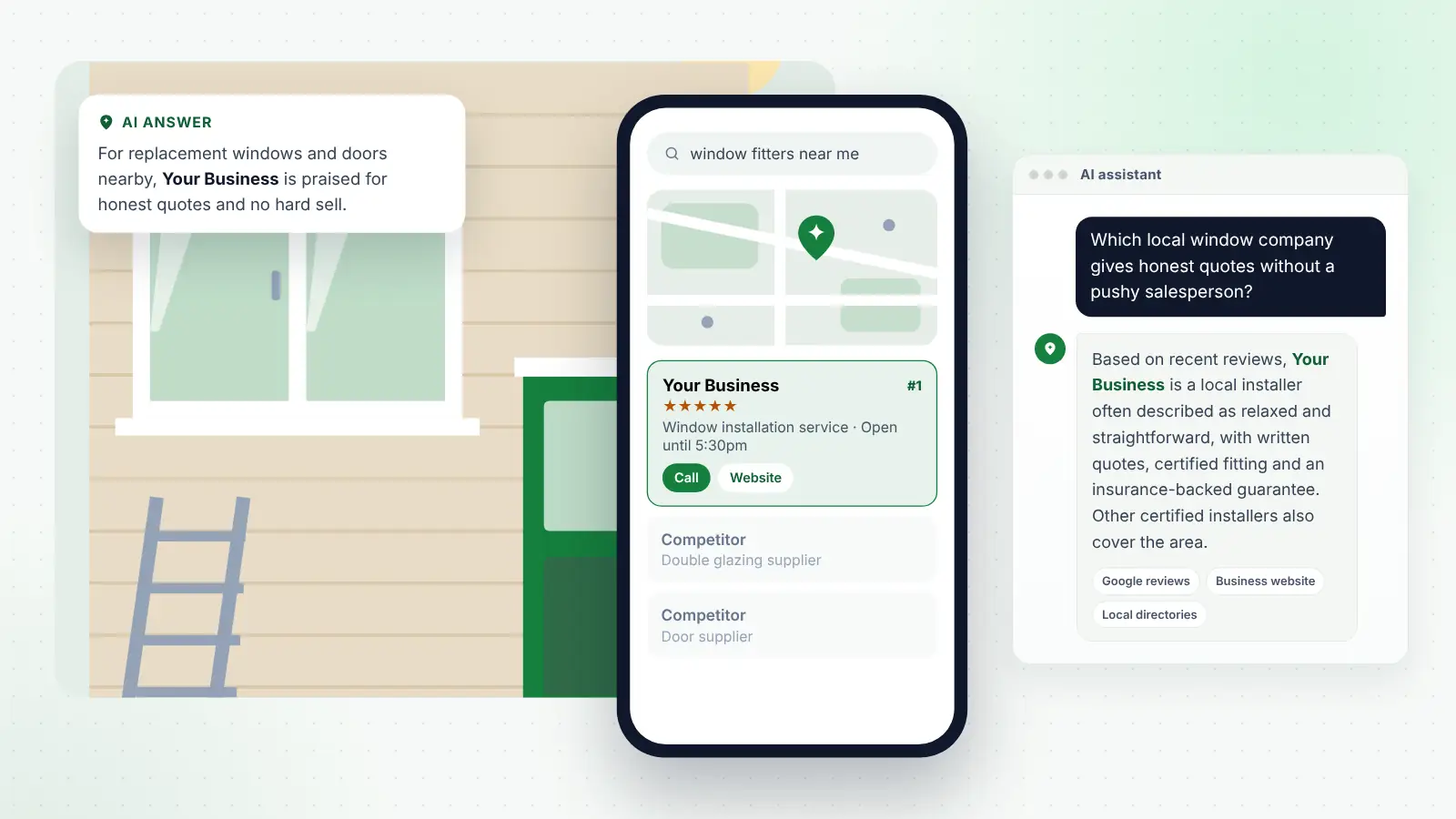
Homeowners increasingly ask AI assistants for help before booking quotes. Questions sound like “Which window company near me doesn’t use pushy sales tactics?”, “Is it worth replacing 15-year-old double glazing?”, “What should be included in a window quote?”, “Do I need a FENSA certificate to sell my house?” or “Who fits composite doors in [town] with good reviews?” ChatGPT, Gemini, Perplexity, Microsoft Copilot and Google AI Overviews all answer questions like these, and some name specific local firms.
These tools build their answers from information already published about you. If your reviews repeatedly mention relaxed surveys and written quotes, and your website explains your process clearly, an assistant has something specific to say. If your online presence is a logo and a phone number, it has nothing to work with, and it will describe the businesses that have explained themselves.
Practical steps that help:
- Describe your approach in plain words. A sentence such as “We survey, send a detailed written quote within three working days and never ask for a decision on the day” is the kind of clear statement AI tools can repeat.
- State certifications and protections consistently. Use the same wording for your scheme registration, guarantee and deposit protection on your website, Google profile and directory listings.
- Publish honest FAQs. Answer the questions homeowners ask at surveys: how long fitting takes, whether trickle vents are needed, what the certificate is for, what happens if they cancel, how long the quote is valid.
- Encourage detailed reviews on more than one platform. Assistants draw on reviews across the web, not only Google.
- Earn mentions on reputable sites. Trade body directories, fabricator installer finders, local news and community organisations all add to the picture.
For window and door installers this matters because the questions people ask AI are mostly about trust: who will not pressure them, who is certified, whose guarantee is real. Those are exactly the strengths an honest independent installer has, as long as they are written down where the tools can find them.
Frequently asked questions
Will I lose jobs if I stop offering on-the-day discounts?
You may lose a few customers who expect to haggle, but many installers find they win more jobs overall because homeowners trust the first price. A fair price with a clear validity period is easier to compare and easier to defend in reviews.
How long should a window and door quote be valid?
There is no fixed rule. Many installers use 30 to 90 days, depending on how often their fabricator’s prices change and how far ahead their diary is booked. State the period clearly on the quote and explain what happens after it lapses.
Do customers really care about FENSA or Certass?
Many do not know about it until it is explained, but once they understand that a certificate is needed when selling the house and that registered installers are checked, it becomes an important reason to choose you. Explain it briefly at the survey and in your quote.
Is DGCOS the same as an ombudsman?
DGCOS is an industry membership scheme funded by installers. It offers deposit protection, insurance-backed guarantees and dispute resolution for members’ customers, but it is not a statutory ombudsman. Describe it accurately and explain what your customers actually receive.
Can I start fitting before the 14-day cancellation period ends?
Only if the customer expressly asks you to, ideally in writing, and understands they may have to pay for work done or goods ordered if they cancel. The rules on made-to-measure products in supply-and-fit contracts can be complex, so have your terms checked by a solicitor.
How quickly will better reviews and photos bring in enquiries?
Some improvement can come within weeks of completing your Google profile and adding photos, but stronger map visibility and AI mentions usually build over three to six months of steady reviews and content.
Final thoughts
Competing with national window and door brands does not mean matching their tactics. It means building a process that is just as deliberate but far more comfortable for the customer: a structured, unhurried survey, a detailed written quote with a clear validity period, plain explanations of certification, guarantees, deposits and cancellation rights, and honest talk about energy performance.
Then make that approach visible. Photograph your work, ask for detailed reviews, publish the answers to the questions you hear at every survey and keep your details consistent across the web. Homeowners searching on Google, and the AI tools they increasingly consult, will have clear evidence of the kind of installer you are.