Street food is one of the most popular ways into the food business. A converted van, a horsebox or a gazebo with a good griddle costs far less than a restaurant, and the best traders build loyal followings at markets, festivals and, increasingly, weddings and private parties. Many owners start part-time at weekends while they test a menu.
The low barrier to entry is also the challenge. There are a lot of traders, good pitches are expensive, and the weather can wipe out a weekend’s takings. The businesses that last tend to combine public trading with private bookings, handle their paperwork properly so organisers trust them, and make it easy for people to find and book them between events.
This guide covers registration and hygiene, gas safety, trading consents, the documents events ask for, pricing private bookings, and getting found through local search and AI recommendations.
Key points
- Register as a food business with the council where your vehicle or stall is normally kept, at least 28 days before you start trading; registration is free.
- Your hygiene rating comes from that council and follows you to every event, so prepare properly for the first inspection.
- Trading on a street or public land usually needs a street trading consent or licence from the council for that area; private events work differently.
- LPG appliances should be checked and certificated by a Gas Safe registered engineer qualified for mobile catering, and most organisers will ask to see the certificate.
- Weddings and private parties often pay better than public pitches, so take deposits, use clear terms and publish guide prices.
- Couples and organisers find traders on Google Maps and, increasingly, through AI assistants, so reviews, photos and consistent details matter.
In this guide
- Choose your concept and your setup
- Register as a food business
- Food hygiene ratings for mobile traders
- Street trading consents and where you can trade
- Gas safety for LPG catering units
- The paperwork events will ask for
- Allergens and dietary needs
- Weddings and private bookings
- Local SEO: getting found between events
- AI search: how hosts ask for recommendations
- Frequently asked questions
- Next steps
Choose your concept and your setup
Decide what you will sell and who you will sell it to before you buy anything. A tight menu of four or five dishes you can serve quickly usually beats a long one. Organisers want traders who keep a queue moving, and couples want food guests will talk about.
- Gazebo or market stall. The cheapest start, suited to markets and smaller events, though setup takes time and some festivals prefer trucks.
- Trailer or horsebox. Popular for weddings because they photograph well. Check your towing vehicle and driving licence entitlement for the combined weight.
- Converted van or food truck. Self-contained and quick to set up, but a bigger upfront cost and another vehicle to insure.
- Specialist units. Pizza ovens, hog roasts, coffee carts and mobile bars each have their own equipment and safety considerations.
Festivals bring volume but high pitch fees. Weekly markets build regulars. Private bookings give guaranteed income for a set number of guests. Most successful traders end up doing a mix.
Register as a food business
Every food business, including a mobile one, must register with the council at least 28 days before trading. Registration is free and cannot be refused. For a mobile unit, you register with the council where the vehicle or stall is normally kept, usually overnight, not with every council where you trade.
You also need:
- A food safety management system based on HACCP principles. Many small traders use the Food Standards Agency’s Safer Food, Better Business pack or a trade association system.
- Food hygiene training for everyone who handles food, typically a recognised Level 2 course.
- Records of fridge and cooking temperatures, cleaning, suppliers and allergens in every dish.
- HMRC registration as self-employed or a limited company.
Storing a large trailer on a driveway or residential street can raise planning or parking questions, so ask your council if you are unsure.
Food hygiene ratings for mobile traders
After you register, an environmental health officer from your home council will inspect the unit. Mobile traders are rated under the same Food Hygiene Rating Scheme as restaurants, from 0 (urgent improvement necessary) to 5 (very good), based on food handling, the condition of the unit and how you manage food safety.
Your rating follows you to every market and wedding, and organisers check it. Display is a legal requirement in Wales and Northern Ireland and voluntary in England. The Food Standards Agency explains how the Food Hygiene Rating Scheme works. Scotland runs a separate pass or improvement required scheme.
Common problems for mobile traders include no hot water for handwashing, too little fridge space, poor separation of raw and ready-to-eat food in a small unit, and records that slip on busy days.
Tip
Many organisers ask for a rating of 4 or 5, and some accept only 5. Treat your first inspection as part of your launch, because a low rating can keep you out of the events you most want.
Street trading consents and where you can trade
Selling on streets and public places is controlled by councils. In most of England and Wales, councils can use Schedule 4 of the Local Government (Miscellaneous Provisions) Act 1982 to designate consent streets, licence streets and prohibited streets. Trading in a consent or licence street needs council permission; trading in a prohibited street is not allowed. “Street” is defined widely and can include beaches and other areas the public can enter without paying.
- Each council sets its own policy, fees and conditions, so check with the licensing team wherever you want a regular pitch.
- Mobile consents for traders who move around often limit how long you can stay in one spot.
- Councils commonly ask for public liability insurance, photos of the unit and sometimes a basic criminal record check.
- London, Scotland and Northern Ireland use different legislation.
Private land is different. A wedding on a farm, a garden party or a ticketed festival is usually controlled by the landowner or organiser rather than a street trading consent, though planning rules and the event’s own licence still apply. Ask organisers what permissions they hold.
Gas safety for LPG catering units
Most units cook with LPG, and gas is where organisers, councils and fire officers are most cautious. Have your installation and appliances checked and certificated by a Gas Safe registered engineer qualified to work on mobile catering units; a domestic gas engineer is not enough. The back of the engineer’s Gas Safe ID card lists the work they are qualified to do.
NCASS, the trade association for mobile and independent caterers, advises testing and certification at least once a year. Most events will ask for an in-date certificate before you are allowed on site.
- Store cylinders outside the cooking area, upright, secure and well ventilated.
- Treat empty cylinders as full, because they still contain vapour.
- Replace worn hoses and use the correct regulators.
- Turn gas off at the cylinder when you finish and before you travel.
- Carry suitable fire extinguishers and a fire blanket, and know how to use them.
Generators, hook-ups and appliances should also be maintained by a competent electrician, and many organisers ask for portable appliance testing records.
The paperwork events will ask for
Festival applications and wedding venues ask for a familiar set of documents. Keep them in one folder and update them before each season.
| Document | Who issues it | Why organisers ask |
|---|---|---|
| Food hygiene rating | Your home council | Shows your standards were inspected |
| Gas safety certificate | Gas Safe engineer qualified for mobile catering | Confirms LPG appliances were checked |
| Electrical or PAT records | A competent electrician | Shows electrical equipment is safe |
| Public liability insurance | Your insurer | Covers injury or damage to the public |
| Employers’ liability insurance | Your insurer | Required by law once you employ staff |
| Food safety management system | You or a trade association | Shows how you control hazards |
| Risk and fire risk assessments | You | Shows you have planned for risks on site |
| Allergen information | You | Shows you can answer customer questions |
Public liability insurance is not compulsory for every trader, but almost every event, venue and council insists on it, often at £5 million. Specialist mobile catering policies usually bundle public and product liability, equipment and stock. Your vehicle needs its own insurance covering business use.
Risk assessments should cover hot surfaces, gas, generators, cables, manual handling and crowds. The law requires written findings once you employ five or more people, but write them down regardless. Most events expect a fire risk assessment for the unit and have their own rules on spacing and gas storage.
Tip
Send your documents as one tidy PDF pack named with your business and the season. Organisers handling dozens of traders remember the ones who made their job easy.
Allergens and dietary needs
Every food business must be able to tell customers which of the 14 major allergens are in its food: cereals containing gluten, crustaceans, eggs, fish, peanuts, soya, milk, tree nuts, celery, mustard, sesame, sulphites, lupin and molluscs. For food served loose from a hatch, the information can legally be given verbally if a sign tells customers to ask.
The Food Standards Agency’s best practice guidance for non-prepacked food recommends going further, with written information customers can see easily, backed by a conversation. It is not a legal obligation, but it suits a busy truck where staff change and queues are long.
- Keep an allergen matrix for every dish, including sauces, breads, toppings and frying oil.
- Recheck labels whenever a supplier or product changes.
- Be honest about cross-contact in a small unit with shared fryers and surfaces.
- For private events, collect dietary requirements in advance and confirm them in writing.
Food wrapped before customers choose it, such as boxed brownies on the counter, may count as prepacked for direct sale and need a full ingredients label.
Weddings and private bookings
Weddings, birthdays and corporate parties are often the most profitable work for a street food trader. You know the numbers, you are paid whatever the weather and there is no pitch fee.
Pricing private events
Most traders charge per head with a minimum spend or minimum guest numbers. Build in ingredients and packaging, staff time including travel and setup, fuel and gas, insurance and equipment wear, and a margin that lets you turn down poor events. Publish guide prices, such as a starting price per head with a minimum number of guests, so couples can check you fit their budget before they enquire.
Deposits and terms
Take a deposit to secure the date, with written terms explaining what happens if the client cancels or numbers change. Consumer law requires terms to be fair and clear, and a deposit should reasonably reflect the costs or lost business a cancellation causes. Keep terms short and in plain English, and get them accepted in writing. Confirm vehicle access, ground conditions, power, water, service times and an on-the-day contact.
Wedding fairs and venues
Wedding fairs at barns, country houses and hotels let couples taste your food and meet you. Bring samples, a printed price guide and a way to capture contact details, then follow up within a couple of days. Venues without their own kitchens often keep a recommended supplier list, and a good relationship with the coordinator can bring bookings every season.
Local SEO: getting found between events
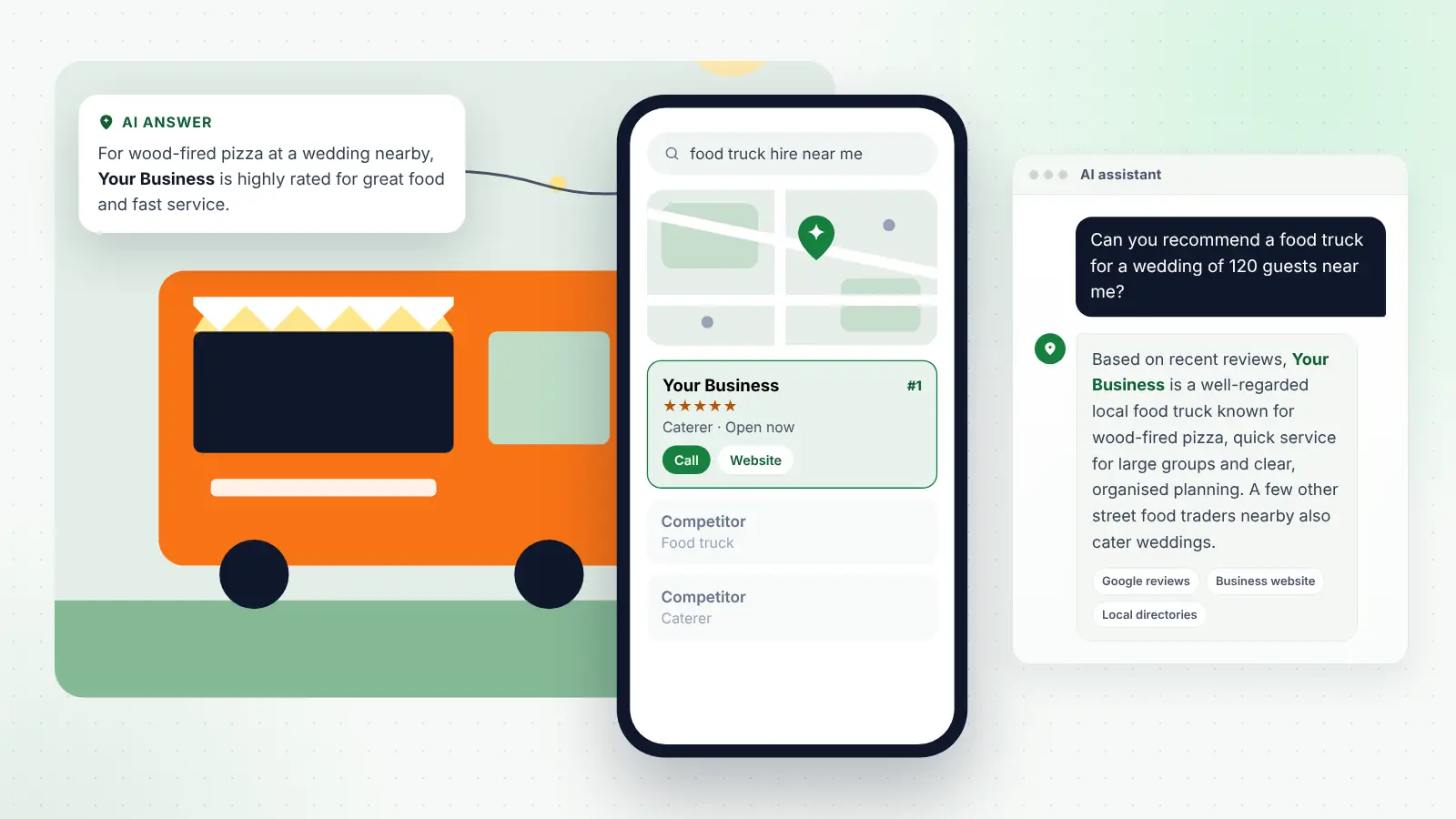
Couples, party hosts and office managers search on their phones for “food truck hire near me”, “pizza van for wedding [county]”, “street food catering for party” or “food trucks [town] this weekend”. They scan the map, look at photos and reviews, and contact two or three traders. Because you move around, your online presence is often the only way people can find you again.
Google Business Profile
Set up your profile as a service-area business, listing the towns and counties you cover rather than a home address. Choose an accurate primary category, such as caterer, add menus with photos and starting prices, and upload real photos from weddings, festivals and markets regularly. Use posts to announce upcoming pitches, and add an enquiry link that goes straight to your booking form.
Reviews, details and your website
Ask private clients for a review a day or two after the event. Reviews that mention the occasion, guest numbers, food and service help other hosts picture you at their event. Reply to each one briefly and personally.
Use the same name, phone number and website across Google, wedding directories, event sites and social profiles. Your website should have pages for weddings, private parties and corporate events, plus the main areas and venues you cover, with guide prices, capacity, space and power needs and the documents you can provide. Links from venue supplier pages, wedding blogs and local food festival trader lists help too. If you would rather have specialists handle this while you run the truck, we offer local SEO for street food traders and food trucks on rolling monthly plans.
AI search: how hosts ask for recommendations
More people now ask ChatGPT, Gemini, Perplexity and Copilot to suggest suppliers, and Google often shows an AI Overview above the usual results. The questions are longer and more specific: “Can you recommend a food truck for a wedding of 120 guests near Harrogate?” or “Which street food vans do vegan options for a garden party?”
Assistants suggest street food traders based on details they can find and check across the web:
- Consistent details about your name, menu, area and contact information across the web.
- Reviews on Google and wedding directories that describe real events.
- Clear descriptions of what you serve, how many guests you can feed and the events you cater.
- An FAQ page covering guest numbers, pricing, setup space, power, dietary options, travel and deposits.
- Mentions on reputable sites, such as venue supplier lists, local food guides and event listings.
Write as if answering a host directly. “We serve up to 200 guests in two hours and need a level space of about six by four metres” is far more useful to a person, and to an AI assistant, than a vague promise of great food. Local SEO and AI visibility usually build over three to six months, so start well before the season you want to fill.
Frequently asked questions
Which council do I register my food truck with?
The council where the vehicle or stall is normally kept, usually where it is parked overnight. You do not register with every council where you trade, although you may need street trading permission for regular public pitches.
Do I need a street trading licence for weddings?
Usually not on private land where the landowner has booked you, such as a wedding venue or a client’s garden. Street trading rules apply to streets and public places. Ask the venue what permissions are in place, and check with the council if unsure.
What gas certificate do events ask for?
An in-date gas safety certificate for your unit from a Gas Safe registered engineer qualified for mobile catering. NCASS advises testing and certification at least once a year.
How much public liability insurance do I need?
There is no single legal amount, but most events, venues and councils set a minimum, and £5 million is common. Check each organiser’s terms, and add employers’ liability insurance once you take on staff.
Should I join NCASS?
Membership is not compulsory, but NCASS offers food safety systems, guidance and discounted insurance for mobile caterers. Some festivals prefer or require members, so it can open doors as well as making compliance easier.
Next steps
Start with the foundations: register with your council, put your food safety system and training in place, get your gas installation certificated, and build a tidy paperwork pack. Test your menu at local markets before committing to expensive festival pitches.
As you grow, balance public trading with private bookings, and make it easy for hosts and organisers to find you, see your food and trust your setup. A complete Google profile, steady reviews and clear, honest information on your website will help fill your diary well beyond the weekends you already have booked.