Running an independent bike shop has never been simple. Online retailers sell on thin margins, the weather decides whether spring is busy, and e-bikes have brought new stock costs, skills and safety questions. Yet what a rider cannot get from a website, such as a trusted mechanic, a proper fit, a test ride and someone to fix a snapped chain on a Saturday, is exactly what an independent shop does best.
This guide covers the main levers for an established bike shop, workshop or mobile bike mechanic in the UK, as things stand in October 2026: workshop pricing, e-bike rules and battery safety, Cycle to Work, finance, qualifications, and how local search and AI assistants now influence where riders go.
Key points
- The workshop brings riders back every year and steadies cash flow, so price it properly, make it easy to book and treat it as a core product.
- E-bikes sold as standard must meet the EAPC rules (250 watts, assistance cutting out at 15.5mph); refusing illegal conversions protects your customers and your reputation.
- Lithium-ion battery safety is a growing regulatory focus, with statutory guidelines already in place and further product safety rules being developed under the Product Regulation and Metrology Act 2025.
- Cycle to Work remains an important sales channel, and packages above £1,000 are possible through providers that hold the right FCA permissions.
- Cytech qualifications and Association of Cycle Traders membership are the clearest trust signals you can show riders.
- Riders check Google Maps, reviews and AI assistants before visiting, so accurate listings, local inventory and clear service pages matter as much as stock.
In this guide
- Know where your money actually comes from
- The workshop is the heart of the business
- Selling e-bikes honestly and safely
- Cycle to Work: making the scheme work for you
- Finance: getting the FCA rules right
- Show your qualifications and memberships
- Specialist services and community links
- Local SEO: being found when riders search nearby
- AI search: how riders now ask for recommendations
- Frequently asked questions
- Final thoughts
Know where your money actually comes from
Once you account for discounting, stock holding costs and the cash tied up in e-bikes, the margin on a new bike can be modest. Look at every income stream separately.
| Income stream | Typical pattern | Why it matters |
|---|---|---|
| New bikes and e-bikes | Peaks in spring and early summer | Brings in new customers who will need servicing |
| Servicing and repairs | Busy in spring, steadier with good planning | Repeat income and the strongest source of loyalty |
| Parts, tyres and accessories | Year-round, with a pre-Christmas lift | Good margins and frequent visits |
| Bike fitting | Steady among committed riders | High value per hour and builds reputation |
| Cycle to Work sales | Linked to employer scheme windows | Brings riders who may not have visited otherwise |
| Mobile call-outs | Commuters and families who cannot travel | Extends your reach beyond walk-in trade |
Track how many of the bikes you sell come back to your workshop within a year, how long stock sits before it sells, and where each enquiry came from. Those numbers say more about the shop’s health than turnover.
The workshop is the heart of the business
For most independent shops, the workshop keeps the doors open between October and February. It is also where trust is built: a rider whose bike has been well looked after tends to buy their next bike from the same shop.
Price the workshop properly
Many shops undercharge because they compare themselves with the cheapest competitor. Work out your real hourly cost, including rent, wages, tools, training and admin, then publish a clear menu of common jobs:
- A safety check or basic service.
- A full service, with a list of what it covers.
- A strip-down or annual overhaul.
- Common single jobs, such as puncture repair, brake bleeding, gear indexing and wheel truing.
- E-bike servicing, with a note of which motor systems you work on.
Say clearly where parts are charged separately. The price you advertise should include any compulsory fee, so avoid surprise charges added at the counter.
Make booking easy
Riders expect to book online. A good workshop booking system lets customers choose a service, pick a drop-off date, describe the problem and receive updates. Add the booking link to your website and Google Business Profile, and keep a few same-day slots for quick jobs: a commuter with a puncture chooses the shop that can help today.
Tip
Send a photo of worn parts with every quote for extra work, and grade each item by urgency. Riders approve more work when they can see the problem, and the photos reduce disputes later.
Spread the workload across the year
- Promote winter service packages in autumn, and discount pre-season services booked before March.
- Send every bike buyer a service reminder at the right interval.
- Promote commuter safety checks for lights, brakes and tyres as the clocks change.
- Offer collection or a mobile service for customers who cannot get to you.
Selling e-bikes honestly and safely
E-bikes bring riders who may not have bought a bike for years, and responsibilities with them. A shop that explains the rules and safety clearly becomes the obvious place to buy.
Know the EAPC rules
In Great Britain, an e-bike can be ridden on the road like a normal bicycle, without registration, tax or insurance, if it meets the rules for an electrically assisted pedal cycle (EAPC). In summary:
- It must have pedals that can be used to propel it.
- The motor must have a maximum continuous rated power of no more than 250 watts.
- The motor must stop providing assistance when the bike reaches 15.5mph.
- Riders must be at least 14.
Throttle use is restricted. A throttle that works without pedalling is generally limited to helping the bike pull away at walking pace, up to 6km/h; anything more needs type approval. In January 2025 the Department for Transport confirmed it would not take forward proposals to raise the power limit to 500 watts or allow full throttle assistance, so the familiar rules still apply.
Refuse illegal conversions and de-restriction
A bike that goes beyond the EAPC rules is treated as a motor vehicle, needing registration, insurance, a suitable licence and a helmet. Most powerful conversions and de-restricted bikes meet none of these, leaving the rider exposed to police action and uninsured if they injure someone.
Many shops have a written policy: no de-restriction devices, no conversion kits that exceed the rules, and no work on bikes clearly modified beyond them. Explain it calmly on your website and at the counter. It protects your reputation and your insurance.
Take battery fire safety seriously
Battery fires are a serious concern and a regulatory priority. In December 2024 the government published statutory guidelines on lithium-ion battery safety for e-bikes, setting out the safety features producers and distributors should build in to reduce the risk of thermal runaway. The Office for Product Safety and Standards has also published guidance for businesses that repair, modify or convert e-bikes.
The Product Regulation and Metrology Act 2025 gives the government powers to update product safety law. In 2026 it consulted on a new product safety framework that highlights e-bike batteries, chargers and conversion kits and clarifies online marketplaces’ responsibilities, and the Office for Product Safety and Standards has commissioned the British Standards Institution to develop a fast-track specification for e-bike battery systems. Final rules were still being developed at the time of writing, so check the latest position.
In practice, a responsible shop should:
- Sell batteries and chargers only from reputable suppliers, matched to the motor system.
- Refuse to fit or charge batteries that look damaged, swollen or of unknown origin.
- Store and charge batteries away from escape routes, and include them in your fire risk assessment.
- Check your insurance reflects e-bike sales, storage and repairs.
- Give buyers simple advice on safe charging and storage.
Tip
Publish a short “e-bike battery safety” page with charging and storage advice and your policy on third-party batteries and conversions. It reassures cautious buyers, and AI assistants often draw on this kind of clear, practical information.
Make test rides count
Few people buy an e-bike without trying it. Offer booked test rides with time to explain motor systems, range and servicing, follow up a few days later, and run brand demo days for people still deciding.
Cycle to Work: making the scheme work for you
The Cycle to Work scheme lets employers provide bikes and equipment to staff through salary sacrifice, so employees spread the cost and save on tax and National Insurance. It brings in riders who might never have visited.
How it works for retailers
The details vary by provider, but the usual pattern is:
- You register with scheme providers as a participating retailer.
- An employee gets a quote from you and applies through their employer’s provider.
- Once approved, the provider issues a voucher or certificate, which you redeem.
- The provider pays you, minus commission, and the employee collects the bike.
Commission rates and payment terms differ, so compare providers and factor them into your pricing. Find out which providers large local employers use, and state clearly on your website and Google profile which schemes you accept.
Packages above £1,000
The scheme was long run with a £1,000 cap, which limited its use for e-bikes. Government guidance refreshed in 2019 confirmed employers can offer packages above £1,000, and in late 2025 the government decided against reintroducing a cap. Hire agreements of that size are regulated credit, though, so higher-value schemes generally run through providers with the right Financial Conduct Authority permissions, and not every employer offers them yet. Ask your providers what they support and avoid promising a higher limit until the customer’s employer confirms it.
Finance: getting the FCA rules right
Finance helps riders afford a quality e-bike, but it is regulated. Introducing customers to a lender, even for interest-free credit, is usually credit broking, which needs FCA authorisation, either your own or as an appointed representative of an authorised firm.
Buy now pay later has also changed. The FCA began regulating deferred payment credit on 15 July 2026, so third-party lenders offering it must be authorised (or hold temporary permission) and must carry out affordability checks. The FCA’s buy now pay later guidance explains what customers can now expect. If you offer a buy now pay later option at your checkout, ask your provider whether anything has changed for you.
Whatever you offer:
- Make finance promotions clear, fair and not misleading.
- Explain that you are a broker, not the lender, where that applies.
- Never suggest approval is guaranteed or rush anyone into borrowing.
Show your qualifications and memberships
Riders cannot easily judge a mechanic’s skill, so visible credentials help. Cytech is the cycle industry’s technical training and accreditation scheme, owned by the industry through the Association of Cycle Traders (ACT). The main levels are:
| Qualification | What it covers |
|---|---|
| Technical One | The minimum standard for mechanics, covering theory and practical work |
| Technical Two | Full assembly, set-up and ongoing servicing and maintenance |
| Technical Three | Modular training for high-end brands and equipment |
| Technical e-bike | Servicing and diagnosing electrically assisted bikes |
Cytech has introduced status badges, such as Cytech technician and Cytech e-bike certified, that help riders recognise each mechanic’s level, and ACT members can apply for Cytech Accredited shop status. Show these on your website, Google profile and shop wall, alongside manufacturer training and brand dealer status.
Specialist services and community links
Bike fitting attracts committed riders and those with discomfort, earns well per hour and often leads to the next bike sale. Explain what a fit includes, how long it takes and what happens afterwards. Wheel building, suspension servicing and cargo or adaptive bikes also set you apart from online sellers.
Independent shops are part of the local cycling scene, so build on it:
- Offer club members a discount and support their events.
- Work with Bikeability instructors and schools.
- Run maintenance evenings and workplace bike checks for local employers.
- Host group rides that start and finish at the shop.
These relationships also produce mentions on club, school and community websites, which helps local search.
Local SEO: being found when riders search nearby
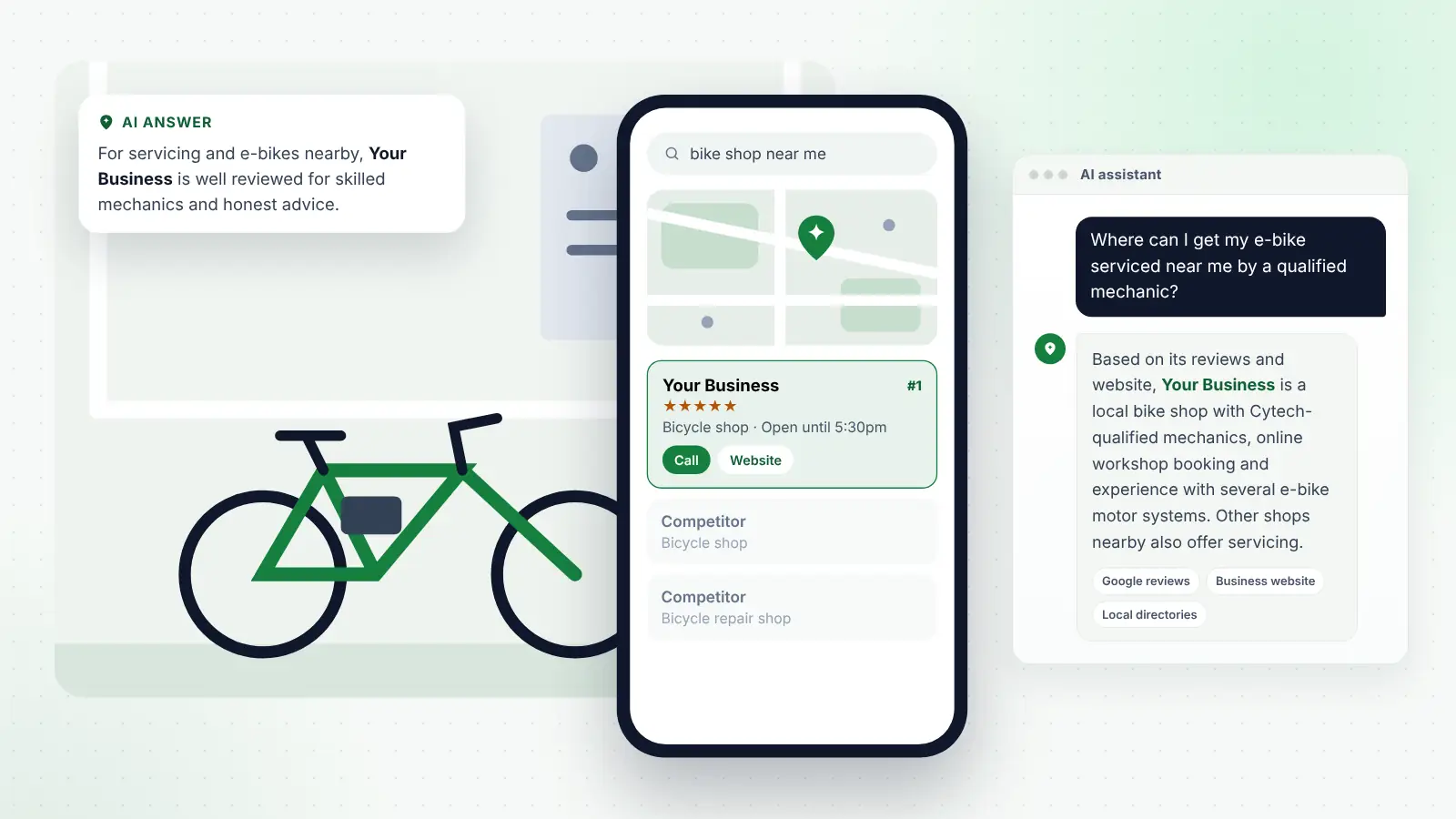
When riders need a repair, a test ride or a fit, they search locally. Typical searches include “bike shop near me”, “bike repair near me”, “e-bike shop near me”, “bike service near me”, “mobile bike mechanic” and “cycle to work bike shop”. The shops at the top of the map for those searches get far more calls and visits.
A bike shop that riders find easily locally usually has these basics in place:
- Google Business Profile. Choose accurate categories (such as bicycle shop and bicycle repair shop), list your services and brands, keep holiday and seasonal hours up to date, add your booking link and post photos of the shop, workshop and events.
- Free local listings and local inventory. Through Google Merchant Center you can show in-stock products on Google for free, so a rider searching for a particular bike, tyre or helmet sees it is available nearby. Your epos supplier may be able to send stock data automatically.
- Reviews. Ask every buyer and workshop customer for a review, and reply to every review calmly.
- Consistent details. Your name, address and phone number should match on your website, brand dealer locators, Cycle to Work retailer lists and directories.
- A useful website. Separate pages for servicing, e-bikes, fitting, Cycle to Work, finance and mobile repairs help riders and search engines. Mobile mechanics should add pages for each area covered.
- Local and industry links. Mentions from clubs, schools, event organisers, local news and cycling websites build authority over time.
Expect the gains to come through over three to six months, so groundwork done in winter pays off by spring. If you would rather have specialists handle it while you run the shop and workshop, a service such as local SEO for bike shops and cycle repair businesses can manage your profile, listings, content and links for you.
AI search: how riders now ask for recommendations
A growing number of riders ask AI assistants as well as searching Google. They type questions such as “Which bike shop near me can service a Bosch e-bike?”, “Where can I get a professional bike fit near Bristol?” or “Which local bike shops accept Cycle to Work?” into ChatGPT, Gemini, Perplexity or Copilot, and Google’s AI Overviews answer similar questions at the top of search results.
These tools build answers from information they can cross-check across the web, so the same signals matter:
- Consistent information. Your shop name, address, workshop hours and services should read identically on every listing and dealer locator.
- Clear service descriptions. Pages that say plainly which brands you sell, which e-bike motor systems you service, which Cycle to Work providers you accept and whether you offer fitting or mobile repairs.
- Reviews with detail. Reviews mentioning specific jobs give AI tools something concrete to summarise.
- FAQs in plain English. Short answers to the questions riders ask, such as how often a bike should be serviced, what the EAPC rules mean or how Cycle to Work vouchers work.
- Mentions on reputable sites. Local news, club and cycling websites add weight.
Every couple of months, ask a few AI assistants about bike shops in your area. Inaccurate answers usually point to inconsistent information somewhere online.
Frequently asked questions
Can I convert a customer’s bike to electric?
Yes, but the finished bike must still meet the EAPC rules to be ridden on the road as a bicycle. Use reputable kits with matched batteries and chargers, and follow the Office for Product Safety and Standards guidance for businesses that carry out conversions.
Do I need FCA authorisation to offer finance on bikes?
Usually, yes. Introducing customers to a lender is generally credit broking, which needs FCA authorisation, either your own or as an appointed representative of an authorised firm. Check with your finance partner and the FCA register before promoting finance.
Is Cycle to Work still worth offering?
For most shops, yes. It brings in riders through their employers and makes better bikes affordable. Compare commission and payment terms, and register with the providers local employers use.
How can a small shop compete with online retailers?
Compete on what they cannot offer: expert servicing, test rides, fitting, quick repairs and local knowledge. Make those easy to find and book online.
Final thoughts
An independent bike shop grows by doing what online sellers cannot: a reliable workshop, honest e-bike advice, safe battery practice and a team that knows its riders. Get the rules right on e-bikes, Cycle to Work and finance, show your qualifications, and keep your information accurate wherever riders search. Start with your workshop menu and Google profile, then build steadily.