Most holiday let owners start on Airbnb, Vrbo or Booking.com for a simple reason: it works. You list the property, guests arrive and the platform handles payment and much of the messaging. But after a season or two, many owners look at what they paid in fees and realise that a noticeable share of their income went to a platform for guests who might happily have booked direct.
The goal for most owners is not to leave the platforms. It is to shift the balance so that your own website becomes the natural place to book, past guests come back to you rather than to an app, and new guests can find you on Google and through AI assistants without a middleman.
This guide is for UK holiday cottage owners, self-catering operators and small letting companies, and is written as things stand on 27 October 2026.
Key points
- Platforms are valuable for reach, but your own website, past guests and local search are where direct bookings are built over time.
- The furnished holiday lettings tax regime was abolished from April 2025, so holiday let profits are now taxed much like other rental income; speak to an accountant about your own position.
- Scotland requires a short-term let licence, Wales requires registration with the Welsh Revenue Authority by 31 March 2027, and England’s national register is expected to start in 2027.
- Google does not normally allow a Business Profile for an individual holiday home, so your website, directories and the platforms that feed Google’s vacation rental results carry more of the load.
- A clear niche, such as genuinely dog-friendly cottages or houses for large groups, makes you easier to choose and easier for AI assistants to recommend.
In this guide
- Work out what each booking really costs
- Make booking direct easy and trustworthy
- How the tax and rules have changed
- Choose a niche guests can remember
- Turn platform guests into direct guests next time
- Work with your local area
- Local SEO: being the cottage guests can book direct
- AI search: what assistants say when guests ask where to stay
- Fill the quieter weeks
- Frequently asked questions
- Next steps
Work out what each booking really costs
Commission is the obvious cost of a platform booking, but direct bookings are not free either. Pull a year of bookings and compare channels honestly.
| Channel | Costs to include | What to look for |
|---|---|---|
| Airbnb, Vrbo, Booking.com | Host fees or commission, any guest fees that make you look more expensive | Cancellation rates, guests who rebook direct later |
| Cottage agencies | Commission, which is often higher, sometimes a joining or photography fee | Marketing reach, changeover support, contract length |
| Your own website | Booking software, card processing, hosting and upkeep | Visitors who check availability but do not book |
| Past guests and referrals | Email software, a small welcome gift | Keeping guest details accurate and permission-based |
For most owners, leaving the platforms is not the answer yet. Keep them for reach and last-minute gaps while building the direct channel season by season. Read your platform terms before making changes, particularly anything about contacting guests or promoting your own website through platform messaging, which most platforms restrict.
Make booking direct easy and trustworthy
Many guests who find your cottage on a platform will search for its name to see if it has its own website. What they find decides whether they book with you.
What a good direct booking page needs
- Live availability and prices for each property, without needing to email you first.
- The full price shown early. Since April 2025, the Digital Markets, Competition and Consumers Act 2024 has required headline prices to include any unavoidable charges, so a mandatory cleaning fee belongs in the price guests see first, not at the last step.
- Clear sleeping arrangements: bedrooms, which beds are doubles, twins or bunks, and whether any bedroom is downstairs.
- Honest, recent photos of every room, the garden, the parking and the view.
- Secure online payment, an instant confirmation email and clear cancellation terms next to the price.
- Practical details: check-in times, parking, Wi-Fi, phone signal and any steps or steep access.
A phone number, a real name, a postal address and recent reviews from other platforms help guests trust a business they have not met. You do not need to undercut the platforms: small, genuine benefits such as a welcome hamper or flexible arrival days often work better. Check your platform contracts before advertising a lower price elsewhere.
Tip
Search for your own cottage by name on a phone. If the first result is a platform listing rather than your website, your direct booking journey has a gap that is worth fixing first.
How the tax and rules have changed
The rules differ between England, Scotland and Wales. Always check the current position for your property with your council and an accountant.
The end of the furnished holiday lettings tax regime
The special tax treatment for furnished holiday lettings was abolished from 6 April 2025 for income tax and capital gains tax, and from 1 April 2025 for corporation tax. In broad terms, holiday let profits are now treated like other residential property income. Mortgage interest relief is given as a basic rate tax credit rather than a full deduction, capital allowances on new furniture and equipment are no longer available (existing pools can continue), profits no longer count as relevant earnings for pension contributions, and the business capital gains reliefs that once applied no longer do.
The effect depends on how the property is owned and financed, so talk to an accountant before you set next year’s prices.
Business rates and council tax
In England, a self-catering property is generally assessed for business rates if it was available to let for at least 140 nights and actually let for at least 70 nights in the last 12 months, and you plan to make it available for at least 140 nights in the coming year. In Wales the thresholds are 252 nights available and 182 nights let, and Welsh councils can charge council tax premiums on properties that do not qualify. The government’s guide to business rates for self-catering property sets out the current tests.
Scotland: short-term let licensing and visitor levies
In Scotland, short-term lets need a licence from the local council, and every host must now have one before accepting bookings and receiving guests. Operating without one is a criminal offence. Mandatory licence conditions are mainly about safety, but they also require your licence number, and your EPC energy rating where the property needs an EPC, to appear on adverts and listings. Councils can add their own conditions, and in short-term let control areas planning permission may also be needed. The Scottish Government’s guidance for hosts explains the scheme.
Scotland also has visitor levies set by individual councils. Edinburgh’s 5% levy applies to stays from 24 July 2026, Glasgow’s 5% levy applies to stays from 25 January 2027, and other councils, including Aberdeen and Stirling, have approved schemes starting in 2027. Check whether your council has a scheme and how it applies to bookings already taken.
Wales: the visitor accommodation register and levy
Anyone in Wales responsible for visitor accommodation that takes bookings of 31 nights or less, including self-catering lets, must register with the Welsh Revenue Authority. Registration is free, opened in autumn 2026 and must be completed by 31 March 2027, even if your council does not introduce a levy. The Welsh Government’s registration overview explains who needs to register.
Welsh councils can also choose to introduce a visitor levy after consultation, and Cardiff has already done so for stays from 1 April 2027. The rates set in the law are £1.30 per person per night for most accommodation, including self-catering, and 75p for shared hostel rooms and campsite pitches. Check your own council’s position before quoting prices for future years.
England: a national register on the way
England does not yet have a national registration scheme for holiday lets. The legal framework sits in the Levelling-up and Regeneration Act 2023, and the government currently expects the register to start in March 2027. Details of what owners will need to provide are still being finalised, so watch for government announcements and keep your safety certificates, insurance and records in order now.
Tip
Keep your licence or registration numbers, safety certificates and insurance details in one place. Clear, verifiable information reassures guests and platforms, and saves time when new requirements arrive.
Choose a niche guests can remember
Thousands of cottages describe themselves as cosy and well located. Guests and AI assistants find it much easier to recommend a property that is clearly right for a particular kind of stay.
Pet-friendly done properly
Dog owners are a loyal market, and many struggle to find properties that are genuinely suitable. If you welcome dogs, be specific:
- How many dogs you accept, any size limits and any charge per dog.
- Whether the garden is fully enclosed, how high the fencing is and whether gates close securely.
- Which rooms dogs can use, and practical extras such as an outdoor tap, towels and a list of local vets.
- Nearby dog-friendly beaches, walks and pubs, with any seasonal beach restrictions.
Other niches that work
- Large groups and celebrations: houses that sleep ten or more, with a big dining table and enough bathrooms.
- Accessible stays: step-free access, ground-floor bedrooms and wet rooms, described with measurements.
- Walkers, cyclists and remote workers: drying rooms, secure storage, routes from the door and reliable broadband.
Pick the one or two that genuinely fit each property and make them obvious everywhere guests look.
Turn platform guests into direct guests next time
Your past guests are the cheapest source of future bookings. Guests who enjoyed their stay often look for you directly next time.
- Make your property name memorable and use the same name everywhere, including on signage and the welcome book.
- Put your website in the welcome book, where platform rules allow.
- Ask permission to stay in touch, for example through a sign-up on your own website, and keep a record of that consent.
- Send a few useful emails a year, such as next summer’s availability or an autumn short break, rather than constant offers.
Work with your local area
Owners who are part of their local community get bookings that platform strangers never see. Useful partners include wedding venues, local pubs and activity providers, event organisers, your tourism association and businesses that host visiting contractors outside peak season. These relationships also create local mentions and links that help with search.
Local SEO: being the cottage guests can book direct
Local search works differently for holiday lets than for most businesses. Guests usually search for an area and a type of stay, such as “holiday cottages in the Peak District”, “dog friendly cottage Northumberland coast” or “cottage with hot tub near Keswick”. Platforms and large agencies dominate many of those results, so independent owners need to be precise about where they can realistically appear.
If you would rather have specialists handle the work while you run your properties, our SEO for holiday lets and holiday cottages service covers the profile, listings, content and links described below.
Google Business Profile and its limits
Google’s Business Profile guidelines treat rental properties such as holiday homes as ineligible, because a profile requires in-person contact with customers during stated hours. A single cottage with self check-in usually cannot have its own profile, and creating one anyway risks suspension. A letting company with an office that guests or owners can visit is normally eligible, and that profile is worth optimising with the right category, accurate hours, photos and links to your property pages.
Google’s vacation rental results
Google also shows holiday homes in its own vacation rental results, with prices and availability. These come from booking platforms and from professional property management companies connected through approved connectivity providers. Individual homeowners are not currently eligible to list themselves, so a single cottage usually appears through the platforms it is listed on. If you run a letting company, ask whether your software provider is a Google connectivity partner that can send your listings with a link to your own booking page. Listing is free.
Reviews, consistent details and your website
Reviews on Airbnb, Vrbo and Booking.com stay on those platforms, so ask direct guests to review you on a tourism directory, an independent review site or your letting office’s Google profile if you have one. Make sure your property names, addresses, phone number and website are identical across tourism boards, cottage directories and local listings.
Your website is the one place you control completely. Give each property its own page with sleeping arrangements, pet policy, accessibility details, prices, availability and photos. Add area pages that answer real questions, such as the best dog-friendly beaches. Mentions and links from your tourism association, event organisers and local news sites, earned through the partnerships above, tell search engines you are a genuine part of the area.
AI search: what assistants say when guests ask where to stay
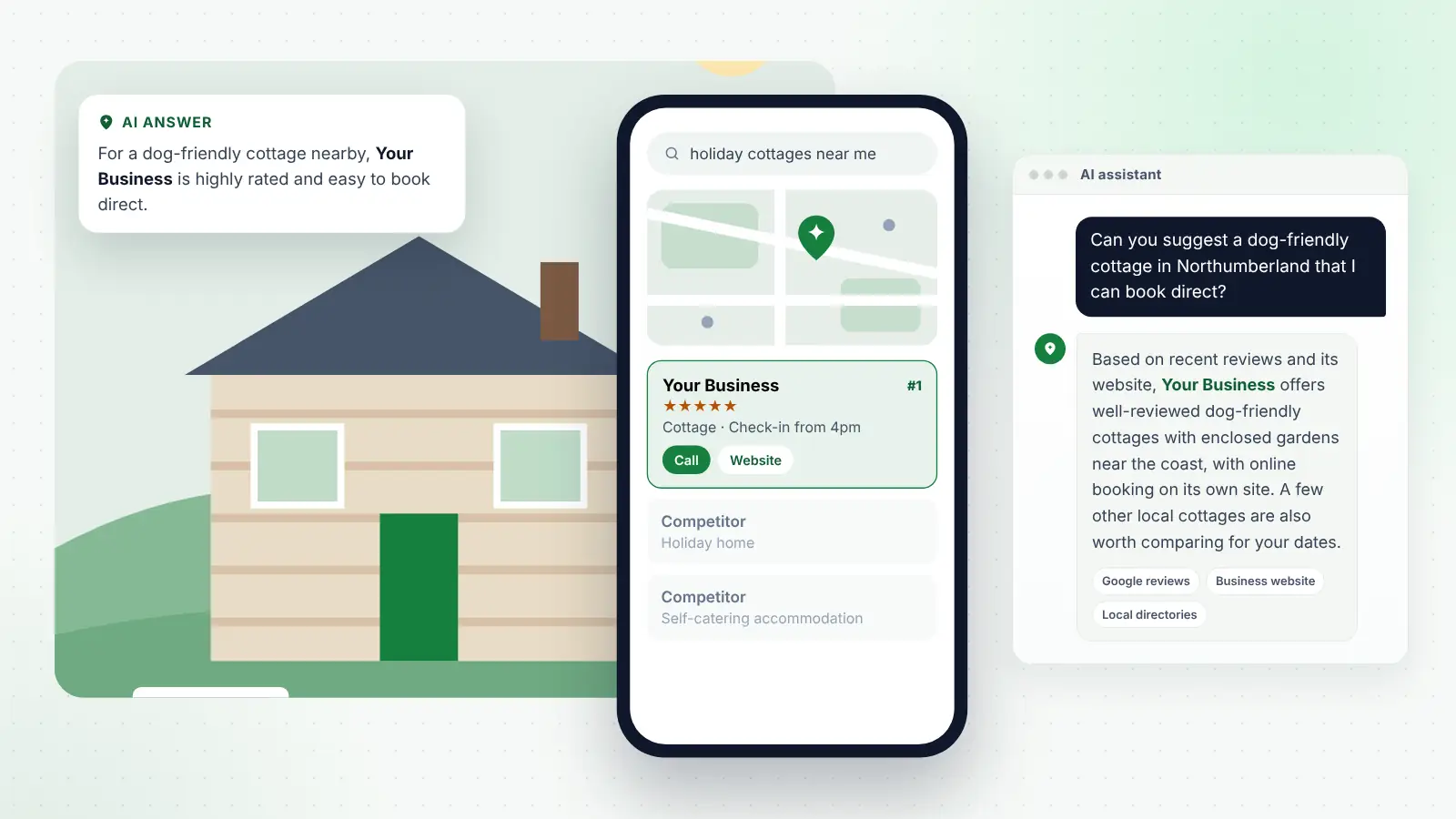
More guests now ask ChatGPT, Gemini, Perplexity, Copilot and Google’s AI Overviews to help plan a holiday. The questions are detailed and conversational, for example:
- “Find a dog-friendly cottage near the Northumberland coast with an enclosed garden.”
- “Which holiday houses in the Lake District sleep 12 and have a hot tub?”
- “Is there a self-catering cottage in Pembrokeshire with a ground-floor bedroom?”
When a guest asks a chatbot for a cottage shortlist, it relies on property details it can find and cross-check online. For holiday lets, that usually means:
- Clear property pages that state facts plainly, such as “sleeps 6 in 3 bedrooms” or “up to two dogs, fully enclosed garden”.
- Consistent details across your website, tourism boards, directories and platforms.
- Reviews that mention the things people ask about, such as the garden, the location or how welcoming you are to dogs.
- Helpful FAQs about parking, changeover days, accessibility and cancellation terms.
- Mentions on reputable local and travel sites, such as tourism associations and walking guides.
You cannot control what an AI assistant says, and visibility builds gradually over months, but clear and consistent information makes accurate recommendations more likely.
Tip
Ask an AI assistant to recommend a cottage like yours in your area, then check what it says about your property. If details are wrong or missing, update your website and listings so the correct information is easy to find.
Fill the quieter weeks
With higher tax costs for many owners and occupancy tests for business rates, empty weeks matter more than they used to. Offer three- and four-night breaks outside the school holidays with flexible arrival days, promote seasonal reasons to visit such as autumn walks and winter stargazing, email past guests first when gaps appear, and review minimum stays that may be blocking bookings.
Frequently asked questions
Can I create a Google Business Profile for my holiday cottage?
Usually not. Google’s guidelines list rental properties such as holiday homes as ineligible, because a profile needs in-person contact with customers during stated hours. A letting company with an office that customers can visit is normally eligible. For individual cottages, focus on your website, the platforms that feed Google’s vacation rental results, and tourism directories.
Does the end of the furnished holiday lettings regime affect my pricing?
It may. Since April 2025, holiday let profits are taxed much like other rental income, which reduces mortgage interest relief for many owners. Ask an accountant how it affects your net income per booking.
Do I need to register my holiday let?
It depends where it is. In Scotland, you need a short-term let licence from your council. In Wales, you must register with the Welsh Revenue Authority by 31 March 2027. In England, a national register is expected to start in 2027, with details still to be confirmed. Check your council’s website for local rules, including planning.
Is it worth having my own website if I only have one cottage?
In most cases, yes. A simple site with live availability and secure booking gives returning guests somewhere to book direct and protects you if a platform changes its fees or rules.
How should I show cleaning fees on my website?
Include any compulsory charge, such as a mandatory cleaning fee, in the headline price guests see first. Optional extras, such as a dog charge or a late checkout, should be clearly offered rather than added automatically.
Next steps
Work out what each channel really costs, make your booking page clear and complete, and check the licensing, registration and tax rules for your part of the UK. Then choose the niche each property genuinely suits, describe it consistently and stay in touch with guests who loved their stay. Direct bookings rarely arrive all at once, but steady work on these foundations usually brings a larger share of each season to you first.