Tiling is one of the most visible trades in a home. A bathroom, kitchen or hallway floor is looked at every day, and customers notice uneven grout lines, lipping between tiles or a cracked corner for years. That is exactly why good tilers are in demand: homeowners and other trades will wait for someone they trust to do it properly.
Starting a tiling business can be relatively low cost, but the work has changed. Tiles are larger and heavier, wet rooms and underfloor heating are common and outdoor porcelain is a standard patio choice, each with standards to follow.
This guide covers the practical steps to starting a tiling business in the UK: choosing the work you want, the standards and rules that matter, how to quote, whether to supply tiles, how to work with other trades and how to make sure customers can find you when they search.
Key points
- Decide early whether you will mainly work direct for homeowners, subcontract for bathroom fitters and builders, or build a specialism such as wet rooms or large-format porcelain.
- BS 5385 is the British Standard code of practice for wall and floor tiling, and working to it protects both your customers and your reputation.
- Wet rooms need a complete, compatible tanking system installed and tested before tiling, not just waterproof adhesive and grout.
- Electric underfloor heating in a bathroom usually involves notifiable electrical work, so connecting it is a job for a registered electrician.
- Quote clearly per square metre, and spell out what is included, from preparation and tanking to trims, wastage and removal of old tiles.
- Strong photos of finished work, detailed reviews and a well-maintained Google profile help you win better jobs locally and in AI recommendations.
In this guide
- Decide what kind of tiling business you want to run
- Training, skills and credentials
- Work to BS 5385
- Wet rooms and tanking
- Underfloor heating and Part P
- Setting up the business
- How to quote per square metre
- Supply and fit versus labour only
- Working with bathroom fitters and other trades
- Photograph every finished floor and wall
- Local SEO for tilers
- How AI assistants choose a tiler
- Frequently asked questions
- Final thoughts
Decide what kind of tiling business you want to run
Most tilers do a mix of work, but the balance you choose shapes your income, your diary and how you market yourself.
Direct work for homeowners
Bathrooms, en suites, splashbacks and kitchen or hallway floors make up most domestic tiling. Working direct usually pays better and every happy customer can leave a review, but you spend more time on quotes, site visits and customer questions.
Subcontracting for other trades
Bathroom fitters, kitchen fitters and builders often need a reliable tiler for their programme. This can keep your diary full with little marketing, but the main contractor usually sets the rate and the timescale.
Specialisms worth building
- Wet rooms and walk-in showers, which need tanking skills and careful falls to the drain.
- Large-format porcelain, where big, heavy tiles need flat substrates, levelling systems and specialist handling and cutting equipment.
- Outdoor porcelain paving, which uses different bedding methods from internal tiling and overlaps with landscaping.
Specialisms tend to command better rates and give you something specific to promote online.
Training, skills and credentials
There is no legal licence needed to work as a tiler in the UK, but customers and contractors increasingly expect evidence that you know the trade.
- Formal training. An NVQ or apprenticeship in wall and floor tiling is the most recognised route. Short courses work best alongside time with an experienced tiler.
- A CSCS card. Most construction sites will expect one.
- Manufacturer training on tanking, adhesive and underfloor heating systems, as many guarantees depend on correct installation.
- Membership of The Tile Association. The Tile Association (TTA) is the main trade body for the UK tiling industry. It has categories for independent tile fixers and larger contractors, and its membership criteria for tile fixers include a period of trading, project references, public and employers’ liability insurance and agreeing to follow its code of practice.
Membership will not win work on its own, but it shows you take standards seriously, and the TTA’s technical guidance is useful on complex jobs.
Work to BS 5385
BS 5385 is the British Standard code of practice for wall and floor tiling. It is published in several parts, covering internal walls, external walls, floors and tiling in specific conditions. It is not a law in itself, but it is the benchmark that manufacturers, trade bodies and anyone assessing a dispute will use to judge whether a job was done properly.
The areas where tilers most often fall short include:
- The background. Check the substrate is sound, dry, flat and strong enough for the weight of the tiles, particularly with large-format porcelain or stone on walls.
- Drying times. New screeds and plaster need time to dry before tiling.
- Adhesive coverage. Floor tiles and tiles in wet areas need solid bed coverage, with no hollow spots that can crack under load or trap water.
- Movement joints. Larger areas, junctions between materials and floors with underfloor heating need movement joints in the right places.
- Flatness and lippage. Bigger tiles show every imperfection in the surface below.
Tip
Keep a short record of each job: the substrate, primers, adhesive, grout and any tanking or heating products used, with batch numbers and photos. If a problem appears later, a record of what you used and how makes it far easier to resolve fairly.
Wet rooms and tanking
Wet rooms and level-access showers pay well, but they are also where water damage claims come from. Tiles and grout are not waterproof on their own, so a wet room relies on a waterproofing layer behind the tiles, usually called tanking.
What a properly tanked wet room needs
- A suitable former or screed with falls so that water runs to the drain rather than pooling.
- A drain compatible with the tanking system, with a proper seal between the membrane and the drain body.
- A complete tanking system, either a liquid membrane, a sheet membrane or waterproof boards, with matching tapes, corner pieces and pipe collars.
- Correct coverage of the floor and walls, with extra attention at corners and pipes.
- Curing and testing. Allow the membrane to cure, then test before tiling where the manufacturer recommends it.
Use one manufacturer’s system throughout where possible, as mixing brands can void guarantees.
A new wet room can also involve drainage, ventilation or structural changes that need building regulations approval, so agree who is responsible before you start.
Underfloor heating and Part P
Electric underfloor heating mats are often laid by tilers and make a good add-on service. The electrical connection is a different matter.
In England, the Building Regulations make certain domestic electrical work notifiable under Part P. The Planning Portal’s guide to electrical work explains that installing a new circuit, replacing a consumer unit, and work in special locations, which in England means the spaces around baths and showers, are notifiable. Notifiable work should be carried out by an electrician registered with a competent person scheme, or inspected and certified by building control. Rules differ in Wales, Scotland and Northern Ireland.
In practice, most tilers handle underfloor heating like this:
- Lay the mat or cable to the manufacturer’s instructions and test its resistance before, during and after tiling.
- Leave the electrical connection, thermostat wiring and certification to a registered electrician.
A good relationship with a local electrician lets you offer a complete service without taking on work you are not qualified to do.
Setting up the business
Structure, tax and registration
Most tilers start as sole traders, registering with HMRC for self assessment, and some move to a limited company as they grow. If you work as a subcontractor for builders or bathroom fitters, register for the Construction Industry Scheme (CIS). Registered subcontractors have a lower deduction taken from payments than unregistered ones.
Insurance and waste
Public liability insurance is essential, and employers’ liability is required if you take on staff. Tool cover is worth considering, as vans are often targeted. If you take old tiles, boards and packaging away, you will usually need to register as a waste carrier and use licensed disposal.
Health and safety
Cutting porcelain, ceramic and stone tiles can produce silica dust, which HSE warns can cause serious lung disease. Use wet cutting or on-tool extraction where you can, wear suitable respiratory protection and clean up with a vacuum rather than by sweeping. Knee protection and safe lifting techniques matter too, especially with large-format tiles.
Typical startup costs
| Item | Typical cost | Notes |
|---|---|---|
| Hand tools, trowels, levels and mixers | £500–£1,500 | Quality tools last and improve finish |
| Tile cutters and wet saw | £300–£1,500 | Large-format cutters and grinders cost more |
| Levelling system and suction lifters | £100–£400 | Useful for large-format porcelain |
| Dust extraction and RPE | £200–£800 | Depends on equipment chosen |
| Van | £6,000–£20,000 | A used van is fine to start |
| Insurance | A few hundred pounds a year | Varies with cover and turnover |
| Training and courses | £0–£3,000 | Many manufacturer courses are low cost |
These are rough guides only. Costs vary by supplier, location and how much equipment you already own.
How to quote per square metre
Most domestic tiling is priced per square metre, sometimes with a day rate for preparation. Two quotes at the same rate can describe very different jobs.
A clear quote should state:
- The measured area for walls and floors, and the tile sizes and layout assumed.
- Whether removing old tiles, making good walls or levelling floors is included.
- Any tanking, backer boards, underfloor heating or decoupling membranes.
- Trims, silicone, grout type and any sealing for natural stone.
- An allowance for cuts and wastage, which rises with large tiles, herringbone and diagonal layouts.
- Who supplies materials and how extras will be priced if hidden problems appear.
Charge more for mosaics, complex patterns and large-format tiles that need extra handling, and consider a minimum charge for small jobs. Rates vary widely by region, so check what established local tilers charge.
Tip
Visit before quoting for anything bigger than a splashback. Checking the walls and floor in person is the only reliable way to price preparation, and it shows the customer you are thorough.
Supply and fit versus labour only
Both models are common, and many tilers offer either depending on the customer.
| Supply and fit | Labour only | |
|---|---|---|
| Who buys tiles | You, often through a trade account | The customer |
| Margin | Fitting plus a margin on materials | Fitting only |
| Control over quality | High: you choose suitable products | Lower: you work with what arrives |
| Main risks | Ordering errors, returns, cash flow | Wrong quantities, unsuitable tiles, delays |
| Best for | Full bathrooms, wet rooms, systems with guarantees | Customers who have chosen tiles already |
Even on labour-only jobs, it is usually best to supply the adhesive, grout and tanking yourself so you know the products are compatible. Agree in writing who orders enough tiles, as running short of a batch can hold up a job for weeks.
Working with bathroom fitters and other trades
Bathroom and kitchen fitters are often the biggest source of steady work for tilers, and builders, plumbers and tile showrooms can send work your way too.
What fitters value most is reliability: arriving on the day planned, working cleanly around new sanitaryware and leaving their customer happy. A few habits help:
- Agree who is responsible for tanking, boarding and silicone before the job starts.
- Confirm the order of work, such as when the shower tray or bath goes in relative to the tiling.
- Flag problems early, such as walls out of square or floors that need levelling.
- Photograph your work on each job, with the fitter’s agreement, so you can use it in your portfolio.
Recommend good fitters back when your direct customers need a bathroom installed. Referrals that flow both ways tend to last longer.
Photograph every finished floor and wall
Customers choose tilers largely on photos, so a strong portfolio matters.
- Shoot finished rooms in good light, with the room cleared and wiped down.
- Include close-ups of corners, cuts around pipes, mitred edges and grout lines, because this is where quality shows.
- Record the hidden work. Photos of tanking, levelling and underfloor heating mats reassure customers that you do the parts they will never see.
Use them on your website, Google profile and social media, and add new ones regularly.
Local SEO for tilers
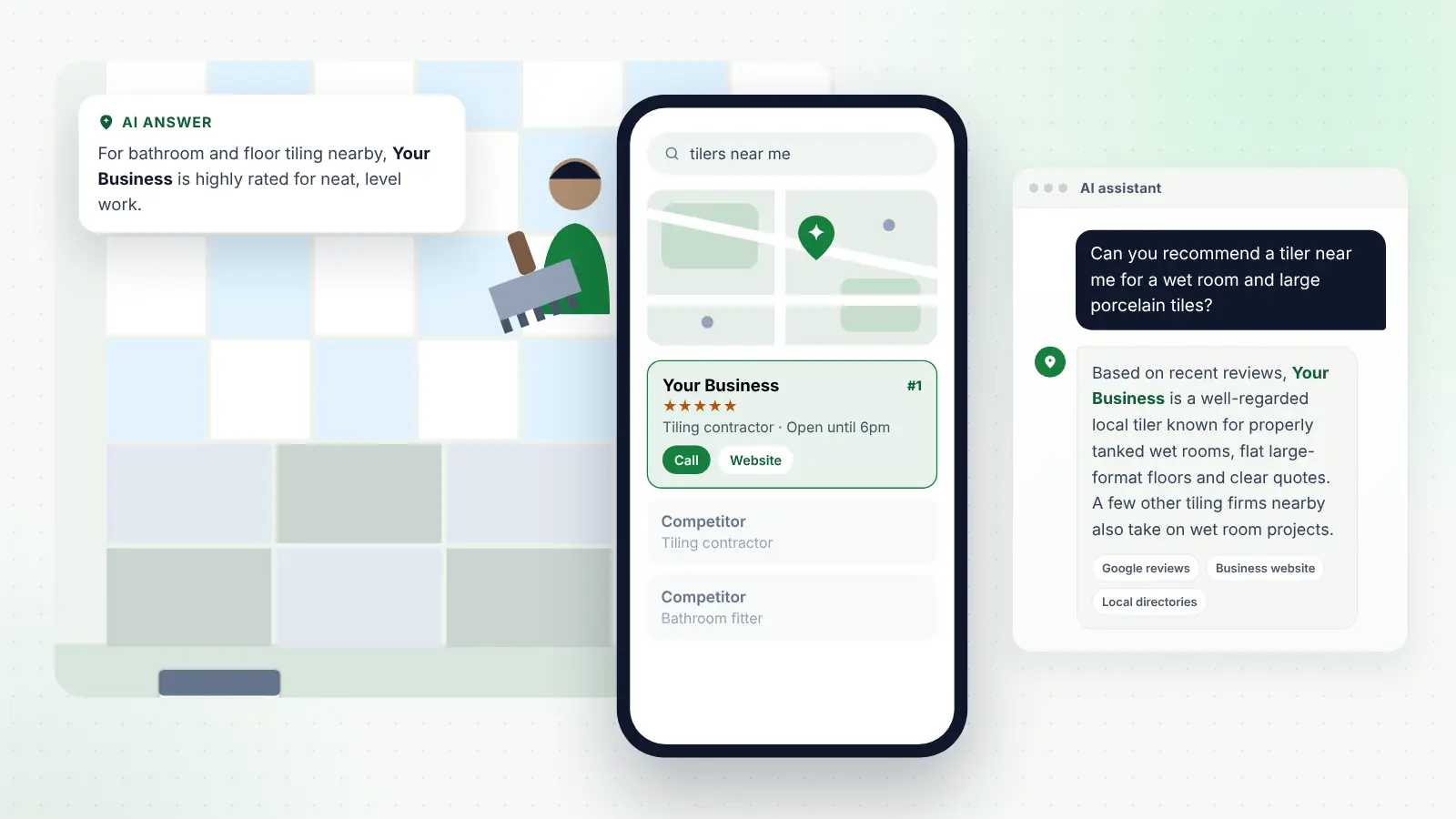
When someone needs a tiler, they usually search on Google or Google Maps with phrases such as “tilers near me”, “bathroom tiler in [town]”, “wet room installers near me” or “large format porcelain tiler”. The businesses in the map results get a large share of those enquiries, and your Google Business Profile is what decides whether you appear there.
To build strong local visibility:
- Fill in every section of your Google Business Profile. Choose an accurate primary category, add every service you offer, set your service areas and upload real project photos regularly.
- Collect detailed reviews. Ask every happy customer, and encourage them to mention the work, such as “wet room” or “kitchen floor”, and the town. Respond to each one, unhappy customers included, in a calm and constructive way.
- Keep your details consistent across Google, Bing, Apple Maps and trade directories.
- Build a website with service and area pages for bathroom tiling, floors, wet rooms and outdoor porcelain, each with photos, guide prices and FAQs.
- Earn local links from suppliers, tile showrooms, trade partners, community groups and local news.
Expect the bigger gains to take three to six months, depending on how many tilers compete near you. If you would rather concentrate on tiling, you can have specialists in local SEO for tilers and tiling firms manage your profile, listings and content for you.
How AI assistants choose a tiler
More homeowners now ask AI assistants for recommendations rather than typing a short search. They might ask ChatGPT “who is a good tiler near me for a wet room?”, ask Gemini “how much does it cost to tile a bathroom floor?”, or use Perplexity, Copilot or Google AI Overviews to compare local options. These tools often give a short answer naming a few businesses.
They draw on information found across the web and are more likely to mention businesses that have:
- Consistent information about the business, its services and its area on its website and listings.
- Plenty of genuine reviews that describe the work done and the customer’s experience.
- Clear service descriptions, such as “tanked wet rooms” or “large-format porcelain floors”, rather than vague claims.
- Helpful FAQs answering real customer questions about costs, preparation, drying times and aftercare.
- Mentions on reputable sites, such as trade associations, local news, supplier case studies and community websites.
Customers often ask detailed questions before choosing a tiler, so a business that explains how it tanks a wet room or what a square metre price includes is more likely to be cited.
Frequently asked questions
Do I need qualifications to start a tiling business?
There is no legal requirement for a specific qualification to work as a tiler in the UK. However, an NVQ or apprenticeship in wall and floor tiling, a CSCS card for site work and manufacturer training for tanking and underfloor heating will make it easier to win work and protect you if a job is ever disputed.
Should I join The Tile Association?
Membership is voluntary, but it gives you technical guidance and shows you work to recognised standards. Independent fixers are asked for references, insurance and a trading history.
Can I connect electric underfloor heating myself?
Only if you are qualified to do electrical work. In England, adding a new circuit or working around a bath or shower is notifiable under Part P, so it is normally best left to an electrician registered with a competent person scheme.
How do I avoid problems with large-format tiles?
Check the substrate is flat and strong enough before quoting, use full adhesive coverage and levelling systems, plan movement joints and price for the extra handling time.
Final thoughts
A successful tiling business is built on careful preparation and honest quoting. Work to BS 5385, get your tanking and underfloor heating right, build strong relationships with fitters and other trades, and photograph everything you do. Combine that with a complete Google profile, steady reviews and clear information online, and you give both customers and AI assistants good reasons to recommend you.