PAT testing is one of the more accessible ways into the electrical compliance market. The training is short, the equipment fits in a car boot, and almost every workplace, school, rental property and event has portable electrical equipment that someone is responsible for keeping safe. Done well, it becomes a business built on repeat visits rather than one-off jobs.
It is also a market with a credibility problem. Some operators still tell customers that PAT testing is a legal requirement every year, and many customers have been sold more testing than they need. The businesses that last tend to be the ones that explain the rules honestly, test competently, leave tidy records and turn up when they said they would.
This guide covers what the law actually requires, the qualification you need, equipment and startup costs, which customers to target, pricing, recurring contracts, and how to use local SEO and AI search to win work in your area.
Key points
- The Electricity at Work Regulations 1989 require electrical equipment to be maintained to prevent danger; HSE is clear that PAT testing itself is not a legal requirement and there is no fixed annual rule.
- The City & Guilds 2377 award, based on the IET Code of Practice for In-service Inspection and Testing of Electrical Equipment (5th edition), is the qualification most clients recognise.
- Testing frequency should be risk-based: a low-risk office needs far less than a construction site or a busy event venue.
- Private landlords in England must have fixed wiring inspected at least every five years, but PAT is not mandatory for them; social landlords now have a separate duty to check equipment they supply.
- The real value is in recurring contracts, reminders and records clients can rely on.
- A strong Google Business Profile, honest content and consistent details online help you appear on Google Maps and in AI recommendations.
In this guide
- What the law says about PAT testing
- The IET Code of Practice and risk-based frequencies
- Being a competent PAT tester
- Kit and launch budget
- Choosing who to sell to
- Landlords: what is and is not required
- Pricing your services
- Building recurring contracts and reminders
- Local SEO for PAT testing businesses
- AI search and PAT testing
- Frequently asked questions
- Next steps
What the law says about PAT testing
Getting this right matters for your clients and your reputation. The Health and Safety Executive’s portable appliance testing FAQs set out the position plainly.
- The duty is maintenance. The Electricity at Work Regulations 1989 require electrical equipment that could cause injury to be maintained in a safe condition. They do not say how that must be done or how often.
- PAT testing is not a legal requirement in itself. It is one way of showing equipment is maintained, alongside user checks and formal visual inspections.
- There is no fixed annual rule. HSE says annual testing is not always necessary in low-risk environments.
- Labels and records are not legally required, although HSE recognises records are useful for managing a maintenance scheme.
- Competence is required. Visual checks can be done by a trained member of staff; combined inspection and testing needs more knowledge and experience.
None of this makes PAT testing pointless. Insurers, landlords, venues, event organisers and public sector buyers often ask for evidence of a maintenance regime, and a competent tester provides exactly that. But build your business on the real reason for testing, which is preventing danger, not on the idea that customers will be prosecuted for missing an annual visit.
Tip
Write a short, honest explanation of the law on your website and send it with quotes. Customers who have been told the truth by you are less likely to be won over by a cheaper tester making scare claims.
The IET Code of Practice and risk-based frequencies
The main industry reference is the IET Code of Practice for In-service Inspection and Testing of Electrical Equipment, currently in its fifth edition. It sets out how equipment should be inspected and tested, how to classify it, and how to decide sensible intervals between checks.
Frequency depends on risk. The factors include:
- The environment. An office or library is very different from a construction site, workshop or commercial kitchen.
- The type of equipment. Hand-held and frequently moved items suffer more damage than stationary ones.
- Who uses it. Equipment used by the public, children or many different people may need checking more often.
- History. Frequent faults on previous visits suggest a shorter interval; consistently good condition may justify a longer one.
A good tester recommends a mix of user checks, formal visual inspections and combined inspection and testing, with intervals set for each category. In a typical office, desktop IT may need far less attention than kettles and extension leads. On a construction site, 110V tools and leads need much more frequent checks. Explaining this at the first visit shows the client you are thinking about their risks, not the number of items you can bill for.
Being a competent PAT tester
There is no legal licence to carry out PAT testing, but the law requires competence and clients increasingly ask for proof of it.
City & Guilds 2377
The City & Guilds 2377 award in the in-service inspection and testing of electrical equipment is the qualification most clients, insurers and facilities managers recognise. Courses based on the fifth edition of the Code of Practice are commonly delivered over two days, followed by an open-book multiple-choice exam and a practical assessment. Providers usually expect candidates to understand electrical systems and the hazards of electricity, and some offer a pre-course self-assessment.
Building wider competence
The certificate is a starting point. You also need practical experience interpreting results rather than just reading pass or fail from the screen, confidence fitting plugs and fuses correctly, and judgement about when an item should be withdrawn rather than repaired.
Know where your work stops. Many PAT businesses later add emergency lighting checks and fixed wire testing, but fixed wire testing requires a much higher level of electrical qualification and experience. Plan it as a separate step or partner with a qualified electrician.
Kit and launch budget
Startup costs are modest compared with most trades. Prices vary by supplier and specification, so treat these as rough guides.
| Item | Rough guide | Notes |
|---|---|---|
| PAT tester | A few hundred pounds to well over £1,000 | Downloadable testers that store results save hours on paperwork |
| Training and assessment | Typically a few hundred pounds | Check the course covers the current Code of Practice |
| Test software | Free to a monthly subscription | Some testers include software; others need a separate package |
| Labels and consumables | Usually modest | Fuses, plugs, pass and fail labels, a label printer |
| Adaptors and leads | Varies | 110V, three-phase and IEC adaptors for site or commercial kit |
| Insurance | Varies by cover and turnover | Public liability and professional indemnity |
Budget for annual calibration of your tester. Clients and auditors may ask to see a current calibration certificate, and it is a simple trust signal to display.
Most testers start as sole traders. Register with HMRC, keep business and personal finances separate from day one, and ask an accountant about structure and VAT as you grow. Public liability insurance is essential, and professional indemnity is worth discussing with a broker because clients rely on your judgement about what is safe to use.
Choosing who to sell to
PAT testing customers have different priorities, and your marketing works better if you decide which ones you want most.
- Offices and small businesses. Steady, low-risk work. They value minimal disruption, early or evening slots and records they can forward to their insurer.
- Schools and nurseries. Larger inventories and a preference for testing during holidays. Many buy through approved supplier lists, so ask how they procure.
- Care homes. Equipment used around vulnerable people, often with tighter internal policies and audits.
- Landlords and letting agents. Furnished lets, HMOs and holiday lets. A reliable relationship with a letting agent can bring a steady stream of properties.
- Events. Short-notice, high-volume testing of stallholder and hired equipment, often required by organisers before anything is plugged in.
- Construction sites and hire companies. Higher-risk 110V tools and frequent retesting. HSE strongly recommends hire equipment is inspected and tested before each hire.
Many successful testers specialise in two or three sectors and become known for them.
Landlords: what is and is not required
Landlords search for PAT testing often, and many are unsure what they need. Being clear with them is good practice and good marketing.
- Fixed wiring in England. Private landlords must have the fixed electrical installation inspected and tested by a qualified person at least every five years, usually with an electrical installation condition report. The government’s guidance for landlords on electrical safety standards explains the rules.
- Portable appliances. These regulations do not require private landlords to PAT test, although landlords should still make sure appliances they supply are safe, and many use PAT records to show that.
- HMOs. Mandatory HMO licence conditions require landlords to keep supplied electrical appliances in a safe condition and to provide a declaration about their safety when the council asks. PAT records are a common way to support that, and some councils add their own conditions.
- Social landlords. The standards have been extended to social housing in England, and social landlords must also check equipment they provide at least every five years. The rules have applied to new social tenancies since 1 December 2025, and first checks on existing tenancies had to be carried out before 1 November 2026.
- Wales, Scotland and Northern Ireland have their own rules, so landlords there should check the guidance for their nation.
Fixed wire testing is electrician territory. If you do not hold the right qualifications, partner with a local electrician and refer work both ways.
Pricing your services
PAT testing is usually priced in one of three ways:
- Per item, with a minimum charge per visit.
- Per visit or half day, for larger sites.
- Annual or multi-year contracts, with an agreed schedule and price for each visit.
Per-item pricing is easy to understand but encourages comparison on price alone. Whatever model you use, be clear about what is included: minor repairs such as plugs and fuses, labelling, the format of records, failure reports, out-of-hours working and travel outside your core area. Rates vary by region, volume and sector. Rather than chasing the lowest price, compete on reliability, ease of booking and the quality of your records.
Tip
Quote a minimum visit charge on every job. It protects you from long drives for three kettles, and most customers accept it when it is explained upfront.
Building recurring contracts and reminders
The most valuable thing a PAT testing business owns is its client list with due dates. Every client is a future visit, provided you manage it well.
- Agree intervals at the first visit. Record the recommended interval for each equipment category and explain why.
- Send reminders early. Contact clients six to eight weeks before their next visit so you can plan routes and they can arrange access.
- Deliver records quickly. Send digital records within a day or two, in a format clients can pass to their insurer or auditor.
- Offer combined visits. Bundling PAT with emergency lighting checks or fixed wire testing, through a partner if needed, makes you harder to replace.
- Plan around seasons. Book schools for holidays, retailers outside peak trading and offices around their quieter months.
Most testing software can generate due-date reports. The aim is that no client ever has to chase you, and none drifts to whoever happens to call first.
Local SEO for PAT testing businesses
When an office manager is told by their insurer to arrange PAT testing, or a landlord needs appliances checked before a new tenancy, they usually search on Google and call the first few businesses that look reliable. Searches such as “PAT testing near me”, “PAT testing for landlords”, “office PAT testing cost” and “PAT testing for events” are typical, and the map results take a large share of those calls.
National compliance firms and lead-generation sites often appear prominently, but local search favours businesses that are genuinely local, well reviewed and clearly described.
A Google profile for test visits
- Choose an accurate primary category and add a service for each type of testing you offer.
- Set a service area that matches where you will actually travel.
- Add real photos of you testing, your equipment and your vehicle.
- Write a description that explains the sectors you serve and how you set retest intervals.
Reviews
Ask every satisfied client for a review soon after you deliver their records. Reviews that mention punctuality, minimal disruption, clear records and helpful advice are the most persuasive. Reply to every review politely, including critical ones.
Matching details on business directories
Keep your business name, service area and phone number identical everywhere: your website, Google, Bing Places, Apple Business Connect, UK directories and trade listings. Inconsistent details make it harder for search engines to trust your information.
Your website and local links
Create a page for each main service, such as offices, schools, landlords and HMOs, events and construction sites, plus pages for the areas you cover with genuinely local detail. Include an honest explanation of the law, your qualification, insurance and calibration, and how to book. Links from chambers of commerce, local business groups, event organisers, letting agents and partner electricians all show you are an established local business.
If you would rather focus on testing while specialists look after this, our local SEO for PAT testing companies covers your profile, listings, content and links on a rolling monthly plan.
AI search and PAT testing
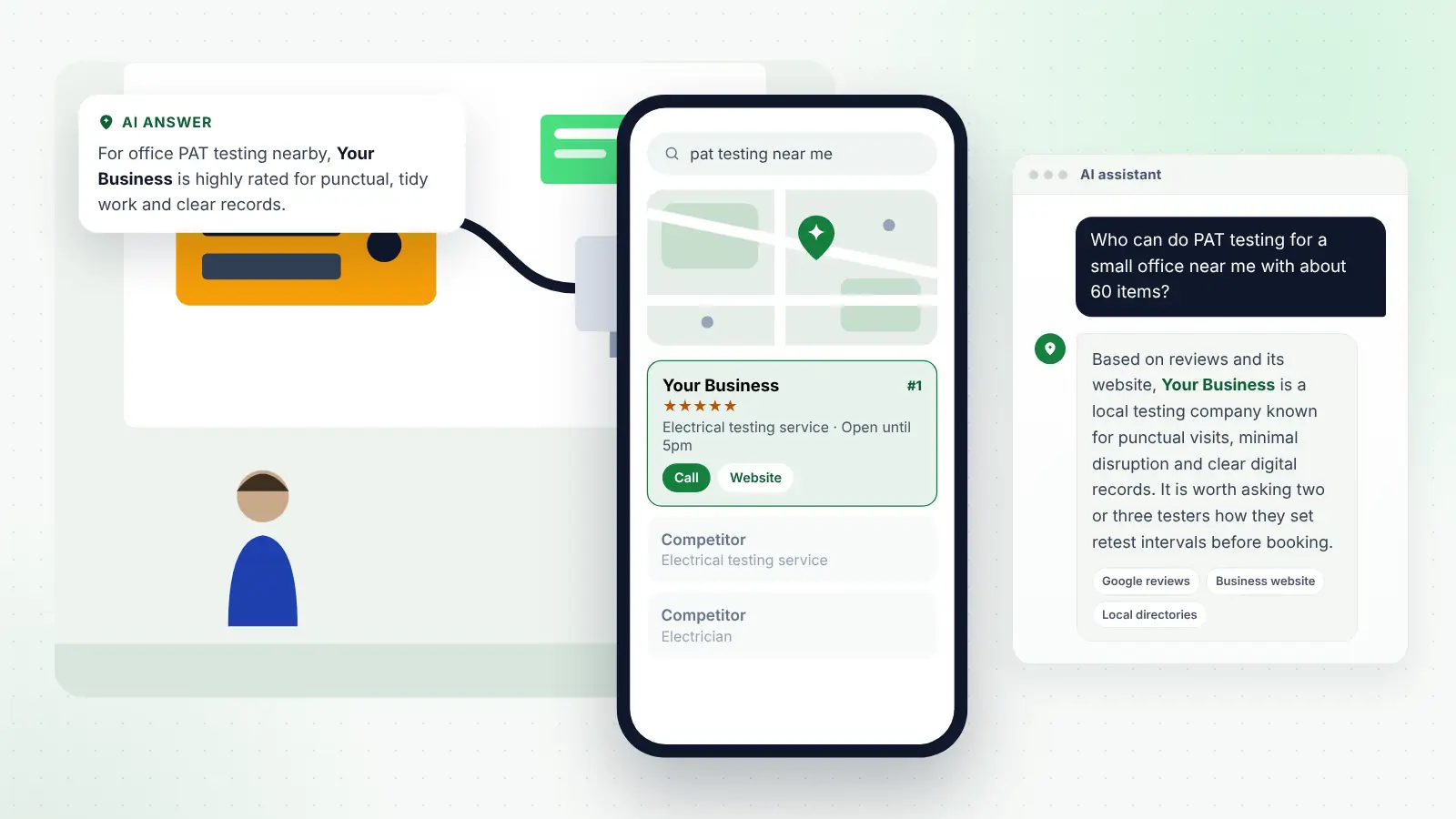
More people now ask AI assistants for recommendations instead of scrolling through search results. ChatGPT, Gemini, Perplexity, Copilot and Google’s AI Overviews are asked questions such as:
- “Who does PAT testing for small offices near me?”
- “Is PAT testing a legal requirement for landlords?”
- “How often does a school need PAT testing?”
- “Can someone PAT test stallholder equipment before our event on Saturday?”
AI assistants build answers from sources they trust:
- Consistent information across the web, so they can be confident about who you are and where you work.
- Reviews from managers saying how smoothly testing went.
- Clear service descriptions that say exactly which sectors and equipment you cover.
- FAQs that answer real questions accurately, such as how frequencies are set or what landlords need.
- Mentions on reputable local and industry sites, such as directories, local news and partner websites.
Accuracy matters more than ever. An AI assistant asked whether annual PAT testing is a legal requirement is likely to draw on HSE’s position. If your website says the opposite, it undermines your credibility with both the tool and the customer.
Tip
Add an FAQ page answering the ten questions clients ask you most, in plain English. Those answers help customers, and they give AI assistants accurate information about your business.
Frequently asked questions
Do I need to be an electrician to start a PAT testing business?
No. There is no legal requirement to be a qualified electrician, but you must be competent. Most testers take the City & Guilds 2377 award and build practical experience, and some electrical background is very helpful.
How often should equipment be tested?
It depends on the equipment, environment and how it is used. The IET Code of Practice supports a risk-based approach, so a low-risk office may need far less frequent testing than a construction site or event venue.
Do landlords need PAT testing?
Private landlords in England must have fixed wiring inspected at least every five years, but PAT testing is not specifically required. HMO landlords must keep supplied appliances safe and declare their safety when asked, and social landlords now have a duty to check equipment they provide.
Can I add emergency lighting and fixed wire testing later?
Yes, and many testers do. They are separate disciplines with their own standards and qualifications, so train properly first or partner with qualified specialists.
Next steps
Get qualified, buy a reliable downloadable tester and decide which two or three sectors you want to serve. Set up a system for records and reminders before your first job, so every client becomes a recurring one.
Then make sure people searching for a tester in your area can find you: a complete Google Business Profile, an honest and clear website, consistent details across the web and a steady flow of reviews. Visibility in local search and AI recommendations usually builds over three to six months.