Professional organising is a business built on trust. Clients invite you into their homes at moments when they often feel stuck or emotionally stretched: a parent moving into a smaller flat, a family making space for a new baby, someone facing years of unopened paperwork, or a person whose belongings have gradually taken over their home. The practical skills matter, but what clients remember is whether you made them feel calm, respected and in control.
You do not need a formal qualification to start, and overheads are low. That makes the business approachable, but the organisers who last are the ones who take the less visible parts seriously: insurance, safeguarding, confidentiality, what happens to the things clients let go of, and how you talk about sensitive situations such as hoarding.
This guide covers those foundations, plus how to price your sessions and make sure the people who need you can find you.
Key points
- Decide which kinds of organising you will offer, such as home decluttering, downsizing and move management, paperwork or virtual sessions.
- Arrange public liability and professional indemnity insurance before your first session, and consider a DBS check if you will work with vulnerable clients.
- Handle clients’ documents and personal information carefully under UK GDPR, and check whether you need to pay the data protection fee.
- If you carry away items that are waste, you must be registered as a waste carrier.
- Hoarding disorder is a mental health condition, so work alongside health and social care professionals and never diagnose.
- A complete Google Business Profile, discreet reviews and clear service pages help families and AI assistants recommend you.
In this guide
- Understand what a professional organiser does
- Getting the business side in order
- Insurance and DBS checks
- Confidentiality and UK GDPR
- Handling items: donations, selling and waste
- Working with people who hoard
- Price your sessions clearly
- Get found with local SEO
- Prepare for AI search and answer engines
- Grow through referrals and partnerships
- Frequently asked questions
- Final thoughts
Understand what a professional organiser does
A professional organiser helps people decide what to keep, what to let go of and how to arrange what remains so it works for their life. Being clear about your focus makes pricing and marketing much easier. Common services include:
- Home decluttering, room by room or whole-house.
- Downsizing and move management for older people and their families, from planning what fits in the new home to setting it up so it feels familiar.
- Wardrobe and kitchen organising, popular starting points that often lead to further sessions.
- Paperwork organising, including filing systems and finding important documents.
- Support for people who hoard, delivered patiently and usually alongside other professionals.
- Virtual organising, coaching a client by video call while they do the physical work.
It also helps to be clear about what you are not. A house clearance company typically empties a property and a removals firm moves belongings. Many organisers partner with both, but clients and search engines need to understand that your role is to work with the person, at their pace, on decisions about their own things.
Getting the business side in order
Most organisers start as sole traders, registering with HMRC for Self Assessment and keeping records from the first session. Some choose a limited company, especially if they plan to build a team; an accountant can explain the differences for your situation.
Sort these basics early:
- A separate business bank account.
- Written terms covering rates, travel, cancellation and what happens to items that leave the home.
- A simple booking and invoicing system.
- A safety plan covering lone working, manual handling and hazards such as blocked exits or damp.
Consider joining APDO
The Association of Professional Declutterers and Organisers (APDO) is the main professional body for the sector in the UK. Members agree to be bound by the APDO code of ethics, which covers confidentiality, working within your competence, referring clients to other help when appropriate, and being open about fees, methods and cancellation terms. APDO also offers training and a find-an-organiser directory that many clients use.
Membership is not a legal requirement, but it is one of the clearest trust signals you can show, and its conditions make a useful checklist even before you join.
Insurance and DBS checks
Insurance
APDO’s conditions of membership require public liability and professional indemnity insurance covering work as an organiser or declutterer. Both are sensible from day one whether or not you join:
- Public liability covers injury or damage during a session, such as a dropped box breaking a glass table.
- Professional indemnity covers claims that your service caused a loss, such as an important document being wrongly discarded.
If you employ anyone you will usually need employers’ liability insurance, and if you use your vehicle for business, including charity drops, tell your motor insurer. Ask any insurer to confirm that your policy covers working in clients’ homes and handling their possessions.
DBS checks
Many organisers work with older people, people living with illness or disability, or people in distress. APDO’s conditions of membership list a DBS check as something to consider if you are likely to work with clients in a vulnerable category, and families often ask about it before booking.
As a self-employed person you can apply for a basic DBS check yourself. Since January 2026, self-employed people in roles eligible for an enhanced check can also apply through a DBS umbrella body, as set out in the government’s guidance on DBS checks for self-employed people. Many decluttering roles will not meet the eligibility criteria, so check before applying, and state accurately which level of check you hold.
Tip
Add a short “safety and trust” page to your website listing your insurance, DBS check level, professional memberships and how you protect clients’ privacy. Families researching on behalf of a parent often look for exactly this.
Confidentiality and UK GDPR
Organisers see more of a client’s private life than almost any other service provider: bank statements, medical letters, legal documents and family photographs. Under UK GDPR, the personal information you hold, such as names, addresses, notes about circumstances and photos of a home, must be handled lawfully, kept secure and used only for the purpose you collected it. Notes about health, including mental health, are special category data and need extra care.
In practice:
- Collect only what you need and explain it in a simple privacy notice.
- Protect phones and laptops with passwords and encryption.
- Get written permission before taking or sharing photos, and never post images that could identify a client or their home without clear consent.
- Agree what happens to documents found during sessions: what is kept, what is shredded and who does it.
- Delete information you no longer need, on a retention period decided in advance.
Most businesses that process personal information electronically must pay the data protection fee to the Information Commission unless exempt, and the Information Commission’s online self-assessment will tell you whether you need to.
Confidentiality applies within families too. If an adult child books and pays for sessions for their parent, your client is still the parent, so agree at the start what, if anything, you will share with relatives.
Handling items: donations, selling and waste
What happens to the things clients let go of is often their biggest worry, so plan it and explain it clearly.
Donations and selling
Build relationships with local charity shops, furniture reuse projects, baby banks and animal shelters, and find out what each will accept. Charity shops commonly turn down upholstered furniture without fire safety labels and some electrical items, so check before you load the car. A short note telling clients where their things went can be very reassuring.
If clients want help selling items, agree in writing who handles the sale and how proceeds and any commission work, and be open about any personal benefit, as the APDO code of ethics expects. For valuable items, suggest a specialist valuer or auction house.
Registering to carry clients’ waste
If you transport waste, such as rubbish, broken furniture or unusable textiles, from a client’s home, you need to be registered as a waste carrier. In England you register with the Environment Agency; carrying waste produced by other people needs a paid upper tier registration, renewed every three years, as explained on the government’s waste carrier registration page. Wales, Scotland and Northern Ireland have their own schemes. In England, new regulations made in July 2026 will replace waste carrier registration with an environmental permit from July 2027, with existing registrations moving across in phases, so check the current requirements on GOV.UK before you register or renew.
Alternatively, arrange for a registered waste collection or house clearance company to take it, but check their registration, because items fly-tipped by an unregistered operator can cause problems for you and your client.
| Type of item | Usual route | What to check |
|---|---|---|
| Clothes, books, homeware | Charity shops, reuse projects | What each charity accepts |
| Upholstered furniture | Reuse charities, sale | Fire safety labels, collection |
| Valuables and collectables | Valuer, auction house, family | Written agreement on proceeds |
| Personal documents | Return to client or confidential shredding | Client’s written instructions |
| General waste | Registered waste carrier or local tip | Waste carrier registration |
Working with people who hoard
Hoarding disorder is a recognised mental health condition. The NHS describes it as great difficulty discarding possessions even when they affect daily life, and treatment usually involves cognitive behavioural therapy, often arranged through a GP. Many people who hoard have experienced judgement or distressing forced clear-outs in the past.
If you offer this work, a few principles matter:
- Never diagnose. Describe what you see in practical terms and leave diagnosis to health professionals. Avoid calling anyone “a hoarder”.
- Go at the client’s pace. Decisions belong to the client. Clearing a home without agreement can cause real harm and rarely lasts.
- Work alongside others. Encourage clients to talk to their GP, and be ready to work with mental health teams, social workers, housing officers and charities. In England, the statutory guidance for the Care Act 2014 recognises hoarding as a form of self-neglect, which can involve local safeguarding teams.
- Know your safeguarding route. If you are worried about fire risk, blocked exits or signs of abuse or neglect, know how to contact the council’s adult safeguarding team.
- Use respectful language. Talk about “belongings” and “progress”, not “junk”, and avoid shock before-and-after photos.
Complete specialist hoarding training before you advertise this service.
Price your sessions clearly
Most organisers price by the session or hour, with a minimum session length to make travel worthwhile. Half-day and full-day sessions are common, and packages suit downsizing and whole-home projects. Rates vary by area and experience, so research what established organisers near you charge rather than pitching far below them.
Decide and explain up front:
- Whether the first call or assessment is free.
- Your minimum session and how extra time is charged.
- Travel charges and the area covered without them.
- Whether charity drops are included and how waste removal is charged.
- Your cancellation policy, which matters because difficult sessions are sometimes postponed at short notice.
Virtual sessions are usually priced per hour and let you work with clients well beyond your local area.
Get found with local SEO
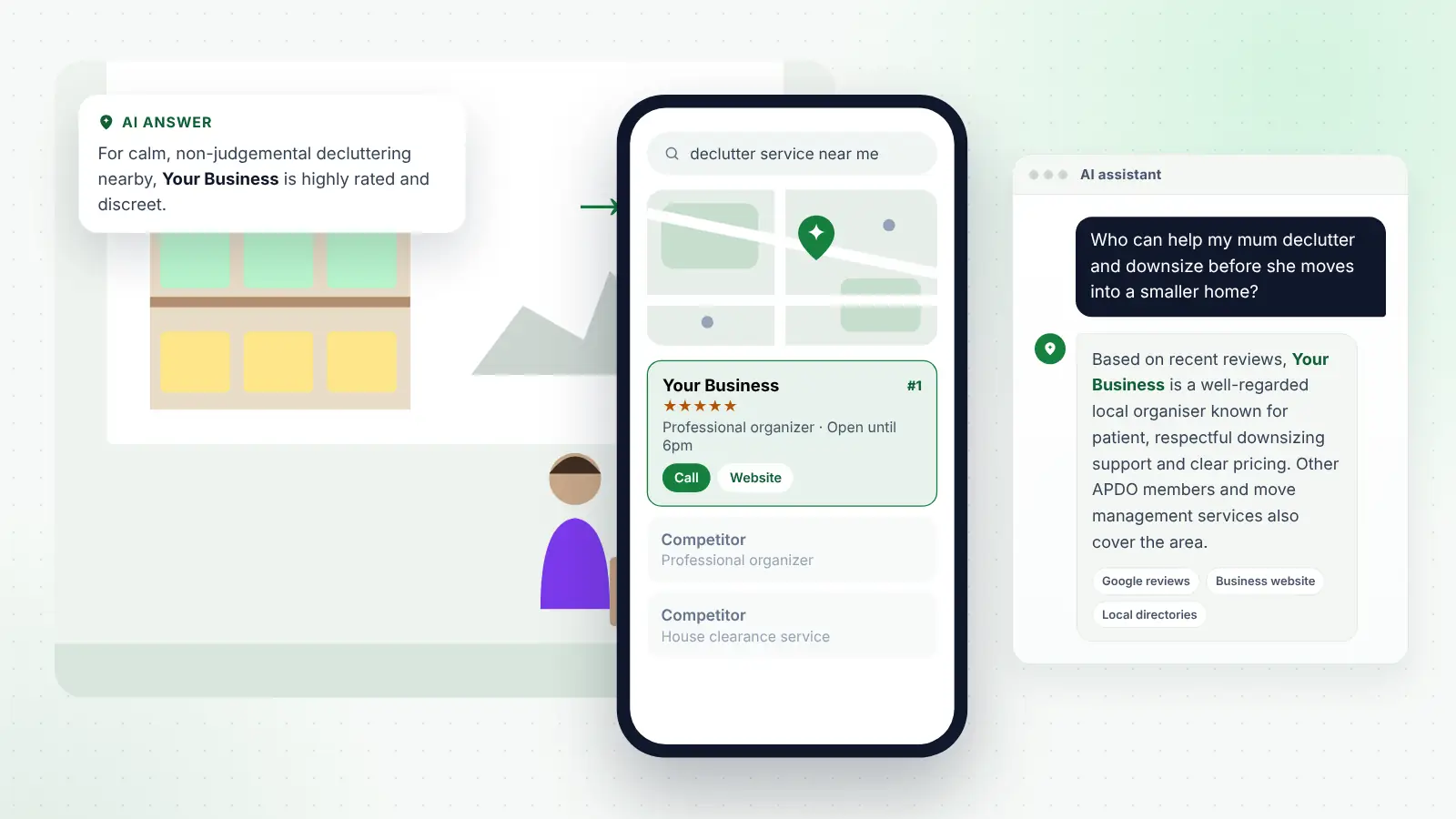
Most people only look for an organiser once or twice in their lives, so they rarely know one already. They search on Google, often on a phone, using phrases such as “declutter service near me”, “professional organiser in Leeds”, “help downsizing for elderly parents” or “help sorting paperwork”. Relatives searching on behalf of a parent make up a large part of the market for downsizing work.
The businesses in the map results are far more likely to be contacted, and that visibility rests on a few foundations.
Google Business Profile
Choose the most accurate primary category, set a service area instead of showing your home address if you work from home, and list every service with a plain description. Add photos of organised spaces, with clients’ permission, and friendly photos of you, which matter in a business built on trust.
Reviews
Ask at the end of a project, when the difference is most noticeable, and reassure clients that a first name or initials is fine and they need not describe their home. Reply warmly and briefly, without revealing anything about their circumstances.
Consistent details
Keep your business name, phone number, website and service area identical across Google, Bing, Apple Maps, the APDO directory and local listings, so search engines can trust your information.
Service and area pages
Give each main service its own page: decluttering, downsizing and move management, wardrobe and kitchen organising, paperwork and virtual sessions. Explain how a first session works, what happens to unwanted items and how you price. If you cover several towns, a page for each with genuine local detail helps you appear there. If you would rather have specialists handle this, our page on local SEO for professional organisers and declutterers explains how that can work.
Local links
Links and mentions from local charities you donate to, estate agents and removal firms you partner with, community magazines and groups you give talks to all help search engines judge your credibility.
Prepare for AI search and answer engines
More people now ask AI assistants such as ChatGPT, Gemini, Perplexity, Copilot and Google’s AI Overviews for recommendations. Questions like “who can help my dad downsize before he moves into sheltered housing?”, “is there a kind declutterer near me who understands hoarding?” or “how much does a professional organiser cost?” are exactly what people type or speak into these tools.
In our study of 8,320 Google Maps listings, AI tools named 52% of businesses with 300 or more Google reviews, against 26% of those with fewer than 20.
These tools tend to rely on consistent information across the web, reviews, clear service descriptions and mentions on reputable local and industry websites. To give yourself the best chance:
- Describe each service plainly, including who it is for and how it works.
- Add an FAQ section answering what clients ask on the phone, such as whether they need to be present and what happens to their things.
- Keep your details identical on every listing.
- Mention your memberships, insurance and DBS check accurately.
- Earn mentions on charity partner pages, local websites and industry articles.
This matters for organisers because families often ask an AI assistant for a shortlist before making a single call. Visibility builds gradually, typically over two to three months.
Grow through referrals and partnerships
Referral partners can bring a steady flow of well-matched clients. Consider estate agents and removal companies, solicitors handling probate and lasting powers of attorney, retirement and sheltered housing teams, age-related charities and carers’ groups, and, if you offer hoarding support, social workers, occupational therapists and housing officers. Give each a short explanation of how you work, thank them for referrals and keep information about shared clients confidential.
Tip
A client who books a kitchen session often returns for a wardrobe or paperwork, so a friendly follow-up a few weeks after each project is one of the simplest ways to win repeat work.
Frequently asked questions
Do I need qualifications to become a professional organiser?
There is no legal requirement for a qualification in the UK. Training from APDO and other providers builds skills and confidence, and specialist training is strongly recommended before offering hoarding support.
Do I need a waste carrier registration?
Yes, if you transport waste from clients’ homes. Carrying waste produced by other people requires an upper tier registration. If registered carriers or clearance firms take the waste instead, check their registration.
Should I get a DBS check?
If you are likely to work with vulnerable clients, a DBS check is strongly advisable, and APDO’s membership conditions suggest one in those circumstances. You can apply for a basic check yourself, and for an enhanced check through an umbrella body only if your role is eligible.
Can I help someone who hoards?
Yes, with patience, specialist training and a willingness to work alongside GPs, mental health professionals and social care teams. Never diagnose, never remove items without agreement, and know how to raise a safeguarding concern.
How should I price my first sessions?
Check what established organisers nearby charge, set a minimum session length and decide what is included. Very low prices can be hard to sustain and can undermine trust.
Final thoughts
A decluttering business can be deeply rewarding, because you help people through some of the hardest transitions in their lives. The foundations are not glamorous: proper insurance, careful handling of documents and data, a clear plan for unwanted items, compassionate boundaries around hoarding and honest pricing. Put those in place, make it easy for families and AI tools to understand what you offer, and treat every client as someone who may one day recommend you.