Photo booth hire looks simple: buy a booth, load the van and let guests have fun. The businesses that last treat it as an events service. They arrive on time, set up neatly, look after guests’ photos and make life easy for the venue.
The market has also widened. Alongside classic enclosed booths, clients now ask for magic mirrors, open-air selfie pods, 360 video platforms, audio guestbooks and fully branded set-ups for corporate events. Each brings its own costs, space needs and paperwork.
This guide covers what you need to start a photo booth hire business in the UK: choosing your booths, the insurance and electrical safety records venues ask for, handling guest photos under UK GDPR, music in 360 clips, fair deposits, and how to get found by couples, parents and event planners.
Key points
- Start with one or two booth types that suit the events you want, and price packages around your real costs per event.
- Most venues will ask for public liability insurance and evidence your equipment has been safety checked, so have both ready before your first booking.
- Guest photos are personal data, so keep galleries private by default, agree how long you keep images and ask before using any in your own marketing.
- Adding a commercial song to a 360 clip that guests share online usually needs a sync licence, so many operators use licensed music libraries instead.
- Use written contracts with deposits and cancellation terms that are clear, fair and proportionate to your genuine loss.
- Venue supplier lists, wedding fairs, clear service pages and strong reviews all help couples, planners and AI assistants find and recommend you.
In this guide
- Choose your booths and the events you want
- Startup costs and equipment
- Insurance and electrical safety records
- Guest photos, online galleries and UK GDPR
- Music in 360 videos
- Deposits, contracts and cancellations
- Venue supplier lists and wedding fairs
- Branded corporate activations
- Local SEO for photo booth hire
- AI search: how clients ask assistants for a booth
- Frequently asked questions
- Next steps
Choose your booths and the events you want
Weddings, proms, birthdays and corporate events all book photo booths, but they want different things, so decide which you want to serve first.
| Booth type | Best suited to | Things to consider |
|---|---|---|
| Classic enclosed booth | Weddings, parties, proms | Feels private and fun, but needs more floor space and van room |
| Magic mirror | Weddings, formal parties | Eye-catching, interactive screen; heavier and more fragile to transport |
| Open-air selfie pod | Most events, smaller venues | Compact and quick to set up; fits group shots well |
| 360 video booth | Proms, birthdays, evening receptions, brand events | Needs a clear safe area, careful supervision and video editing software |
| Audio guestbook | Weddings, anniversaries | Small, low-cost add-on that raises the value of a booking |
Many new operators start with one versatile booth and add a 360 platform or audio guestbook once bookings come in.
Decide what each package includes, such as hours, attendant, prints, props, backdrop, guest album, gallery and travel.
Startup costs and equipment
Costs vary widely depending on whether you buy new, used or build your own, and on the software and printer you choose. Treat these as rough guides only.
| Item | Typical cost range | Notes |
|---|---|---|
| Booth or magic mirror shell and screen | £1,500–£8,000 | Used units can be good value if you check the hardware carefully |
| Camera and lighting | £500–£2,500 | Many booths use a DSLR or mirrorless camera with soft lighting |
| Dye-sublimation printer | £600–£1,500 | Budget for spare media; prints are a big part of the cost per event |
| 360 platform | £500–£3,000 | Check stability, weight limits and the safety barrier or stanchions |
| Booth software subscription | Varies | Often charged monthly or annually; check gallery and sharing features |
| Backdrops, props and guest albums | £200–£1,000 | Refresh props regularly so photos do not look dated |
| Flight cases and a suitable van | Varies widely | Many start with a large car or estate and upgrade later |
Work out your cost per event, not just your startup costs: print media, lost props, fuel, attendant wages, software, insurance and the hours spent on enquiries, travel, set-up and pack-down. A four-hour wedding booking can easily take a full day.
Tip
Before you buy, do a full trial set-up and pack-down at home with a stopwatch. Knowing exactly how long you need, how much space the booth takes and how many sockets it uses makes every venue conversation easier.
Insurance and electrical safety records
Public liability insurance
Public liability insurance covers you if a guest is injured or the venue’s property is damaged because of your equipment or your staff. It is not a general legal requirement for a photo booth business, but most venues will ask to see a certificate before you can set up, and many specify a minimum level of cover. Check what your venues ask for when choosing a policy.
You may also want equipment cover, and employers’ liability insurance is generally a legal requirement once you employ staff, so check with your insurer or broker.
PAT testing and electrical checks
Booth kit is moved and plugged in at different venues, so it takes more wear than office equipment. The Health and Safety Executive explains that the Electricity at Work Regulations 1989 require electrical equipment that could cause injury to be maintained in a safe condition, but that the law does not require PAT testing, or annual testing, as such.
In practice, many venues ask for a recent PAT certificate as a condition of entry. Regular testing by a competent person, labelled equipment and quick visual checks of plugs and leads before every event are sensible habits. Keep a simple record and send it with your insurance certificate.
Risk assessments for 360 booths
A spinning arm and a raised platform need thought. Keep a short risk assessment covering the safe area around the platform, weight limits, how many people can stand on it at once, cable routes and how the attendant controls the queue. Adapt it for each venue and keep a copy with you.
Guest photos, online galleries and UK GDPR
Photos of identifiable people are personal data, so you need a clear, simple approach.
- Work out your role. Agree with each client who decides how the photos are used, and put it in your contract. Your responsibilities differ if you also use photos for your own marketing.
- Tell guests what happens. A small sign and a line on the sharing screen explaining where photos go, and how to ask for removal, goes a long way.
- Keep galleries private by default. Password-protected or link-only galleries are safer than public pages that anyone can browse or search.
- Set a retention period. Agree with your client how long the gallery stays online and how long you keep the files, then delete them when that time ends. The ICO’s guidance on storage limitation explains that the law does not set fixed periods, but you must be able to justify how long you keep data.
- Ask before using photos in your marketing. Get clear permission from the client and, ideally, the people shown before posting guest photos on your website or social media.
- Take extra care with young people. Proms and children’s parties involve under-18s, so agree a photo policy with the school or parents and avoid using these images in your own marketing.
- Secure your kit. Password-protect booth devices and do not keep sharing data longer than needed.
Most businesses that process personal data need to pay the data protection fee to the ICO unless they are exempt. The ICO has a short self-assessment to check whether it applies to you.
If a corporate activation collects guests’ email addresses for marketing, the brand needs proper consent, so agree in writing who is responsible.
Music in 360 videos
360 booths usually produce short slow-motion clips with music, and guests share them straight to social media. This is where many operators get caught out.
The venue’s music licence generally covers music played in the room. It does not cover adding a song to a video. Putting music alongside moving images normally needs a synchronisation licence, which covers both the song itself and the recording. The Intellectual Property Office explains that these rights are usually held separately, by music publishers and record labels.
Licensing chart hits clip by clip is rarely practical, so most operators instead:
- Use royalty-free or production music libraries whose licence clearly covers commercial use and sharing on social media.
- Use the music library built into their booth software, after checking what that licence actually allows.
- Offer clients a short list of approved tracks rather than taking requests for chart songs.
Keep a copy of the licence, and do not promise a chart song unless you are sure you have the rights.
Deposits, contracts and cancellations
Photo booth hire is a date-specific service. Once you accept a booking for a Saturday in June, you are likely to turn away other enquiries for that date. Your contract should reflect that fairly.
Confirm every booking in writing: date, venue, hours, package, fee and payment schedule, deposit, cancellation and postponement terms, equipment failure, venue rules and overtime.
Under the Consumer Rights Act 2015, terms in consumer contracts must be fair and transparent. In practice:
- Explain the deposit clearly before the client commits, not only in small print.
- Keep retained amounts proportionate. Keeping a deposit that reflects your genuine loss is easier to justify than keeping the full fee when a client cancels well ahead and you rebook the date.
- Do not rely on the word “non-refundable” alone. If you cancel, the client should normally get their money back or an agreed alternative.
- Set out postponement terms, including how new dates and any price changes are handled.
- Have a back-up plan for breakdowns, such as spare parts, a second booth or a trusted operator nearby.
Contracts made online or by phone normally give consumers a 14-day cancellation period, but services related to leisure activities with a specific date or period of performance are generally exempt. Wedding bookings can be large and made far in advance, so it is worth having your terms checked by a solicitor.
Venue supplier lists and wedding fairs
For wedding work, a place on a venue’s recommended supplier list can be one of the most valuable sources of bookings. Couples trust the venue, and coordinators recommend suppliers who make their day easier.
To earn and keep that place:
- Be easy to work with. Arrive on time, use the agreed entrance, keep cables taped down and pack away quietly.
- Send your documents in advance, including insurance, electrical safety records, risk assessment and space and power needs.
- Share photos of your booth in their room, with permission, so the venue can show couples what it looks like.
- Ask how the list works. Some venues charge a fee or commission, so weigh it against likely bookings.
Wedding fairs suit photo booths well, because couples can try the booth and leave with a print showing your name. Bring a price guide and a way to check dates. Venue open days bring couples who have already booked the venue.
DJs, photographers, planners and stylists are natural referral partners because they work the same events.
Tip
Ask every enquiry how they heard about you and keep a simple spreadsheet. Fair stand fees, supplier list charges and directory subscriptions are much easier to judge once you know how many bookings each one produced.
Branded corporate activations
Corporate clients, from product launches and exhibition stands to awards dinners and Christmas parties, can fill weekday dates but expect a polished service.
What corporate clients usually want:
- Branded overlays, backdrops and print templates that match their brand guidelines, signed off before the event.
- Fast digital sharing, often with a custom microsite or branded email.
- Professional paperwork, including insurance, risk assessments, method statements and sometimes supplier onboarding forms.
A corporate page with branded examples, used with permission, helps win this work.
Local SEO for photo booth hire
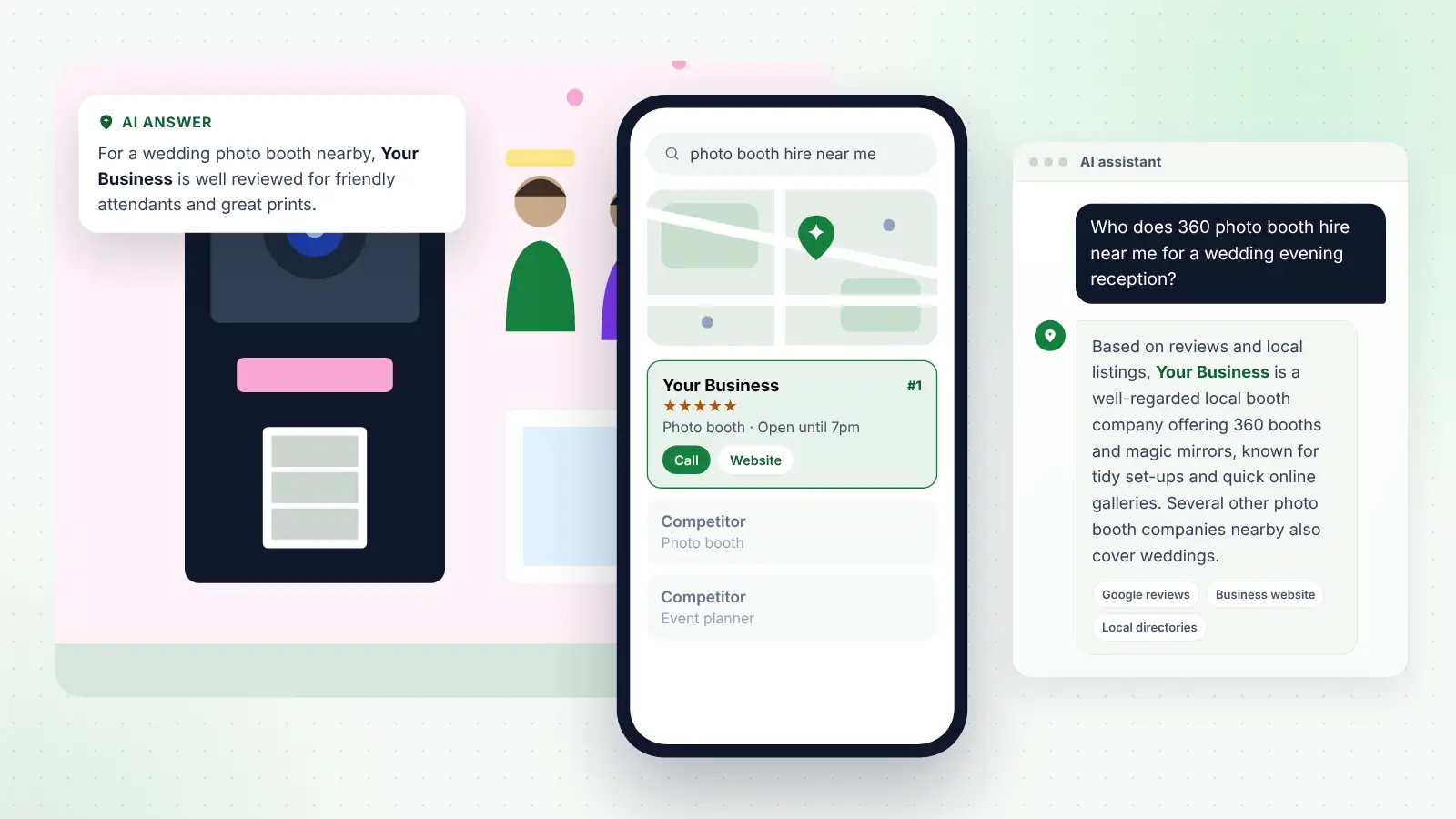
Photo booths are booked locally, and people search by booth, event and place: “photo booth hire [town]”, “magic mirror hire near me”, “360 booth hire for prom”, “audio guest book hire [county]”, “wedding photo booth [venue name]” or “branded photo booth [city]”. The map results, with their ratings, photos and contact buttons, are where many shortlists start.
Google Business Profile
Choose the most accurate primary category, such as Photo booth, and add secondary categories only if they genuinely apply. Most booth businesses work from home or a unit, so set up as a service-area business and list the areas you cover. Add each booth type and package as a service, and upload photos of your booths at real events, sample prints and short clips regularly.
Reviews
Ask every client for a review after the event, with a direct link. Reviews that mention the venue, the booth, the attendant and how guests enjoyed it are especially helpful. Reply to every review, and never offer incentives in return for one.
Consistent details
Keep your business name, phone number, website and area the same on Google, Apple Maps, Bing, wedding directories, venue supplier pages and social profiles.
Pages for each booth and event type
Build separate pages for wedding booths, 360 booths, magic mirrors, audio guestbooks, proms and corporate hire, each with real photos, what is included, space and power needs and a starting price. Add venue or area pages only where you have genuine experience to share.
Local links
Links from venue supplier pages, other suppliers, wedding blogs and local news all help. If you would rather spend your time at events, specialist local SEO for photo booth hire companies can look after your profile, listings, pages and links. Booking visibility usually grows over three to six months.
AI search: how clients ask assistants for a booth
Couples, parents and planners increasingly ask AI assistants such as ChatGPT, Gemini, Perplexity and Microsoft Copilot for suggestions, and Google often shows an AI Overview above the results. Questions tend to be specific: “Who does magic mirror hire in [county] for a wedding?”, “Is there a 360 booth company near [town] that does proms?” or “Which photo booth companies in [city] do branded prints for corporate events?”
These tools rely heavily on text, so a site of photos with few words gives them little to go on. They tend to draw on:
- Consistent details across your website, Google profile, directories and supplier pages.
- Clear service descriptions naming each booth type, the events you cover, your areas and starting prices.
- Reviews that describe the event and the experience in clients’ own words.
- FAQs covering space and power, set-up time, attendants, prints, galleries and how long photos are kept.
- Mentions on reputable sites, such as venue supplier lists, wedding blogs and local news.
A booth company whose site says plainly “360 booth and magic mirror hire across [county], with private online galleries” is much easier to recommend than one whose home page only says “unforgettable memories”.
Frequently asked questions
Do I need a licence to run a photo booth business?
There is no specific licence for photo booth hire. You do need to register your business for tax, keep your equipment safe, handle guest photos properly under UK GDPR and check whether you need to pay the ICO data protection fee. Venues will usually ask for insurance and electrical safety records.
Is PAT testing a legal requirement?
Not as such. The law requires electrical equipment used at work to be maintained in a safe condition. Many venues still ask for a PAT certificate, so regular testing and records are a sensible part of running the business.
How long should I keep guests’ photos?
There is no fixed legal period. Agree a period with each client, tell them what it is, delete images when it ends and do not keep files indefinitely just in case.
How much deposit should I take?
There is no fixed amount. Explain it clearly before the client commits, and make sure any amount you keep after a cancellation is proportionate to your genuine loss.
Next steps
A photo booth business grows on reliability: the right booths, prices based on real costs, paperwork ready, guest photos handled carefully and fair contracts. Build venue and supplier relationships, and track where bookings come from.
Then make sure your Google profile, reviews and website say clearly what you offer, where and for whom, so search engines and AI assistants have good reason to recommend you.