Most personal trainers who have been in business for a couple of years hit the same wall. January fills the diary, a handful of loyal clients carry you through the summer, and every autumn you find yourself replacing the people who drifted away in spring. The coaching is good. The problem is that the business depends on a steady stream of new starters to stand still, and the stream is lumpy.
Getting more clients and keeping them for longer are really the same job. The trainers and small gyms with full, stable diaries tend to be known for a particular kind of client, run a consultation that feels like the start of something rather than a sales pitch, sell in a way that rewards commitment, notice when someone is about to drop off, and have a few dependable sources of referrals that do not rely on social media. They also make it easy for people who have never heard of them to find them and trust them.
This guide is for personal trainers and small gyms that are already trading. It covers positioning, consultations, packages and pricing models, retention, referrals, partnerships with physiotherapists and workplaces, online and hybrid coaching, the trust signals clients look for, the advertising rules that apply to transformation and weight-loss claims, and how local search and AI assistants now send clients your way.
Key points
- Being clearly known for one type of client makes every other part of marketing easier, and it does not stop you training anyone else.
- A consultation should diagnose and plan rather than sell, and it needs a simple, prompt follow-up for people who do not sign on the day.
- Packages and monthly coaching usually suit retention better than pay-as-you-go, but expiry dates, cancellation terms and refunds must be clear and fair.
- Many clients drift away quietly in the first few months, so plan reviews and new goals before motivation dips.
- Physios, workplaces and clubs can become reliable referral partners if you stay within your scope and agree how referrals work.
- Before-and-after photos, testimonials and weight-loss claims are advertising, so they must be genuine, representative and backed by evidence.
In this guide
- Be the obvious choice for someone
- Turn the free consultation into a plan
- Packages, pay-as-you-go or monthly coaching
- Keep clients past the first few months
- Referrals that happen naturally
- Build partnerships with physios, workplaces and clubs
- Online and hybrid coaching
- Trust signals and claims that stay within the rules
- Local SEO: being found by people ready to start
- AI search: what assistants say about trainers near you
- Frequently asked questions
- Next steps
Be the obvious choice for someone
General personal training is a crowded market. When someone searches for a trainer, they see a big-box gym with a team of PTs, a dozen independents and countless online coaches. If you describe yourself as “helping people of all ages and abilities reach their goals”, you look like all of them, and the only thing left to compare is price.
An established trainer has an advantage that a newcomer does not: data. Look at your current and past clients and ask:
- Which clients stayed longest and referred the most people?
- Which results are you proudest of, and who were they for?
- Which enquiries do you convert easily, and which rarely sign?
- Which sessions do you most enjoy coaching?
The answer usually points to a group, such as women over 40 starting strength training, men in their fifties who have been told to lose weight by their GP, runners who keep getting injured, new parents, people training for a specific event, or office workers with back pain who want to move better. That becomes your lead message on your website, your Google profile and your social media.
A clear position does not mean refusing other clients. It means the first thing people read makes the right person think “this is for me”. A gym can do the same at a larger scale, with a clear identity such as a strength-focused studio, a gym for beginners who find big gyms intimidating, or a small-group coaching space for busy parents.
Show the specialism, do not just claim it
Back up your position with proof: the qualifications that relate to it, a page explaining how you work with that group, a few genuine client stories with written permission, and photos of real sessions. A page called “Strength training for women over 40” with honest, specific content will do more than a headline on your homepage.
Turn the free consultation into a plan
Many trainers offer a free consultation and then see a disappointing share of people sign. Often the consultation is either a free workout, which shows you can run a session but not that you understand the person, or a sales conversation that makes people defensive.
A consultation that converts well tends to follow a clear structure:
- Before the meeting. Send a short questionnaire covering goals, training history, injuries, health conditions and availability. It saves time and signals that you take it seriously.
- Listen first. Ask what has gone wrong before, what they want to be able to do in six months, and what would make them stop. Write it down in front of them.
- Screen properly. Use a health questionnaire, and if anything suggests they need medical clearance, say so plainly and help them arrange it. A trainer who recommends seeing a GP or physio first is more trustworthy, not less.
- Show a little of what working together looks like. A few movement checks or a short demonstration is enough. It is not a full session.
- Present one recommended option. Based on what they told you, suggest the format and frequency you would recommend and why, with the price and terms in writing. Offer one alternative at most.
- Follow up promptly. If they want to think about it, send a short summary of what you discussed and your recommendation the same day, then one friendly follow-up a few days later.
Track how many consultations you run, how many sign, and why the others did not. If people repeatedly say “too expensive”, the issue may be that the consultation did not make the value clear, rather than the price itself.
Tip
Send every consultation a written summary within a few hours, in their words: their goal, what is holding them back and your recommended plan. People sign when they feel understood, and a summary proves you listened.
Packages, pay-as-you-go or monthly coaching
How you sell your time has a large effect on how long clients stay. Pay-as-you-go makes the decision to stop very easy, while packages and monthly plans build commitment and give you predictable income. Each has its place.
| Model | How it usually works | Best suited to | Things to get right |
|---|---|---|---|
| Pay-as-you-go | Client pays per session | Occasional clients, technique check-ins | Easy for clients to drift; no income certainty |
| Session packages | Block of sessions bought upfront, used within a set period | Clients with a clear short-term goal | Fair expiry periods, clear rules on unused sessions |
| Monthly coaching | Regular monthly payment for a set number of sessions and support | Long-term clients, hybrid coaching | Clear notice and cancellation terms, what happens with missed sessions |
| Small group training | Several clients share sessions at a lower individual price | Gyms and studios, clients who like company | Group size, mixing abilities, booking and waitlists |
| Hybrid or online coaching | Programme and check-ins online, with occasional in-person sessions | Clients who travel, those who can train alone | Response times, what is included, platform reliability |
Keep your terms fair and clear
Whatever you sell, put the terms in writing before the client pays: what is included, how long a package lasts, how much notice is needed to cancel or move a session, what happens if you cancel, and how to stop a monthly plan. Consumer contract terms must be fair and transparent under the Consumer Rights Act 2015, so a package that expires very quickly, or a policy that keeps the client’s money in every circumstance, is likely to cause disputes and may not be enforceable. Allowing a package to be paused for illness or injury, with evidence where reasonable, is fair and builds goodwill.
If you sell rolling monthly plans, prepare for the new subscription contract rules under the Digital Markets, Competition and Consumers Act 2024, which are due to come into force in January 2027. They cover areas such as pre-contract information, reminder notices, cooling-off periods and making it easy to cancel, so check the official guidance and the Competition and Markets Authority’s guidance as they are finalised.
Keep clients past the first few months
Clients rarely leave because of one bad session. They leave because progress slows, life gets busy, the novelty wears off or they quietly decide they can do it on their own. In many diaries this happens in the first few months, and much of it is predictable.
Build in reviews and new goals
Schedule a short review every eight to twelve weeks. Compare progress against the goal they gave you at the consultation, using measures that matter to them, such as strength, how their back feels, energy, sleep or being able to play with their children. Then set the next goal before the current one is reached. A client who has just completed a first pull-up needs a reason to keep going, and that reason should come from you.
Watch for the warning signs
Most trainers can tell when a client is drifting. The signs include more late cancellations, shorter conversations, missing home sessions, stalled progress and “I might need to cut back”. When you notice them, ask directly and kindly what has changed. Often the fix is simple: a different time, a lower frequency for a few weeks, a change of training style or a short-term goal such as an event.
Make leaving a pause, not an ending
Some clients will stop for genuine reasons such as money, moving, a new job or a baby. Make it easy to come back. Offer a lower-frequency option, a home programme or a maintenance check-in every month or two. With their permission, keep in touch occasionally. Clients are far more likely to return if the door was left open.
Referrals that happen naturally
Referrals are usually the best source of new clients for an established trainer, because the new client arrives already trusting you. Most happy clients are willing to refer, but they need prompting and an easy way to do it.
- Ask at the right moment. Just after a milestone, a personal best or a good review session, ask whether they know anyone who would benefit from the same help.
- Make it specific. “Do you know anyone else who wants to get stronger but feels nervous in a big gym?” works better than “Tell your friends about me”.
- Give them something to pass on. A short link to your consultation page, or a “bring a friend” session where the friend trains alongside them.
- Thank people properly. A handwritten note or a free session for both is enough. Keep any reward simple and transparent.
- Partner sessions. Couples, friends and colleagues training together often stay longer because they hold each other accountable.
Build partnerships with physios, workplaces and clubs
A few good professional relationships can bring a steadier flow of clients than any amount of social media.
Physiotherapists and other clinicians
Many physiotherapy patients need a structured route back to strength and fitness once their treatment ends, and a physio is far more likely to refer to a trainer they know and trust. To build that trust:
- Stay clearly within your scope. You are not treating injuries; you are helping people train safely once they have been cleared.
- Ask for the patient’s consent before sharing any information, and agree a simple way to update the physio on progress.
- Refer back promptly if pain returns or something changes.
- Agree in writing whether any referral fees or reciprocal arrangements apply, and be open with clients about them.
Sports therapists, osteopaths and chiropractors can work in a similar way. Because health information is sensitive, check that the way you store and share it meets your data protection obligations.
Workplaces
Local employers often want to support staff wellbeing but do not know where to start. Options include lunchtime small-group sessions on site or nearby, discounted packages for staff, a talk on desk posture and strength, or a short programme before a charity event. Approach the HR or office manager with a clear, simple proposal, and confirm that your insurance covers training at a workplace.
Clubs and local groups
Running clubs, cycling clubs, rugby and football teams, walking groups and parent groups all have members who want to get stronger, avoid injury or prepare for events. A free workshop, a strength session for juniors’ parents, or a sponsored kit deal can lead to steady enquiries and natural local links to your website.
Online and hybrid coaching
Online coaching lets you work with clients beyond travelling distance and at times you cannot fill in person. For most local trainers, hybrid coaching is the most useful version: a programme and check-ins through an app, with in-person sessions every week or two to coach technique and keep the relationship strong. It suits clients who travel, cannot afford several in-person sessions a week, or are moving away.
To make it work:
- Define exactly what is included, such as how often the programme is updated, how quickly you reply to messages, and whether video form checks are part of it.
- Screen online clients as carefully as in-person ones, using the same health questionnaire and consent process.
- Check your insurance covers online coaching and the countries where your clients live.
- Get distance-selling terms right. When you sell services online or by phone, consumers generally have a 14-day right to cancel. If a client asks you to start within that period, they may have to pay for what has been provided if they then cancel. Explain this clearly before they buy.
- Keep it personal. A short voice note or video message after a good week does more for retention than an automated reminder.
Trust signals and claims that stay within the rules
Clients choosing a trainer cannot judge coaching quality in advance, so they look for proof. Make it easy to find.
Qualifications, membership and insurance
Show your Level 2 and Level 3 qualifications, any specialist training relevant to your clients, such as pre- and post-natal, older adults or exercise referral, and a current first aid certificate. CIMSPA, the Chartered Institute for the Management of Sport and Physical Activity, sets professional standards for the sector and endorses training against them. Membership is voluntary, but it shows clients and partners that you are committed to recognised professional standards and ongoing learning. Confirm that you hold public liability and professional indemnity insurance appropriate to how you work. Physios and employers in particular will ask.
Before-and-after photos, testimonials and weight-loss claims
Your website, Google profile, social media posts and paid ads all count as advertising and are covered by the CAP Code, which the Advertising Standards Authority (ASA) enforces. The code contains specific rules on weight control and slimming, and the ASA takes claims in this area seriously. Practical principles for trainers:
- Before-and-after photos must be genuine and unedited in ways that would mislead, taken in comparable conditions, and used with the client’s written permission. The ASA treats them like testimonials, so keep signed and dated proof that they are genuine.
- Show what is typical, not just the best case. If one client lost a large amount of weight, do not imply that every client will. Say how long it took and what was involved.
- Hold evidence for any claim you make, including health benefits. CAP advises generally avoiding claims that people can lose a precise amount of weight in a stated period, and says it is unacceptable to claim that people who are overweight (rather than obese) have lost more than 2lb a week.
- Avoid promises of guaranteed results or quick fixes, and avoid suggesting that training can treat or cure medical conditions.
- Testimonials must be real and reflect the client’s genuine experience. Fake reviews and testimonials are banned under UK consumer law, and testimonials on their own are not enough evidence for a weight-loss claim.
- Do not target or appeal to under-18s with weight-loss marketing, which the CAP Code prohibits, and take extra care with anything that might affect vulnerable people in relation to weight loss and body image.
The ASA and CAP publish advice on weight-loss and fitness advertising, and it is worth reading before you plan a “transformation” campaign. Ads that focus on strength, energy, confidence and the experience of training are generally easier to get right and often more persuasive for the clients you want.
Local SEO: being found by people ready to start
Most personal training is bought locally, and most people start looking with a search on their phone. Typical searches are specific: “personal trainer near me”, “female personal trainer [town]”, “strength coach for over 50s [area]”, “small group personal training near me”, “PT who works with back pain [town]”, “gym for beginners near me”. Many searchers are ready to act, especially in January, after summer and following a GP appointment. The trainers and gyms that appear in the map results for those searches, with good reviews and clear information, get the consultations.
Local SEO matters even more for an established trainer trying to grow steadily, because it brings a flow of enquiries outside the January rush and reduces your reliance on referrals and social media.
Get your Google Business Profile right
If you run a studio or gym, list it at that address. If you travel to clients or train them outdoors, a service-area profile with your address hidden is usually the right set-up. Follow Google’s guidelines closely, because listing an address where you do not genuinely meet clients can lead to suspension. Choose the most accurate primary category, such as “Personal trainer” or “Gym”, write a description that leads with your specialism, list services such as one-to-one training, small groups and hybrid coaching, link your consultation booking page, and add real photos of sessions with clients’ permission.
Reviews that name the goal
Ask for reviews after milestones and review sessions, with a direct link. Reviews that mention the client’s situation and goal, such as “first time in a gym at 52”, “back pain gone after twelve weeks” or “stronger after my second baby”, help you appear for those searches and show people like them what to expect. Reply to every review. Never offer incentives for positive reviews.
Consistent details and useful pages
Keep your name, phone number, website and service area consistent on Google, Apple Maps, Bing, social media, fitness directories and any partner websites. On your website, create a page for each service and each specialism, a page for each main area you cover if you travel, a page for your consultation explaining exactly what happens, and an FAQ covering cost, frequency, what to wear and whether beginners are welcome.
Local links
Links from the physios, clubs, employers and community groups you work with are some of the most valuable links you can get, because they are genuinely local and relevant. Ask partners whether they would list you on a recommended providers page.
Local SEO builds over time, typically three to six months, so starting in late summer or autumn puts you in a stronger position for the new year. If you would prefer to spend that time coaching, specialist local SEO for personal trainers and gyms can look after your profile, reviews strategy, listings and service pages.
AI search: what assistants say about trainers near you
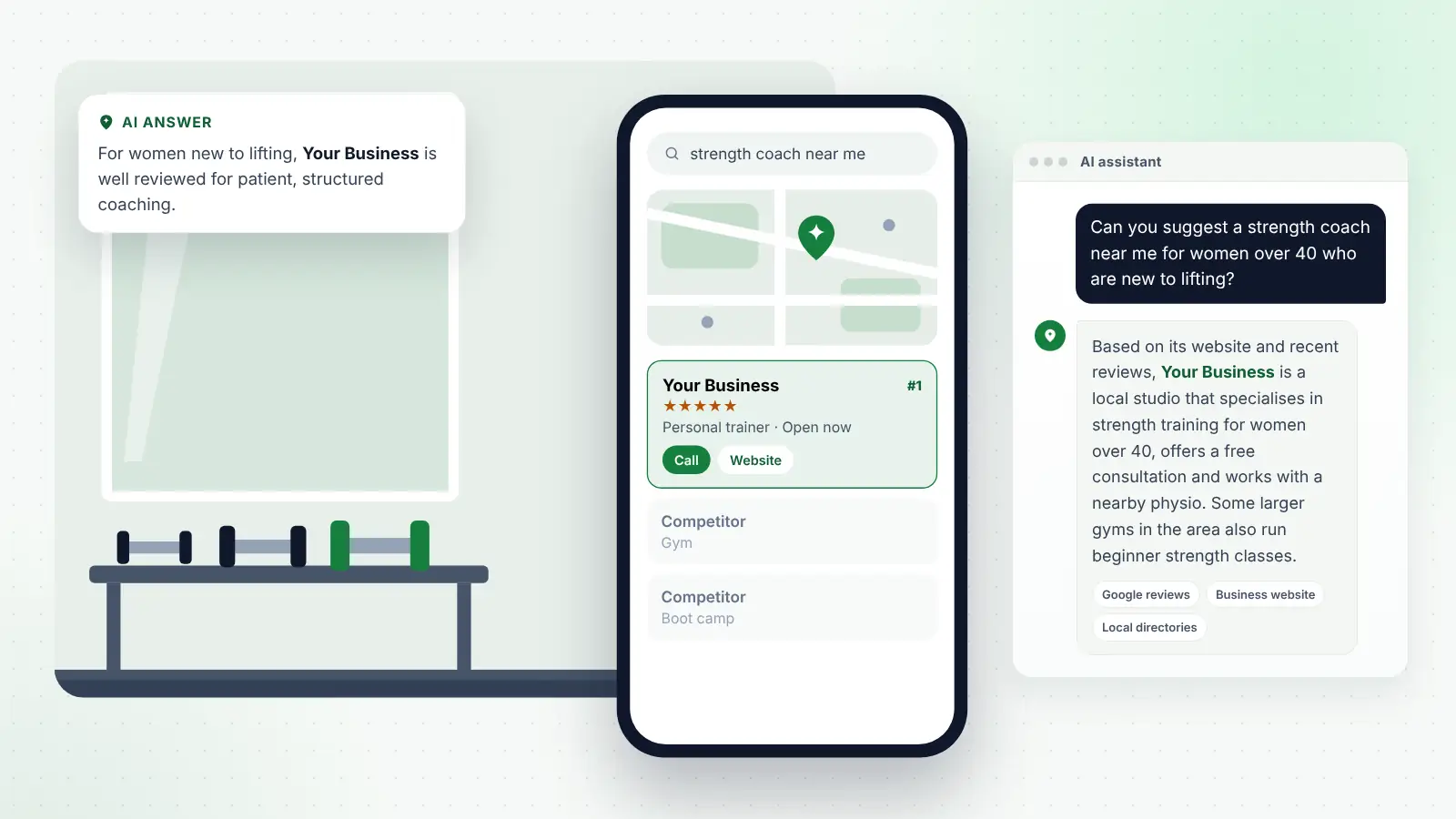
More people now ask AI assistants to help them choose. Someone might ask ChatGPT “Can you suggest a strength coach near me for women over 40 who are new to lifting?”, ask Gemini “Which personal trainers in Reading work with people recovering from knee surgery?”, ask Perplexity “Is there a small gym in Bristol that is good for complete beginners?”, or ask Copilot for “a personal trainer near my office in Manchester who does early mornings”. Google’s AI Overviews and AI Mode also summarise local options for many of these searches.
These tools try to give a confident recommendation, so they rely on information they can find and check across the web:
- Consistent details on your Google profile, website, directories and partner sites.
- Clear descriptions of your specialisms and services, so the tool can match you to requests such as “beginners”, “over 40”, “post-natal” or “after knee surgery”.
- Reviews that describe specific situations and outcomes, written in clients’ own words.
- Visible trust signals, such as qualifications, CIMSPA membership, insurance and partnerships with named clinics.
- FAQs that answer real questions, such as what happens at a consultation, how often to train and whether you work alongside physios.
- Mentions on reputable local sites, such as a physio clinic’s recommended providers, a running club’s partners page or local news.
This is often called answer engine optimisation, or AEO, and it rewards exactly the positioning described earlier. An assistant asked for “a trainer who works with people after knee surgery” is far more likely to suggest someone whose website has a page on returning to training after injury, whose reviews mention it, and whose local physio lists them as a partner, than someone who says “all goals welcome”. Keep every claim realistic, because the same advertising rules apply to the content AI tools read.
Tip
Ask two or three AI assistants the exact question your ideal client would ask, naming your town. Note who they recommend and why, then make sure your own website and profile answer that question clearly and honestly.
Frequently asked questions
How many clients does a full-time personal trainer need?
It depends on how often each client trains, your prices and whether you run small groups or hybrid coaching. Work backwards from the income you need and the number of sessions you can deliver well each week, then decide how many clients and which formats get you there without burning out.
Should I still offer a free consultation?
For most trainers, yes, as long as it is a structured planning conversation rather than a free workout. Some established trainers charge a small fee and deduct it from the first package, which can reduce no-shows. Either way, follow up promptly with a written summary.
Can I use client before-and-after photos?
Yes, with the client’s written permission, as long as the photos are genuine, not edited in a misleading way, taken in comparable conditions and not presented as typical if they are not. Avoid implying a precise amount of weight loss in a set time, hold evidence for any claims you make, and read the ASA’s advice on weight-loss advertising first.
How do I get referrals from physiotherapists?
Introduce yourself with a clear explanation of who you work with, your qualifications and insurance, and how you stay within your scope. Ask for consent before sharing client information, update the physio on shared clients and refer back promptly when needed. Trust builds from a few well-handled referrals.
Is online coaching worth adding?
It can be, particularly as a hybrid option for existing clients who travel, move away or want to train more often than they can afford in person. Define what is included, check your insurance, screen clients properly and explain cancellation rights clearly before they buy.
Next steps
Start with positioning. Look at your best clients, decide who you want to be known for and rewrite your website and Google profile to say so clearly. Then tighten your consultation and follow-up, review your packages and terms for fairness and clarity, and diary a progress review for every current client.
Alongside that, build one or two partnerships, ask for referrals at the right moments and keep your profile, reviews and service pages accurate and specific. A trainer who is easy to find, easy to understand and easy to trust needs fewer new clients each year, because the ones they win stay.