Many financial advisers set up their own firm after years with a bank, a national wealth manager or a larger independent practice. You already know how to run a fact-find, build a cash flow plan and explain sequencing risk to someone a year away from retirement. What you want now is the freedom to serve clients your way, build a practice you own and choose the people you work with.
Financial advice is one of the most heavily regulated activities a small business can carry on, and that shapes nearly every decision. Your advisers need the right qualifications and a current Statement of Professional Standing, your firm must be authorised by the Financial Conduct Authority (FCA) or be an appointed representative of a firm that is, and everything from your service description to a short LinkedIn post has to meet FCA rules. Getting the structure right at the start saves cost, stress and rework later.
This guide covers the practical steps: qualifying, choosing between direct authorisation and a network, deciding whether to describe your advice as independent or restricted, meeting your obligations under the Consumer Duty, marketing compliantly and helping local clients find you on Google and through AI assistants. It is general information, not regulatory, legal or tax advice, so check the detail with the FCA, your intended network or a compliance consultant before you commit.
Key points
- Retail investment advisers need an appropriate qualification at Level 4, such as a diploma in regulated financial planning, and a current Statement of Professional Standing from an FCA-accredited body.
- Your firm can apply to the FCA for direct authorisation or join a network as an appointed representative, where the principal firm takes regulatory responsibility for your advice.
- You must tell clients whether your advice is independent or restricted before you advise, and only describe it as independent if it genuinely meets the FCA’s standard.
- The Consumer Duty requires good outcomes for retail clients, including fair value and clear, understandable communication about fees and services.
- Websites, Google Business Profile posts, social media and shared testimonials can all be financial promotions, so they must be fair, clear, balanced and approved, and must never imply guaranteed returns.
In this guide
- Get qualified and keep your Statement of Professional Standing
- Decide whether to seek your own FCA permissions or join a network
- Decide whether your advice is independent or restricted
- Understand the Consumer Duty and your wider obligations
- Build your proposition and plan your costs
- Build introducer links with accountants and solicitors
- Market your firm compliantly
- Local SEO for a new advice firm
- Being described accurately by AI assistants
- Common mistakes to avoid
- Frequently asked questions
- Next steps
Get qualified and keep your Statement of Professional Standing
Since the Retail Distribution Review, anyone giving retail investment advice must hold an appropriate qualification from the FCA’s list in its Training and Competence sourcebook. In practice this means a Level 4 qualification, most commonly a diploma in regulated financial planning from a recognised awarding body such as the Chartered Insurance Institute or the London Institute of Banking and Finance.
The qualification on its own is not enough. Retail investment advisers also need a Statement of Professional Standing (SPS) issued by an FCA-accredited body. The SPS confirms that your qualifications have been verified and that you have made an annual declaration about keeping your knowledge up to date and acting ethically. It must be renewed every year.
Your continuing professional development is part of this. The FCA’s professional standards for advisers require at least 35 hours of CPD a year for retail investment advice, of which at least 21 hours must be structured, such as courses, seminars or assessed e-learning. Accredited bodies check a sample of advisers’ CPD records each year, so keep yours properly.
Additional qualifications and permissions
- Pension transfers. Advising on transfers out of defined benefit and other safeguarded pensions needs a specific FCA permission and a pension transfer specialist qualification. Where safeguarded benefits are worth more than £30,000, members must take advice from an appropriately authorised adviser before transferring. Many small firms choose not to offer this advice, or refer it to a specialist, because of the risk and insurance cost involved.
- Later life and equity release. Advising on lifetime mortgages needs a separate qualification and permissions, so add it only if it fits your client base.
- Chartered or certified status. Higher-level qualifications and chartered titles are not required, but they help with credibility and with more complex planning.
- Protection. Life cover, income protection and critical illness advice is regulated insurance distribution, so you need the right permissions and demonstrable competence.
Tip
Keep a CPD log from your first day in business that records what you learned and how it applies to your clients. It makes your SPS renewal, network audits and any regulatory query far easier.
Decide whether to seek your own FCA permissions or join a network
This is the biggest structural decision you will make, and both routes are common.
Joining a network as an appointed representative
An appointed representative (AR) carries on regulated activities under the responsibility of an authorised principal firm, usually called a network. The network is responsible to the FCA for your regulated activities. It supervises your advice, approves your financial promotions, checks client files and usually provides professional indemnity insurance, research tools, platform agreements and compliance support.
In return, the network typically takes a share of your income, charges fees, or both, and sets rules on branding, websites, investment propositions, platforms and the suppliers you can use. Some networks require you to follow a centralised investment proposition, which can affect whether your advice can be described as independent.
Directly authorised firm
A directly authorised (DA) firm applies to the FCA for its own permissions and carries full responsibility for compliance. You gain control over your proposition and keep more of your income, but you take on more work, cost and risk. A DA firm will typically need to:
- Submit an application with a business plan, financial projections, compliance arrangements and details of the people running the firm.
- Meet the Senior Managers and Certification Regime, including approval of the people performing senior manager functions.
- Meet the FCA’s capital resources requirements and hold professional indemnity insurance that satisfies FCA rules.
- Build its own compliance monitoring, file checking, complaints handling, training and competence scheme and record keeping.
- Pay FCA fees, Financial Ombudsman Service and Financial Services Compensation Scheme levies, and submit regular regulatory returns.
Authorisation can take several months, and longer if the FCA needs more information, so build that into your plans. Many advisers start as an AR and revisit direct authorisation once they have an established client bank.
| Factor | Appointed representative | Directly authorised |
|---|---|---|
| Regulatory responsibility | Principal firm or network | Your own firm |
| Time to start | Often weeks, depending on the network | Typically several months for FCA authorisation |
| Compliance oversight | Provided by the network | You build it, often with a consultancy |
| Professional indemnity insurance | Usually arranged through the network | You arrange your own |
| Investment proposition | May be set or restricted by the network | Your own choice |
| Income | Network takes a share or charges fees | You keep more but carry more fixed costs |
| Marketing approval | Network approves promotions | Your firm approves its own |
What to ask before signing with a network principal
- What share of initial and ongoing fees do you keep, and what are the fixed monthly charges?
- Will my advice be independent or restricted under your proposition, and why?
- What does the package include, such as indemnity cover, research tools, back-office software and paraplanning?
- How long do file checks and promotion approvals usually take?
- Who owns the client bank and ongoing income if I leave, and what are the exit terms?
Decide whether your advice is independent or restricted
Before you advise a client, you must tell them in writing whether your advice is independent or restricted. The labels matter, and the FCA expects firms to describe their advice accurately and not to hold themselves out as independent when they are not.
To describe your advice as independent, your recommendations must be based on a comprehensive and fair analysis of the relevant market and be unbiased and unrestricted. In practice, that means considering a sufficiently broad range of products and providers that could meet a client’s needs, rather than steering everyone to one platform or a fixed product list.
Restricted advice is anything that does not meet that standard. It might focus on certain types of product, a limited panel of providers or a single investment proposition. Restricted advice is not lower quality advice, and many excellent firms are restricted. You must explain the nature of the restriction clearly, and you cannot describe yourself as independent in your marketing, your firm name or your Google profile if you are not.
Tip
Decide your label before you build your brand. Many firms use “independent financial adviser” in their business name or domain. If your proposition is restricted, choose a name such as “financial planning” or “wealth planning” from the start rather than rebranding later.
Understand the Consumer Duty and your wider obligations
Since July 2023, any advice firm serving retail clients with products and services still open to sale has had to meet the Consumer Duty. It requires firms to act to deliver good outcomes for retail customers, and for an advice firm it covers four areas:
- Products and services. Your advice and ongoing service should be designed for, and suit, your target market.
- Price and value. The total cost to the client, including initial, ongoing, platform and fund charges, should represent fair value for what they receive.
- Consumer understanding. Communications should help clients make informed decisions, in language they understand.
- Consumer support. Clients should find it easy to ask questions, change their service or complain, with extra care for those in vulnerable circumstances.
Ongoing advice fees deserve particular care. If clients pay for an ongoing service, they must actually receive it. Keep clear records of reviews offered and delivered, and be ready to show that the service represents fair value.
Complaints, the Ombudsman and the FSCS
You need a complaints procedure that meets FCA rules. Clients who are unhappy with your final response can usually refer their complaint to the Financial Ombudsman Service, which can make binding awards up to a limit that is reviewed each year. You must tell clients about this right.
The Financial Services Compensation Scheme (FSCS) can compensate eligible clients if an authorised firm fails and cannot pay valid claims. At the date of writing, the FSCS limit for investment claims and for bad pension advice is £85,000 per eligible person per firm for firms that failed after 1 April 2019. Firms contribute to both schemes through levies, which are a real cost to budget for.
Data, money laundering and records
You will hold highly sensitive personal and financial data, so you need secure systems, a data protection policy and, in most cases, payment of the data protection fee to the Information Commissioner’s Office. You also need anti-money laundering procedures, including client identification and source of wealth checks proportionate to the risk.
Keep an eye on changes
Two developments are worth noting as they stand in October 2026. The FCA’s targeted support regime, which allows authorised firms to give ready-made suggestions to groups of consumers without full advice, began on 6 April 2026. And the Finance Act 2026 brings most unused pension funds and pension death benefits into the value of an estate for inheritance tax from 6 April 2027, with some exceptions such as death in service benefits, which is prompting many people to review their estate planning. Make sure any content about these topics is accurate, current and approved.
Build your proposition and plan your costs
Clients rarely buy “financial advice”. They buy help with a specific need, such as retiring at 60, passing on wealth fairly or knowing what to do with an inheritance. Define who you serve best, such as people within ten years of retirement, business owners or families with estate planning needs, and design your service around them. Write your target market down, because it underpins your Consumer Duty work as well as your marketing.
Inheritance tax planning often involves both regulated and unregulated elements. Tax advice itself is not regulated by the FCA, but most of the products used to put a plan in place are, and wills and trusts are often handled by a solicitor. Build relationships with professionals who cover the parts you do not.
| Cost | Rough guide | Notes |
|---|---|---|
| Qualifications and SPS | Varies by provider | Exams, study materials and annual SPS fee |
| Network fees or FCA authorisation | Varies widely | Income share or fees for ARs; application fees, levies and compliance costs for DA firms |
| Professional indemnity insurance | Varies | Often included for ARs; higher if you advise on pension transfers |
| Back office, research and cash flow software | Monthly subscriptions | Some networks include these |
| Paraplanning | Per case or salaried | Many small firms outsource at first |
| Website and branding | Varies | Must meet network or compliance rules |
| Office or meeting space | Optional | Many advisers meet clients at home or by video |
All costs vary by provider, area and scale. Get written quotes, allow at least six months of personal and business expenses, and check any restrictive covenants in your employment contract before contacting previous clients.
Build introducer links with accountants and solicitors
Introductions remain a core source of business for most planning firms. Useful relationships include:
- Accountants, especially for business owners and higher earners.
- Solicitors handling wills, trusts, lasting powers of attorney and probate.
- Mortgage brokers who do not advise on investments or pensions.
- Local employers whose staff may need retirement or redundancy guidance.
- Estate agents and conveyancers, for clients releasing equity or downsizing.
Document any introducer arrangements, disclose them where required and never let them influence your advice. Treat introducers as partners: keep them updated, respond quickly and refer work back where it is genuinely appropriate.
Market your firm compliantly
Almost any communication that invites someone to engage in investment activity can be a financial promotion. That includes your website, Google Business Profile posts, emails, seminar invitations, leaflets and social media. Financial promotions must be fair, clear and not misleading, and they must give a balanced view of benefits and risks.
In practice:
- Approval before publication. ARs usually need network approval. DA firms must run their own approval process and keep records.
- Risk warnings. Where you discuss investments, make clear that their value can fall as well as rise and that clients may get back less than they invested. Your compliance team will confirm the exact wording and placement.
- No implied guarantees. Never suggest guaranteed returns, “safe” growth or that your advice will beat the market. Past performance must not be presented as a reliable guide to the future.
- Status disclosure. Show your firm’s FCA status, or your principal’s if you are an AR, and whether your advice is independent or restricted.
- Social media. The FCA’s guidance on financial promotions on social media expects each post to be compliant on its own, with risk information prominent rather than hidden in a caption. Firms remain responsible for their promotions when others share them, and if you share a client’s post and it amounts to a financial promotion, you are responsible for its compliance.
- Testimonials and reviews. Featuring client testimonials on your website or in posts can form part of a financial promotion. Use only genuine, representative comments, avoid any that mention returns or imply outcomes, and get them approved. Fake reviews are unlawful under consumer law.
Helpful, factual content is easier to approve and more useful to readers than content built around performance. Explaining how retirement income options work, what an advice meeting involves or how your fees are calculated builds trust without making promises.
Local SEO for a new advice firm
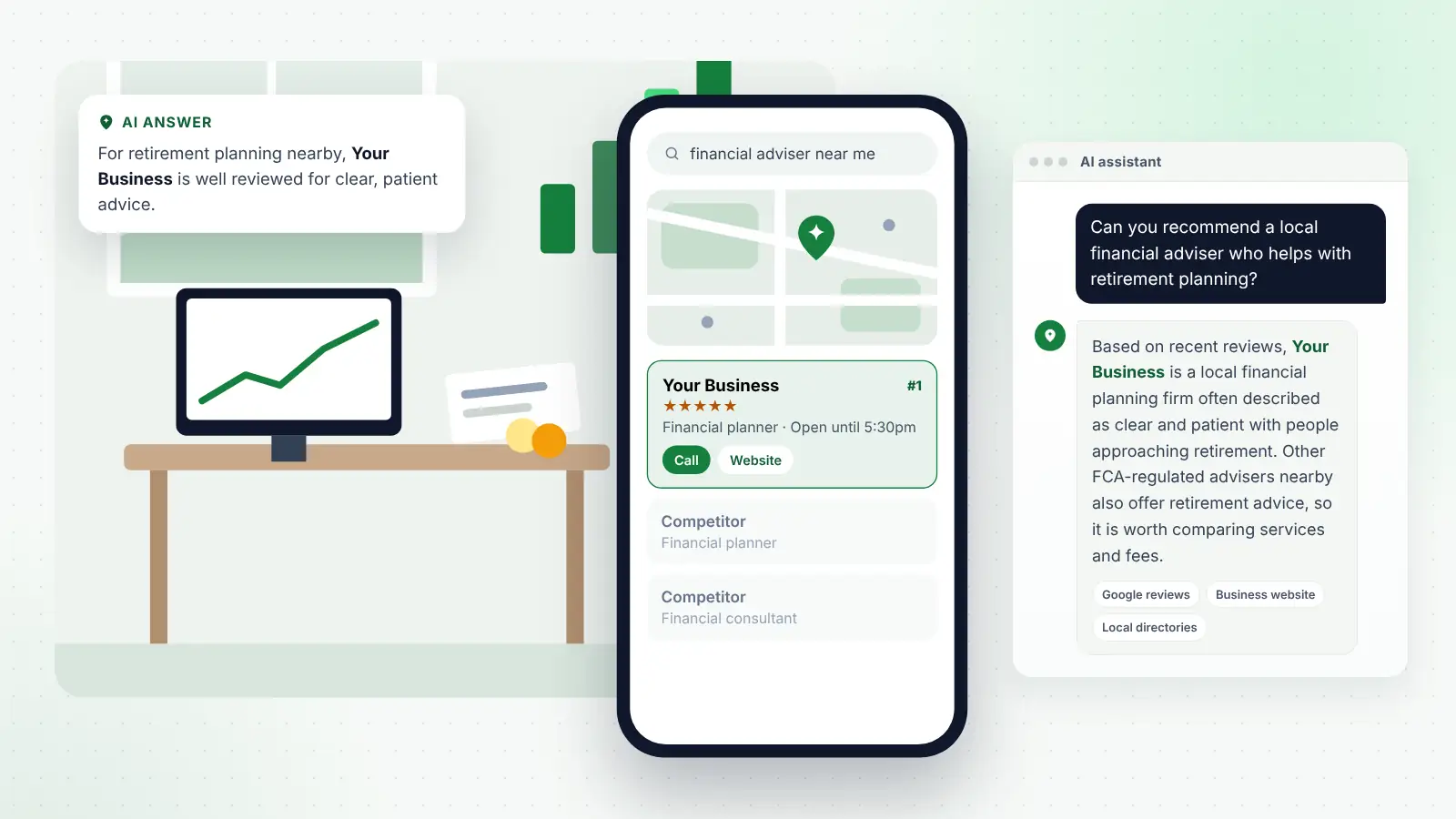
When people look for an adviser, many start with Google. Typical searches include “financial adviser near me”, “independent financial adviser in [town]”, “retirement planning adviser”, “pension advice near me” and “inheritance tax planning adviser”. These are high-value searches from people who usually want someone they can meet, and local search lets a small firm compete with national wealth managers for exactly those clients.
The map results at the top of these searches are driven largely by your Google Business Profile, your reviews and how consistently your details appear across the web.
Google Business Profile
- Choose an accurate primary category, such as “Financial planner” or “Financial consultant”, and add relevant secondary categories.
- Advising from a home office and meeting clients at their kitchen tables instead? Register as a service-area business so your own address stays hidden.
- Describe your services plainly: retirement planning, pensions, investments, inheritance tax planning and protection, plus whether you meet in person, by phone or by video.
- Treat the description and posts as financial promotions and get them approved like any other marketing.
Reviews
Reviews influence both rankings and client decisions. Ask clients at a natural point, such as after their plan is in place or after a review meeting, and make it easy with a direct link. Never offer incentives. Reply professionally and never reveal any client details, even if the reviewer has shared them.
One set of firm details on every directory
Keep your firm name, address, phone number and FCA status consistent across your website, Google profile, the FCA Register, your network’s adviser listings, adviser directories and general UK directories. Inconsistent details confuse search engines and clients alike.
Pages for each advice need and each town
Create a dedicated page for each main service and client type, such as retirement planning, pension advice, inheritance tax planning and business owners. Where you advise clients across several towns, give each its own page with real local detail, such as nearby employers’ pension schemes or the solicitors you work with there. Explain your process, your fees, your regulatory status and your independent or restricted status on every relevant page.
Local links
Mentions and links from respected finance and local business sites strengthen your firm’s standing with Google. Good sources include local business groups, chambers of commerce, community sponsorships, seminar partners and the websites of accountants and solicitors you work with.
Local SEO takes steady effort over months. If you would rather spend your time with clients, specialist SEO for financial advisers that works within compliance approval processes can manage your profile, listings, content and links for you.
Being described accurately by AI assistants
More people now ask AI tools such as ChatGPT, Gemini, Perplexity, Copilot and Google AI Overviews to explain financial advice and suggest local firms. Typical questions include “Can you recommend a financial adviser near me who helps with retirement planning?”, “What is the difference between an independent and restricted adviser?”, “How much does a financial adviser charge?” and “Who can help with inheritance tax planning in [town]?”.
When an assistant suggests an adviser, it leans on facts about the firm it can find and verify online, chiefly:
- Consistent firm details across your website, Google profile, the FCA Register, network listings and directories.
- Genuine reviews that describe the service clients received, such as clear explanations and regular contact.
- Clear service descriptions stating who you help, where you work, how you charge and whether your advice is independent or restricted.
- FAQ-style content that answers the real questions prospective clients ask, in plain English.
- Mentions on reputable sites, such as local news, professional bodies, introducers’ websites and community organisations.
This matters for advisers because prospective clients often start with a question rather than a firm name. A site that sets out how advice works with you, what it costs and which areas you specialise in gives AI tools far less room to get your firm wrong. The same rules apply: content that AI tools might summarise still needs to be approved, balanced and free of any suggestion of guaranteed returns.
Common mistakes to avoid
- Calling yourself independent when you are restricted. Check your label against your actual proposition before choosing a name or domain.
- Choosing a network on headline income share alone. Compare approval times, indemnity cover, investment proposition and exit terms.
- Publishing marketing without approval. Even a quick Google post or LinkedIn update can be a financial promotion.
- Promoting performance. It attracts the wrong clients, is hard to approve and risks implying guarantees.
- Unclear ongoing fees. Clients who cannot see what they pay for are more likely to leave or complain.
- Underestimating cash flow. Allow time for the advice process, file checks and fee collection before income arrives.
Frequently asked questions
Do I need to be FCA authorised to give financial advice?
To give regulated advice, the firm needs its own FCA authorisation or must operate as an appointed representative under an authorised principal, typically a network. Individual advisers also need an appropriate qualification, a current Statement of Professional Standing for retail investment advice and to be assessed as competent.
Clients can check any firm’s status on the FCA Register, and many do before choosing an adviser.
Should I join a network or become directly authorised?
A network is usually quicker and simpler, with compliance oversight, indemnity insurance and systems provided. Direct authorisation gives you more control and potentially more income, but you take on full regulatory responsibility and the cost of building your own compliance framework. Many advisers start with a network and review the decision once established.
Can I call myself an independent financial adviser?
Only if your advice meets the FCA’s standard for independent advice, based on a comprehensive and fair analysis of the relevant market that is unbiased and unrestricted. If your proposition is limited to certain products or providers, your advice is restricted and you must describe it that way.
Can I use client testimonials on my website?
You can, but treat them as part of your marketing. They should be genuine and representative, must not refer to investment returns or imply guaranteed outcomes, and should be approved by your compliance team or network before you publish or share them.
Can I start a financial advice firm from home?
Yes, many advisers work from home and meet clients by video, by phone or at the client’s home. Set your Google Business Profile up as a service-area business if clients do not visit you, keep client data secure and check your network’s rules and your home insurance.
Next steps
Start by confirming your qualifications and SPS, then decide whether a network or direct authorisation suits your experience and ambitions. Decide early whether your advice will be independent or restricted, and build your name, fees and proposition around that. Set up your Consumer Duty records, complaints process and ongoing service before your first client, and build relationships with local accountants and solicitors.
With permissions, PII and processes sorted, turn to making sure people nearby can find the firm. A well-managed Google Business Profile, genuine reviews, clear and approved website content and consistent details across the web all help, in Google and in AI assistants. Treat compliance as part of good marketing rather than a barrier to it, and your firm will be well placed to grow steadily.