Many physiotherapists reach a point in their career where they want more control over how they treat patients, how long appointments last and how their working week is structured. Private practice offers that. It also means taking on the responsibilities of running a business: regulation, insurance, data protection, premises, pricing and, above all, finding a steady supply of patients.
The good news is that physiotherapy is a trusted profession with strong local demand. People with back pain, sports injuries, post-operative needs or long-standing problems actively look for help nearby, often paying for it themselves to avoid waiting. The clinics that do well tend to combine sound clinical practice with clear systems and a visible, credible presence where patients search.
This guide walks through the practical steps for setting up a private physiotherapy practice in the UK, with a focus on England where rules differ between nations. It covers registration and regulation, insurance and insurer recognition, premises, pricing, responsible marketing and how patients now find clinics through Google and AI assistants.
Key points
- You must be registered with the HCPC to use the title “physiotherapist”, and you need professional indemnity cover as a condition of registration.
- A standalone physiotherapy service in England is not normally within the scope of CQC registration, but adding doctors, nurses or certain other services can change that.
- You will hold health information, so data protection and the ICO data protection fee need attention from the start.
- Recognition by private medical insurers can bring patients, but each insurer sets its own criteria and fee levels.
- Most self-pay patients search for their problem, such as “physio for back pain near me”, so local SEO and AI search visibility should be built around the conditions you treat.
In this guide
- Check your registration and protected title
- Indemnity cover and other insurance for physios
- Understand CQC registration
- Data protection and clinical records
- Decide on your practice model and premises
- Self-pay, insurers and referral partners
- Market your practice responsibly
- Getting found by people in pain nearby
- When patients ask an AI assistant for a physio
- Run the practice well from day one
- Frequently asked questions
- Final thoughts
Check your registration and protected title
To practise as a physiotherapist in the UK, you must be registered with the Health and Care Professions Council (HCPC). “Physiotherapist” and “physical therapist” are protected titles, which means it is an offence for anyone to use them without being on the HCPC register. Patients, insurers and referrers can check the register, so make sure your registration is current and your details are correct.
HCPC registration also brings ongoing obligations. You need to meet its standards of proficiency and its standards of conduct, performance and ethics, keep a record of continuing professional development, and renew your registration every two years. As a business owner, you are responsible for checking that any physiotherapists you employ or contract are registered too.
Professional body membership
Membership of the Chartered Society of Physiotherapy (CSP) is voluntary, but many UK physiotherapists join. It offers professional guidance, support with employment and practice questions, and access to insurance arrangements. Many patients recognise the CSP name, and some insurers and referrers look for it. If you specialise, membership of a relevant professional network, such as one for sports, musculoskeletal, pelvic health or neurological physiotherapy, can add credibility.
Indemnity cover and other insurance for physios
The HCPC requires registrants to have a professional indemnity arrangement in place as a condition of registration. Check exactly what your cover includes, particularly if you move from NHS employment, where cover was provided by your employer, to private practice. You may get indemnity through professional body membership or buy a separate policy, but make sure it covers self-employed private work, every treatment you provide and every location you work in.
Other insurance to consider:
- Public liability insurance, if not already included, covering injury to patients or visitors on your premises.
- Employer’s liability insurance, which is usually a legal requirement once you employ staff.
- Buildings, contents and equipment cover, depending on your premises and lease.
- Business interruption or income protection, which can matter a great deal for a solo practitioner who cannot work.
If you offer additional techniques such as acupuncture or dry needling, shockwave therapy or sports massage, confirm that they are covered and that you hold the required training.
Tip
Keep a single folder with your HCPC registration, indemnity certificate, CSP membership and training certificates. Insurers, referrers and corporate clients will ask for them, and it saves time when they do.
Understand CQC registration
In England, the Care Quality Commission (CQC) regulates providers of certain “regulated activities”, including treatment of disease, disorder or injury. Whether you need to register depends on who provides the treatment and what services you offer, not simply on the fact that you treat patients.
Physiotherapists are not among the healthcare professionals listed in the CQC’s scope for treatment of disease, disorder or injury. The CQC’s guidance on treatment of disease, disorder or injury explains that if you are one of the professionals not on that list, such as a physiotherapist, and you run a standalone treatment service, you do not need to register for that activity.
That exemption has limits, so check carefully if any of the following apply:
- Your team includes listed professionals, such as doctors, registered nurses, paramedics or radiographers, who provide or supervise treatment.
- You employ or contract listed professionals to deliver treatment as part of your service.
- You provide other regulated activities, such as certain diagnostic or screening procedures.
Rules can change, and the regulators in Scotland, Wales and Northern Ireland work differently. If you are unsure, read the CQC’s scope of registration guidance or contact the CQC directly before you open.
Data protection and clinical records
As a physiotherapist you will hold health information, which is treated as special category data under UK data protection law. You need a lawful basis for processing it, appropriate security, and a clear privacy notice explaining what you collect and why. Most businesses that process personal data must pay the data protection fee to the Information Commissioner’s Office (ICO) unless they are exempt, and the ICO’s online self-assessment will tell you whether that applies to you.
Practical steps include:
- Choose secure practice management software with encrypted storage, access controls and a reliable backup.
- Keep clinical records that meet HCPC and professional body expectations, and set a retention policy.
- Get clear consent for treatment, for sharing information with referrers or insurers, and for any marketing emails.
- Train any staff on confidentiality and how to handle data requests.
Decide on your practice model and premises
Private physiotherapists work in several ways, and many combine more than one.
| Model | How it works | Advantages | Things to watch |
|---|---|---|---|
| Room rental | You rent a treatment room by the hour, day or month in an existing clinic | Low set-up cost, shared reception | Less control over branding and hours |
| Home visits | You treat patients in their homes | Very low overheads, suits older or post-operative patients | Travel time, equipment, lone working |
| Gym or sports club base | You work from a gym, leisure centre or club | Steady flow of active patients | Check the arrangement and any CQC implications for other professionals on site |
| Own clinic | You lease and fit out premises | Full control, room to add a team | Higher fixed costs and responsibilities |
Choosing premises
If you open your own clinic, look for good access for people in pain or with limited mobility: ground-floor or lift access, nearby parking, step-free entry and accessible toilets. Treatment rooms need privacy, adequate size for a couch and exercise space, and good hand-washing facilities. Check that the planning use of the premises suits a clinic, ask the council about business rates, and have a solicitor review the lease. If you play music in waiting areas, you will usually need TheMusicLicence from PPL PRS.
Rough start-up costs
The figures below are rough guides only and vary widely by area and model.
| Item | Typical cost | Notes |
|---|---|---|
| Treatment couch and equipment | Can range from several hundred to a few thousand pounds | Electric couches cost more but help patients with limited mobility |
| Practice management software | Monthly subscription | Look for notes, booking, invoicing and insurer billing |
| Indemnity and other insurance | Annual premium | Depends on services and staff |
| Room rental or lease | Varies by area | Hourly rental keeps early costs low |
| Website and branding | One-off build or monthly fee | Include clinician profiles and clear pricing |
| ICO data protection fee | Annual fee | Check which tier applies |
Self-pay, insurers and referral partners
Self-pay patients
Self-pay patients are usually the core of a private practice. Set clear prices for an initial assessment and follow-up sessions, and publish them. Patients appreciate knowing the cost before they book, and it reduces enquiries that do not convert. Explain what happens at each appointment, how many sessions patients might typically need for common problems, and that it depends on assessment.
Private medical insurers
Being recognised by private medical insurers can bring additional patients, and some patients will only use providers their insurer recognises. Each insurer sets its own criteria for recognising physiotherapists, which often include HCPC registration, professional body membership, a minimum level of post-qualification experience, suitable premises and indemnity cover. Fees are set by the insurer and are often lower than self-pay rates, so weigh up how much insured work suits your business. Apply to the insurers most used in your area and keep your recognition details up to date.
Referral partners
Relationships with local GPs, consultants, personal trainers, running clubs, sports teams, Pilates studios and employers can bring a steady flow of referrals. Offer something genuinely useful, such as an injury talk for a running club, a workplace ergonomics session or clear updates for referring clinicians (with patient consent).
Market your practice responsibly
Healthcare marketing in the UK is covered by the CAP Code, enforced by the Advertising Standards Authority (ASA), as well as by the HCPC’s standards on honesty and integrity. In practice, this means:
- Only make claims you can support with good evidence. Avoid stating or implying that physiotherapy will cure a condition or guarantee a result.
- Do not discourage people from seeking medical advice for conditions that need it. Make red flag symptoms and when to seek urgent help clear on your website.
- Use testimonials carefully. Genuine patient reviews are valuable, but they cannot be used to support claims that would otherwise need evidence.
- Describe your qualifications accurately, including postgraduate training and special interests.
- Be clear about prices and what they include.
Responsible, accurate information is also what patients trust most, and it is what AI assistants are more likely to rely on.
Getting found by people in pain nearby
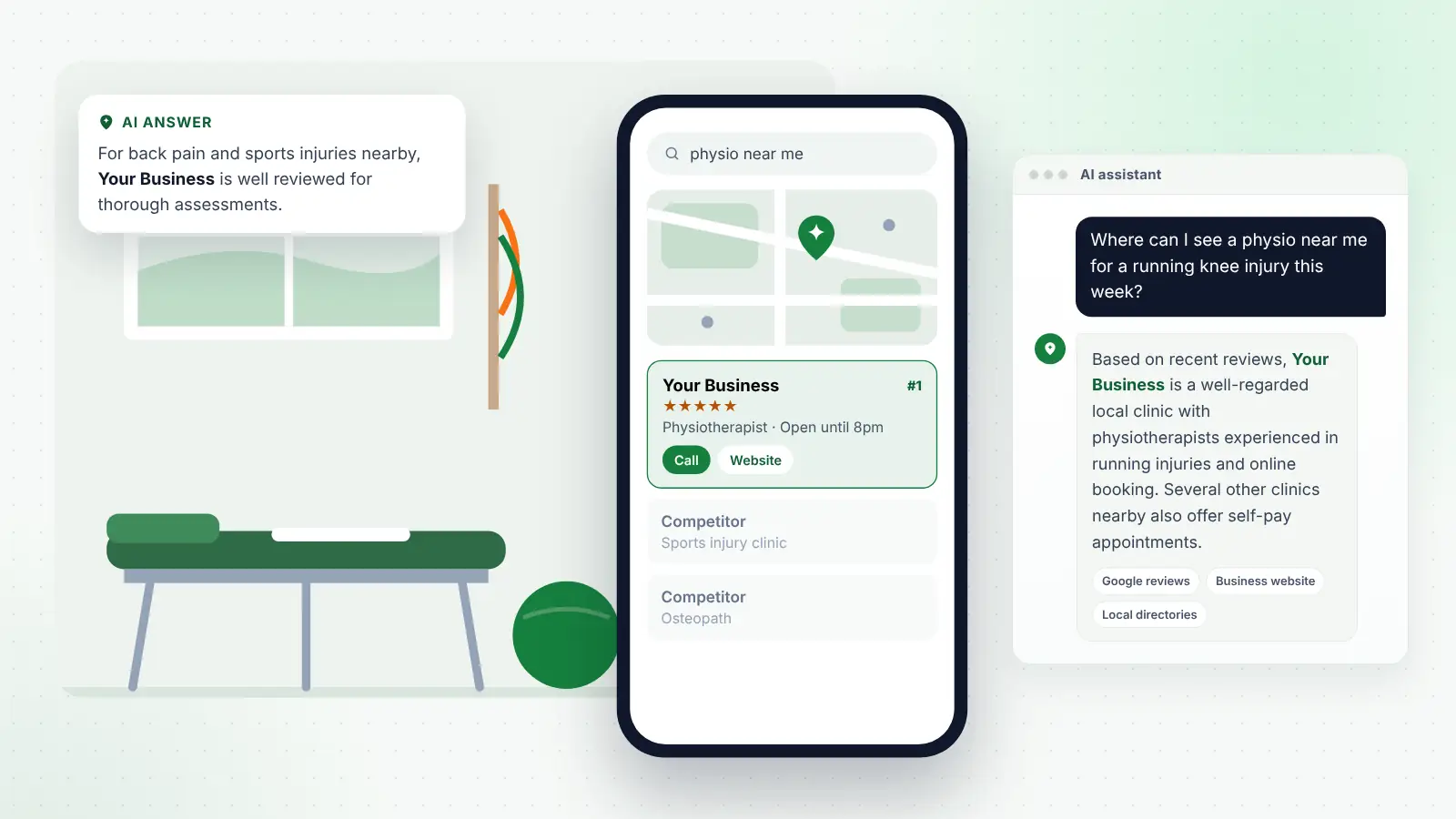
People in pain rarely search for “physiotherapist” in the abstract. They search for help with their problem, close to where they live or work: “physio near me”, “physio for back pain [town]”, “sports injury clinic near me”, “knee physio [area]”, “pelvic health physio near me”, “physio Saturday appointments”. Clinics that appear for these searches, with clear information and good reviews, win far more self-pay patients.
The Google Maps results at the top of the page, with their ratings, opening hours and booking buttons, are often where the decision is made. Appearing there consistently is one of the most reliable ways to fill your diary.
Fill in every part of the clinic’s Google profile
Choose “Physiotherapist” as your primary category and add accurate secondary categories only if they genuinely apply. List your services, such as musculoskeletal assessment, sports injury rehabilitation, post-operative rehab and home visits, with clear descriptions. Add opening hours, accessibility information, an online booking link and real photos of your clinic and team. If you only do home visits, set up as a service-area business and hide your home address.
Collect patient reviews ethically
Reviews strongly influence both rankings and patient choice. Ask patients at the end of a course of treatment, when they have seen progress, and make it easy with a direct link. Never offer incentives for reviews, and when replying, do not confirm that someone is a patient or discuss their treatment, because that would breach confidentiality. A short, polite thank-you is enough.
Match your clinic details on every directory
Make sure your clinic name, address, phone number and website are identical on Google, Apple Maps, Bing, healthcare directories, insurer directories and professional body listings. Inconsistent details confuse patients and search engines.
Build condition and service pages
Your website should include pages for the main conditions and services you treat, written in plain language: what the problem is, how assessment works, what treatment might involve, what patients can do in the meantime and when they should see a GP or seek urgent care. Add clinician profiles with qualifications and special interests, clear prices and a page for each area you serve. Keep content clinically accurate and measured.
Links from sports clubs, gyms and health sites
Links from local running and sports clubs, GP practice pages, local news, community health events and relevant professional networks help show search engines that your clinic is established and trusted.
Local SEO builds gradually, and results usually take three to six months to show clearly. If you would rather spend your time with patients, specialist SEO for physiotherapists and physio clinics can manage your profile, listings, condition content and links.
Tip
Use the words patients use alongside clinical terms. A page titled “Shoulder pain and frozen shoulder” will match more searches than one titled only “Adhesive capsulitis”.
When patients ask an AI assistant for a physio
More people now describe their symptoms to an AI assistant and ask where to get help. Someone might ask ChatGPT “Where can I see a physio near me for lower back pain this week?”, ask Gemini for “a physio in [town] who specialises in running injuries”, or ask Perplexity or Copilot “Is there a pelvic health physio near me who offers evening appointments?”. Google’s AI Overviews also appear for many health and local searches.
AI tools aim to give safe, reliable answers, so for health-related questions they lean heavily on trustworthy, consistent information. For a physiotherapy clinic, that typically includes:
- Consistent clinic details across Google, your website, healthcare directories and insurer listings.
- Reviews that describe the problems patients came with and the care they received.
- Clear service and condition descriptions, so the tool can match you to a specific request such as “running injury” or “post-operative knee rehab”.
- FAQs answering real questions, such as whether patients need a GP referral, how long an assessment takes, or whether you accept their insurer.
- Mentions on reputable sites, such as professional body directories, local news, sports club partner pages and health information sites.
- Evidence of qualifications, such as HCPC registration and clinician profiles, which help establish credibility.
Making a clinic easy for assistants to recommend is known as answer engine optimisation (AEO). For healthcare, accuracy and responsibility matter more than ever. A clinic that clearly explains which conditions it treats, who its clinicians are, how to book and when to seek urgent help is much easier for an AI assistant to recommend than one with vague, promotional wording.
Run the practice well from day one
Good systems save time and improve patient experience. Use online booking with reminders, take card details or deposits if you have a cancellation fee, and give patients home exercise programmes through an app or clear written guides. Encourage patients to book their next appointment before they leave, so they complete their course of treatment.
Track a few numbers each month: new patients, where they found you, average number of sessions per patient, cancellations and the balance between self-pay and insured work. These will show you which referral sources and marketing efforts are worth your time.
Frequently asked questions
Do I need to register with the CQC to run a physiotherapy practice?
In England, a standalone service where physiotherapists provide treatment is not normally within the scope of CQC registration for treatment of disease, disorder or injury. That can change if your team includes listed professionals such as doctors or nurses, or if you provide other regulated activities. Check the CQC’s scope of registration guidance for your situation.
Do I need my own professional indemnity insurance?
The HCPC requires you to have a professional indemnity arrangement in place. If you are moving from NHS employment to private work, your employer’s cover will not extend to your private practice, so you need to arrange suitable cover, either through professional body membership or a separate policy.
Should I join the CSP?
Membership is voluntary, but many UK physiotherapists are members. It offers professional guidance and support, and patients, insurers and referrers often recognise it. Weigh up the benefits against the cost for your circumstances.
How do I get recognised by private health insurers?
Apply directly to each insurer. Each one sets its own criteria, which often include HCPC registration, professional body membership, post-qualification experience, suitable premises and indemnity cover. Their fees are usually fixed, so consider how insured work fits alongside your self-pay prices.
Can patients book without a GP referral?
Yes. Self-pay patients can usually book a private physiotherapy appointment directly. Some insurers require a GP or specialist referral before they will fund treatment, so make this clear on your website.
Final thoughts
Starting a private physiotherapy practice builds on the clinical skills you already have, but it also asks you to become a careful business owner. Keep your HCPC registration and indemnity in order, understand where the CQC’s scope applies, look after patient data, choose a practice model you can sustain and market your services accurately.
Then make sure the people searching for help with their back, knee or shoulder can find you. A complete Google profile, steady patient reviews, clear condition pages and consistent information across the web will help both search engines and AI assistants point patients to your clinic.