Many pest control businesses start with domestic work: wasp nests, mice in the kitchen, rats under the decking. It is satisfying, reasonably paid and builds a reputation quickly. But it is also seasonal and unpredictable. Commercial contracts change the shape of the business. A portfolio of restaurants, cafes, shops, offices and housing blocks gives you planned, recurring income, steadier weeks and a reason to take on another technician.
Winning those contracts takes a different approach from answering emergency calls. Commercial clients are buying risk management. They want someone who will turn up on schedule, spot problems early, document everything and help them pass inspections. They check credentials, read reports and compare prices more carefully than a homeowner with a wasp nest ever will.
This guide is for pest controllers who are already trading and want more contract work. It covers which sectors to target, the credentials buyers check, keeping your rodenticide competence current, surveys and proposals, pricing, audit-ready reporting, housing work, and how to keep the domestic side running alongside. It also covers how commercial buyers find pest controllers on Google and through AI assistants. Rules are described as they stand in October 2026.
Key points
- Commercial pest control clients are buying risk management and documentation, not just treatments.
- BPCA or NPTA membership, recognised qualifications and suitable insurance are the first things contract buyers look for.
- Since 1 January 2026, buying professional rodenticides requires CRRU-approved certification under five years old, or older certification plus membership of an approved CPD scheme such as BASIS PROMPT or BPCA Registered.
- A thorough survey and a clear written proposal win more contracts than a low headline price.
- Audit-ready reports, trend data and fast follow-up on findings are what keep contracts renewing.
- Domestic emergency work can sit alongside contracts if you plan capacity and keep your online presence clear about both.
In this guide
- Choose the commercial sectors that suit your business
- What contract buyers check before they talk to you
- Keep your rodenticide competence current: CRRU and CPD
- The survey and proposal: where contracts are won
- Pricing a commercial pest control contract
- Audit-ready reporting: what keeps contracts renewing
- Housing associations, managing agents and multi-site clients
- Running domestic emergency work alongside contracts
- Local SEO for pest control: how commercial buyers find you
- AI search: what assistants say when asked for a commercial pest controller
- Frequently asked questions
- Next steps
Choose the commercial sectors that suit your business
Commercial pest control covers a wide range of premises, and each sector has its own pressures. Choose two or three to focus on first, based on your experience, location and capacity.
| Sector | Who usually buys | Typical concerns | What helps you win |
|---|---|---|---|
| Restaurants, cafes and takeaways | Owner or general manager | Food hygiene inspections, reviews, rats and cockroaches | Fast response, discreet visits, clear reports for inspectors |
| Food manufacturing and storage | Technical or quality manager | Third-party audits, stored product insects, birds | Audit-ready documentation, trend analysis, technical knowledge |
| Pubs and hotels | Owner, manager or group operations | Rodents, bed bugs, insects in guest areas | Out-of-hours visits, discretion, multi-site reporting |
| Retail and offices | Facilities or office manager | Mice, flies, appearance to customers and staff | Reliability, tidy equipment, minimal disruption |
| Housing associations and managing agents | Contract manager, block manager | Resident complaints, communal areas, bins, repeat infestations | Resident communication, proofing, clear job records |
| Schools and care settings | Business manager, site manager | Safeguarding, product safety, timing | Safe product choice, DBS-checked staff where needed, flexibility |
Food businesses are often the natural starting point. Food hygiene law requires food businesses to have adequate procedures to control pests, and environmental health officers will ask what arrangements are in place during inspections. A restaurant owner who has just had a poor inspection, or found droppings in a dry store, is often looking for a contractor immediately.
What contract buyers check before they talk to you
Commercial clients usually filter suppliers before they ask for a price. Make the following easy to find on your website and ready to send as documents.
Trade body membership
The two main UK trade associations are the British Pest Control Association (BPCA) and the National Pest Technicians Association (NPTA). Membership signals that your business meets recognised standards and gives clients a body to refer to. Some commercial clients, particularly in food and facilities management, prefer or require members. Check each association’s current membership criteria, as both set requirements around qualifications, insurance and professional conduct.
Qualifications
The RSPH/BPCA Level 2 Award in Pest Management is the commonly recognised baseline qualification for technicians. Further qualifications in specific areas, such as bird control, fumigation or advanced rodent management, help you win more specialised work. List qualifications by technician, not just for the business.
Insurance
Public liability insurance is essential, and employers’ liability insurance is a legal requirement in most cases once you employ staff. Many commercial clients specify minimum levels of public liability and sometimes professional indemnity cover. Read tender documents carefully and check your policy covers the work you are bidding for.
Health and safety documentation
Have standard documents ready: risk assessments, COSHH assessments for products you use, method statements, product safety data sheets, and your health and safety policy. Larger clients may ask for an SSIP-accredited health and safety assessment, so check what is common in your target sectors.
Tip
Build a “contract pack” PDF containing your capability statement, certificates, insurance, trade body membership, sample report and COSHH summaries. Being able to send it within minutes of an enquiry makes you look like a contractor already working at that level.
Keep your rodenticide competence current: CRRU and CPD
Rodent control is the core of most commercial contracts, so your ability to buy and use professional rodenticides is central to the business.
The UK Rodenticide Stewardship Regime, run by the Campaign for Responsible Rodenticide Use (CRRU UK), controls the sale and use of professional rodenticides. From 1 January 2026, suppliers accept only two forms of proof of competence:
- A certificate from a CRRU UK-approved training course completed within the last five years.
- An older approved certificate, together with current membership of a CRRU UK-approved CPD scheme.
The approved CPD schemes listed by CRRU UK are BASIS PROMPT, BPCA Registered and the British Pest Register. These schemes require a minimum of three CPD points or hours each year of rodent control content that meets CRRU guidelines, as part of the scheme’s normal annual requirements. Someone joining a scheme for the first time needs to meet the membership criteria in the current year to be ready for the following year. The CRRU UK page on CPD and stewardship sets out the details.
For a business building a contract portfolio, this matters in three ways:
- Compliance. Check every technician’s certificate dates and CPD status, and diarise renewals. A lapsed technician cannot buy professional rodenticides.
- Credibility. Commercial clients and auditors increasingly ask about stewardship. Being able to explain your CRRU compliance and show CPD records is a strong selling point.
- Better practice. The stewardship regime encourages integrated pest management: surveying, proofing, hygiene and non-toxic monitoring, with rodenticides used only where justified. That approach also produces the kind of reports commercial clients value.
Glue traps are also now tightly restricted in Great Britain, so make sure your rodent control methods and procedures reflect the current law in each nation where you work.
The survey and proposal: where contracts are won
Most commercial contracts are won or lost before a price is discussed. A thorough initial survey shows the client you understand their premises and their risks.
What to cover on the survey
- Walk the whole site, inside and outside, including bins, drainage, deliveries, voids, roof spaces and storage areas.
- Note current evidence of pests, entry points, harbourage and conditions that attract pests.
- Ask about past problems, previous contractors and any recent inspection or audit findings.
- Find out who will receive reports and what format they need.
- Identify any audit standard the client works to, and what it requires of pest control.
What to put in the proposal
- A short summary of findings, with photos.
- A proposed monitoring plan: number and location of monitoring points, visit frequency and type of equipment.
- Any recommended proofing or hygiene improvements, priced separately.
- Response times for call-outs between routine visits.
- Reporting arrangements and a sample report.
- Price, payment terms and contract length.
Keep proposals clear and readable. Many small business owners will make the decision themselves, and they will not read a 30-page document.
Pricing a commercial pest control contract
Commercial contracts are usually priced as an annual fee billed monthly or quarterly, covering a set number of routine visits and call-outs within agreed response times. Rather than guessing, build the price from the work.
Factors to include
- Number of routine visits per year and time on site for each.
- Number of monitoring points and the equipment cost.
- Travel time and distance, including congestion and parking.
- Reporting time, including writing up and sending reports.
- Expected call-outs, based on the site’s risk and history.
- Products and consumables.
- Admin, insurance, CPD and software costs.
- Your target margin.
Common pricing mistakes
- Underpricing to win the first contract. Low prices are hard to raise later and set expectations for the rest of your portfolio.
- Unlimited call-outs. Define how many call-outs are included, or charge for call-outs beyond a set number.
- Ignoring proofing. Proofing work is valuable, solves problems and should be priced separately rather than absorbed.
- No annual review. Include a clause that allows a price review each year.
Prices vary widely by region, sector and site size, so benchmark against the local market rather than relying on national figures.
Audit-ready reporting: what keeps contracts renewing
For many commercial clients, the report is the product. It is what they show environmental health officers, auditors, head office or the housing association board.
What good reports include
- Date, time and technician name for each visit.
- A site plan showing monitoring points, numbered consistently.
- Findings at each point, including activity levels.
- Actions taken and products used, with quantities where required.
- Recommendations for the client, such as proofing or hygiene improvements, with clear responsibilities.
- Follow-up on previous recommendations.
- Trend data over time, so the client can see whether activity is rising or falling.
Make reports easy to use
Digital reporting software makes it easier to produce consistent, timestamped reports with photos and to send them immediately. Many clients appreciate a short summary at the top: “No activity found. Two recommendations outstanding.” Keep reports easy to find, and make sure a client can produce the last year of records quickly during an inspection or audit.
Tip
After each visit, highlight any client action that is still outstanding at the top of the report. When an auditor asks about pest control, a client who can show recommendations being tracked looks well managed, and that reflects well on you.
Housing associations, managing agents and multi-site clients
Housing work brings volume but different challenges. Infestations often span several flats, residents may not be cooperative, and the contract manager needs clear records showing work has been done.
What helps you win and keep this work:
- Resident communication. Clear notice letters, reliable appointment windows and polite technicians reduce complaints.
- Proofing and bin areas. Many recurring rodent problems come from communal areas, so recommend practical fixes.
- Clear job records. Record access issues, no-access visits and resident advice given, so the landlord has evidence of what was done.
- Responsiveness. Housing providers are under pressure to deal with resident complaints quickly.
Multi-site clients, such as pub groups or retail chains, want consistent standards and reports across all sites. If you can only cover part of their estate, be honest, and consider partnering with trusted contractors in other areas.
Running domestic emergency work alongside contracts
Domestic work remains valuable. It is often higher margin per visit, builds reviews and can lead to commercial work, because restaurant owners and office managers are also homeowners. The challenge is capacity.
Practical ways to balance both:
- Protect contract visits. Schedule routine visits first, and fit domestic work around them.
- Keep spare capacity in peak season. Late summer wasp season can overwhelm small teams, so plan for it.
- Set clear domestic response times. Promise only what you can deliver. Customers prefer an honest “tomorrow morning” to a missed “within the hour”.
- Use domestic work for reviews. Domestic customers are often the ones who leave detailed Google reviews, which commercial buyers also read.
- Track profitability by work type. Know which jobs make money and adjust your pricing or focus accordingly.
Local SEO for pest control: how commercial buyers find you
A facilities manager hunting for a contractor types very different words from a householder with mice. A restaurant manager might search “pest control for restaurants [town]”, “commercial pest control near me”, “pest control contract cost” or “rat problem in restaurant kitchen”. An office manager might search “office pest control”. Housing managers often search “pest control for housing associations”. If your online presence only talks about wasps and mice in homes, you may never appear for these searches.
Google Business Profile
- Choose an accurate main category, such as “Pest control service”.
- List both commercial and domestic services clearly, including commercial contracts, food business pest control and bird control if you offer them.
- Add photos of professional equipment, clean vans and proofing work (without identifying commercial clients unless they have agreed).
- Keep hours and contact details accurate, and say clearly whether you offer out-of-hours visits.
Reviews
Ask both domestic and commercial customers for reviews. Commercial clients may be more reluctant, but a short review from a cafe owner mentioning “reliable monthly visits and clear reports” is very persuasive to other business owners.
Website pages for commercial work
Create dedicated pages for commercial pest control, for each key sector (restaurants and food businesses, hotels and pubs, offices, housing), and for the main towns you cover. Explain your survey process, reporting, credentials and response times. Include a sample report or screenshots, and answer questions such as “how often should a restaurant have pest control visits?”.
Matching listings and links from business sites
Keep your name, address and phone number consistent across your website, Google, Bing Places, Apple Business and directories, including the BPCA or NPTA member directory if you are listed. Local business networks, chambers of commerce, food business groups and trade suppliers can provide useful local links and referrals.
If you would rather focus on running the business, local SEO for pest control companies and technicians covers your profile, reviews, commercial service pages and citations as an ongoing service. Results typically build over three to six months.
AI search: what assistants say when asked for a commercial pest controller
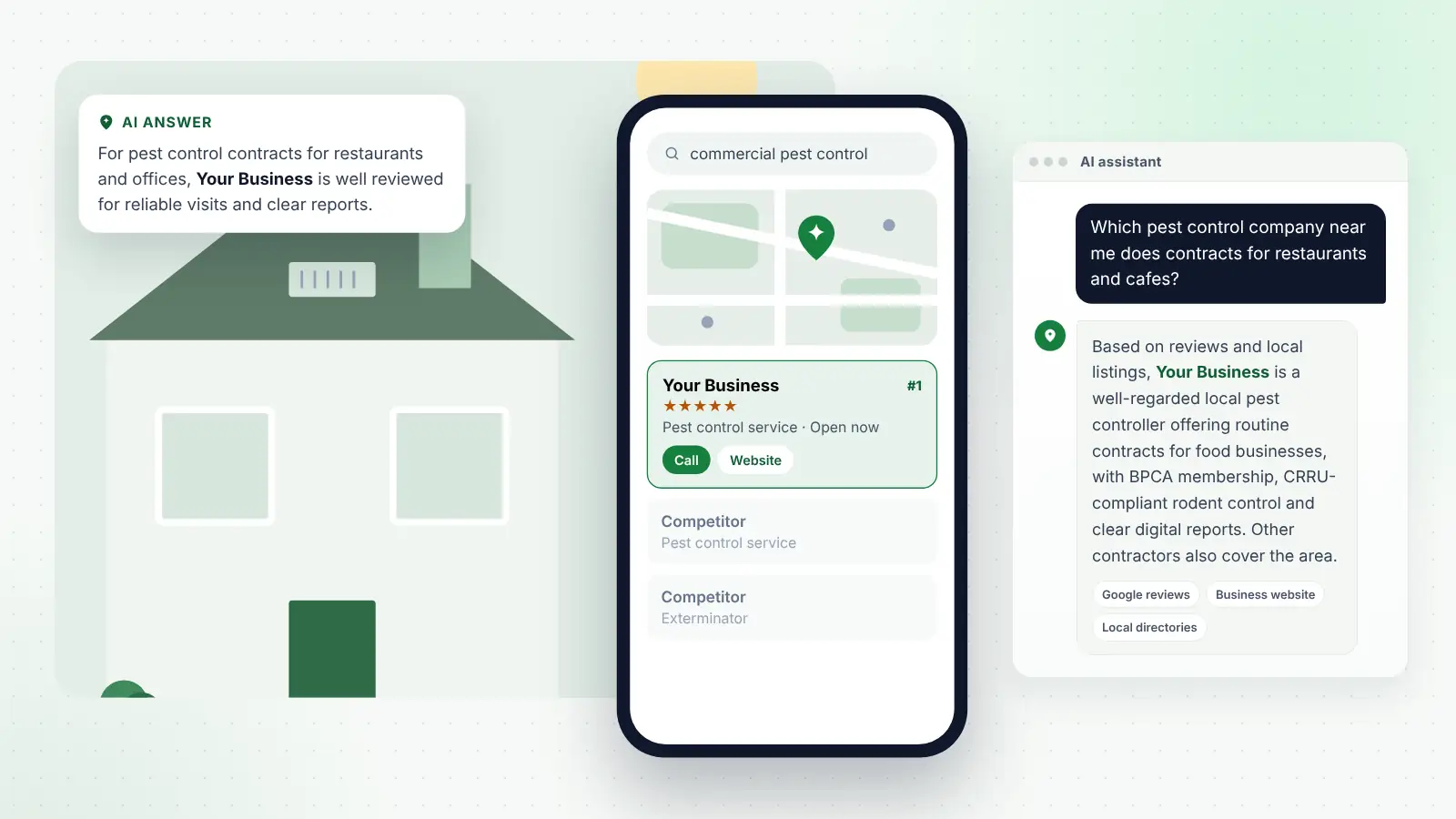
Business owners increasingly ask AI assistants for recommendations. A restaurant owner might ask ChatGPT “Which pest control company near me does contracts for restaurants?”, Gemini “What should a pest control contract for a cafe include?”, or Copilot “How often should a food business have pest control visits?”. Google’s AI Overviews often answer questions like these at the top of search results.
AI tools build recommendations from information they can find and cross-check, including:
- Identical company details on your website, Google profile, BPCA or NPTA listing and business directories.
- Reviews that mention commercial work, sectors and qualities such as reliability and reporting.
- Clear service descriptions explaining what your contracts include, the sectors you serve and the areas you cover.
- FAQs answering questions buyers really ask, such as visit frequency, what reports include and how CRRU rules affect rodent control.
- Mentions on reputable sites, such as trade association directories, local business groups and local news.
Practical steps:
- Write a commercial FAQ section on your website.
- Describe your credentials, such as trade body membership, qualifications and CPD scheme membership, in plain text.
- Use the same service and area descriptions across your website and listings.
- Ask commercial clients for reviews that mention their sector and your reporting.
- Ask several AI assistants for commercial pest control in your area and see which businesses they name.
Frequently asked questions
Do I need to be a BPCA or NPTA member to win commercial contracts?
It is not a legal requirement, but many commercial clients see membership as a sign of professional standards, and some prefer or require it. Check both associations’ membership criteria and choose the one that fits your business.
What is BASIS PROMPT?
BASIS PROMPT is a professional register and CPD scheme. It is one of the CPD schemes approved by CRRU UK, so membership can support your proof of competence for buying professional rodenticides if your certificate is more than five years old.
What changed with CRRU rules in 2026?
From 1 January 2026, buying professional rodenticides requires either a CRRU-approved certificate less than five years old, or an older certificate plus current membership of an approved CPD scheme meeting its annual requirements. Check the CRRU UK website for current details.
How often should a commercial site have routine visits?
It depends on the type of premises, the risk and any audit standard the client works to. Lower-risk offices may need fewer visits than food businesses. Base the frequency on the survey and explain your reasoning in the proposal.
Can I keep doing domestic work once I have contracts?
Yes. Many successful pest control businesses do both. Schedule contract visits first, keep spare capacity for peak seasons and be honest about domestic response times.
Next steps
Winning commercial pest control contracts is about showing buyers you can reduce their risk and document it properly. Get your trade body membership, qualifications, insurance and CRRU compliance in order, build a clear contract pack, survey thoroughly, price from the work, and produce reports that make clients look good during inspections and audits. Keep your domestic work running alongside, and make sure your website and listings clearly describe your commercial services, so the buyers searching for a reliable contractor can find you.